8 min read
Over the past several articles, we have examined the forces remaking commercial real estate finance one at a time: real-time stablecoin settlement, cross-border capital flows, digital due diligence, AI valuation, tokenized debt, private credit, distress cycles, and the modernization of capital-markets infrastructure. Each is significant on its own. But the real advantage is not any single capability.
It is what happens when valuation, compliance, and capital markets stop operating as separate disciplines and start operating as one connected system. That is the thesis behind CR Equity AI — and this article ties the series together by showing how the pieces fit.
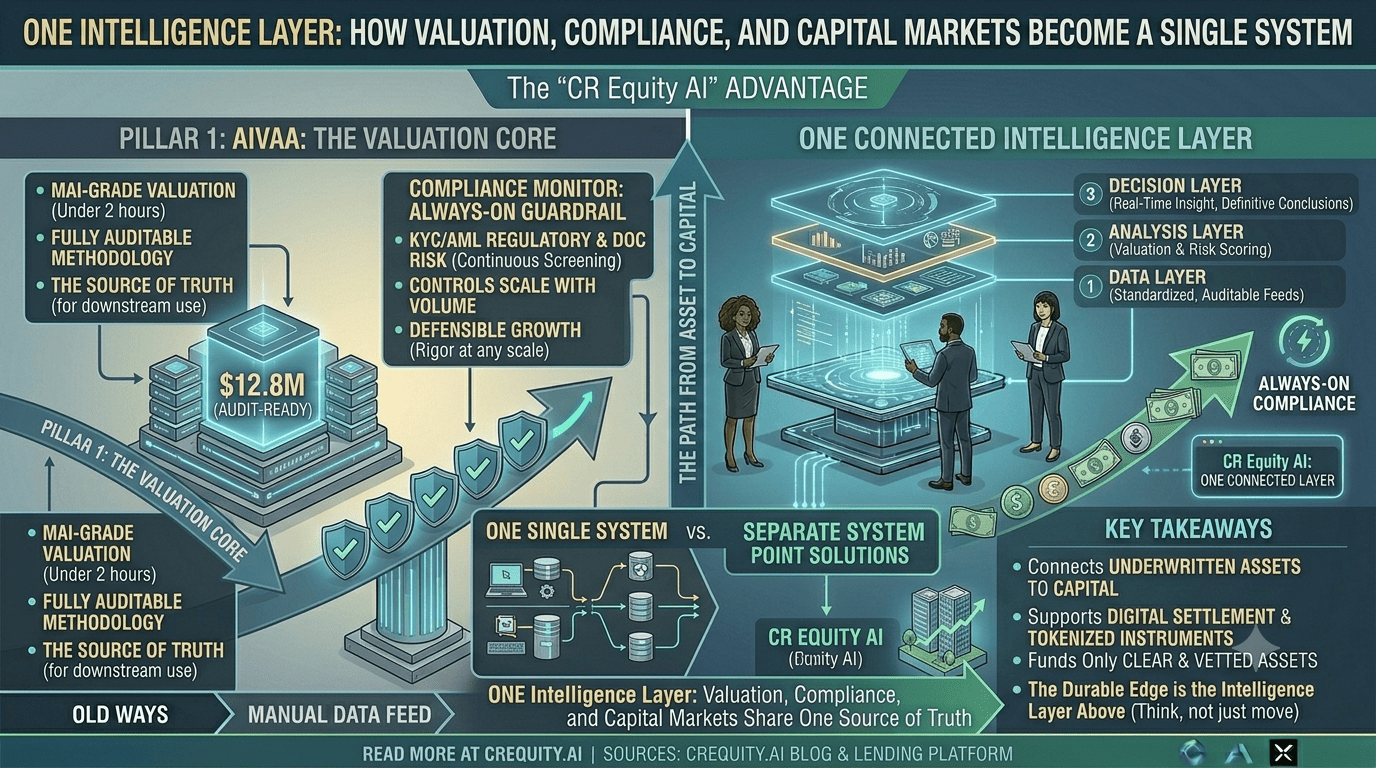
AIVAA: the valuation core
At the center of the platform sits AIVAA, the AI valuation and analysis engine. It produces MAI-grade valuations in under two hours, drawing on verified data and a fully auditable methodology. Every other module depends on it, because every CRE decision ultimately rests on what an asset is worth.
AIVAA is not a standalone tool bolted onto a workflow. It is the source of truth the rest of the ecosystem builds on. When valuation is fast, consistent, and reconstructable, everything downstream — compliance screening, lender matching, capital deployment — inherits that reliability. When valuation is slow or opaque, every downstream decision inherits that weakness instead.
Compliance Monitor: the always-on guardrail
Compliance Monitor runs continuously across the platform, screening for KYC, AML, regulatory, and documentation risk in real time rather than at periodic checkpoints. It is what allows the platform to move fast on legitimate capital while catching the transactions that warrant scrutiny.
The design choice matters. Because compliance runs alongside every other function rather than as a separate review stage, controls scale automatically as volume grows. A fund doubling its origination does not have to double its compliance headcount or accept twice the risk of something slipping through. The hundredth deal is screened to the same standard as the first — which, as the private-credit cycle is currently demonstrating, is the difference between defensible growth and fragile growth.
Capital Markets Engine: the liquidity layer
The Capital Markets Engine connects underwritten, compliant assets to capital — supporting the digital settlement, cross-border flows, and tokenized instruments explored across this series. It is where a valued, vetted deal becomes a funded one.
Its position in the stack is the point. By sitting downstream of valuation and compliance, the engine works only with assets that have already been analyzed and cleared. That compresses the path from decision to close, because the work that normally happens in sequence — value it, vet it, then find capital — happens on a single connected file. Cross-border financing and stablecoin settlement stop being separate projects and become features of the same flow.
Integrations and the network effect
No platform operates in isolation. Integrations with data providers, lenders, and capital partners extend the ecosystem’s reach and enrich the data that powers every module. Each integration makes the intelligence layer smarter and the network more valuable.
This is the compounding advantage. More data improves valuation; better valuation attracts more capital; more capital draws more partners; more partners contribute more data. It is a loop that strengthens with use — the kind of advantage that is difficult to replicate because it is built from accumulated connections, not just code.
One platform, one intelligence layer
Valuation, compliance, and capital markets have always been treated as separate problems, handled by separate teams using separate tools that barely talk to each other. CR Equity AI’s thesis is that they are actually one connected problem — and that solving them together, on one intelligence layer, is what unlocks the speed, defensibility, and liquidity the next era of CRE demands.
The throughline across every article in this series is the same: the rails are becoming faster and more digital, but the durable advantage belongs to whatever can think across them. A two-hour valuation, always-on compliance, and instant settlement are each valuable. Connected, on one platform, they are something more — a system where a deal can move from asset to analysis to capital without ever leaving the same source of truth.
Key takeaways
-
AIVAA is the valuation core — MAI-grade, under two hours, auditable — and every other module inherits its reliability.
-
Compliance Monitor runs continuously, not at checkpoints, so controls scale automatically with volume.
-
The Capital Markets Engine sits downstream of valuation and compliance, so it funds only vetted assets — compressing time to close.
-
Integrations create a compounding loop: more data → better valuation → more capital → more partners → more data.
-
The advantage isn’t any single capability; it’s valuation, compliance, and capital markets operating as one connected intelligence layer.
The next era of commercial real estate finance will not be won with a faster point solution. It will be won on a connected platform where valuation, compliance, and capital markets share one source of truth. To see how CR Equity AI brings all three into a single intelligence layer — and how the AIVAA engine would underwrite your next deal — request a walkthrough at crequity.ai or contact the team at support@crequity.ai.
Sources
-
CR Equity AI — AI Commercial Real Estate Lending Platform (MAI-grade valuation, audit-ready, settlement) — https://crequity.ai/
-
CR Equity AI Blog — International Commercial Real Estate Funding (CREAi valuation, blockchain documentation) — https://blog.crequity.ai/blogs/international-commercial-real-estate-funding