

A lender-ready fix-and-flip loan application requires six core components in this order: a complete property file (purchase contract, ARV comps, as-is condition photos, preliminary title report), verified borrower and entity documents (government ID, LLC formation docs, bank statements, proof of funds), a line-item rehab budget with licensed contractor bids, a scope of work (SOW), underwriting metrics (ARV, LTV, LTC, and LTARV calculations), and a written exit strategy. Assemble these before you contact a lender, not after.
Priority-order checklist for desk review:
- Purchase contract (executed, with all addenda)
- Property photos (current, dated, interior and exterior)
- As-is value: broker price opinion (BPO) or appraisal
- ARV comps or comparative market analysis (CMA) — three or more, within one mile, sold within 90 days
- Preliminary title report
- Scope of work (SOW) with line-item rehab budget
- Licensed general contractor (GC) bid(s) with insurance certificates
- Borrower/entity formation docs (LLC operating agreement, EIN letter)
- Government-issued photo ID
- Bank statements (most recent 30–90 days)
- Proof of funds for down payment and reserves
- Schedule of Real Estate Owned (SREO)
- Written exit strategy (sale timeline or refinance plan)
Pro Tip: Order your digital folder to match the lender’s desk-review sequence: property file first, borrower file second, rehab package third. The single most commonly overlooked document is the preliminary title report — missing it stalls underwriting before it starts.
Key Takeaways
A lender-ready fix-and-flip application requires ARV comps, a realistic rehab budget with contractor bids, verified proof of funds, a licensed GC with permits, and a written exit strategy — assembled in lender desk-review order before submission.
| Point | Details |
|---|---|
| ARV comps control the loan | Provide three or more closed sales within 90 days, within one mile, condition-matched, with an adjustment grid. |
| Rehab budget must include contingency | Add a contingency line; a budget without one signals inexperience to underwriters. |
| Proof of funds must be verifiable | Submit 30–90 days of bank statements showing funds seasoned in the account before closing. |
| Licensed GC and permits are non-negotiable | An unlicensed contractor or missing permits will stall underwriting regardless of deal quality. |
| CR Equity Ai Inc funds in 24–48 hours | Qualified sponsors with a complete file can close fix-and-flip financing through CR Equity Ai Inc with decisions in as little as 4 hours. |
Table of Contents
- What does a fix-and-flip lender actually evaluate first?
- What property documents does your lender need to see?
- Which financial documents will your lender pull and inspect?
- How do you present experience and team credentials to a lender?
- How do lenders calculate ARV, LTV, LTC, and LTARV?
- How do you assemble and submit a lender-ready application package?
- What causes fix-and-flip loans to stall, and how do you fix it?
- When does FHA 203(k) make more sense than a private rehab loan?
- What underwriters actually read first
- CR Equity Ai Inc closes fix-and-flip deals faster than the standard process
- Primary sources and useful lender references
- Sources
- FAQ
What does a fix-and-flip lender actually evaluate first?
Lenders evaluate the deal first, the borrower second, and the exit strategy third. Credit score matters, but it rarely controls the outcome the way it does on a conventional mortgage. The asset’s after-repair value (ARV) and the realism of the rehab budget are the two variables that determine whether a file moves forward.
Lender priority order:
- ARV and comps — does the projected value hold up against recent, comparable closed sales?
- Rehab budget realism — are the line items credible, contractor-sourced, and complete?
- Exit strategy — is there a defined sale timeline or a refinance path with documented equity?
- Borrower liquidity and experience — do reserves cover the hold period plus a contingency buffer?
- Title and insurability — is the property free of liens, encumbrances, or zoning issues that block closing?
ARV and the rehab budget beat borrower credit on deal quality because the lender’s collateral is the finished property, not the borrower’s income stream. A borrower with a moderate credit score and a well-documented ARV on acquisition with a detailed rehab budget is a stronger file than a higher-score borrower with a vague scope of work and unsupported comps.
According to industry underwriting guides, lenders apply multiple leverage limits simultaneously — LTV (loan-to-value on as-is), LTC (loan-to-cost), and LTARV (loan-to-after-repair value) — and cap the loan at whichever ratio produces the lowest dollar amount.
For a fast 7–14 business day close, prepare the ARV comps, the executed purchase contract, the rehab budget with contractor bids, and proof of funds before submitting. A clean, complete submission can often close within that window when documentation is complete; appraisal timing and title are the main variables that extend it.
What property documents does your lender need to see?
The property file must prove three things: ARV, current condition, and clear title. Every document in this section serves one of those three purposes.
Complete property file checklist:
- Executed purchase contract with all addenda and assignment clauses
- Seller disclosures (as available)
- Current interior and exterior photos, date-stamped
- As-is valuation: BPO, desktop appraisal, or full appraisal (lender-specific)
- ARV comps or CMA — minimum three closed sales, within one mile, sold within 90 days, condition-matched
- Preliminary title report from a licensed title company
- Zoning verification and any existing permits or permit history
- Homeowner’s insurance binder or quote (lender-named as additional insured)
Sample folder structure lenders prefer:
/01_Property
   01a_PurchaseContract_123MainSt.pdf
   01b_Photos_123MainSt_2026-01.zip
   01c_AsIsAppraisal_123MainSt.pdf
   01d_ARVComps_123MainSt.pdf
   01e_PrelimTitle_123MainSt.pdf
   01f_ZoningVerification_123MainSt.pdf
   01g_InsuranceBinder_123MainSt.pdf
Consistent, descriptive file names let an underwriter open the right document in seconds. Avoid generic names like “scan001.pdf.”
Pro Tip: When packaging ARV comps, include a one-page summary grid showing each comp’s address, sale price, square footage, price per square foot, sale date, and distance from subject. Underwriters validate ARV faster when they can see the adjustment logic without opening MLS sheets one by one.
The Dan Harkey submission checklist used by many private lenders specifically calls out ARV comps and the preliminary title report as the two documents most likely to be incomplete on first submission.
Which financial documents will your lender pull and inspect?
Lenders need verifiable proof of reserves and source of funds. Unverifiable funds are one of the top causes of underwriting delays, and the fix is straightforward: document every dollar before you submit.
Borrower and entity financial document checklist:
- Government-issued photo ID (passport or driver’s license)
- Entity formation documents: LLC operating agreement, articles of organization, EIN confirmation letter
- Bank statements: most recent 30–90 days (all pages, all accounts used for the transaction)
- Proof of funds for down payment and closing costs (bank or brokerage statement, dated within 30 days)
- Personal financial statement (assets, liabilities, net worth summary)
- Schedule of Real Estate Owned (SREO): address, value, mortgage balance, equity, rental income if applicable
- KYC/AML materials: beneficial ownership certification for entities, source-of-funds declaration
- Tax returns: personal and/or entity (when requested — typically for larger loan amounts or first-time borrowers)
File-labeling examples:
BankStmt_JohnDoe_Chase_Jan2026.pdfProofOfFunds_JohnDoe_Schwab_2026-01-15.pdfSREO_JohnDoe_2026.pdf
Industry guides report that lenders commonly set minimum credit score thresholds in the 620–700+ range, depending on the lender and the borrower’s experience level. Demonstrated experience and strong liquidity can offset a lower score at many private lenders.
When a guarantor is involved, the lender will typically require the guarantor’s ID, personal financial statement, and bank statements in addition to the entity’s documents. Personal tax returns are most often requested when the borrower is a first-time investor or when the loan amount exceeds the lender’s standard threshold for income-free underwriting.
How do you present experience and team credentials to a lender?
Demonstrated project execution reduces your cost of capital and increases the leverage a lender will extend. The evidence that proves execution is specific: completed project data, not a general description of your background.

Portfolio presentation format:
Three to five completed projects presented in this format carry more weight than a narrative bio. Include before-and-after photos as a separate attachment.
Contractor package checklist:
- GC license number and state verification
- Certificate of insurance (general liability and workers’ compensation, lender-named)
- Signed contractor bid with line-item breakdown
- References from prior projects (two or three, with contact information)
- Permitting history: any open or closed permits on prior jobs
First-time investors can offset a limited track record by presenting a stronger contractor package. A licensed GC with documented prior rehab projects, a detailed bid, and a permitting history effectively transfers execution credibility to the team. Some lenders also accept an increased escrow holdback or a controlled disbursement arrangement as a structural substitute for borrower experience.
How do lenders calculate ARV, LTV, LTC, and LTARV?
ARV-backed exposure controls lending limits. Lenders calculate three ratios simultaneously and apply the most conservative result to set the maximum loan amount.
Core underwriting terms defined:
- ARV (after-repair value): the appraised or estimated market value of the property after all planned renovations are complete
- As-is value: the property’s current market value in its present condition, before any rehab work
- LTV (loan-to-value): loan amount divided by as-is value — measures exposure against current collateral
- LTC (loan-to-cost): loan amount divided by total project cost (purchase price plus rehab budget) — measures exposure against total capital deployed
- LTARV (loan-to-after-repair value): loan amount divided by ARV — the most commonly cited ratio in fix-and-flip underwriting
- Hold period: the planned duration from acquisition close to property sale or refinance
- Points: origination fees expressed as a percentage of the loan amount (one point equals 1%)
- Draws: disbursements of the construction holdback, released in phases as rehab milestones are completed
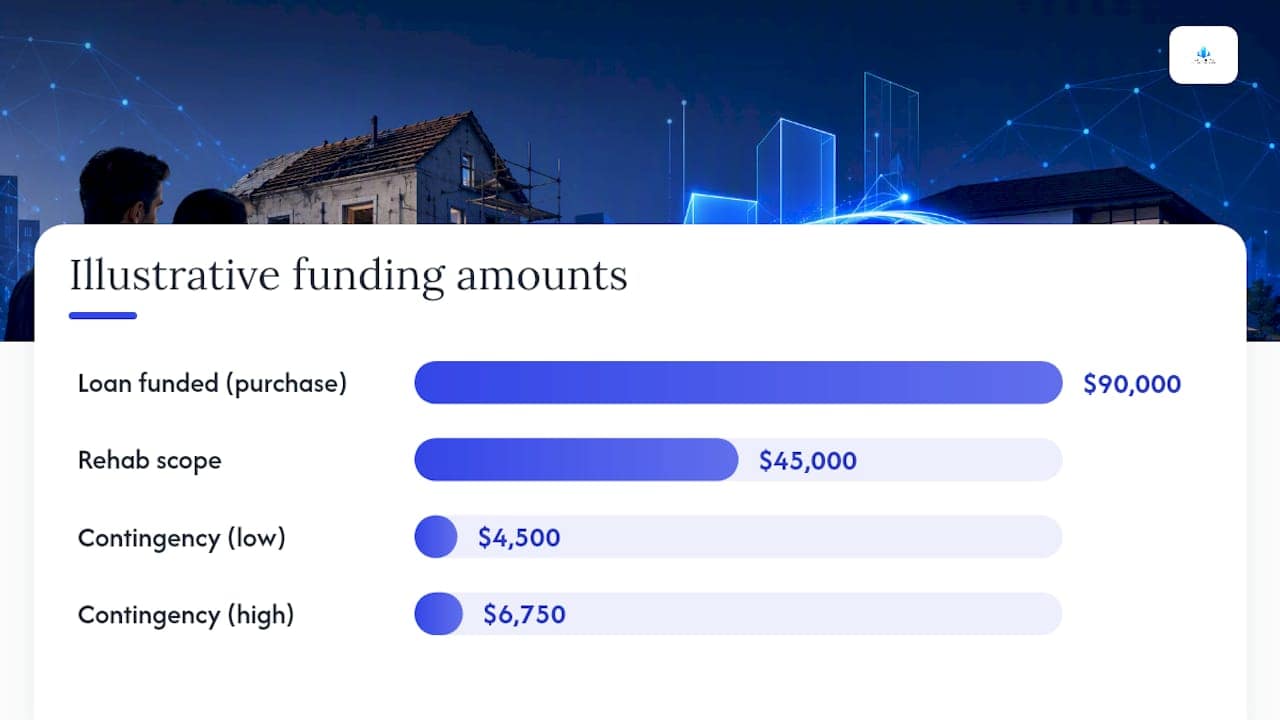
How the three ratios interact — illustrative example:
In this example, LTV controls. The lender would fund $90,000 against the purchase and hold the rehab funds in a construction holdback, releasing them in draw disbursements tied to completed work and inspections.
Lenders view an unpadded budget as a risk signal. A $45,000 scope with a $4,500–$6,750 contingency line shows you understand field conditions; a budget with no contingency suggests you have never managed a rehab.*
For deals where qualified sponsors seek higher advance rates, CR Equity Ai Inc publishes the specific underwriting conditions that can unlock up to 100% LTV on fix-and-flip programs.
How do you assemble and submit a lender-ready application package?
Submit the deal with a one-page cover memo first, then the property file, then the borrower file, then the rehab scope and budget. That sequence matches the order in which underwriters review a file.
Step-by-step submission order:
- Cover memo — one page: deal summary, requested loan amount, requested terms, exit plan, hard dates (contract expiration, desired close date)
- Property file — purchase contract, photos, as-is valuation, ARV comps, preliminary title report, zoning, insurance
- Borrower/entity file — ID, entity docs, bank statements, proof of funds, SREO, personal financial statement, KYC materials
- Rehab package — scope of work, line-item budget, contractor bids, GC license and insurance, permitting plan
- Experience portfolio — completed project table, before/after photos, references
Sample cover memo fields:
- Property address and brief description
- Purchase price, rehab budget, ARV
- Requested loan amount and loan-to-ARV
- Planned exit: sale at $X by [target date] or refinance into DSCR product
- Contract expiration date and desired closing date
- Borrower/entity name and contact
Draw schedule template outline:
Draw inspections are typically borrower-funded and required before each fund release. Budget for inspection fees in your holding cost estimate. Digital submission platforms can accelerate the mortgage approval process by centralizing document uploads and automated status tracking.
What causes fix-and-flip loans to stall, and how do you fix it?
Most stalls are fixable with documentation or scope changes. The underwriter is not declining the deal; they are waiting for evidence that removes a specific risk. Identify the flag, provide the remedy, and the file moves.
Top red flags and quick fixes:
- Incomplete title — open liens, easements, or ownership disputes
Fix: Order a full preliminary title report and provide a title commitment from a licensed title company before submission. - Unlicensed contractor — GC without a valid state license or lapsed insurance
Fix: Replace with a licensed GC or add a co-GC with active credentials. Never submit a bid from an unlicensed contractor. - Missing permits — scope of work requires permits that are not yet pulled
Fix: Provide a permit covenant (written commitment to pull permits before work begins) or a permit-ready plan set. - Unrealistic rehab budget — line items that are below market rate or missing categories
Fix: Get a second contractor bid and reconcile the difference. - Unverifiable funds — down payment or reserves sourced from undocumented transfers
Fix: Provide 60-day bank statements showing the funds seasoned in the account, plus a source-of-funds letter for any large deposits. - Weak comps — ARV supported by sales more than six months old, more than two miles away, or in materially different condition
Fix: Replace with three or more closed sales within 90 days, within one mile, and condition-matched. Include a one-page adjustment grid. - No exit strategy — no documented plan for repayment at loan maturity
Fix: Provide a written exit memo: projected sale price, target list date, and a fallback refinance scenario with a DSCR or bridge product.
When a deal cannot clear these flags within the current product structure, consider shifting to an alternate program. A property requiring owner-occupant financing may fit the FHA 203(k) program better than a private rehab loan. A deal with a longer hold period may fit a bridge product. A ground-up project may require a construction loan with milestone draws rather than a fix-and-flip holdback structure.
Verify lender and broker credentials before submitting any file. NMLS Consumer Access lets you confirm licensing status in seconds.
When does FHA 203(k) make more sense than a private rehab loan?
The HUD 203(k) program insures combined acquisition-plus-rehabilitation mortgages under specific eligibility rules. It is a government-backed product, not a private fix-and-flip loan, and the documentation requirements, timelines, and occupancy rules differ substantially.
203(k) program structure:
- Limited 203(k): covers minor repairs and non-structural improvements up to program limits; does not require a HUD consultant for all tasks
- Standard 203(k): covers major rehabilitation including structural work; requires a HUD-approved consultant to prepare the cost estimate, oversee draws, and certify completion
24 CFR §203.50 sets the eligibility and procedural rules, including occupancy requirements, escrow advance conditions, and consultant duties. The borrower must intend to occupy the property as a primary residence — this disqualifies most fix-and-flip investors who plan to sell.
When to consider 203(k) vs. private rehab financing:
| Factor | FHA 203(k) | Private Fix-and-Flip |
|---|---|---|
| Occupancy requirement | Owner-occupant required | Investment/non-owner OK |
| Rehab scope | Eligible improvements list applies | Broad scope accepted |
| Timeline to close | 45–60+ days typical | 7–14 business days (clean file) |
| Credit requirements | FHA minimums apply | Lender-specific, often 620+ |
| Loan limits | FHA county limits | Deal-specific, lender-set |
| Consultant required | Yes (Standard track) | No |
The HUD 4240.4 handbook provides draw request forms, rehabilitation checklists, and escrow commitment procedures used in 203(k) administration. Investors who plan to sell immediately after rehab will not meet the occupancy requirement and should use private rehab financing instead.
What underwriters actually read first
The first thing an underwriter opens is the ARV comp package. Not the credit report. Not the tax returns. The comps. If the ARV does not hold, nothing else in the file matters, because the collateral value drives every ratio that controls the loan amount.
Files that close fast share one characteristic: the borrower anticipated every question before it was asked. The cover memo states the exit. The comp grid shows the adjustment logic. The rehab budget includes a contingency line. The title report is already ordered. None of these items require extraordinary effort — they require sequence and preparation.
One non-obvious friction point during draw inspections: lenders release funds only after the inspector certifies the prior phase is complete. Delays happen when the borrower schedules the inspection before the work is actually finished. A failed inspection costs a fee and adds days to your hold period.
Define every term on first use in your submission documents. Write one idea per sentence. Underwriters read dozens of files per week; a submission that is clear and ordered gets processed faster than one that requires interpretation.
CR Equity Ai Inc closes fix-and-flip deals faster than the standard process
Assembling a complete file is the hardest part. CR Equity Ai Inc removes the second hardest part: waiting. As a direct private lender, CR Equity Ai Inc underwrites the asset and the deal, not just the borrower’s paperwork. Decisions arrive in as little as 4 hours. The fix-and-flip program funds in 24–48 hours for qualified sponsors, with up to 100% LTV available under specific underwriting conditions. CR Equity Ai Inc publishes advance-rate grids before you apply, supports ITIN and foreign national investors, and requires no income verification on most real estate programs.

Prepare your file in the order this article describes: property file, borrower/entity docs, rehab scope with licensed contractor bids, and a one-page exit memo. Then run your deal through the quick-quote tool to see preliminary rates and LTV terms before you submit. If you are ready to apply, go directly to the loan quote page for a fast pre-approval.
Primary sources and useful lender references
The following sources are used throughout this article and are the authoritative references for fix-and-flip underwriting rules, FHA 203(k) program mechanics, and practical submission standards.
- HUD 203(k) program page — official HUD program description covering Limited and Standard 203(k) tracks, consultant requirements, and eligible improvements
- 24 CFR §203.50 — Cornell Law — federal regulatory text governing eligibility, escrow advance rules, and consultant duties for HUD-insured rehab loans
- HUD 4240.4 Handbook — practical appendices including draw request forms, rehabilitation checklists, and escrow commitment procedures
- Fix-and-Flip Loan Submission Checklist — Dan J. Harkey — practitioner-authored submission checklist used as a lender-facing document template
- Fix & Flip Loans: The Complete Guide — Baseline — explains construction holdback structure and draw/inspection process
- NMLS Consumer Access — verify lender and broker licensing before submitting a file or accepting terms
This article is general information, not a substitute for advice from a qualified financial advisor. Consult a qualified financial professional about your own circumstances before acting on anything here.
Sources
- HUD 203(k) program page
- 24 CFR § 203.50 (rehabilitation loans) — Cornell Law
- Fix-and-Flip Loan Submission Checklist — Dan J. Harkey
FAQ
What credit score do you need for a fix and flip loan?
Most private fix-and-flip lenders set minimum credit score thresholds in the 620–700+ range, depending on the lender and the borrower’s experience level. Strong liquidity and a documented project history can offset a lower score at many lenders.
Is a fix and flip loan the same as a hard money loan?
Fix-and-flip loans are a category of hard money loan. Both are short-term, asset-based loans underwritten primarily on collateral value rather than borrower income, but fix-and-flip products typically include a construction holdback and draw schedule structured around the rehab plan.
How long does it take to get a fix and flip loan?
A clean, complete submission can close in 7–14 business days with most private lenders. Appraisal timing, title clearance, and documentation completeness are the main variables. CR Equity Ai Inc funds qualified fix-and-flip deals in 24–48 hours.
What are the five core documents required for a fix and flip loan application?
The five documents most consistently required across lenders are: the executed purchase contract, the ARV comps or CMA, the line-item rehab budget with contractor bids, bank statements and proof of funds, and the preliminary title report. A complete file also includes entity docs, ID, and a written exit strategy.
Recommended
- 100% Fix and Flip Financing: The Two Conditions That Unlock It | CR Equity AI
- Your commercial lending checklist: secure financing fast | CR Equity AI
- Fix & Flip Loan | Rehab Financing Funded in 24–48 Hours | CR Equity AI
- Small Balance Commercial Loans: What Each Asset Class Actually Gets | CR Equity AI