
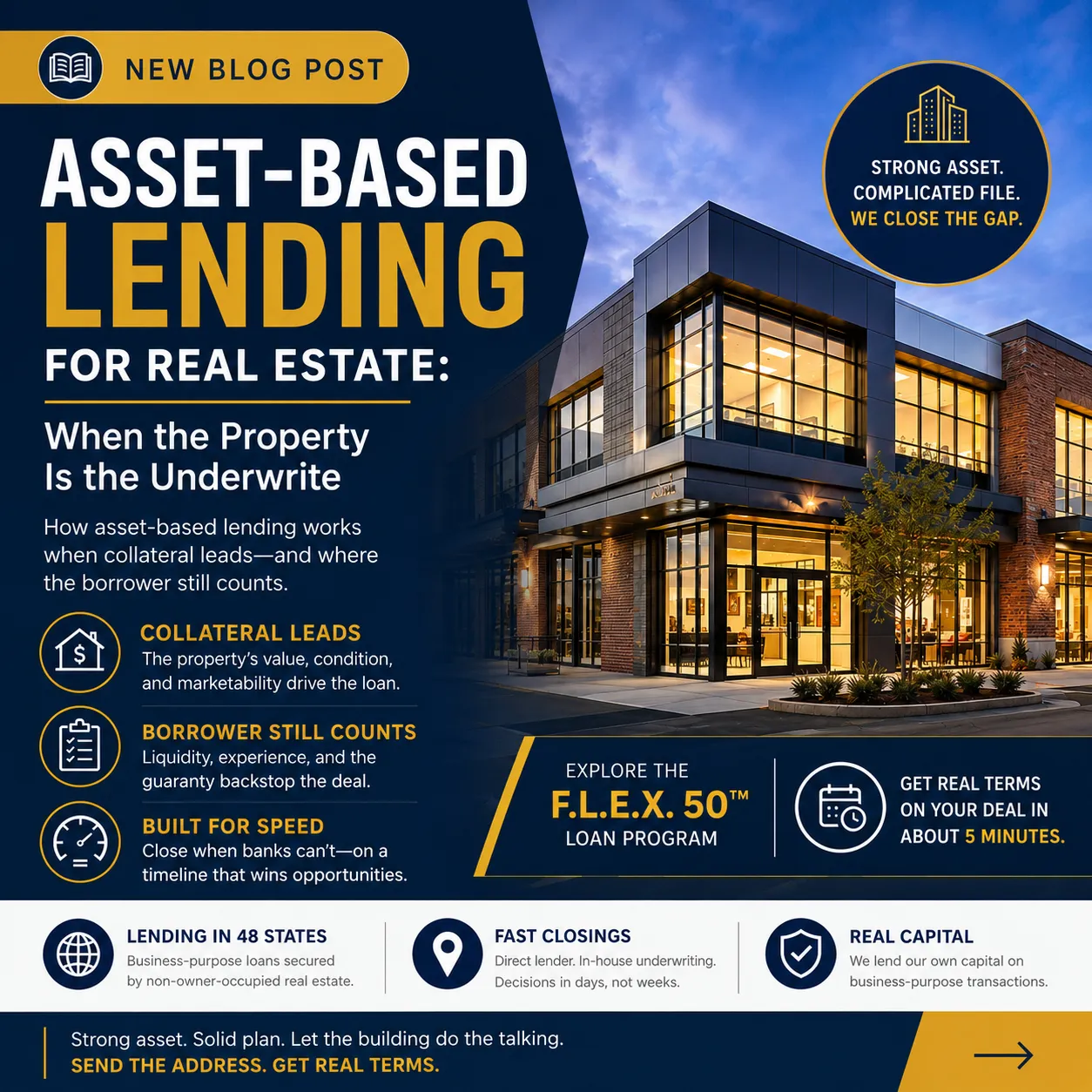
Your building is strong and your tax returns are not the story you want told. That is the situation asset-based lending exists for. This piece walks through what an underwriter tests when the collateral leads, the places your own profile still moves the outcome, and the deals where this structure is the wrong answer.
Key Takeaways
- In asset-based lending the collateral leads the credit decision; the borrower backstops it rather than driving it.
- Underwriters split as-is value, post-improvement value, and a realistic ninety-day sale price, then size to the conservative one.
- Marketability is scored separately from value. An unusual property with a thin buyer pool gets treated as thin, not as cheap.
- Liquidity, experience, and the guaranty are where a borrower still swings the outcome on an asset-first file.
What It Means to Say the Property Is the Underwrite
Asset-based lending means the collateral carries the credit decision. It does not mean the borrower is irrelevant, and it certainly does not mean documents disappear. It means the lender’s first and largest question is what the property is worth, how fast it would sell, and what that value does if your plan stalls.
Income-documented lending runs the other direction. There, verified borrower cash flow leads and the property secures the position. Two lenders can study the same building and reach different answers purely because of which question they asked first.
That ordering explains both halves of the reputation. Asset-based files close on condition that would stop a bank cold, and they also die on things a bank would shrug at, such as a cloudy title chain or a use that never conformed to zoning.
The Collateral Stack an Underwriter Actually Tests
Value, and How Much of It Is Real
An asset-based underwriter separates three numbers investors habitually treat as one: as-is value today, value once your scope is complete, and the price a motivated seller would truly clear in ninety days. Sizing anchors to the conservative end of that set. AIVAA, our AI valuation and underwriting engine, produces the instant valuation and platform analysis that opens the file, and a human reads the output against the rest of the package.
Marketability, Which Is Not the Same as Value
A building can appraise well and still be difficult to sell. Single-tenant industrial in a one-employer town, a converted church, a parcel sharing a septic field with no recorded easement: real value on paper, thin buyer pool in practice. Lenders size for the pool. If your collateral is unusual, expect the underwriter to spend more time on who buys it than on what it is worth.
Where the Borrower Still Matters
Three places, consistently. Liquidity, because somebody has to fund the surprise. Experience, because a first-time sponsor on a complicated asset is a different risk than a tenth-time sponsor on a familiar one. And the guaranty, because carve-outs for fraud, waste, and unpermitted transfers are standard in this market and are enforced.
Credit is pulled. On our side that begins as a soft credit pull at pre-qualification, a soft inquiry that does not affect your score, with a hard pull possible later in the process. On an asset-based file, credit usually shapes structure rather than deciding the outcome.
Asset-Based and Income-Documented, Side by Side
Two underwriting philosophies on the same building
| Dimension | Asset-based | Income-documented |
|---|---|---|
| Leading question | What is the collateral worth, and how fast does it sell? | Can documented borrower income carry the debt? |
| Core file | Valuation, title, insurance, scope, entity authority | Tax returns, wage or K-1 income, global cash flow |
| Property condition | Can be poor; the improvement plan is underwritten | Generally must be habitable and stabilized |
| Speed constraint | Valuation and clearing title exceptions | Income verification and committee cycles |
| Where it breaks | Thin buyer pool, clouded title, illegal use | A return that reads worse than the business performs |
Neither column is superior. They answer different questions, and the skill is knowing which question your deal can actually pass.
Strong asset, complicated paperwork? That is the gap our F.L.E.X. 50 program was built to sit in.
A Worked Example: Cash-Out on a Small Mixed-Use Building
Illustrative worked example
You own a two-story mixed-use building free and clear, ground-floor retail with two apartments above, bought five years ago and improved since. You want capital out for the next acquisition. Your last two returns show heavy depreciation and modest taxable income.
An income-documented lender reads those returns and sizes small. An asset-based lender reads the building: as-is value, lease terms, the rent roll, and how mixed-use of this size actually trades in your county.
Assume, purely for illustration, an as-is value of $780,000 and a first-position loan sized at 60 percent of it, which sits inside the band common for small-balance commercial. That is $468,000 gross. Net proceeds land lower after origination, title, and any required escrow, and the underwriter will want reserves left standing after closing.
Illustrative only. Not a quote or a commitment to lend. Structure varies by asset, sponsor, and state.
When Asset-Based Lending Is the Wrong Tool
Three situations. You can document income comfortably and plan to hold for a decade, in which case you are paying for speed you do not need. Your exit is genuinely undefined, which no collateral strength repairs. Or the collateral is the weakest part of the deal, and asset-based underwriting will discover that faster and less gently than you will.
Where it fits is the gap between a strong building and a complicated file, on a clock. If that describes your deal, the F.L.E.X. 50 loan program is the right place to start. For adjacent structures, see Commercial Bridge Loans: How Investors Use Short-Term Capital to Win Deals in 2026 .
Where We Lend
CR Equity AI is a direct lender writing business-purpose loans against non-owner-occupied property in 48 states, with operations in Tallahassee, Florida and headquarters in Alexandria, Virginia.
Frequently Asked Questions
What Is Asset-Based Lending in Real Estate?
It is business-purpose lending in which the property secures and largely decides the loan. The underwriter leads with collateral value, condition, marketability, and lien position, then looks at the sponsor for liquidity, experience, and the guaranty. Borrower income documentation plays a supporting role rather than a gating one.
Does Asset-Based Lending Mean No Documentation?
No. The document set shifts rather than shrinking. Expect valuation support, a clean title commitment, entity formation and authority papers, an insurance binder naming correct parties, proof of liquidity, and a written exit. What you generally avoid is the full personal income package a bank would require.
What Property Types Work for Asset-Based Loans?
Non-owner-occupied residential investment property, small multifamily, mixed-use, retail, office, light industrial, and land in some cases. The practical test is not the label on the property but whether a defined pool of buyers exists at a defensible price inside a normal marketing period.
How Does the Lender Establish Value?
Usually in layers. An automated valuation and platform analysis produces an early read, then third-party support such as an appraisal or broker opinion confirms or corrects it, and title work confirms what you actually own. Where those layers disagree, the underwriter sizes to the conservative figure.
Let the Building Do the Talking
Send the address, the current rent roll if there is one, and what you want the capital to do. We lend our own capital across 48 states on business-purpose transactions.
Review the F.L.E.X. 50 program · Get real terms on your deal in about five minutes
About the Author
Robert S. Stewart Jr. is the Founder and CEO of CR Equity AI, Inc., an AI-native specialty real estate private credit and commercial lending platform founded in 2021. He is a U.S. military veteran and a licensed real estate professional in Florida and Virginia, and has personally originated all 477 loans CR Equity AI has closed since inception, representing more than $300 million in originations. CR Equity AI was named to the Inc. 5000 at #1036.
CR Equity AI, Inc. | NMLS ID 2797309 | 2308 Mount Vernon Ave, Suite 206, Alexandria, VA 22302
This article is provided for general informational purposes only and is not an offer, commitment, or solicitation to lend, and is not legal, tax, accounting, or investment advice. CR Equity AI originates business-purpose loans secured by non-owner-occupied real property in 48 states; products, availability, terms, and eligibility criteria vary by state, property type, transaction, and borrower, and are subject to underwriting, credit approval, and final documentation. Any figures shown are illustrative examples, not quoted terms. Nothing herein constitutes a consumer credit offer. Equal opportunity lender.