

What are scalable capital solutions, and why do they matter?
Scalable capital solutions are structured, multi-layer financing arrangements that combine senior debt, mezzanine financing, and private or preferred equity to fund commercial real estate and business projects beyond what traditional bank lending allows. The term “structured finance” is the recognized industry standard for this approach. Where a conventional bank looks at your current Debt Service Coverage Ratio (DSCR) and Loan-to-Value (LTV) and stops there, structured capital solutions lend on future value, making them the practical choice for acquisition, construction, value-add, and bridge-to-stabilization projects.
Why scalable capital solutions matter comes down to three factors: execution certainty, financing flexibility, and access to capital that traditional lenders simply will not provide. Borrowers gain customized amortization schedules and liquidity mechanics unavailable from conventional sources. The SBA 504 loan program adds a government-backed layer for owner-occupied commercial properties, providing up to 90% financing with a fixed-rate SBA debenture. Platforms like CR Equity Ai Inc bring machine-learning underwriting and real-time lender matching to the process, compressing timelines and expanding access.
Key reasons business owners and investors choose structured capital access:
- Financing beyond bank limits: Capital stacks reach leverage levels that single-lender mortgages cannot match.
- Speed of execution: Bridge and mezzanine structures close in days or weeks, not months.
- Customized terms: Amortization, covenants, and liquidity mechanics are negotiated to fit the deal.
- Government-backed options: The SBA 504 program offers predictable, long-term fixed rates for qualifying owner-occupied projects.
- AI-driven access: Platforms like CR Equity Ai Inc automate underwriting and lender matching, reducing friction across the credit lifecycle.
Key components of structured financing for commercial real estate
Understanding capital solutions means understanding the capital stack. Each layer carries its own cost, risk profile, and position in the repayment waterfall.
- Senior debt: The first-lien position, typically covering 50–65% of project cost at the lowest interest rate. Because this lender gets paid first in a default, they accept the least risk and charge accordingly. Maximize this layer whenever possible.
- Mezzanine financing: Sits above senior debt in the stack. Mezzanine lenders take on more risk and charge higher rates, but they allow borrowers to reach 80–85% of total project cost without diluting equity ownership permanently.
- Preferred equity: Used when senior lender covenants prohibit additional debt. Preferred equity investors receive a fixed return and sit in the equity layer, keeping debt ratios clean for the senior lender while still filling the capital gap.
- Bridge loans: Short-term instruments with LTV up to 75–80% and terms typically running 6–24 months. They solve timing problems: close fast, stabilize the asset, then refinance into permanent debt.
- Construction loans: Can reach 85% loan-to-cost for ground-up development, funding draws as construction milestones are met.
- SBA 504 loans: Structured as a 50% commercial lender first mortgage, a 40% SBA/CDC second mortgage, and 10% borrower equity. The SBA/CDC portion has a capped amount set by the program, with slightly higher limits for small manufacturers. Most SBA 504 loans close in a matter of weeks, with the appraisal typically driving the timeline.
Typical project use cases where these layers apply:
- Acquisition: Bridge loan closes the deal fast; permanent financing follows stabilization.
- Value-add: Mezzanine or preferred equity funds renovations while senior debt covers acquisition.
- Construction: Construction loan funds the build; SBA 504 or conventional permanent loan takes out the construction debt at completion.
- Bridge to stabilization: Short-term bridge financing carries the asset through lease-up before a long-term refinance.
For a deeper look at how bridge financing accelerates repositioning projects, the mechanics are worth reviewing before structuring any value-add deal.

Benefits, costs, and risk factors you need to evaluate
The financial case for structured capital solutions is straightforward when you run the actual math. Paying a premium rate on a bridge or mezzanine piece is justified when rapid closing secures a discounted asset or funds renovations that materially increase property value. The refinancing cycle after stabilization then replaces the higher-cost short-term debt with long-term, lower-rate permanent financing.
Core benefits:
- Execution certainty: Structured lenders commit to close. That certainty has real dollar value in competitive acquisition markets.
- Flexible terms: Bespoke covenants, interest-only periods, and liquidity mechanics that bank loan officers cannot approve.
- Leverage optimization: Combining layers allows investors to control larger assets with less equity deployed, improving cash-on-cash returns.
- Portfolio continuity: Keeping liquidity free for the next deal rather than tying it all into one project.
Financial considerations and risk factors:
- Premium interest rates: Mezzanine and bridge debt costs more than senior debt. Model the total interest cost against the value created or the discount captured.
- Short maturities: Bridge loans typically have terms spanning from around one to three years, requiring a validated exit plan before the lender will commit.
- Maturity cliff risk: If market conditions shift and refinancing is unavailable at maturity, extensions are expensive and forced sales are possible.
- Lender sophistication: Structured finance lenders move quickly to protect collateral. Inter-creditor agreements between senior and mezzanine lenders govern who controls the asset in a default scenario.
Pro Tip: Before committing to a bridge or mezzanine structure, build a conservative exit model with a lender-validated refinancing plan. A clear exit strategy is not optional — it is the first thing a structured lender will scrutinize, and failing to have one documented is the fastest way to lose deal approval.
Capital solutions strategies also feature protective covenants and asset-level underwriting that resemble private equity techniques, giving lenders granular control over cash flows and collateral while providing borrowers with terms calibrated to their specific risk profile.
How AI-driven platforms are changing capital access
CR Equity Ai Inc represents the operational shift now underway in structured financing. The platform applies machine-learning underwriting and automated document intelligence to compress the credit lifecycle from weeks to days. Borrowers submit applications and receive multiple lender offers in minutes, with AI-enhanced credit models pre-underwriting each opportunity before it reaches a lender’s desk.
Key capabilities that differentiate AI-driven capital platforms from traditional financing channels:
- Automated underwriting: Machine-learning models score credit risk, analyze cash flows, and flag collateral issues without manual review delays.
- Real-time lender matching: The platform routes each deal to the lenders whose credit boxes it fits, eliminating the manual broker outreach process.
- Digital KYC/AML verification: Automated identity and compliance checks run in parallel with underwriting, not sequentially.
- Cloud-native infrastructure: Secure, scalable architecture supports high transaction volumes without the bottlenecks of legacy bank systems.
- Product range: CR Equity Ai Inc supports commercial loan programs including bridge financing, construction loans, self-storage acquisition and development, business term loans, working-capital solutions, and asset-based credit lines.
The practical result is that investors and business owners who previously waited 45–90 days for a credit decision can now structure and close deals on timelines that match market opportunities. AI-driven platforms also improve transparency: borrowers see offer terms, rate comparisons, and lender requirements in a single interface rather than navigating multiple relationships manually.
How to use scalable capital strategies effectively in 2026
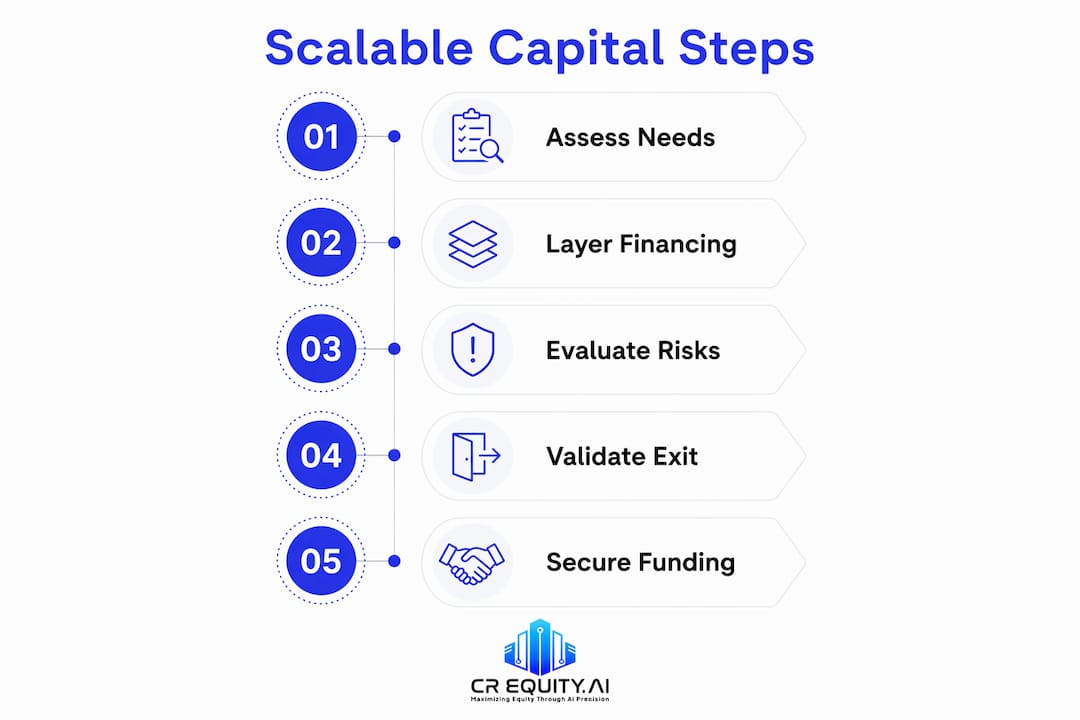
Selecting the right capital structure starts with matching the financing type to the project’s risk profile, timeline, and exit plan. A value-add multifamily deal with a 24-month renovation timeline calls for a different structure than an owner-occupied medical office acquisition targeting an SBA 504 loan.
Practical steps for business owners and investors:
- Define the project type first: Acquisition, construction, value-add, or stabilized refinance each point toward different capital layers and lender types.
- Build the capital stack from the bottom up: Maximize senior debt, then layer mezzanine or preferred equity only for the gap that senior debt cannot cover.
- Engage capital advisors early: Advisors who specialize in complex layered financing and AI credit platforms have relationships with private debt funds, family offices, and insurance companies where structured finance lives. A residential mortgage broker cannot navigate inter-creditor agreements or negotiate exit fee terms.
- Document the exit strategy before approaching lenders: For bridge and mezzanine structures, the refinancing or sale plan must be credible and supported by market data.
- Use AI platforms to accelerate the process: CR Equity Ai Inc’s AI-driven credit infrastructure automates the application, underwriting, and lender-matching steps that traditionally consume weeks of calendar time.
- Plan for the SBA 504 timeline: Owner-occupied projects qualifying for the SBA 504 program should budget 45–75 days from application to closing, with the appraisal as the primary scheduling constraint.
- Model volatile market scenarios: In 2026, with rate environments shifting, stress-test the refinancing exit at rates 150–200 basis points above your base case before committing to a short-term structure.
For investors working through the workflow for securing bridge financing in 2026, the documentation checklist and lender sequencing steps are worth reviewing before submitting any application. Business owners evaluating business loan programs alongside real estate financing will find that the same layered capital logic applies across both asset classes.
Key Takeaways
Scalable capital solutions combine senior debt, mezzanine financing, and equity layers to fund commercial real estate and business projects at leverage levels and speeds that traditional bank lending cannot match.
| Point | Details |
|---|---|
| Capital stack structure | Senior debt covers 50–65% of project cost; mezzanine and equity layers fill the remaining gap. |
| SBA 504 financing | Provides up to 90% financing for owner-occupied CRE, with the SBA/CDC portion capped at $5.0–$5.5 million. |
| Bridge loan parameters | Terms run 6–24 months with LTV up to 75–80%; a validated exit strategy is required before lender approval. |
| AI platform advantage | CR Equity Ai Inc automates underwriting and lender matching, compressing credit decisions from weeks to minutes. |
| Exit strategy priority | Bridge loans spanning 12–36 months require a lender-validated refinancing or sale plan to avoid costly extensions. |