
An AI-driven working capital solution is a short-term financing product matched to your project’s cash-conversion cycle, using machine-learning underwriting to accelerate approval and reduce manual friction. For U.S. real estate investors and business owners, explaining working capital solutions comes down to one practical verdict: use them to cover short-term liquidity gaps, vendor prepayments, or pre-stabilization cash-flow timing mismatches. Avoid them for long-duration construction projects where a repayment window of several months to a year will create repayment pressure before the asset produces income.
Platforms like CR Equity Ai Inc can fund qualified applicants rapidly, often within a couple of days, provided documentation and eligibility signals are in order. The key metric lenders evaluate alongside the Current Ratio is the cash conversion cycle — the time between capital deployed and cash received — because that interval determines whether a short-term product is appropriate or a longer bridge structure is needed.
Table of Contents
- What types of working capital solutions apply to real estate?
- How do you align loan term to your project’s cash-conversion cycle?
- How does AI change underwriting speed and accuracy?
- What timelines and fees should you expect?
- What do AI underwriters look for — eligibility and documents?
- Step-by-step: how to apply and what to expect
- When does AI-driven working capital make sense versus other options?
- Real-world examples: AI-driven working capital in practice
- Why CR Equity Ai Inc is a strong fit for real estate working capital
- Key Takeaways
- The case for fixing operations before you borrow
- Get working capital offers from CR Equity Ai Inc
- Useful sources
What types of working capital solutions apply to real estate?
Working capital financing covers short-term operational gaps through several distinct product structures. Each carries a different cost shape, term length, and repayment cadence.
- Revolving lines of credit: Draw and repay as needed up to a set limit; interest accrues only on the drawn balance. Best for ongoing liquidity management, vendor payments, or seasonal cash-flow gaps. Covenants often require balance-sheet strength and consistent revenue.
- Short-term term loans: Lump-sum disbursement repaid over a fixed schedule, typically 3–18 months. Useful for one-time vendor prepayments, materials purchases, or pre-lease tenant improvement costs where the cash need is defined.
- Invoice financing: Advances against outstanding receivables. Practical for property managers or contractors with slow-paying clients, though less common for direct real estate acquisition.
- Asset-based credit lines (ABL): Borrowing capacity tied to eligible collateral — receivables, inventory, or specific assets. Useful for operators with identifiable asset pools but limited traditional cash flow.
- Merchant cash advances (MCAs): Repaid via a percentage of daily revenue. Fast to access but carry the highest effective cost; generally unsuitable for real estate projects with irregular cash flows.
- Specialized bridge working-capital products: Designed for stabilization gaps — the period between construction completion and full occupancy or lease-up. Repayment aligns with stabilization milestones rather than a fixed monthly billing cycle.
Matching the product to the use case is the primary selection rule: lines for recurring needs, short-term loans for defined one-time gaps, and bridge working-capital structures for stabilization timing mismatches.
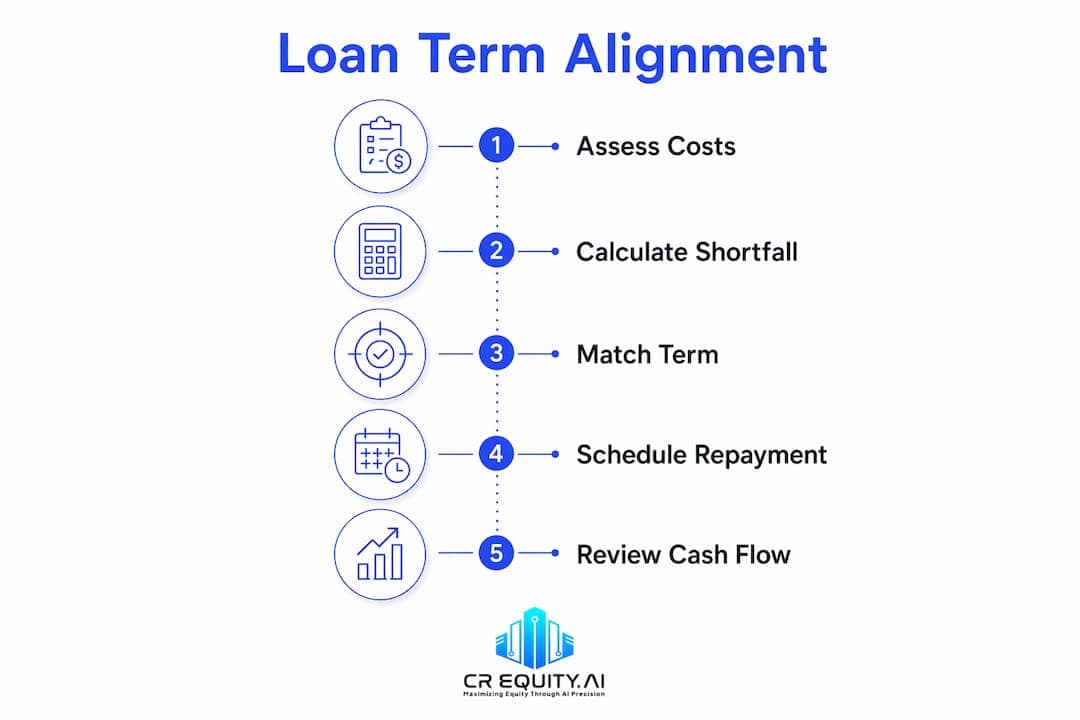
How do you align loan term to your project’s cash-conversion cycle?

Match term length and repayment cadence to when the project actually produces cash. That single rule prevents the most common and costly mistake in real estate working capital: using a 90-day product to fund a 14-month stabilization gap.
For real estate, the cash conversion cycle runs from capital deployed through construction or renovation, through lease-up or stabilization, to the point where rents or sale proceeds cover obligations. Standard 6–12 month working-capital loans often fail for construction and stabilization projects because the repayment clock starts before the asset generates income.
A practical alignment sequence:
- Assess the project timeline: Identify the date when the asset will produce stable cash flow.
- Map cash inflows: Estimate monthly revenue or proceeds from that stabilization date forward.
- Calculate the monthly shortfall: (Monthly operating costs + debt service) minus projected monthly revenue = minimum monthly capital needed.
- Choose repayment cadence: Select a product whose first principal payment falls after the projected cash-flow positive date, with a buffer.
- Build a contingency buffer: Add 15–20% to the projected shortfall to absorb delays.
Pro Tip: Before applying, run a simple monthly shortfall calculation: if your project costs $40,000 per month to carry and generates $0 until month 8, you need at least $320,000 in working capital with a repayment start no earlier than month 9. Any product with earlier repayment creates a structural cash-flow problem.
How does AI change underwriting speed and accuracy?
AI improves working capital underwriting in three concrete ways: faster document processing, more nuanced risk weighting using cash-flow signals, and real-time lender matching that surfaces multiple offers simultaneously. For real estate investors, that combination shortens the decision window from weeks to hours.
Specific benefits worth noting:
- Automated document intelligence reads structured PDFs, rent rolls, and bank statements without manual data entry, cutting processing time materially.
- Multi-source risk signals allow the model to weight cash-flow velocity, DSCR, and project budget realism alongside traditional credit scores.
- Multiple simultaneous offers give borrowers pricing leverage they rarely get from a single-lender process.
The limits are equally real. Garbage-in, garbage-out applies directly: poorly organized or incomplete documents degrade model accuracy. Model bias is a documented risk in AI underwriting, particularly for non-standard collateral or unusual project structures. Complex deals — mixed-use development, ground-up construction with phased draws — often require human review on top of the automated decision.
Practical risk controls: run sensitivity checks on your projected cash flows before submitting, flag unusual collateral types explicitly in your application, and confirm that KYC/AML and digital verification protocols meet institutional standards. CR Equity Ai Inc’s platform automates KYC/AML and uses a secure cloud-native infrastructure, which addresses the compliance layer without adding borrower friction.
What timelines and fees should you expect?
Fast AI-enabled platforms can fund qualified applicants rapidly, often within a couple of days, costs still vary by risk profile, term length, and repayment structure. The global working capital loan market was projected to grow at over 10% CAGR from 2024 to 2032, reflecting sustained fintech investment in faster, more automated origination.
| Dimension | Detail |
|---|---|
| Funding speed (AI platforms) | 24–48 hours for qualified applicants with complete documentation |
| Market growth | >10% CAGR projected 2024–2032 (global working capital loan market) |
| Origination fees | Typically charged as a percentage of loan amount at closing |
| Factor fees | Common in MCAs; expressed as a multiplier on the advance amount |
| Yield spreads | Vary by term, collateral quality, and borrower liquidity |
| Prepayment penalties | Present in some fixed-term products; negotiate removal where possible |
Cost comparison checklist: calculate the total dollar cost (not just the stated rate), confirm whether prepayment penalties apply, verify the effective APR across the full term, and compare repayment cadence against your projected cash-flow positive date.
What do AI underwriters look for — eligibility and documents?
Preparation shortens underwriting significantly. AI reads documents, so structured, machine-readable files matter as much as the underlying financials.
Eligibility signals lenders evaluate:
- Revenue run-rate and consistency over the prior 12–24 months
- DSCR (Debt Service Coverage Ratio) on the subject property or business
- Cash reserves relative to projected monthly carry costs
- Project budget realism and draw schedule credibility
- Property valuation and ownership track record
- KYC/AML compliance documentation
Document checklist:
- Executed purchase contracts or construction agreements
- Construction draw schedule with milestone dates
- 12–24 months of business bank statements
- Historical P&L statements and current balance sheet
- Rent rolls (for income-producing properties)
- Pro-forma with conservative and base-case projections
- Title documents and entity formation records
- Digital KYC/AML materials (government-issued ID, beneficial ownership)
Lenders want current P&L, bank statements, and realistic pro-formas before approving — preparation directly improves both speed and pricing.
Pro Tip: Package documents as machine-readable PDFs with descriptive file names (e.g., “2025_Q4_BankStatements_EntityName.pdf”) and include a one-page document index. AI underwriting systems process named, structured files faster than scanned image bundles, which can shave hours off the decision timeline.
Step-by-step: how to apply and what to expect
A concise application sequence for an AI-driven working capital product:
- Prepare documents (1–3 days): Assemble the full document checklist above; convert to machine-readable PDFs.
- Soft credit check (minutes): Most AI platforms run a soft pull that does not affect your credit score.
- Document upload and intake (same day): Submit via the platform’s secure portal; automated document intelligence begins processing immediately.
- Automated underwriting decision (hours): The AI model scores risk, matches lender criteria, and generates preliminary offers.
- Review and select offer (same day): Compare total dollar cost, repayment cadence, and term length across multiple offers.
- Closing conditions (1–2 days): Satisfy any outstanding conditions — title confirmation, additional KYC, or collateral verification.
- Funding (24–48 hours from completed file): Funds wire upon closing.
To hit the 24–48 hour fast-funding path, submit a complete, structured document package at intake. Incomplete files are the single most common cause of delays. Accelerating receivables and resolving outstanding payables before applying also strengthens your eligibility profile, as lenders evaluate operational efficiency as a signal of repayment capacity.
When does AI-driven working capital make sense versus other options?
Use AI-driven working capital for short-term liquidity mismatches and project-level cash-flow timing gaps. Choose bridge or construction financing for longer-duration capital needs or when you require larger, term-specific amortization structures.
Decision rules:
- Stabilization date within 12 months: working capital or a short-term line is likely appropriate.
- Stabilization date beyond 12 months: a bridge loan or structured construction financing typically aligns better with the repayment timeline.
- Need is recurring (vendor payments, seasonal gaps): a revolving line of credit fits better than a term loan.
- Need is one-time and defined: a short-term term loan with a fixed repayment schedule is cleaner.
- Project involves phased construction draws over 18+ months: construction loan rates and structures are purpose-built for that timeline; working capital products are not.
The core risk of misalignment is using short-term, high-interest products for long-duration projects — a mistake that creates repayment pressure before the asset produces income.
Real-world examples: AI-driven working capital in practice
Case 1 — Vendor prepayment on a single-family rehab: An investor needed $85,000 to prepay a contractor for materials on a 90-day flip. A traditional bank line would have taken 3–4 weeks to approve. An AI-driven short-term term loan funded in 36 hours, allowing the contractor to lock material pricing and start on schedule. The project closed on time; the loan was repaid from sale proceeds.
Case 2 — Tenant improvement gap before lease commencement: A small commercial property owner needed $120,000 for tenant improvements on a signed 5-year lease that did not commence for 60 days. A revolving working-capital line covered the TI costs; repayment began when the first lease payment arrived. The AI underwriting model weighted the executed lease as a primary repayment signal, approving the line in under 48 hours.
Case 3 — Materials financing during a supply delay: A developer experienced a 6-week supply delay on a multifamily renovation. Rather than halt the project, the developer used an asset-based working-capital line secured against the existing property’s equity to pre-purchase materials from an alternate supplier. The line was repaid upon project completion and refinance. The AI platform’s AIVAA property valuation provided a same-day collateral assessment, removing a typical 2-week appraisal bottleneck.
Why CR Equity Ai Inc is a strong fit for real estate working capital
CR Equity Ai Inc provides AI-driven underwriting, automated document intelligence, real-time lender matching, and fast working capital funding for eligible applicants. The platform’s capabilities directly address the friction points real estate investors face in traditional lending.
Key platform features relevant to working capital borrowers:
- Multiple offers in minutes via real-time lender matching, giving borrowers pricing leverage
- AIVAA property valuations for same-day collateral assessment on real estate-secured products
- Automated KYC/AML and digital verification that satisfies compliance requirements without manual back-and-forth
- Secure cloud-native infrastructure protecting sensitive financial and ownership documents
- Working-capital lines, short-term term loans, and asset-based credit lines across commercial real estate and business financing
To get started, prepare your document package per the checklist above, then request a loan quote or review available working capital and business loan programs on the platform. The AI underwriting model processes structured files quickly; a complete submission is the fastest path to a funded offer.
Key Takeaways
AI-driven working capital solutions deliver the most value when term length, repayment cadence, and funding speed are matched precisely to the project’s cash-conversion cycle.
| Point | Details |
|---|---|
| Match term to cash-conversion cycle | Select a product whose repayment start falls after your projected cash-flow positive date. |
| Prepare structured documents | Machine-readable PDFs with descriptive file names materially speed AI underwriting decisions. |
| 24–48 hour funding is achievable | Qualified applicants with complete documentation can fund in 24–48 hours on AI-enabled platforms. |
| Avoid misaligned products | Short-term, high-interest products used for long-duration projects create repayment pressure before income arrives. |
| CR Equity Ai Inc | Offers AI underwriting, AIVAA valuations, real-time lender matching, and fast working capital funding for U.S. real estate investors. |
The case for fixing operations before you borrow
The most underappreciated insight in working capital management is that operational efficiency often reduces the need for external capital as much as finding cheaper capital does. Accelerating receivables, tightening supplier payment terms, and eliminating unnecessary carry costs can shrink the financing gap before a borrower ever submits an application. That is not a reason to avoid working capital financing — it is a reason to enter the process from a stronger position, which directly improves pricing and approval speed.
AI-driven platforms like CR Equity Ai Inc change the equation by removing the underwriting friction that historically penalized well-run but documentation-heavy real estate businesses. The platform’s automated document intelligence and real-time lender matching mean that a borrower who has done the operational work — clean books, structured files, realistic pro-formas — gets rewarded with faster decisions and better offers.
Get working capital offers from CR Equity Ai Inc
Faster approvals and term-matched capital are available now for qualified U.S. real estate investors and business owners through CR Equity Ai Inc’s AI-driven platform.
Submit your document package — bank statements, P&L, rent rolls, and pro-formas — and the platform’s machine-learning underwriting model will match your request to lenders and return multiple offers. Automated KYC/AML and digital verification handle compliance in the same workflow, so there is no separate identity or ownership verification queue. The platform operates on a secure cloud-native infrastructure, meeting institutional-grade data security standards.
Request a loan quote to see working capital offers matched to your project, or review the full range of funding options to confirm the right product structure before you apply.
Useful sources
- Fast working capital: get funded in 24 to 48 hours — CR Equity Ai Inc: funding speed claims and fast-path eligibility criteria.
- Working capital financing options explained — Stripe: product types, market growth context, and misalignment risks.
- What is working capital? Formula and how to calculate it — J.P. Morgan: cash conversion cycle, operational efficiency signals, and lender evaluation criteria.
- Working capital: what is it and why it’s important — Bank of America: lines of credit guidance and balance-sheet requirements.
- Working capital financing explained: lines of credit, loans, and factoring — Clarify Capital: product selection rules by use case.
- Working capital solutions: the complete guide for small business owners — Crestmont Capital: document preparation and underwriting readiness.
- CR Equity AI services — CR Equity Ai Inc: platform capabilities, product types, and KYC/AML compliance features.
- CR Equity AI homepage — CR Equity Ai Inc: automated document intelligence and lender-matching overview.
Recommended
- Scalable Capital Solutions for CRE Investors in 2026
- Leveraging Forward Flow Agreements, Tiered Credit Facilities, and Blockchain-Backed Digital Asets to Capture 1-3% of the Commercial Real Estate Total Addressable Market | CR Equity AI
- Commercial Real Estate Loans, Bridge & Refinance | Business Financing | CR Equity AI
- Working Capital Financing: A Guide for Business Owners