

The fastest, lowest-friction way to match borrowers with lenders is an AI decisioning platform that pre-screens for approval likelihood and returns ranked, pre-qualified offers from multiple lenders in minutes. Two facts support that claim immediately: AI systems evaluate 50+ borrower data points to deliver ranked matches within minutes, and a single intake form replaces the weeks of duplicate paperwork a manual search requires.
Your immediate next steps: gather your credit profile, last two years of tax returns, three months of bank statements, and any property data or entity documents before you submit a single form.

Pro Tip: Upload your most recent bank statements and a current property valuation first. These two inputs carry the highest weight in AI scoring models and will produce more precise lender matches from the start.
Table of Contents
- How do directory and decisioning models differ?
- How does an AI platform match your profile to lenders in real time?
- What documents should you prepare before starting the matching process?
- What timeline and fees should you expect from intake to funding?
- How do you protect your credit score and data during matching?
- What questions should you ask lenders, and what red flags signal a poor match?
- How do you evaluate and choose a lender-matching platform?
- How CR Equity Ai Inc matches borrowers with lenders end to end
- Key Takeaways
- Why AI decisioning changes the math for investors and business owners
- Get matched with the right lenders through CR Equity Ai Inc
- Useful sources and references
How do directory and decisioning models differ?
The lender matching process operates under two distinct paradigms, and the difference in outcome is significant.
Directory model. The SBA’s Lender Match tool is the clearest U.S. example. A borrower describes their needs, and within a few business days the SBA returns a list of interested lenders with contact details. The borrower then reaches out to each lender individually to initiate applications. It is a curated referral list, not a decisioning engine. Each lender may require its own application and document package, and each application can trigger a separate hard credit inquiry.
Decisioning model. An AI-driven platform evaluates the borrower’s full financial profile against a live lender database, scores each potential match by approval probability, and returns ranked offers in minutes. The two-stage architecture common to advanced engines first applies rule-based hard filters (geography, minimum credit, loan size) to eliminate impossible matches, then runs an ML probability layer to surface only viable offers.
- Directory model fits: borrowers with flexible timelines, SBA-specific loan programs, or community-lender relationships they want to formalize.
- Decisioning model fits: real estate investors on compressed acquisition timelines, business owners needing working capital quickly, and any borrower who wants multiple pre-qualified offers without multiple hard pulls.
How does an AI platform match your profile to lenders in real time?
The pipeline produces ranked, pre-qualified offers from a single intake. Here is how each stage works:
- Intake. The borrower submits a digital form covering credit score, annual revenue, requested loan amount, loan purpose, and location. A soft credit pull occurs here, with no impact to the borrower’s score.
- Data aggregation and document parsing. The platform connects to bank feeds, pulls tax records, and ingests uploaded documents via automated document intelligence, building a complete borrower profile without manual re-entry.
- Hard-constraint filter. A rule-based layer eliminates lenders outside the borrower’s geography, below the required loan size, or outside the asset class. This step removes irrelevant pairings instantly.
- ML probability scoring. Machine learning models score each remaining lender match by approval likelihood and acceptance probability, accounting for DSCR thresholds, LTV limits, industry risk ratings, and cash flow patterns.
- Offer optimization and ranking. The engine ranks surviving matches under lender capacity and pricing constraints, surfacing the offers most likely to close on terms the borrower can accept.
- Offer delivery. The borrower receives a ranked list with side-by-side terms. Only after selecting a specific lender does a single hard bureau inquiry occur to initiate formal underwriting.
| Pipeline Stage | Borrower Input | Platform Output |
|---|---|---|
| Intake | Credit score, revenue, loan amount, purpose, location | Soft pull initiated, profile created |
| Data aggregation | Bank statements, tax returns, property data | Complete borrower profile |
| Hard-constraint filter | None (automated) | Ineligible lenders eliminated |
| ML scoring | None (automated) | Approval probability per lender |
| Offer ranking | None (automated) | Ranked, pre-qualified offer list |
| Offer delivery | Lender selection | Single hard pull, formal underwriting begins |
Pro Tip: The most common data gap that lowers match scores is incomplete or inconsistent revenue documentation. Make sure your bank statements and tax returns reflect the same revenue figures — discrepancies trigger lower confidence scores in the ML layer.
What documents should you prepare before starting the matching process?
Verified income, bank statements, and complete property data are the highest-impact inputs for matching accuracy. Submit these first:
- Credit profile. A current credit report with score, ideally pulled within 30 days.
- Bank statements. Three to six months of business bank statements showing cash flow patterns.
- Tax returns. Two years of business and personal returns to confirm revenue and income stability.
- Property data. Address, current valuation, rent rolls, and lease agreements for any collateral property.
- Entity documents. Articles of incorporation, operating agreement, and EIN confirmation.
- DSCR documentation. Net operating income (NOI) figures and existing debt schedules so the platform can calculate debt service coverage.
Each item maps to a specific scoring variable. Bank statements feed the cash flow model. Tax returns confirm revenue. Property data drives LTV and DSCR calculations. Entity documents satisfy KYC requirements. Gaps in any of these categories reduce match precision and slow underwriting.
What timeline and fees should you expect from intake to funding?
Directory model: lender list in roughly two business days, then days to weeks of individual outreach, application submission, and underwriting per lender. Total time to a funded loan commonly runs several weeks or longer.
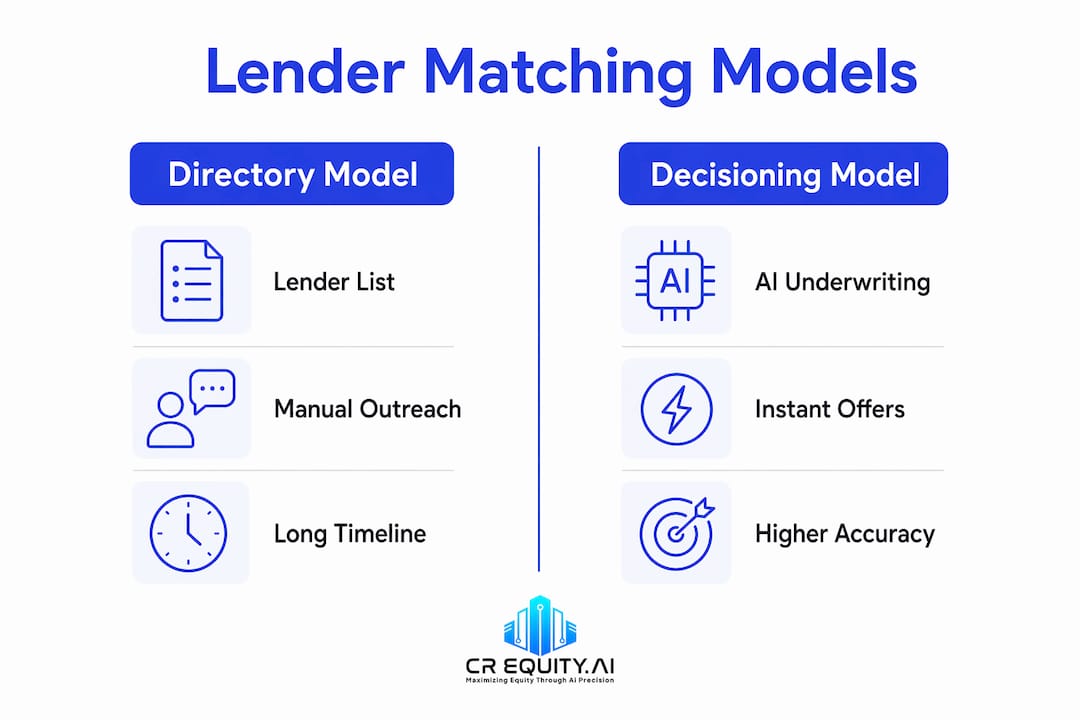
AI decisioning model: ranked offers in minutes to hours after intake; formal underwriting and commitment letter in days; funded loan in days to a few weeks depending on due diligence complexity.
Timeline milestones for an AI-driven process:
- Minutes: soft-pull intake complete, initial ranked offers delivered.
- 24–72 hours: document verification and automated underwriting complete.
- 3–10 business days: term sheet issued, hard pull triggered on borrower’s selection.
- 2–4 weeks: due diligence, title, and closing for most commercial transactions.
Common fee line items to anticipate:
- Origination fee: typically 1%–3% of the loan amount, paid at closing.
- Underwriting or processing fee: a flat platform fee covering document review and credit analysis.
- Valuation fee: charged when an automated property valuation (such as AIVAA) or third-party appraisal is required.
- Prepayment penalty: varies by lender and loan structure; always confirm before signing.
For construction or bridge transactions, reviewing current construction loan interest rate ranges before intake helps set realistic pricing expectations. A bridge loan calculator can model carry costs before you commit to a specific term.
How do you protect your credit score and data during matching?
Insist on soft-pull prequalification until you select a specific offer. AI decisioning platforms protect borrower credit by using soft pulls during prequalification and triggering a single hard bureau inquiry only when the borrower commits to one lender application.
- Soft pull: no credit score impact; used during intake and matching.
- Hard pull: triggered once, on the lender you select; standard for formal underwriting.
- KYC/AML verification: expect automated identity verification, beneficial ownership confirmation, and sanctions screening. These are compliance requirements, not optional steps.
- Data security: confirm the platform operates on encrypted, cloud-native infrastructure with SOC 2 or equivalent attestation.
Pro Tip: Before submitting any financial data, locate the platform’s privacy policy and confirm in writing that prequalification uses only a soft pull. Any platform that cannot confirm this in its documentation is a red flag.
What questions should you ask lenders, and what red flags signal a poor match?
Ask every lender these questions before accepting a term sheet:
- What is the full APR, including all origination and platform fees?
- Are there prepayment penalties, and what is the calculation method?
- What covenant triggers could accelerate repayment or modify terms?
- Is the loan recourse or non-recourse, and under what conditions?
- Who services the loan after closing, and what are the servicing arrangements?
The SBA recommends explicitly verifying prepayment penalties, grace periods, covenant triggers, and recourse status before proceeding with any lender.
Red flags to watch for:
- Non-transparent fee structures with costs disclosed only at closing.
- Multiple unexplained hard credit pulls before you have selected a lender.
- No documented KYC/AML process or inability to confirm compliance procedures.
- Vague or missing servicer information on the term sheet.
- Pressure to accept an offer without a written term sheet.
How do you evaluate and choose a lender-matching platform?
The top three criteria for real estate investors and business owners are match precision (approval probability accuracy), speed to ranked offers, and data security and compliance posture. An AI lending platform guide for investors covers these in detail.
Checklist for platform evaluation:
- Soft-pull policy confirmed in writing.
- Number of active lender verticals (bridge, construction, DSCR, SBA, non-QM, asset-based).
- ML underwriting transparency: can the platform explain why a match scored highly?
- Alternative data use: does the platform incorporate real-time bank cash flow and automated property valuations?
- SLA for initial offer delivery: minutes or hours, not days.
- KYC/AML compliance documentation available on request.
| Evaluation Criterion | Strong | Acceptable | Weak |
|---|---|---|---|
| Soft-pull policy | Confirmed in writing | Stated verbally | Not confirmed |
| Speed to ranked offers | Under 30 minutes | Same business day | Multiple days |
| Lender verticals covered | 5+ asset classes | 3–4 asset classes | 1–2 asset classes |
| ML transparency | Explainable scoring | Summary only | Black box |
| KYC/AML documentation | Publicly available | On request | Not available |
How CR Equity Ai Inc matches borrowers with lenders end to end
CR Equity Ai Inc delivers multiple ranked, pre-underwritten lender offers from a single intake submission. The platform’s workflow for a commercial real estate or business borrower runs as follows:
- Intake (minutes): borrower submits loan purpose, amount, property address, and financial profile through a single digital form; soft pull initiated.
- AIVAA valuation (automated): the platform’s AI-powered property valuation tool generates an instant property value estimate, feeding LTV and DSCR calculations without waiting for a third-party appraisal.
- Document automation (hours): automated document intelligence parses uploaded bank statements, tax returns, and entity documents, eliminating manual data entry.
- ML underwriting (automated): machine learning models score the borrower profile against the platform’s lender database, applying hard-constraint filters first, then probability scoring for approval likelihood.
- Ranked offer delivery (minutes to hours): the borrower receives side-by-side term comparisons across bridge, construction, acquisition, refinance, and asset-based products.
- Single hard pull on selection: formal underwriting begins only after the borrower selects a preferred offer.
CR Equity Ai Inc also integrates automated KYC/AML and digital verification, so compliance checks run in parallel with underwriting rather than creating a separate queue. The result is faster offers, less paperwork, and a credit file that remains intact until the borrower is ready to commit.
Key Takeaways
AI decisioning platforms match borrowers with lenders faster and more accurately than directory models by evaluating 50+ data points and returning ranked, pre-qualified offers in minutes from a single intake.
| Point | Details |
|---|---|
| Use a decisioning model | AI platforms return ranked offers in minutes; directory models take days and require individual outreach. |
| Prepare documents first | Bank statements, tax returns, property data, and entity docs are the highest-impact inputs for match accuracy. |
| Protect your credit | Confirm soft-pull prequalification in writing before submitting any financial data to a platform. |
| Ask the hard questions | Verify APR, prepayment penalties, covenant triggers, and recourse status before accepting any term sheet. |
| CR Equity Ai Inc | Delivers multiple pre-underwritten offers from one intake, with AIVAA valuation, ML underwriting, and automated KYC/AML. |
Why AI decisioning changes the math for investors and business owners
The conventional wisdom in commercial lending is that speed and precision trade off against each other. Faster decisions, the thinking goes, mean shallower underwriting. AI decisioning breaks that assumption. When a platform evaluates 50+ variables in parallel rather than sequentially, it can surface a more accurate credit picture in minutes than a loan officer reviewing a single file over several days.
For a CRE investor competing on a self-storage acquisition or a multifamily deal, the difference between a pre-underwritten offer in hours and a lender response in two weeks is often the difference between winning and losing the deal. For a business owner managing cash flow, a working-capital decision that arrives in days rather than weeks has direct operational value. The speed advantage is not a convenience feature. It is a structural change in how capital competes.
Decisioning models also reduce the information asymmetry that has historically favored lenders. When a borrower receives ranked, side-by-side term comparisons, they negotiate from a position of actual market data rather than a single offer with no reference point.
Get matched with the right lenders through CR Equity Ai Inc
Real estate investors and business owners who need pre-underwritten offers fast, without multiple hard pulls or weeks of manual outreach, have a direct path through CR Equity Ai Inc. The platform’s commercial real estate and business loan services cover bridge, construction, acquisition, refinance, and asset-based products, all processed through a single AI-driven intake.
Key platform capabilities: real-time lender matching from one intake form, ML underwriting with 50+ data point evaluation, AIVAA automated property valuation, soft-pull prequalification until offer selection, and integrated KYC/AML compliance. Borrowers receive multiple ranked offers with transparent, side-by-side terms. To see what you qualify for, use the loan quote calculator and get your initial offer range without impacting your credit score.
This article is general information, not financial or legal advice. Confirm current lending terms, rates, and compliance requirements with a qualified professional for your specific situation.
Useful sources and references
- SBA Lender Match Tool — U.S. Small Business Administration official tool documentation; independent government source.
- Real-time lender matching: Your guide to fast funding — CR Equity Ai Inc platform documentation on AI decisioning inputs and pipeline.
- AI underwriting in commercial real estate — CR Equity Ai Inc technical overview of ML underwriting and alternative data use.
- How AI streamlines funding for real estate and business growth — CR Equity Ai Inc blog; speed and transparency claims for AI-driven matching.
- India’s lending market is a classic matching theory problem — Independent engineering analysis on DEV Community; covers two-stage matching architecture and soft-pull mechanics.