
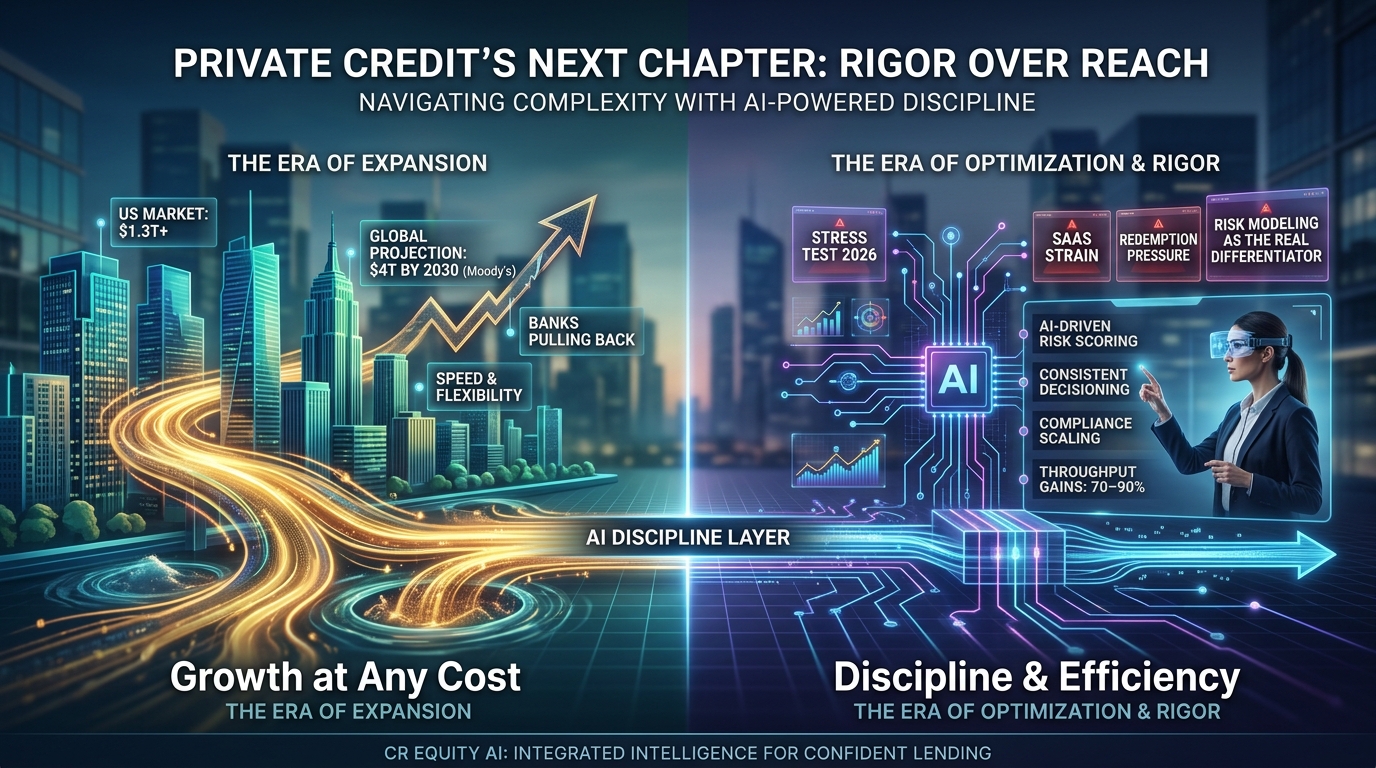
Private credit has grown from a niche corner of the lending world into one of the defining forces in global finance. As banks pulled back from large segments of commercial lending under tighter post-crisis regulation, non-bank lenders stepped into the gap — and the capital followed. The U.S. private credit market expanded from roughly $500 billion to about $1.3 trillion over the past five years, and Moody’s projects global private credit assets to surpass $2 trillion in 2026 on the way toward $4 trillion by 2030.
The funds filling the bank-shaped hole won on speed and flexibility. But 2026 is delivering the asset class its first real stress test, and the lenders who come through it will not be the fastest — they will be the most disciplined. Increasingly, that discipline runs on AI.
Why private credit took share from banks
Banks operate under capital requirements and regulatory constraints that make many commercial real estate and middle-market loans uneconomical for them to hold. Private credit funds, drawing on institutional and high-net-worth capital, can move faster, structure more creatively, and lend where banks will not.
The shift is structural, not cyclical. Industry analysis shows private debt funding climbing from 68% of global buyout deals in 2021 to 77% by 2024, with the majority of non-bank lenders now naming private credit their top revenue driver. This is a genuine reallocation of credit intermediation away from the banking system — and much of it, as more than one bank executive has conceded, was a vacuum the banks created themselves through slow, rigid approval processes.
The trade-off the boom papered over
Speed and flexibility always carried a cost: discipline. Banks spent decades building underwriting infrastructure; newer private lenders had to build that rigor quickly or risk learning expensive lessons in the next downturn. In 2026, the bill on some of that is starting to arrive.
Early 2026 brought visible strain — stress in software-heavy loan books as generative AI pressured SaaS borrowers, rising redemption requests, and pointed warnings from senior bankers about lending standards in parts of the market. Commentators have drawn uncomfortable parallels to how subprime origination migrated outside the banking system before 2008. The lesson is not that private credit is broken; it is that the era of growth-at-any-cost underwriting is over. The market is shifting from expansion to optimization, and risk discipline is the new dividing line.
Risk modeling as the real differentiator
The edge in private credit increasingly comes from the quality of risk modeling. Funds that can accurately price risk — accounting for property type, market conditions, sponsor quality, and structural protections — can lend confidently where competitors hesitate or, worse, misprice.
AI-driven risk scoring lets a fund apply a consistent, data-rich model across every deal in the pipeline. It surfaces the risks that matter and standardizes decisions that were once a function of which analyst happened to review the file. The efficiency gains are real — AI-first credit systems can lift automated approvals by roughly half and increase decisioning throughput by 70–90%, according to industry research — but the more important benefit in a tightening cycle is consistency: the hundredth loan underwritten to the same standard as the first.
Compliance that scales with origination
Speed and flexibility are only sustainable when paired with controls. A compliance engine that runs alongside underwriting — continuously screening for regulatory, documentation, and concentration risk — catches problems before they become portfolio problems. For a fund scaling originations, that is what makes growth defensible rather than fragile.
This is the core of how CR Equity AI is built. Valuation, compliance, and capital markets operate as one connected intelligence layer, so controls scale automatically as volume grows instead of being bolted on after the fact. Concentration risk that would be invisible in a stack of disconnected spreadsheets becomes visible when every deal runs through the same system.
Who wins from here
The private lenders who win the next phase will not be the ones who simply move fastest. They will be the ones who move fast while maintaining bank-grade discipline — a combination that, at the scale this market now operates, only technology makes possible. The asset class is becoming bigger, more global, more institutional, and more complex all at once. Navigating that complexity by hand is no longer an option.
Key takeaways
- U.S. private credit grew from ~$500B to ~$1.3T in five years; global AUM is projected to top $2T in 2026 and approach $4T by 2030 (Moody’s).
- The shift is structural — private debt funded 77% of global buyout deals by 2024, up from 68% in 2021.
- 2026 brought the asset class its first real stress test: SaaS-loan strain, redemption pressure, and warnings on lending standards.
- AI-driven risk scoring delivers consistency — the same standard on every deal — plus throughput gains of 70–90% in decisioning.
- Growth is only defensible when compliance scales with origination; a connected platform makes concentration risk visible before it bites.
Private credit’s next chapter rewards rigor, not just reach. To see how CR Equity AI applies consistent, AI-driven risk scoring and always-on compliance across every deal in your pipeline, request a walkthrough at crequity.ai or contact the team at support@crequity.ai.
Sources
- Creative Planning — The Rise of Private Credit: 2026 Market Trends (U.S. market size) — https://creativeplanning.com/insights/high-net-worth/rising-popularity-private-credit/
- HedgeCo — The $2 Trillion Private Credit Milestone (Moody’s projections) — https://hedgeco.net/news/05/2026/the-2-trillion-private-credit-milestone-how-direct-lending-became-wall-streets-defining-growth-market.html
- CCG Catalyst — Lending Transformation: AI, Private Credit, and the Battle for Borrowers (buyout share, AI decisioning) — https://www.ccgcatalyst.com/thought-leadership/commentary/lending-transformation-ai-private-credit-and-the-battle-for-borrowers/
- LPL Research — Private Credit Under Pressure: Liquidity Mismatches in an AI-Disrupted Cycle — https://www.lpl.com/research/weekly-market-commentary/private-credit-under-pressure-liquidity-mismatches-in-ai-disrupted-cycle.html
- S&P Global Market Intelligence — Private Credit Shaking Up the Banking Landscape — https://www.spglobal.com/market-intelligence/en/news-insights/research/2025/11/spglobal-market-intelligence-report-reveals-private-credit-disruption-and-impact-on-credit-quality-in-the-banking-landscape