
Every commercial real estate distress cycle follows the same script. Capital that bought at the top scrambles to exit, and capital with dry powder and a clear head finds the best entry points in a decade. The hard part has never been the math. It has been seeing the opportunity before the crowd does.
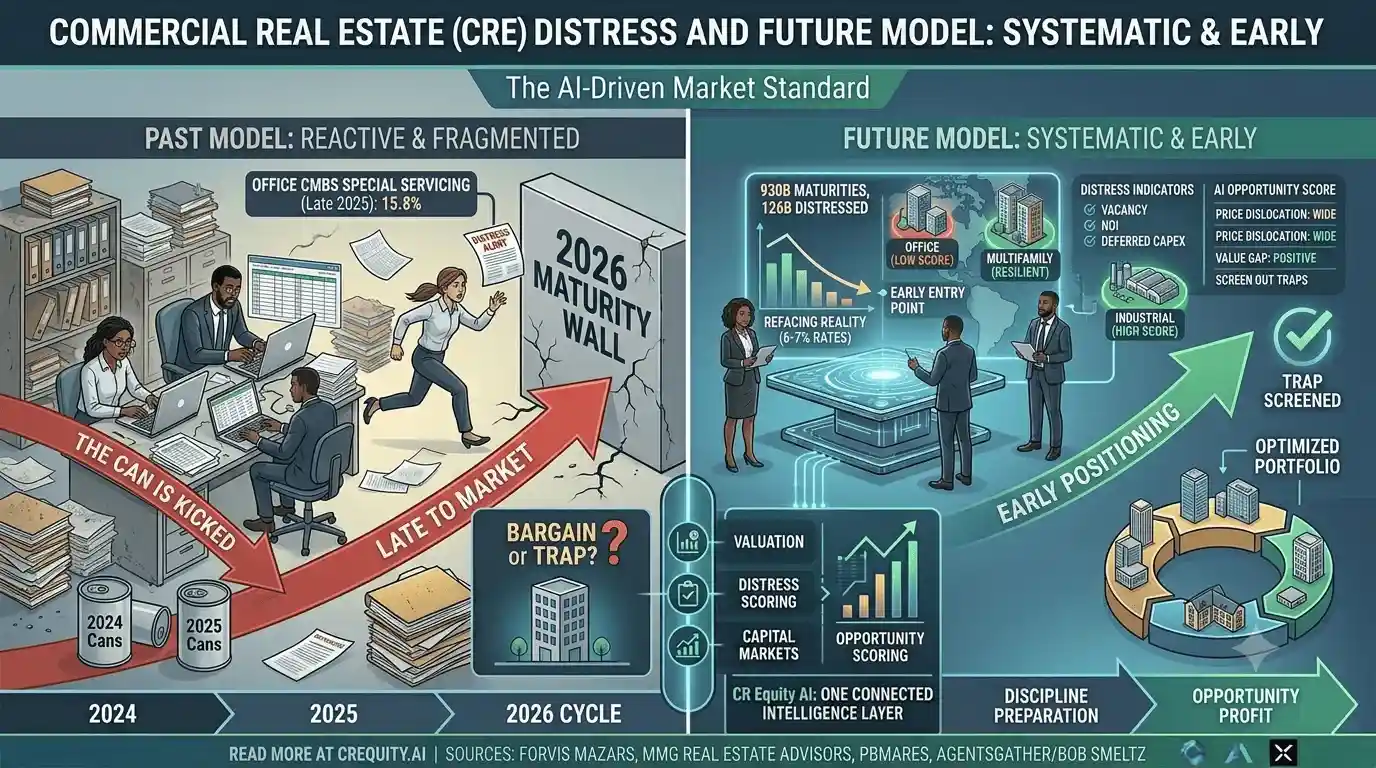
The 2026 cycle is no abstraction. Roughly $930 billion in CRE loans mature this year, with at least $126 billion already considered distressed as of late 2025 — and these loans are coming due in a 6–7% rate environment after being originated at 3–4%. That gap between old terms and new reality is what turns a maturity into a decision: refinance, restructure, sell, or default.
Distress rarely arrives without warning
The signals show up before the headlines do. Rising vacancy, declining net operating income, looming maturities against a tighter refinancing market, and deferred capital expenditure all flag an asset under pressure. The information exists — it is simply scattered across data sources that most buyers never assemble in time.
Consider how visible the office strain already is. The special servicing rate for office CMBS loans climbed to 15.8% in late 2025 — nearly one in six office loans handled by a special servicer rather than the primary one. Payoff rates at maturity, which topped 80% as recently as 2023, have fallen sharply, with analysts projecting more than half of 2026’s securitized office maturities unlikely to pay off on schedule. The investor who tracks these indicators systematically sees the wave forming while others are still reacting to the last one.
Why “extend and pretend” matters now
For two years, the market’s favorite move was to buy time. Through 2024 and 2025, lenders extended, modified, and restructured loans — the “extend and pretend” approach — to push out maturities and avoid forced sales. It worked, in the narrow sense that it delayed defaults.
But it did not erase the underlying problem. The debt and the higher rates remain, and many of those extended loans are now crowding into the 2026 window. Nearly $400 billion of loans originally set to mature in 2025 were pushed into 2026, thickening the wall. The cans that were kicked are landing, which is precisely why disciplined buyers are paying closer attention now than they were two years ago.
Timing the cycle without the guesswork
Timing a distress cycle perfectly is a fantasy. Positioning for one is a discipline. The goal is not to call the bottom but to identify assets where price has dislocated from underlying value — where distress is temporary and fixable rather than structural.
That distinction separates a bargain from a trap, and it is not evenly distributed. The 2026 stress is concentrated, not universal: office remains under the most pressure, while multifamily, industrial, and data-center assets show far more resilience. Analysts describe the distress as “uneven and concentrated in weaker assets.” Telling the difference requires rigorous, current valuation — not a gut feel about where the market is headed.
AI-driven opportunity scoring
AI changes distress investing from a reactive scramble into a systematic search. By continuously scoring assets against distress indicators and current valuations, a platform can surface the opportunities where the gap between price and value is widest — and, just as important, flag the apparent bargains that are actually impaired.
Instead of chasing deals after they hit the broker’s desk, an investor can be early, informed, and selective. The capital is certainly ready: private equity is sitting on significant dry powder explicitly poised to capitalize on this cycle. The edge does not go to whoever has the most capital. It goes to whoever can point that capital at the right assets first.
Key takeaways
- ~$930B in CRE loans mature in 2026, with $126B+ already distressed — loans struck at 3–4% now refinancing into 6–7%.
- Distress signals (vacancy, falling NOI, maturities, deferred capex) precede headlines; office CMBS special servicing hit 15.8% in late 2025.
- “Extend and pretend” delayed defaults but pushed ~$400B from 2025 into 2026 — the wall got thicker, not shorter.
- Distress is concentrated in weaker office assets; multifamily, industrial, and data centers are far more resilient — valuation tells bargains from traps.
- AI opportunity scoring finds the widest price-to-value gaps and screens out impaired “bargains,” letting prepared capital move first.
Distress cycles reward preparation, not panic. The investors who profit are the ones who built the data discipline before the cycle turned — so that when opportunity appears, they already know exactly what they are looking at. To see how CR Equity AI scores assets against live distress indicators and current valuations, request a walkthrough at crequity.ai or contact the team at support@crequity.ai.
Sources
- Forvis Mazars — Navigating Distressed Properties in Commercial Real Estate ($930B maturities, $126B distressed) — https://www.forvismazars.us/forsights/2026/03/navigating-distressed-properties-in-commercial-real-estate
- MMG Real Estate Advisors — The 2026 CRE Refinancing Wall (distress volume, extend-and-pretend) — https://mmgrea.com/2026-cre-refinancing-wall/
- AgentsGather / Bob Smeltz — Commercial Real Estate Debt Crisis 2026 (office special servicing, payoff rates) — https://agentsgather.com/commercial-real-estate-debt-crisis-2026/
- PBMares — Preparing for the CRE Maturity Wall (sector resilience, valuation trends) — https://www.pbmares.com/preparing-for-the-cre-maturity-wall/