

A credit score is the primary gateway lenders use to determine your eligibility and pricing for real estate loans. This real estate credit scoring guide covers the full picture: FICO and VantageScore 4.0 requirements, how credit fits alongside DSCR and LTV in underwriting, and the credit optimization moves that directly affect your rate. Whether you are buying your first rental property or scaling a commercial portfolio, understanding credit analysis for real estate is the difference between a closed deal and a declined application. CR Equity Ai Inc builds its underwriting platform on these same principles, giving investors a clear path from credit profile to funded loan.
What credit score ranges do lenders require for real estate loans?
DSCR loan minimums sit at 620–640 for purchase transactions and 660 or higher for cash-out refinancing as of mid-2026. These are hard floors. Falling below them does not produce a higher rate. It produces a declined application.
Score tiers determine far more than approval. They control your interest rate, your maximum loan-to-value ratio, and how much cash reserves a lender requires you to hold at closing. Investors who clear the 720 threshold unlock the best rate tiers, which translates to 0.50%–0.75% better rates and reduced reserve requirements. On a $1,000,000 loan, a 0.625% rate improvement saves roughly $6,250 annually in debt service.

Loan pricing matrices penalize scores below 680 severely, cutting maximum LTV and raising rates to the point where many deals become financially unworkable. This is not a minor inconvenience. A deal that pencils at 75% LTV may not pencil at 65% LTV, especially in markets with compressed cap rates.
Lenders pull a tri-merge credit report from all three bureaus and select the middle score for approval and pricing decisions. When two borrowers apply together, the lender uses the lower of the two middle scores. A co-borrower with a 640 score pulls a 740-score partner down to 640 for pricing purposes. Investors should audit every borrower’s credit before structuring a deal.
Pro Tip: If your co-borrower has a significantly lower score, run the loan solo if your income and assets qualify. Adding a weaker credit profile to the application can cost you more in rate than the co-borrower adds in qualifying strength.
| Score range | Typical impact |
|---|---|
| Below 620 | Ineligible for most DSCR and agency loans |
| 620–659 | Eligible for purchase; higher rates and lower LTV |
| 660–719 | Standard pricing; cash-out refinance eligible |
| 720 and above | Best rate tiers; reduced reserve requirements |
How is credit scoring integrated with core real estate underwriting metrics?
Real estate credit analysis does not evaluate credit in isolation. Lenders assess three pillars simultaneously before making any decision.
- Sponsor credit. Your FICO or VantageScore 4.0 result, your payment history, and any derogatory events on your full credit report. This is the gateway metric. Without a qualifying score, the other pillars are irrelevant.
- Property financials. Net Operating Income, Debt Yield, and the Debt Service Coverage Ratio. DSCR divides market rent by the fully amortized loan payment. A standard minimum is 1.00, with 1.25 required for higher-tier loan programs. Sub-1.00 transactions face rising requirements and tighter credit standards.
- Loan structure. LTV, loan term, amortization schedule, and prepayment structure. These interact directly with credit score to determine final pricing.
Private lenders weight asset metrics more heavily. A strong property with a 1.40 DSCR can sometimes compensate for a thinner credit profile with a private bridge lender. Institutional lenders, including those operating within Fannie Mae and Freddie Mac guidelines, treat credit score as a non-negotiable gateway. No amount of property cash flow overrides a score below their floor.
Lenders underwrite survival, not upside. They apply conservative Net Operating Income assumptions and Debt Yield floors to insulate the loan against market downturns. This conservative stance means your credit score must hold up under stress scenarios, not just current conditions. A score that qualifies today but carries recent derogatory events may still fail underwriting review.
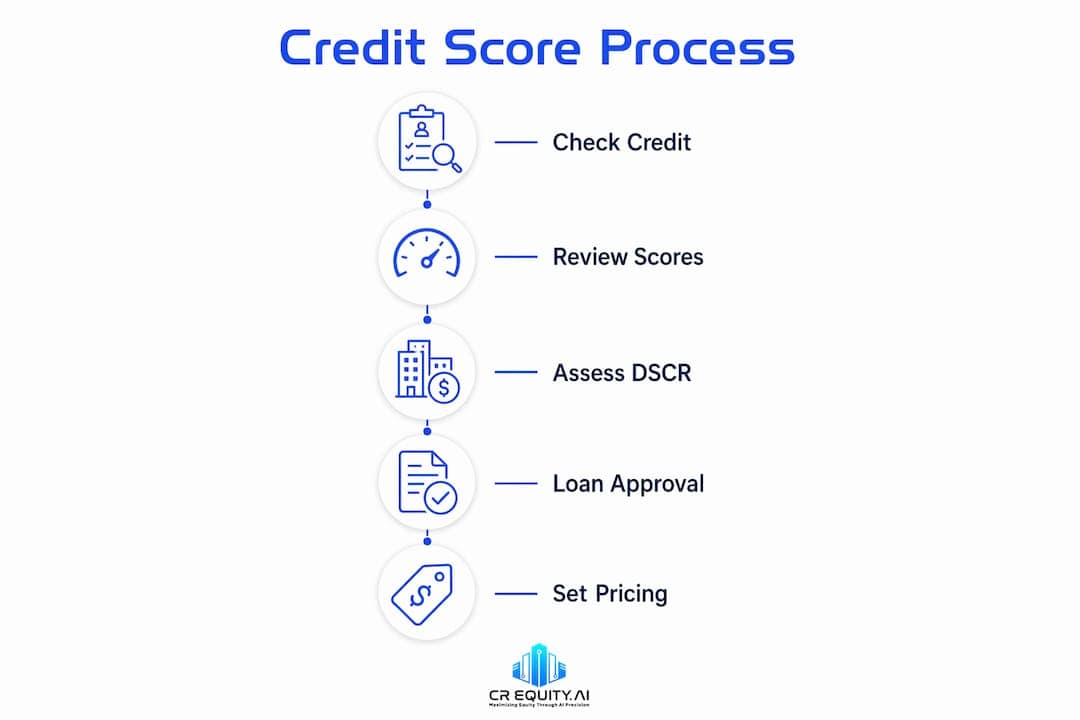
Understanding the credit lifecycle in real estate helps investors see why credit and property metrics must both be strong before approaching institutional capital.
What new credit scoring models influence real estate credit evaluation?
From april 2026, the FHFA permits mortgage lenders to use VantageScore 4.0 alongside classic FICO for Fannie Mae and Freddie Mac loans. This is a structural shift in how agency-backed real estate financing works.
Classic FICO models score borrowers primarily on payment history, utilization, credit age, account mix, and new inquiries. VantageScore 4.0 adds two significant data sources that classic FICO ignores.
- Rental and utility payment history. On-time rent payments now contribute to your score under VantageScore 4.0. Renters who have paid consistently for years but lack traditional credit references gain a meaningful scoring advantage.
- Trended credit data over 24 months. VantageScore 4.0 distinguishes between transactors (those who pay balances in full) and revolvers (those who carry balances). Transactors score higher. This rewards disciplined credit behavior, not just a low utilization snapshot.
VantageScore 4.0 benefits thin-file borrowers by considering alternative data, improving access for renters and self-employed investors who lack traditional credit references. For real estate investors who are self-employed or who hold most assets in property rather than liquid accounts, this model can produce a meaningfully higher score than classic FICO.
The practical implication is direct. An investor who rents their primary residence, pays utilities on time, and carries no revolving balance may now qualify for agency financing that was previously out of reach. Lenders using VantageScore 4.0 can access modern scoring models that capture a fuller picture of creditworthiness. Credit scores rank relative risk rather than predict absolute default, and the new model captures more of the data that reflects actual financial behavior.
How can investors optimize their credit to improve real estate financing outcomes?
Credit optimization for real estate financing requires a deliberate sequence of actions, not a single fix. The goal is to reach the highest score tier possible before submitting a loan application.
- Reduce credit card utilization first. Utilization is the fastest-moving variable in your score. Paying balances down below 10% of each card’s limit can produce significant score gains within one billing cycle.
- Use rapid rescoring. After reducing utilization or correcting errors, rapid rescoring through your lender can update your score within days rather than waiting for the next reporting cycle. This is especially useful when a deal has a tight timeline.
- Add authorized user accounts. Becoming an authorized user on a long-standing account with low utilization and perfect payment history adds that account’s positive history to your report. This strategy works best for investors with thin files or short credit histories.
- Dispute errors on all three bureaus. Credit report errors are more common than most investors expect. A single misreported late payment can suppress your score by 30–50 points. Pull your tri-merge report and dispute any inaccurate derogatory items before applying.
- Avoid new credit applications 60–90 days before applying. Hard inquiries from loan applications typically reduce a credit score by 5–10 points temporarily. Avoid opening new accounts or making large purchases in the months before your real estate loan application.
Pro Tip: Time your credit optimization work at least 90 days before your target application date. Score improvements from utilization reduction and dispute resolutions need time to cycle through bureau reporting before your lender pulls the tri-merge report.
Secondary market seasoning requirements add another layer of complexity. No 30-day mortgage late payment in the prior 12 months, no 60-day late in the prior 24 months, and multi-year waiting periods after bankruptcies or foreclosures. A good score with a recent derogatory event still fails these tests. Investors must review the full credit report story, not just the score number.
For practical guidance on applying these strategies to specific loan types, the DSCR lending guide from CR Equity Ai Inc covers how score tiers map to rate outcomes in 2026.
Key Takeaways
Real estate credit scoring determines loan eligibility, pricing, and LTV limits, making it the single most controllable variable in your financing outcome.
| Point | Details |
|---|---|
| Score floors are hard limits | Most DSCR lenders require a minimum 620–640 FICO; below that, no loan exists at any rate. |
| Score tiers drive rate savings | Scores above 720 unlock 0.50%–0.75% better rates and lower reserve requirements. |
| VantageScore 4.0 expands access | From april 2026, rental and utility history count toward agency loan scores, benefiting self-employed investors. |
| Credit and property metrics work together | Institutional lenders require both a qualifying credit score and a DSCR of 1.00 or higher to approve a loan. |
| Optimize before you apply | Reduce utilization, dispute errors, and avoid new inquiries at least 90 days before your application date. |
What I’ve learned about credit scores that most investors get wrong
Most investors treat their credit score as a static fact rather than a managed asset. That framing costs them money on every deal they close.
The score number matters, but the full credit report story matters just as much. I have seen borrowers with a 710 score get declined because of a 30-day mortgage late from 14 months prior. The score looked fine. The seasoning requirement did not. Underwriters read the narrative behind the number, and recent derogatory events carry disproportionate weight regardless of where the score lands.
The other mistake I see consistently is investors optimizing credit in isolation from property metrics. A 760 score on a deal with a 0.85 DSCR does not close at an institutional lender. The credit score gets you to the table. The property cash flow keeps you there. Both must be in order before you approach capital.
The emergence of VantageScore 4.0 is genuinely good news for self-employed investors and those who hold assets in property rather than traditional accounts. If your rental payment history is clean and your credit file is thin, you may qualify for agency financing in 2026 that was not available to you in 2025. That is a real change worth acting on.
Plan your credit moves the same way you plan a property acquisition. Set a target score tier, identify the gaps, and execute the fixes with enough lead time to let the bureaus catch up before your application date.
— Robert
CR Equity Ai Inc: AI-driven credit tools for real estate investors
CR Equity Ai Inc built its platform specifically for investors who need institutional-grade credit analysis without the friction of traditional underwriting timelines.

The platform’s AI credit infrastructure matches your credit profile and property metrics to lenders in real time, producing multiple loan offers in minutes. Investors can use the loan calculator to benchmark how their current credit score affects DSCR loan pricing before submitting a full application. For those ready to explore the full range of commercial real estate financing products, the CR Equity Ai Inc investor platform provides access to bridge loans, DSCR products, and construction financing, all underwritten with AI-enhanced credit models designed for speed and accuracy.
FAQ
What is the minimum credit score for a DSCR loan in 2026?
Most DSCR lenders require a minimum FICO score of 620–640 for purchase transactions and 660 or higher for cash-out refinancing. Scores above 720 qualify for the best rate tiers and lower reserve requirements.
What is real estate credit analysis?
Real estate credit analysis is the process lenders use to evaluate a borrower’s creditworthiness alongside property financial metrics like DSCR, LTV, and Net Operating Income. Both the borrower’s credit profile and the property’s cash flow must meet lender thresholds for a loan to close.
How does VantageScore 4.0 affect mortgage approvals?
From april 2026, the FHFA allows lenders to use VantageScore 4.0 for Fannie Mae and Freddie Mac loans. This model includes rental and utility payment history and trended data over 24 months, which can produce higher scores for thin-file and self-employed borrowers.
How can I improve my credit score before applying for a real estate loan?
Reduce credit card utilization below 10%, dispute any errors on your tri-merge credit report, avoid new credit applications for 60–90 days before applying, and ask your lender about rapid rescoring after making improvements.
Does a good credit score guarantee loan approval?
A qualifying credit score is necessary but not sufficient. Lenders also require the property to meet DSCR minimums, typically 1.00 or higher, and review the full credit report for recent derogatory events like late mortgage payments or open judgments that can disqualify a loan regardless of the score.