Your bank has had the file for six weeks. The property performs, the rent roll is clean, and the answer is still that it is with credit. Meanwhile the seller is getting restless and your rate lock is a memory.
CR Equity AI writes small balance commercial debt from $100,000 to $100,000,000 against multifamily, mixed-use, office, industrial, retail and hospitality. Rates from 11%. Decision in four hours. Our own capital, which is the reason the timeline is ours to promise.
And the advance rates are published — the same caps the underwriting engine uses to size your loan, on the page, before you apply. Here they are, and here is why they differ the way they do.
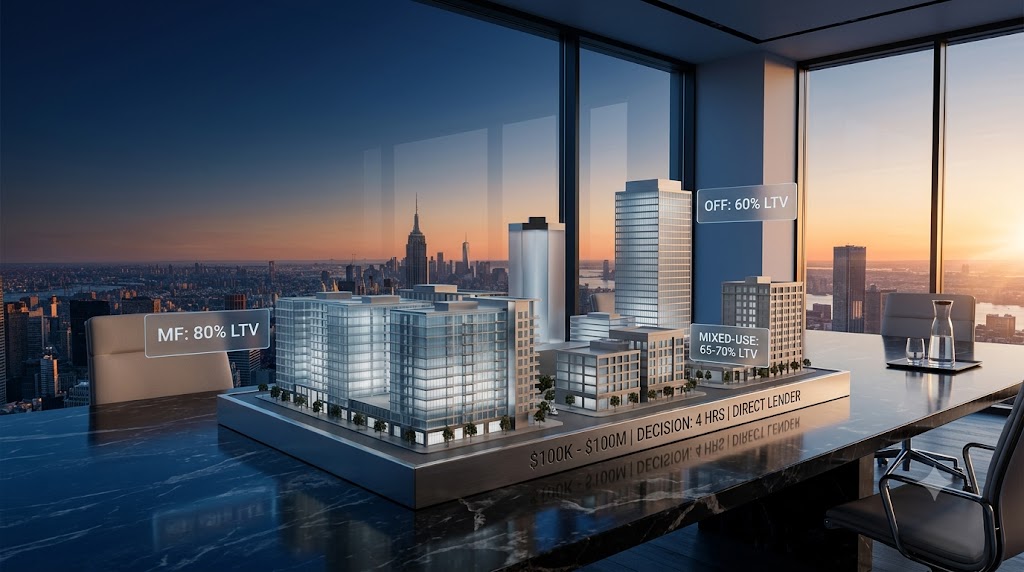
Maximum LTV by asset class
| Asset class | Max LTV | Asset class | Max LTV |
|---|---|---|---|
| Single-family residence | 90% | Storage | 65% |
| Multifamily | 80% | Mixed-use | 65% |
| Retail | 70% | Office | 60% |
| Industrial | 65% | Hospitality | 60% |
| Land | 55% |
Two things to note. Single-family non-owner-occupied reaches 90%, above the 80% headline figure, because a stabilized rental is the most liquid collateral on the list. And land sits at 55% because it is the least — no income, and a resale market that thins fast when conditions turn.
Why the caps differ
The spread from 90% down to 55% is not arbitrary, and understanding it tells you how any commercial lender will read your deal — ours included.
- Income durability. Multifamily at 80% reflects many small tenants on staggered leases. Losing one unit costs you a fraction of the rent roll. Office at 60% reflects the opposite — few tenants, long leases, and a vacancy that removes a large share of income at once.
- Re-tenanting cost and time. An apartment turns in weeks. An office or industrial suite can take quarters and significant tenant improvement dollars before it produces again.
- Operational intensity. Hospitality at 60% is really a business with real estate attached — daily pricing, staffing, and revenue that moves with the season rather than with a lease.
- Liquidity at exit. The advance rate is ultimately a statement about how quickly the asset converts back to cash if the plan does not work. That is why single-family sits highest and land sits lowest.
If your asset is at the lower end of the table, the practical move is not to argue the cap — it is to bring more equity or a stronger stabilization thesis, because both change what the deal looks like at the exit.
The program in one place
| Term | Small Balance Commercial |
|---|---|
| Loan range | $100,000 to $100,000,000 |
| Max LTV | Up to 80% commercial — see the asset-class table |
| Rates | From 11% |
| Decision | 4 hours |
| Collateral | Income-producing CRE except RV and trailer parks |
| Minimum loan | $100,000 |
| Purpose | Business-purpose only |
Where this fits
- Multifamily acquisition or refinance. Buy or recapitalize a cash-flowing asset on the property’s income rather than your W-2.
- Mixed-use and retail. Street-level retail, loft conversions, and neighborhood mixed-use — the deals where banks stall on complexity rather than on credit.
- Value-add commercial. Lease-up, repositioning, or light rehab on office, industrial or hospitality, sized to the asset.
- Cash-out against stabilized CRE. Pull equity from a performing property to fund the next acquisition without selling the one that works.
What being a direct lender actually changes
The phrase gets used loosely, so here is the concrete version.
- Our capital, our decision. No committee that meets on Thursdays, and no broker taking points out of the middle of your deal.
- Underwritten on the asset. We calculate NOI, DSCR and cap rate independently rather than accepting your pro forma at face value. That cuts both ways — an optimistic rent assumption will not survive, but the number in your quote is the number we lend on.
- Terms published. The asset-class table is on the program page before you apply. Most lenders in this range quote after they have your file and a read on your alternatives.
- A timeline we control. Decision in four hours. A bank cannot promise that because the bank does not own the calendar.
Does your deal qualify?
Eligible
- Sponsors financing income-producing commercial or investment property
- Entity and LLC borrowers on business-purpose transactions
- Multifamily, mixed-use, office, industrial, retail, hospitality, storage, and single-family residence
- Deals with defensible NOI, DSCR, or a stabilization thesis
- ITIN and foreign national investors — advance rate based on experience and subject to final underwriting
Not eligible
- RV parks and trailer parks
- Consumer-purpose or owner-occupied primary residence loans — business-purpose only
- Loans under $100,000
- Deals without credible income, a rent roll, or an exit thesis
Frequently asked questions
What is a small balance commercial loan?
Financing for income-producing commercial and investment property — typically multifamily, mixed-use, office, industrial, retail and hospitality — from $100,000 to $100,000,000. We underwrite what the property earns and lend our own capital.
What is the maximum LTV?
Up to 80% on commercial assets, set by asset class. Multifamily reaches 80%, retail 70%, industrial and storage and mixed-use 65%, office and hospitality 60%, and land 55%. Single-family residence reaches 90%.
What rates do you offer?
From 11%. Final pricing depends on the asset, the leverage, and the strength of the income or stabilization thesis.
Do you fund RV or trailer parks?
No. Those are excluded across all CR Equity AI real estate programs.
How fast is the decision?
Four hours. Terms in five minutes from a two-minute application on a soft credit pull.
Is there a minimum loan size?
$100,000. Below that we are not the right lender, and we would rather tell you now than after you have assembled a file.
Sources
- CR Equity AI — Small Balance Commercial Program Terms — https://crequity.ai/programs/small-balance-commercial
- CR Equity AI — Funding Options — https://crequity.ai/funding
Advance rates, pricing, and terms are subject to underwriting approval and executed loan documentation. Final LTV is determined at underwriting. This article is informational and is not a commitment to lend.