
Why CR Equity AI expects to close a senior credit facility before Q4 2026 and why our structure mirrors the deals clearing the market right now.
If you read the Secured Finance Network’s daily wire in July 2026, you saw the same headline written five different ways.
MarineMax refinanced $1.49 billion in senior secured facilities — lower cost, longer maturity, more revolver capacity. Superior Industries closed a senior financing facility with PNC. ADTRAN strengthened its capital structure with a new senior secured facility. Hillman closed a $735 million Term Loan B alongside a $375 million ABL revolver. Evolve Royalties entered a $50 million secured revolver with BMO — with an accordion to $75 million.
Five different industries. One thesis.
Capital in this market is not chasing stories. It is buying senior position, collateral discipline, and a documented path from committed dollars to earning assets. Everything else is priced as risk.
That is the market CR Equity AI is walking into. And it is the market we structured our raise for.
The parallel we are drawing on purpose
Look closely at the Evolve/BMO structure: a committed line, sized conservatively, with a contractual accordion to a larger number subject to conditions. That is not a compromise. That is the shape of how disciplined credit gets extended in 2026.
Our ask is built the same way.
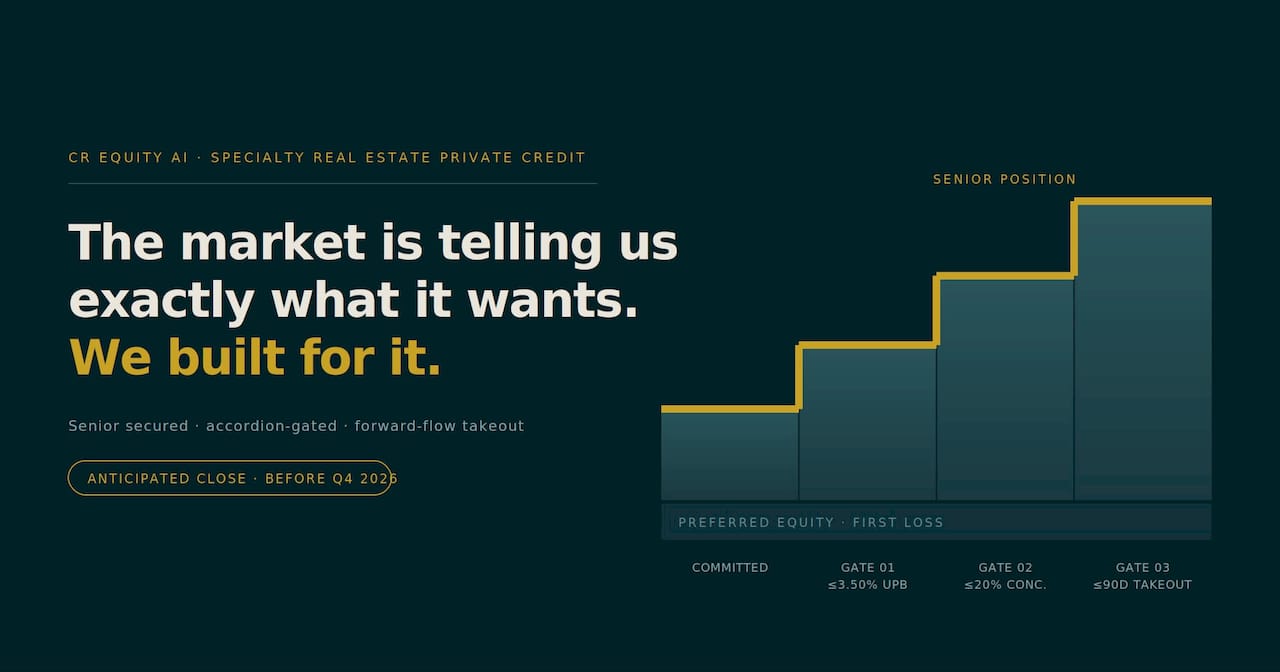
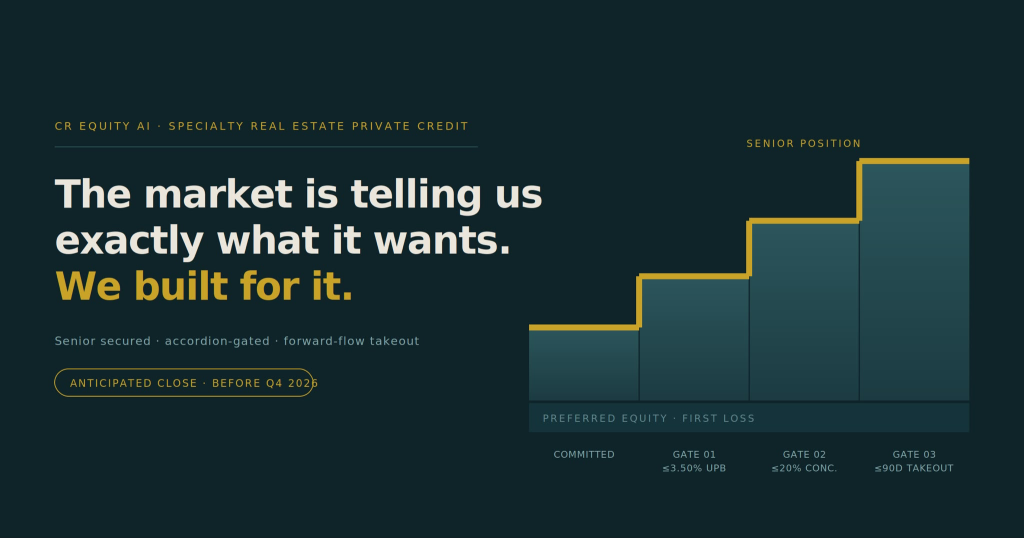
We are seeking a committed senior warehouse line with an accordion mechanism — not a blank check, but a facility that grows in defined increments as the portfolio proves itself. The step-ups are not discretionary. They are gated on performance covenants we proposed ourselves:
- Defaults capped at 3.5% of total unpaid principal balance
- No more than 20% concentration by loan type, asset class, or client
- Forward flow takeout purchasing seasoned notes within 90 days, so the facility turns rather than accumulates
We proposed those gates. A lender did not have to negotiate us into them. That distinction matters, and every credit committee we have sat in front of has noticed it.
Senior means senior
The second thing the July deal flow makes obvious: the senior tranche is where the market has clarity, and the market wants that tranche genuinely protected.
In our structure, the senior lender sits at the top of the stack, full stop. Preferred equity sits beneath it and absorbs first loss. The equity component of our raise exists specifically to fund the haircut between the warehouse advance rate and par — meaning the borrower base is over-collateralized by design, with sponsor capital, not lender capital, filling the gap.
We are not asking a senior lender to take equity risk at debt pricing. That is the single most common reason specialty finance platforms stall at the term sheet stage, and we removed it from the conversation before the conversation started.
Where the AI actually earns its keep
There is a lot of noise right now about AI in secured finance — SFNet is running an entire conference on it. Most of it is about origination speed.
Origination speed is not the point. Risk reduction is the point.
Our AIVAA underwriting and valuation engine exists to compress the variance in a credit decision: consistent valuation methodology, consistent document diligence, consistent exception flagging across every file, every time. A human underwriter has a good day and a bad day. A model does not. For a warehouse lender, that consistency shows up in exactly one place that matters — the tail of the loss distribution.
That is the case we make on the technology stack, and it is deliberately a credit case, not a growth case. A lender advancing against our collateral does not benefit from us originating faster. They benefit from us originating the same way every time, and from being able to prove it in the tape.
What closing before Q4 looks like
Our portfolio spreads across four sleeves — bridge, fix-and-flip, preferred equity, and long-term DSCR — with concentration limits enforced across all of them. Each sleeve has a distinct duration and turn profile, which is what allows a single senior facility to be worked efficiently rather than parked.
Day one, the facility is not funding a pipeline that has to be built. It is funding a pipeline that already exists, against warehouse-eligible loans we are servicing today.
That is the difference between a growth story and a deployment plan. We are bringing the second one.
The honest version
The private credit market spent 2025 and early 2026 getting a hard lesson in what happens when capital outruns underwriting. Redemption gates, Congressional letters, and a lot of very public repricing.
The lenders still writing checks in that environment are writing them into senior, secured, covenanted, collateral-backed structures with real reporting. We think that is the correct response to what happened. We would rather close a facility on those terms than a larger one on looser ones.
We anticipate closing a senior credit facility before Q4 2026.
If you are a warehouse lender, forward flow buyer, or credit fund evaluating specialty real estate private credit, our data room is open — audited financials, full loan tape, technology stack review, and the risk reduction map behind the scaling plan.
Rob Stewart Founder & CEO, CR Equity AI, Inc. Alexandria, VA | Tallahassee, FL
This article is for informational purposes and does not constitute an offer to sell or a solicitation of an offer to buy any security. Forward-looking statements reflect management’s current expectations and are subject to risks and uncertainties; actual results may differ materially.