

A UCC lien is a publicly filed financing statement, called a UCC‑1, that gives notice a creditor claims a security interest in specified business assets. The most important practical effect is priority: a properly perfected filing usually controls who gets paid first if the borrower defaults or sells the collateral. Everything else in Article 9 of the Uniform Commercial Code, filed with a state Secretary of State, exists to answer one question: whose claim wins?
TL;DR:
- Properly filing and maintaining a UCC‑1 is essential, with the five-year lapse rule and continuation filings being critical to preserving priority.
- Exact legal name matching on filings prevents perfection failures that could invalidate a creditor’s claim in bankruptcy or dispute.
- Blanket liens restrict future financing options, while specific collateral descriptions provide more flexibility for borrowers.
- UCC filings generally appear on business credit reports but do not affect personal credit unless the debt is personally guaranteed.
- Regular UCC search and timely termination of paid-off liens help prevent incidental obstacles in asset sales or new borrowing.
Table of Contents
- What Is a UCC Lien and a UCC-1 Financing Statement?
- How a UCC Lien Works: Attachment, Perfection, and Priority
- Specific vs. Blanket Liens: How Collateral Descriptions Shape Risk
- Where and How to File a UCC-1 (And Why Names Matter More Than You Think)
- How to Remove or Challenge a UCC Lien
- A Practical Checklist for Borrowers and Lenders
- Lender Best Practices for UCC Perfection at Speed
- Do UCC Liens Show Up on Credit Reports?
- UCC Liens vs. Mortgage Liens vs. Tax Liens
- How to Search for Existing UCC Liens on a Debtor
- How to Dispute or Challenge a UCC Lien
- What Happens to UCC Liens in Bankruptcy?
- An Editorial Take on UCC Liens and What Fast Lending Gets Wrong
- Sources
- FAQ
What Is a UCC Lien and a UCC-1 Financing Statement?
The Uniform Commercial Code, or UCC, is the body of state law governing secured transactions. Article 9 sets the rules for how a lender turns a promise to repay into a claim on specific property. A security interest is the legal right that lender holds in the borrower’s collateral once the deal is properly structured.
The document that makes this interest visible to the outside world is the UCC financing statement, or UCC‑1. Filing it works like recording a deed for personal property rather than real estate. It is critical to understand that the UCC‑1 is not the loan agreement. It is a notice document, filed publicly, that tells other creditors, buyers, and courts that someone else already has a claim on those assets.
Two parties appear on every filing:
- The secured party, the lender or creditor claiming the interest.
- The debtor, the business or individual whose assets back the loan.
A separate security agreement, signed privately between the two, spells out the actual terms. The UCC‑1 simply announces that agreement exists. Lenders use this structure constantly in equipment financing, inventory-backed lines of credit, accounts receivable factoring, and asset-based business loans where speed and certainty matter more than a traditional mortgage-style closing.
How a UCC Lien Works: Attachment, Perfection, and Priority
A security interest becomes enforceable in two distinct legal steps, and lenders who skip either one end up with a claim that looks solid on paper but collapses the moment another creditor challenges it.
- Attachment. The interest attaches when three conditions are met: the lender gives value (typically the loan itself), the debtor has rights in the collateral, and a security agreement authenticates the arrangement. According to LegalClarity’s breakdown of Article 9, all three must exist before the interest has any legal force at all.
- Perfection. Attachment makes the interest valid between lender and borrower. Perfection makes it valid against everyone else. Filing the UCC‑1 with the correct state office is the usual method, though possession (holding the collateral itself) and control (over deposit accounts or investment property) work for certain asset types. Filing generally goes to the state where the debtor is organized, not where the collateral physically sits.
- Priority. Once perfected, the general rule is first in time, first in right among competing perfected claims. A perfected interest always beats an unperfected one, regardless of which loan closed first.
One notable exception matters more than any other. A purchase-money security interest (PMSI) lets a lender who financed the specific purchase of an asset (say, equipment) jump ahead of an earlier blanket lienholder, provided that lender perfects within the statutory window after the debtor takes possession. Miss that window, and the earlier blanket filing wins outright.
Statutory Snapshot: Perfection is mechanical, not subjective. Courts don’t ask whether a competing creditor “should have known” about a claim, they ask whether the filing exists, in the right office, under the right legal name.
Specific vs. Blanket Liens: How Collateral Descriptions Shape Risk
Collateral description drives how much room a borrower has to grow. A specific lien names precise assets, one piece of equipment, a single vehicle, a defined receivables pool. A blanket lien claims everything: “all assets” or “all personal property, tangible and intangible, now owned or later acquired.”
Blanket liens are common on business term loans and asset-based credit lines, and Bench Accounting’s review of UCC‑1 filings notes they can meaningfully restrict a borrower’s ability to secure additional financing later, since almost nothing is left unencumbered for a second lender to claim.
Collateral generally falls into these categories:
- Inventory and raw materials
- Equipment and machinery
- Accounts receivable
- Intellectual property
- Deposit accounts and cash equivalents
A PMSI applies narrowly. It protects only the lender who financed the specific asset’s acquisition, and only if that lender perfects on time. It never overrides a blanket lien on unrelated collateral.
Pro Tip: Before signing any loan agreement, ask the lender for the exact collateral language that will appear on the UCC‑1. “All assets” and “specified equipment listed in Exhibit A” are two very different commitments, and the difference decides whether you can get a second loan next year.
Where and How to File a UCC-1 (And Why Names Matter More Than You Think)
Filing happens at the debtor’s state Secretary of State office, determined by where the business is legally organized (its state of incorporation or formation), not where its offices or collateral sit. For an individual debtor operating as a sole proprietor, the filing state is tied to their principal residence.
Name accuracy is the single most common failure point in UCC practice. A financing statement filed under “ABC Enterprises LLC” when the legal name is “ABC Enterprises, LLC” can be deemed seriously misleading and defeat perfection entirely, wiping out priority the lender believed it had. State Secretary of State UCC guidance exists precisely because filing rules and acceptable forms vary by state, and some states require variations from the national standard form.
Key filing mechanics to track:
- Verify the debtor’s exact legal name against formation documents, not a trade name or DBA.
- Confirm the correct filing office before submission; filing in the wrong state does not perfect the interest.
- A financing statement is effective for five years from filing and lapses automatically unless continued.
- Continuation statements must be filed in the six-month window immediately before the five-year lapse date, never earlier.
- Fees vary by state; check the relevant Secretary of State site directly rather than relying on secondhand estimates.
Set a calendar alert the day the filing goes in, not the week before it lapses. Lenders who treat continuation as a one-time legal event rather than an ongoing operational task are the ones who discover, too late, that their priority quietly evaporated.
How to Remove or Challenge a UCC Lien
Terminating a UCC filing is not automatic once a loan is paid off. The secured party is responsible for filing a UCC‑3 termination statement, and the timing obligation differs by collateral type.
- For consumer goods, the secured party generally must file the termination within a set period after the debt is satisfied, without the debtor needing to ask.
- For commercial collateral, the debtor typically must send an authenticated demand for termination. Once that demand arrives, the secured party has 20 days to file the UCC‑3 or send the termination statement to the debtor.
- If the creditor ignores that deadline, the debtor can pursue statutory damages. LegalClarity notes that failure to file a required termination exposes the creditor to liability under Article 9, including recoverable losses the borrower suffered as a result.
- Once filed, confirm the termination actually appears in the state’s UCC database. A filed UCC‑3 that never gets indexed correctly leaves the public record looking encumbered.
Borrowers who paid off a loan months ago and are now getting rejected for new financing should check the state UCC database first. It’s often not a new lien, it’s an old one nobody terminated.
A Practical Checklist for Borrowers and Lenders
An active UCC filing sitting on a business’s record does more than sit quietly in a database. It can slow down or outright block additional borrowing, complicate an asset sale, and surface as a red flag the moment a new lender runs a search.
Watch for these warning signs during any UCC search:
- Multiple blanket filings from different creditors on the same debtor.
- Filings under slightly different name spellings, a sign of sloppy prior filings or an attempt to obscure the record.
- Old filings past their five-year lapse date that were never formally terminated, sometimes still listed as active due to a clerical lag.
- Collateral descriptions vague enough to cover assets far beyond what the current loan actually involves.
Pro Tip: Run a UCC search on your own business before a lender does. If you find a lapsed or unterminated filing from a paid-off loan, clear it now. Discovering it mid-underwriting on a time-sensitive deal can cost you the financing window entirely.
Before signing anything, borrowers should verify collateral language matches what was negotiated, confirm no surprise blanket clause crept in, and request written confirmation of the lender’s termination timeline. Lenders, in turn, should verify the debtor’s exact legal name against state formation records, define collateral as specifically as the deal allows, and build continuation dates into a centralized tracking system rather than an individual loan officer’s memory.
Lender Best Practices for UCC Perfection at Speed
Fast underwriting only works if perfection keeps pace with it. A lender who can approve a deal in hours but takes weeks to file correctly has built a process with a serious gap in the middle.
- Verify the debtor’s exact legal name against formation documents before the filing goes out, every time, no exceptions.
- Build collateral descriptions specific enough to survive a challenge, not boilerplate language copied from the last deal.
- Centralize UCC tracking so continuation dates, not individual memory, drive renewal filings.
- Loop in counsel or a professional filing service for multi-state debtors or unusual entity structures.
| Governance Element | Why It Matters |
|---|---|
| Name verification against formation docs | Prevents perfection failure from a single misspelled entity name |
| Centralized continuation calendar | Avoids losing priority through an accidental five-year lapse |
| Collateral specificity review | Keeps blanket liens from becoming a liability in later diligence |
| Multi-state filing protocol | Catches jurisdiction errors before they reach the public record |
CR Equity Ai Inc underwrites the asset and the deal itself, not just paperwork, which means decisions can move quickly without skipping the filing discipline that actually protects a lender’s position later.
Do UCC Liens Show Up on Credit Reports?
UCC filings appear differently across business and personal credit systems, and the confusion here trips up a lot of business owners. A UCC‑1 is a public record filed with a state Secretary of State, and commercial credit bureaus that compile business credit files, the kind lenders pull for commercial underwriting, routinely pick up active UCC filings as part of that report.
An active blanket lien on a business credit file signals to any new lender that assets are already claimed, which can lower the amount a second lender is willing to extend or push them to require a subordination agreement before proceeding. Multiple UCC filings from different creditors, especially several blanket claims stacked on top of each other, tend to read as a business that has leaned heavily on secured borrowing already.
UCC filings generally do not appear on a personal consumer credit report the way a mortgage or an auto loan does, since the UCC framework governs commercial collateral, not individual consumer credit scoring models like FICO. The exception is when a business owner personally guaranteed the loan and the underlying debt itself goes delinquent, at which point the missed payments (not the UCC filing itself) can surface on that owner’s personal file.
For business owners planning to seek additional financing, the practical lesson is simple: a clean UCC record, with no lingering blanket filings from paid-off debt, keeps the business credit profile easier for the next lender to read.
UCC Liens vs. Mortgage Liens vs. Tax Liens
All three are liens in the broad sense, a legal claim against property to secure a debt, but they operate under entirely different bodies of law, and mixing them up leads to real underwriting mistakes.
A mortgage lien attaches to real property, land and buildings, and is recorded at the county level, not with the state Secretary of State. It is governed by state real property law rather than Article 9 of the UCC. A UCC lien attaches to personal property, equipment, inventory, receivables, and intangibles, and follows the perfection and priority rules described earlier in this article.
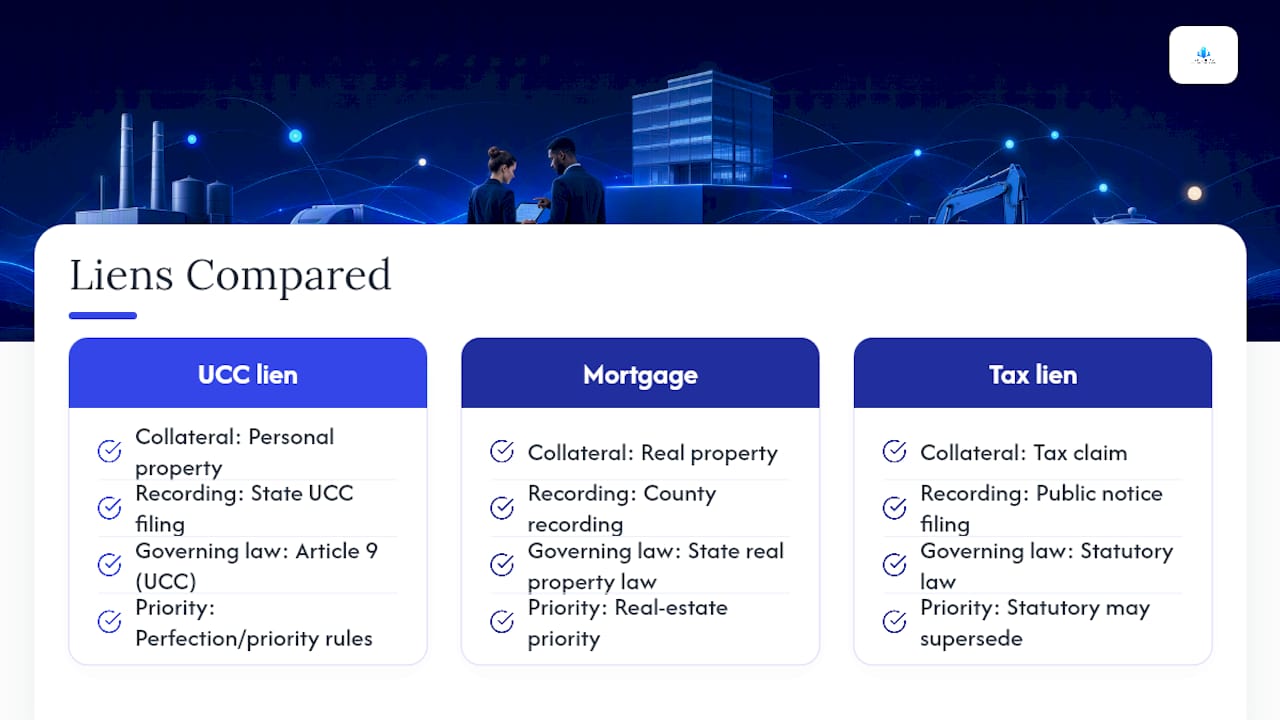
A tax lien, whether filed by the IRS or a state taxing authority, arises automatically by statute the moment a tax debt goes unpaid and gets formalized through a public notice filing. Tax liens often carry statutory priority that can leapfrog even a properly perfected UCC filing, depending on timing and the specific tax rules involved, which makes a tax lien search a standard part of due diligence alongside a UCC search.
The practical distinction that matters most to a lender or business owner: a mortgage lien tells you the real estate is encumbered, a UCC lien tells you the business’s personal property and operating assets are encumbered, and a tax lien tells you the government has a claim that can complicate everything else. Checking only one of the three when evaluating a borrower’s true asset exposure is a common and costly oversight.
How to Search for Existing UCC Liens on a Debtor
Running a UCC lien search is straightforward but easy to do incorrectly. Every state Secretary of State maintains a searchable UCC database, and most offer free online lookup by debtor name directly through the state’s official site.
Search by the debtor’s exact legal name, not a trade name, abbreviation, or DBA. Because perfection depends on precise name matching, a search run under the wrong version of the name can miss filings that are very much still active. Business owners should search under both the current legal entity name and any prior legal names if the entity changed structure or was renamed.
A thorough search should also check the state where the business is currently organized and, when relevant, the state where it was previously organized if it recently reincorporated or relocated. Filings don’t automatically transfer or disappear when a business changes its state of formation, so an incomplete search can miss an old, still-active blanket lien.
For lenders conducting due diligence before extending new credit, a UCC search is a standard, non-negotiable step, not an optional check. Results typically show the filing date, the secured party’s name, the collateral description, and whether the filing has lapsed or been amended or terminated. A search turning up a five-year-old filing with no continuation on record generally means that lien has lapsed automatically, but confirming the lapse date against the original filing date is worth the extra few minutes before assuming the coast is clear.
How to Dispute or Challenge a UCC Lien
A borrower who believes a UCC filing is inaccurate, unauthorized, or filed against the wrong entity has a defined path to challenge it, though the process depends heavily on why the filing is wrong.
If the filing was authorized under a valid security agreement but the debt has since been paid, the correct move is the termination process covered earlier: an authenticated demand followed by the secured party’s 20-day window to file a UCC‑3. That is a payoff dispute, not a fraud dispute, and it resolves through routine Article 9 mechanics.
A genuinely unauthorized filing, one where no security agreement exists, or where a filer claimed a security interest the debtor never granted, is a more serious matter. Because the UCC filing system is largely a notice system that does not verify claims before accepting a filing, fraudulent filings do occasionally slip through. A debtor facing this situation typically needs to file a formal correction statement with the Secretary of State’s office, which becomes part of the public record and flags the disputed claim, and in more serious cases pursue the matter through state court to have the filing declared invalid and removed.
Disputing a filing’s collateral description, when a lender’s filing describes assets well beyond what the security agreement actually covers, generally starts with a direct written demand to the secured party to amend the UCC‑3 to correct the scope. If the creditor refuses without justification, that refusal itself can support a legal claim, since Article 9 imposes real obligations around accurate and timely filings.
What Happens to UCC Liens in Bankruptcy?
A properly perfected UCC lien generally survives a bankruptcy filing largely intact, and that survival is exactly why perfection matters so much before a borrower ever gets into financial trouble.
In a Chapter 7 liquidation, a secured creditor with a perfected UCC lien has a claim against the specific collateral described in the filing that ranks ahead of unsecured creditors, meaning that creditor gets paid from the proceeds of that collateral before general unsecured claims are considered at all. An unperfected security interest, by contrast, can be treated as an unsecured claim in bankruptcy, which is often the single most expensive mistake a lender makes: skipping or delaying the UCC‑1 filing and discovering years later, in a bankruptcy proceeding, that the “secured” loan was never actually secured against other creditors.
In a Chapter 11 reorganization, secured creditors with perfected UCC liens typically retain their collateral position throughout the case, though the reorganization plan may modify payment terms, and the creditor generally has the right to object if the plan doesn’t adequately protect the value of that collateral.
The trustee or debtor in possession can, in some circumstances, challenge a UCC lien’s validity if it was filed defectively, filed too close to the bankruptcy filing date in a way that resembles a preferential transfer, or filed under a name that doesn’t match the actual legal debtor closely enough to survive scrutiny. This is another reason exact-name accuracy, covered earlier, matters well beyond ordinary priority disputes. It can be the difference between a secured claim and an unsecured one when a borrower’s business ultimately fails.
An Editorial Take on UCC Liens and What Fast Lending Gets Wrong
Most explainers on UCC liens treat filing as paperwork, a box to check after the real decision, funding the loan, is already made. That framing gets the priority backward. The filing is the decision. Everything else, the underwriting, the rate, the term sheet, is contingent on whether that UCC‑1 actually perfects correctly.
The conventional advice tends to focus on speed of approval as the differentiator between lenders. It should focus on speed of correct perfection instead. A lender who approves a deal in four hours but files under a slightly wrong legal entity name has built nothing durable. The borrower feels served. The lender is exposed the moment a second creditor shows up with a cleaner filing.
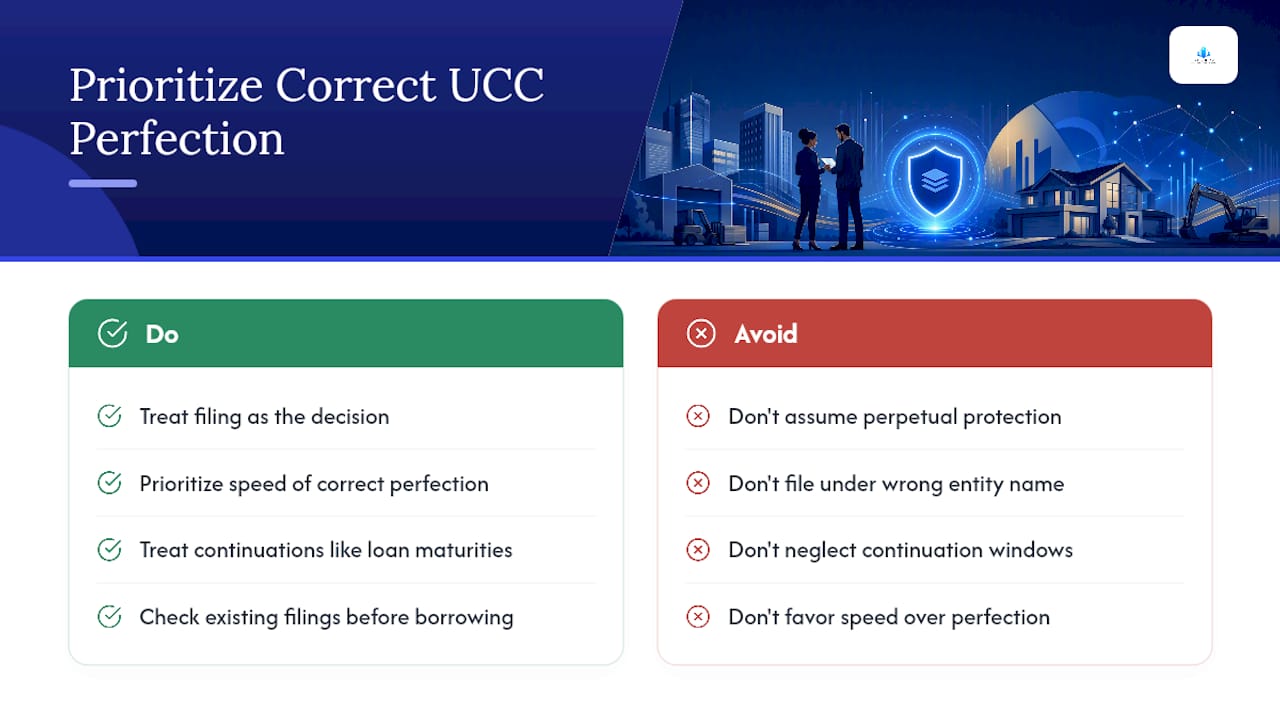
What gets underrated in almost every guide is the five-year lapse rule. Lenders assume a filed UCC‑1 stays protective indefinitely. It doesn’t. A missed continuation window silently converts a secured position into an unsecured one, and nobody notices until a bankruptcy or a competing claim forces the question. If there’s one operational habit that separates disciplined lenders from exposed ones, it’s treating continuation dates as seriously as loan maturity dates, not as an afterthought buried in a file cabinet.
For borrowers, the practical takeaway is just as direct: know what’s already filed against your business before you go looking for new capital. Discovering an old blanket lien mid-negotiation costs deals that a five-minute search would have caught months earlier.
— Robert
This article is general information, not a substitute for advice from a qualified financial advisor. Consult a qualified financial professional about your own circumstances before acting on anything here.
Sources
- UCC Financing Statement | Wex | US Law | LII
- What Is a UCC Lien: How It Works, Priority, and Removal – LegalClarity
- What Is a UCC Filing? Learn the basics | Wolters Kluwer
- UCC Frequently Asked Questions | Department of State
FAQ
How Serious Is a UCC Lien?
A UCC lien on a business’s record is a serious, legally binding claim, not a minor formality. An active blanket UCC filing can block a business from securing additional financing, since most lenders won’t extend new secured credit against assets someone else already claims.
What Is a UCC Lien and How Does It Work?
A UCC lien is a public financing statement, a UCC‑1, that a creditor files with a state Secretary of State to give notice of a security interest in specified business assets. It works through two legal steps, attachment and perfection, and a properly perfected filing generally determines who gets paid first if the borrower defaults.
What Happens if a UCC Lien Is Not Paid?
If the underlying debt goes unpaid, the secured creditor can enforce its rights against the specific collateral named in the filing, which can include repossessing equipment or inventory or collecting outstanding receivables, subject to the remedies laid out in the security agreement and Article 9. The UCC lien itself doesn’t disappear until the debt is resolved and a UCC‑3 termination is filed.
Can a UCC Lien Take Your Bank Account?
A UCC lien can reach a deposit account only if that account was specifically named as collateral in the security agreement and the lender perfected its interest through control, typically a control agreement with the bank, not through a UCC‑1 filing alone. A general business UCC filing on equipment or inventory does not, by itself, give a creditor the right to seize a separate bank account.
Business owners weighing new financing against an existing UCC filing, or lenders looking to move quickly without cutting corners on perfection, can submit a deal directly to see how CR Equity Ai Inc structures asset-based financing around exactly these mechanics.