

What is pre-underwriting and why does it matter for loan approval?
Pre-underwriting is the full financial vetting of a mortgage applicant completed before any home offer is made. Unlike pre-qualification, which relies on self-reported figures, or pre-approval, which involves a surface-level credit and income check, pre-underwriting puts your entire financial profile through the same rigorous review that normally happens after a purchase contract is signed. The result is a near-guarantee of loan approval, contingent only on property-specific steps like appraisal and title.
Why pre-underwriting is important comes down to one core reality: most mortgage deals fall apart during final underwriting, not because buyers are unqualified, but because problems surface too late to fix. Pre-underwriting moves that discovery to the beginning of the process, where there is still time to act.
Key advantages buyers gain from pre-underwriting:
- Loan commitment strength: A pre-underwriting approval functions as a firm loan commitment, effectively removing financing contingencies from your offer.
- Seller confidence: Sellers view pre-underwritten buyers as near-equivalent to cash purchasers, reducing their perceived deal-failure risk.
- Early issue detection: Credit anomalies, debt-to-income (DTI) concerns, and documentation gaps are caught before they can derail a closing.
- Faster closing timelines: Most financial verifications are already complete, leaving only property-specific steps after contract signing.
- Clearer purchasing power: You know exactly how much you qualify to borrow before you begin your home search.
How does the pre-underwriting process work, step by step?
The pre-underwriting process follows a structured sequence that front-loads the work traditional underwriting defers until after an offer is accepted. Understanding each stage helps you prepare the right documents and avoid delays.
- Initial document submission. You submit a complete mortgage application along with tax returns, W-2s, bank statements, pay stubs, and asset documentation. The lender collects everything upfront rather than requesting items piecemeal later.
- Junior underwriter quality check. A junior underwriter conducts a preliminary review of your documents, flagging incomplete files, inconsistencies, or items that will require explanation. This internal quality gate filters out problematic applications before they reach the senior underwriter.
- Comprehensive credit report analysis. The lender pulls a full tri-merge credit report and evaluates your credit history against loan program guidelines. Any accounts in dispute, recent derogatory marks, or thin credit profiles are identified at this stage.
- Income and asset verification. Underwriters verify employment history, calculate qualifying income, and confirm that assets meet reserve requirements. Self-employed borrowers and those with variable income receive particular scrutiny here, since DTI calculations can shift significantly based on how income is documented.
- Red flag identification and resolution. Large unexplained deposits, recent job changes, or gaps in employment history are flagged and addressed before the process moves forward. Resolving these issues now prevents them from surfacing as last-minute closing conditions.
- Conditional approval letter issuance. Once the financial review is complete, the lender issues a pre-underwriting conditional approval letter. This document confirms that your loan is approved subject only to property-related conditions, giving sellers and agents a high degree of confidence in your offer.
What are the key benefits of pre-underwriting for buyers and lenders?
Pre-underwriting speeds final loan approval by completing most financial verifications before the purchase contract is signed. Once a property is selected, only the appraisal, title search, and property insurance remain, which compresses closing timelines considerably.

For buyers, the competitive advantage is direct. Pre-underwriting positions homebuyers nearly equal to cash purchasers in the eyes of sellers, particularly in markets where multiple offers are common. A seller comparing a standard pre-approval letter against a fully underwritten commitment will almost always favor the latter.
Lenders benefit equally. Pre-underwriting helps lenders filter out faulty applications early, improving underwriter productivity, reducing per-loan costs, and increasing closing ratios. When underwriters work only on clean, complete files, turnaround time drops and profitability rises.
Industry insight: Mortgage professionals consistently identify pre-underwriting as a proactive risk management tool that shifts borrower financial verification to the start of the process, enabling more confident home searches and sharply improving lenders’ closing efficiency.
Additional benefits worth noting:
- Reduced surprises at closing: Upfront underwriting minimizes late-stage issues like missing documents, unverifiable income, or DTI concerns that typically surface after an offer is accepted.
- Shopping confidence: Buyers who complete pre-underwriting understand their exact borrowing capacity, allowing them to focus their search on properties they can comfortably afford.
- Stronger negotiating position: A pre-underwriting letter gives buyers more flexibility to offer competitively without draining cash reserves, an advantage even over all-cash buyers in some scenarios.
How does pre-underwriting differ from pre-approval?
Pre-approval and pre-underwriting are related but operate at very different levels of rigor. Confusing the two leads buyers to overestimate the strength of their offer.
- Depth of review: Pre-approval involves a lender reviewing self-reported income, a credit pull, and basic asset information. Pre-underwriting requires full documentation, including tax returns, bank statements, and employment verification, reviewed by an actual underwriter.
- Commitment level: A pre-approval is an indicator you will likely receive a mortgage up to a certain amount. A pre-underwriting approval is a guarantee, subject only to property conditions.
- Timing in the process: Pre-approval typically happens before home shopping begins. Pre-underwriting can delay the start of your home search because it requires a complete file, but the tradeoff is a far stronger offer when you are ready.
- Seller perception: Sellers and listing agents recognize the difference. A pre-underwriting letter signals that financing is effectively secured, while a pre-approval letter leaves meaningful uncertainty.
- When to pursue it: Pre-underwriting is most valuable in competitive markets where bidding wars are common, such as major metro areas where inventory is tight. In slower markets, standard pre-approval may be sufficient to get offers accepted.
Pro Tip: Ask your lender directly whether they offer “upfront underwriting” or a “fully underwritten pre-approval.” Not all lenders provide this service, as it requires dedicated internal resources and early underwriting labor.
How AI platforms are changing the pre-underwriting process
Artificial intelligence is reshaping pre-underwriting by automating the document intelligence and risk scoring that once required days of manual review. Machine-learning models can now analyze tax returns, bank statements, and credit reports in minutes, flagging anomalies and calculating DTI ratios with a consistency that manual review cannot match at scale.
CR Equity Ai Inc operates at this intersection of technology and credit. The platform combines AI-driven underwriting with automated document verification and real-time lender matching, compressing the credit lifecycle from application intake through offer optimization. Borrowers receive multiple lender offers rapidly, while lenders access pre-underwritten opportunities backed by AI-enhanced credit models. For real estate investors and business owners navigating complex income structures, that speed and accuracy changes the calculus of what is possible before a contract is signed.
“You’re becoming a professional, world-class underwriter — someone who is not just interested in doing the right thing but making sure it’s good for everyone. If it’s good for the client and it’s good for the carriers because you’ve done the right job, that’s going to equal profitability later.” — Julian H. Good Jr., CLU, ChFC, 40-year MDRT member and Past President, MDRT Blog
The transparency AI brings to pre-underwriting also benefits buyers. When risk scoring is algorithmic and document review is automated, the criteria for approval become clearer and more consistent. Buyers with non-traditional income, such as self-employment or commission-based earnings, gain from a system that evaluates their full financial picture rather than applying a rigid template.
Pro Tip: If your income is complex or variable, prioritize lenders and platforms that use automated document intelligence. Early AI-driven review of your tax returns and bank statements can surface qualification issues weeks before a traditional underwriter would catch them.
Common issues pre-underwriting identifies before they derail your loan
Pre-underwriting catches problems that would otherwise surface at the worst possible moment: after you are under contract and the clock is running.

Unexplained large deposits are among the most common triggers for underwriting delays. Lenders must source all funds used for a down payment and closing costs. A large deposit without a paper trail raises compliance concerns under FDIC and HUD guidelines, and resolving it mid-closing can push back your settlement date or kill the deal entirely.
Debt-to-income ratio violations often go undetected until full underwriting. Buyers who carry student loans, car payments, or credit card balances may find their qualifying income falls short of program requirements once all obligations are calculated. For applicants with complex income or assets, pre-underwriting identifies DTI issues early, preventing closing derailments common in late-stage reviews.
Employment gaps or recent job changes create documentation challenges. Underwriters typically require two years of stable employment history. A borrower who changed industries or moved from W-2 to self-employment within the past 24 months may face additional scrutiny or require alternative documentation.
Credit report discrepancies are another frequent issue. Accounts in dispute, duplicate tradelines, or errors in reported balances can affect credit scores and loan eligibility. Pre-underwriting provides a preliminary check on credit reports and financial documents, preventing costly discrepancies and delays during final underwriting.
Catching any of these issues before an offer is made gives buyers time to correct records, source documentation, or adjust their loan structure without the pressure of a pending contract deadline.
How to prepare for pre-underwriting to maximize your approval chances
Preparation is the single factor most within a buyer’s control. Gathering the right documents before your lender requests them accelerates the process and reduces back-and-forth. For a deeper look at how underwriting evaluates your full financial profile, the real estate underwriting guide from CR Equity Ai Inc covers each evaluation stage in detail.
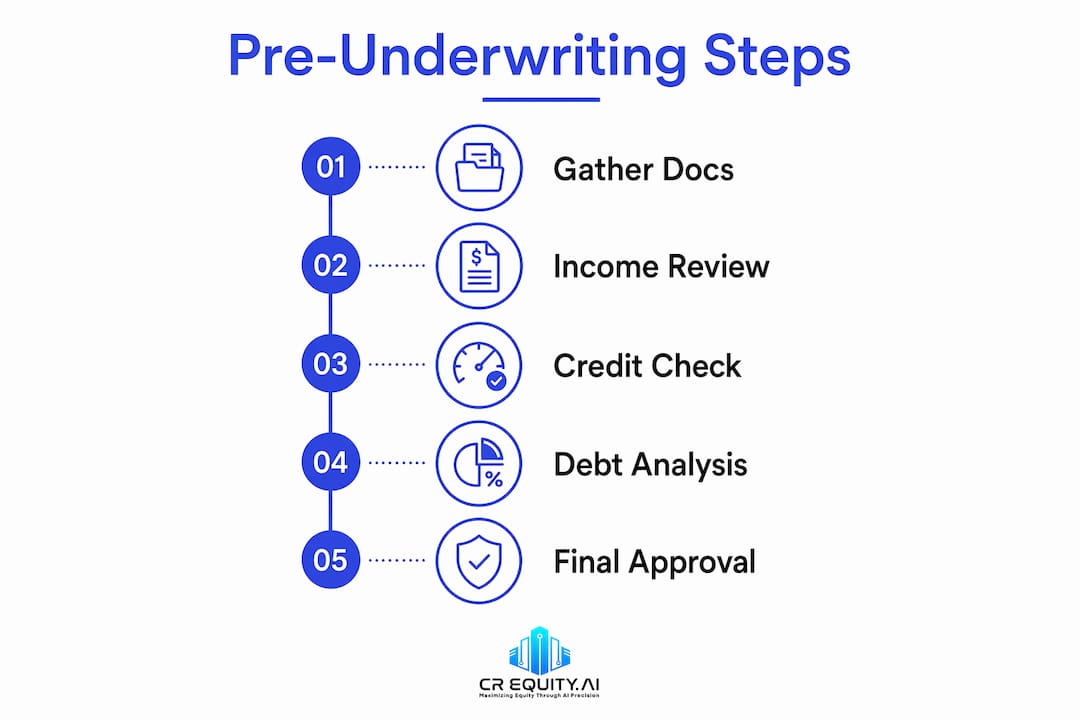
Start by assembling two years of federal tax returns, including all schedules. Add your two most recent pay stubs, two months of bank statements for every account you plan to use, and documentation for any other income sources such as rental income or investment distributions. If you are self-employed, prepare a year-to-date profit and loss statement prepared by a CPA.
Address credit issues before you apply. Pull your credit reports from all three bureaus and dispute any errors in writing. Pay down revolving balances to reduce your credit utilization ratio, and avoid opening new credit accounts in the 90 days before you begin the pre-underwriting process. For buyers who want to understand how credit factors into the broader underwriting decision, credit underwriting fundamentals provide useful context on how lenders weigh each variable.
Finally, document the source of your down payment thoroughly. If any portion comes from a gift, obtain a signed gift letter from the donor. If funds are being transferred between accounts, keep records of every transaction. Lenders operating under real estate SEO and compliance standards increasingly expect digital documentation trails, and having yours organized from the start removes one of the most common pre-underwriting friction points.
Key Takeaways
Pre-underwriting gives buyers a near-guarantee of loan approval by completing full financial vetting before any offer is made, removing financing contingencies and positioning buyers nearly equal to cash purchasers in competitive markets.
| Point | Details |
|---|---|
| Loan commitment strength | Pre-underwriting produces a firm approval, not just an indicator, leaving only property conditions unresolved. |
| Competitive advantage | Sellers view pre-underwritten buyers as near-equivalent to cash purchasers, strengthening offers in bidding wars. |
| Early issue detection | DTI violations, credit discrepancies, and documentation gaps are caught before contract signing, not after. |
| Lender efficiency | Pre-underwriting filters faulty applications early, improving underwriter productivity and closing ratios. |
| AI acceleration | Platforms like CR Equity Ai Inc use automated document intelligence to compress pre-underwriting timelines significantly. |
Ready to move forward with confidence?
CR Equity Ai Inc combines AI-driven underwriting with real-time lender matching to give buyers and investors a decisive edge before they make an offer. Whether you are pursuing a residential purchase, a commercial acquisition, or a bridge financing solution, the platform’s automated credit models deliver faster decisions and greater transparency at every stage of the credit lifecycle. Explore your financing options or use the loan calculator to get a quote and see exactly where you stand before your next offer.