
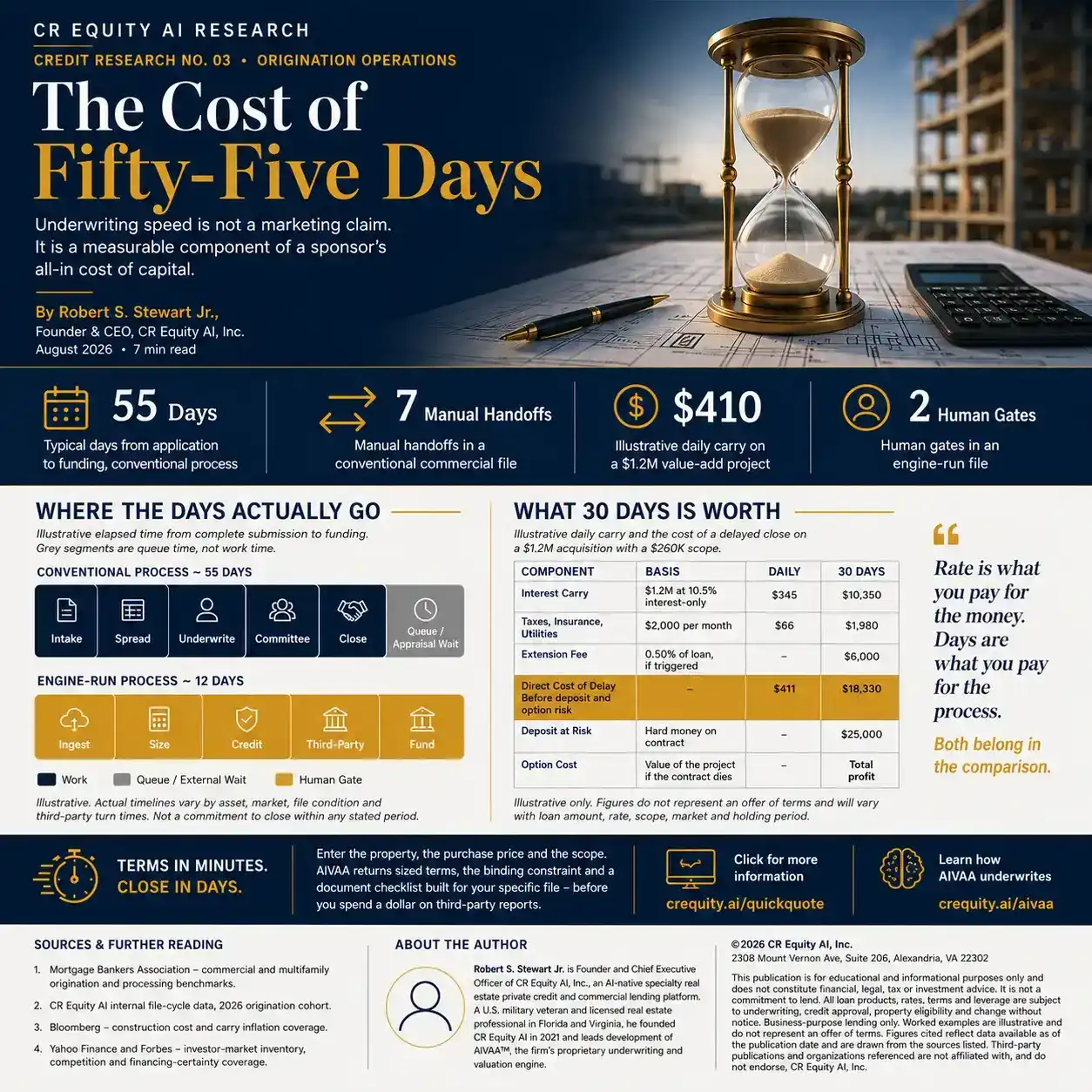
Days are a line item. Every one between application and funding carries extension fees, carry cost, deposit risk and the option cost of a contract that dies. Speed belongs in the underwriting, not the brochure.
| 55 Days | 7 Manual Handoffs | $410 | 2 Human Gates |
|---|---|---|---|
| Typical days from application to funding, conventional process | Manual handoffs in a conventional commercial file | Illustrative daily carry on a $1.2M value-add project | Human gates in an engine-run file |
The deal died on day forty-one. A twelve-unit value-add in a secondary Midwest market, purchase contract at $1.24 million, a sponsor with three completed projects and real equity in the transaction. The credit was never the problem. The lender took thirty-one days to order an appraisal, the appraisal took eleven more, and the second extension request was the one the seller declined. The sponsor lost the deal and a $25,000 deposit to a cash buyer who offered less.
Nobody in that chain made a credit error. The file was underwritten correctly. It was simply underwritten slowly, and slowness is not a neutral quality — it has a price, it is paid by the borrower, and it is almost never quantified in the term sheet comparison that borrowers actually run.
Section 01: Anatomy of a Fifty-Five Day File
Conventional commercial origination takes roughly eight weeks not because any single step is slow, but because the file is a relay. It changes hands seven times, and every handoff introduces a queue.
- Intake to processing. A submission arrives as an email with attachments. Someone renames files, builds a folder, and starts a checklist that is the same checklist used on every deal regardless of asset type.
- Processing to spreading. An analyst keys the rent roll and operating statement into a template by hand. This is where most data-entry errors enter the file, and they survive to committee.
- Spreading to underwriting. The underwriter re-derives what the analyst produced, because they do not trust a template they did not build.
- Underwriting to valuation. An appraisal is ordered — frequently after the credit view has formed, which means the credit view gets revised.
- Valuation to credit committee. The memo is assembled manually. Committee meets on a calendar, not on demand.
- Committee to closing. Conditions are issued as a list. The borrower satisfies them in batches, each of which restarts a review cycle.
- Closing to funding. Title, insurance and entity documents are reconciled at the end, when there is no time left to fix what is wrong.
Add the waiting between those steps and you arrive at eight weeks. Note that only two of the seven handoffs involve credit judgment. The other five are logistics.
Section 02: The Same File on a Single Data Object
When the file never leaves one structured record, the relay disappears. Documents are ingested from a shared folder or broker upload, classified automatically, named to a consistent convention and extracted into fields that carry their own provenance. The engine derives cash flow independently and sizes the loan against every constraint simultaneously rather than sequentially. Valuation and credit run in parallel, because neither is waiting for the other’s output to begin.
What is left is what should have been the work all along: a credit officer reviewing a complete file, and a funder authorizing a wire.
Exhibit 1: Where the Days Actually Go
Illustrative elapsed time from complete submission to funding. Grey segments are queue time, not work time.
Conventional Process
- Intake
- Spread
- Underwrite
- Committee
- Close
- Queue / appraisal wait
Engine-Run Process
- Ingest
- Size
- Credit
- Third-party
- Fund
Approximately 12 days — valuation and credit run in parallel
Legend:
- Work
- Queue / external wait
- Human gate
Illustrative. Actual timelines vary by asset, market, file condition and third-party turn times. Not a commitment to close within any stated period.
Section 03: The Carry Math
Here is the calculation most sponsors skip. Take a $1.2 million value-add acquisition with a $260,000 renovation budget, financed at 10.5% interest-only, with taxes, insurance and utilities running roughly $2,000 a month during the hold.
Exhibit 2: What Thirty Days Is Worth on a Single Project
Illustrative daily carry and the cost of a delayed close on a $1.2M acquisition with a $260K scope.
| Component | Basis | Daily | 30 Days |
|---|---|---|---|
| Interest carry | $1.2M at 10.5% interest-only | $345 | $10,350 |
| Taxes, insurance, utilities | $2,000 per month | $66 | $1,980 |
| Extension fee | 0.50% of loan, if triggered | — | $6,000 |
| Direct cost of delay | Before deposit and option risk | $411 | $18,330 |
| Deposit at risk | Hard money on contract | — | $25,000 |
| Option cost | Value of the project if the contract dies | — | Total profit |
Illustrative only. Figures do not represent an offer of terms and will vary with loan amount, rate, scope, market and holding period.
Eighteen thousand dollars against a project whose entire budgeted profit might be $95,000. That is roughly a fifth of the return, surrendered to a process, before you count the deposit or the deal itself. A sponsor comparing a lender quoting 10.5% against one quoting 11.25% is optimizing the wrong variable if the cheaper lender takes six additional weeks.
Rate is what you pay for the money. Days are what you pay for the process. Both belong in the comparison.
Run the Comparison on Your Own Deal
Sized terms, the binding constraint, and a file-specific document checklist — in minutes rather than weeks.
Section 04: What Speed Does Not Come From
This is the part of the argument that matters most, because the obvious way to close faster is to check less, and that is not a business — it is a loss reserve waiting to be funded.
Nothing in the compressed timeline comes from skipping valuation integrity. The collateral still gets an arm’s-length comparable screen, a confidence assessment, and a full appraisal wherever asset type or evidence density warrants one. Nothing comes from skipping identity, entity or sanctions screening, which are legal obligations rather than service levels. Nothing comes from skipping title and lien position, which is the single most common source of a funding-day surprise. And nothing comes from removing the human decision: a person still approves, and a person still funds.
The days come out of the queue, not the file. Document classification that took a processor two days happens on receipt. Spreading that took an analyst a day is derived on ingestion. Memo assembly that took an underwriter half a week is generated from a ledger that was already complete. Committee scheduling stops being a bottleneck when the package is ready on demand instead of on Thursday.
Section 04b: Where the Constraint Moves Next
Compress the internal process and something predictable happens: the bottleneck relocates. It does not disappear, and pretending otherwise is how lenders end up promising timelines they cannot deliver. On a fast file, three constraints now bind, and only one of them is ours.
Third-party turn times.
Appraisal, title and survey run on their own schedules, and in some markets those schedules have not improved in five years. The only real levers are ordering early — at the moment the file is structurally viable rather than after committee — and maintaining enough vendor depth in each market that a single overloaded firm does not become the critical path. We order valuation the day sizing clears, not the day credit signs.
Borrower responsiveness.
This is now the single largest source of variance in our own cycle times, and it is almost entirely a function of how the request is made. A generic thirty-item checklist produces a slow, partial response. A checklist built for the specific file — naming the entity, the property, the exact documents outstanding, and what each one is needed for — produces a complete response in a fraction of the time. Precision in the ask is a speed feature, not a courtesy.
Entity and insurance mechanics.
Formation documents, operating agreements, good standing certificates, and a lender-acceptable evidence of insurance with correct mortgagee language. None of it is difficult and all of it is routinely left to the final week, where it becomes the reason a Thursday funding becomes a Tuesday funding. On a fifty-five day file this is invisible because there is slack everywhere. On a twelve-day file there is no slack, and the sequence has to be deliberate.
Which is why we push document requests and third-party orders forward rather than backward in the process, and why brokers working with us receive a live feed of what has been received, what has been accepted, and what is sitting outside criteria. On a compressed timeline, information about the file’s state is worth nearly as much as the work on the file itself.
Section 05: Certainty as Negotiating Leverage
There is a second-order effect that rarely appears in the financing conversation and is often worth more than the carry savings.
A seller choosing between two offers is pricing risk, and the risk they care about is whether the buyer actually closes. A financed offer with sized terms, a named lender, and a documented fourteen-day path is a materially different instrument from a financed offer with a pre-qualification letter and a hope. In competitive markets, sponsors regularly win contracts at a lower price because their close was more credible — and the discount they capture frequently exceeds the entire cost of the loan’s rate premium over the hold.
That is the argument for treating speed as a credit product rather than an operational nicety. It changes what the borrower can buy, what they pay for it, and whether the transaction happens at all.
The deal that died on day forty-one was not a credit decline. It was a process outcome. Those are the losses worth engineering out.
About the Author
Robert S. Stewart Jr. is Founder and Chief Executive Officer of CR Equity AI, Inc., an AI-native specialty real estate private credit and commercial lending platform. A U.S. military veteran and licensed real estate professional in Florida and Virginia, he founded CR Equity AI in 2021 and leads development of AIVAA™, the firm’s proprietary underwriting and valuation engine.
Learn more at crequity.ai/aivaa
Sources & Further Reading
- Mortgage Bankers Association — commercial and multifamily origination and processing benchmarks.
- CR Equity AI internal file-cycle data, 2026 origination cohort.
- Bloomberg — construction cost and carry inflation coverage.
- Yahoo Finance and Forbes — investor-market inventory, competition and financing-certainty coverage.
Next Step
Terms in Minutes. Close in Days.
Enter the property, the purchase price and the scope. AIVAA returns sized terms, the binding constraint and a document checklist built for your specific file — before you spend a dollar on third-party reports.
© 2026 CR Equity AI, Inc. · 2308 Mount Vernon Ave, Suite 206, Alexandria, VA 22302.
This publication is for educational and informational purposes only and does not constitute financial, legal, tax or investment advice. It is not a commitment to lend. All loan products, rates, terms and leverage are subject to underwriting, credit approval, property eligibility and change without notice. Business-purpose lending only. Worked examples are illustrative and do not represent an offer of terms. Figures cited reflect data available as of the publication date and are drawn from the sources listed. Third-party publications and organizations referenced are not affiliated with, and do not endorse, CR Equity AI, Inc.