If you are searching for a hard money lender, you have probably already been told the rate and almost nothing about the process. The label is dated and the mechanics moved on. This is what the work looks like now, what the underwriter is testing, and how to tell a real balance sheet from a middleman.
Key takeaways
- Hard money is business-purpose, asset-first, short-term debt on non-owner-occupied property. The asset repays the loan; the borrower backstops it.
- Valuation now starts with a model, not a windshield tour, so the first honest read arrives in minutes rather than days.
- Asset-based never meant document-free, and file standards have tightened as institutional capital moved into the sector.
- Compare the cost of the loan against the cost of losing the deal, not against a bank rate you could not have used anyway.
The job, stated plainly
A hard money lender lends against real property on a short clock, treating the asset as the primary source of repayment and the borrower as the secondary one. The name is a holdover from an era when this capital came from one individual with a checkbook and a lawyer.
What has not changed: the loan is business purpose, secured by non-owner-occupied property, short in term, and priced for speed and certainty rather than for the lowest possible cost. What has changed is almost everything about how the decision gets made.
Two practical consequences fall out of that job description. Condition is not disqualifying, so a building no bank will touch is still financeable. And the calendar is largely yours to control, because the binding constraint is document readiness rather than a committee that meets on Thursdays.
What actually changed between 2015 and 2026
Data replaced the drive-by
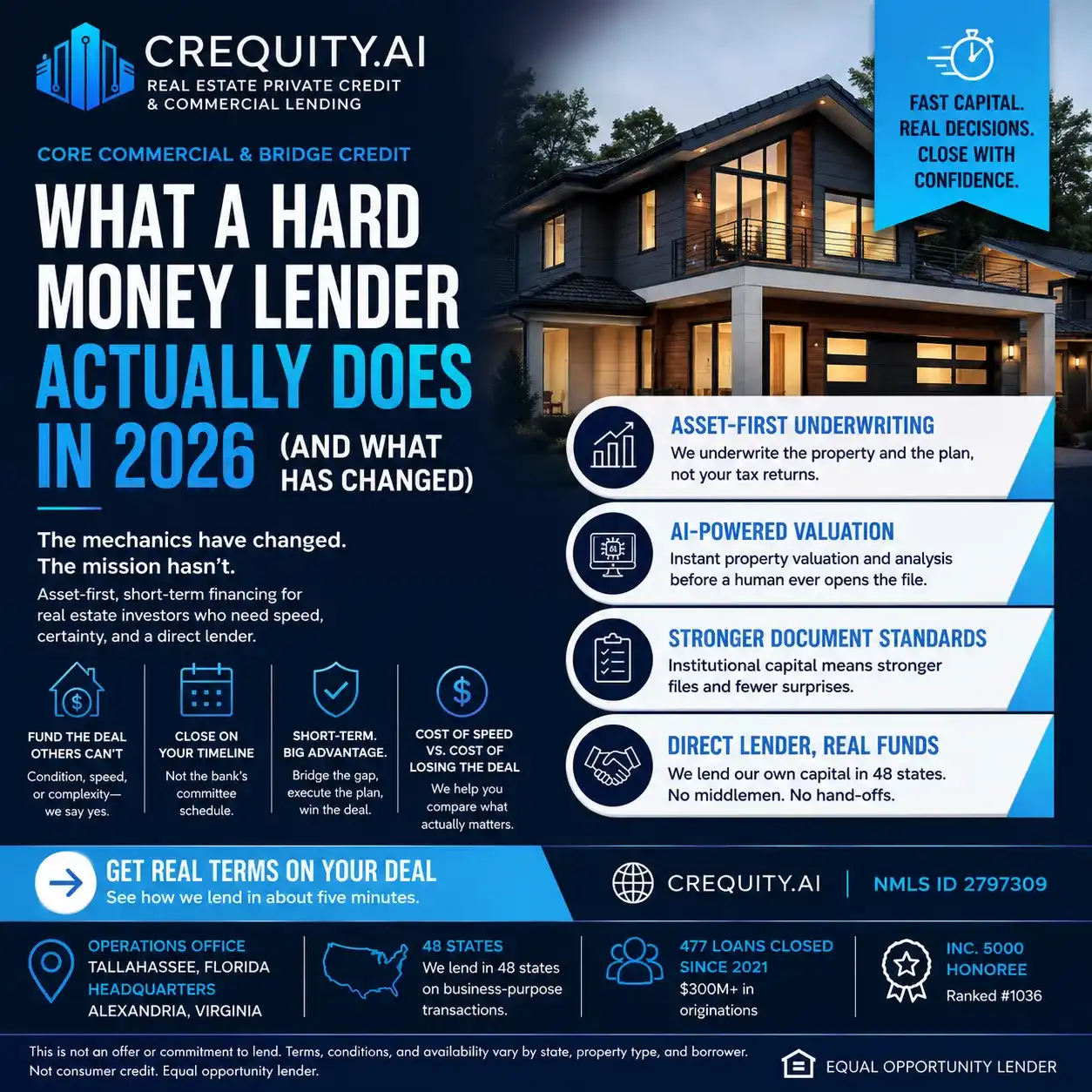
Ten years ago the first look at your property was a person in a car with a clipboard. Today the first look is a model. AIVAA, our AI valuation and underwriting engine, produces an instant property valuation and platform analysis before anyone schedules an inspection. Two things follow. Your early answer arrives in minutes, and it is a more honest answer, because a model will not talk itself into a comparable that does not belong.
Documentation got heavier, not lighter
Investors hear asset-based and assume no paperwork. The opposite happened. Capital in this sector is increasingly funded by institutions that leverage or securitize the loans, and those buyers hold file standards. You will still produce entity documents, insurance naming the right parties, a track record, and a budget that survives a line-item read. Speed now comes from running those steps in parallel, not from skipping them.
The four questions a hard money lender is actually asking
| Question | What is being tested | What kills it |
|---|---|---|
| Is the collateral worth what you say? | As-is value today, in a normal marketing period | Comparables that only work inside your pro forma |
| Does the plan fit the building? | Scope against zoning, structure, and permitting reality | A scope needing approvals nobody has applied for |
| How does this loan get repaid? | A dated sale or a refinance a permanent lender will quote | An exit described as we will figure it out |
| Can you absorb a surprise? | Liquidity remaining after closing and first draws | Every dollar consumed by the down payment |
| Is the file clean? | Title, entity authority, insurance, lien position | An unreleased lien discovered in week three |
Notice that only the first question is about the property in isolation. The rest are about whether the plan and the person behind it hold together.
Have an address and a scope? Start with the CR Equity AI lending platform and get the valuation read before you spend a week gathering documents nobody has asked for yet.
The cost of speed, measured correctly
Short-term private capital costs more than bank debt. Everyone knows this, and most investors still compare it wrong. The comparison is not rate against rate. It is the cost of this loan against the cost of not having it.
Illustrative worked example
A duplex is listed at $310,000. The seller wants a fourteen-day close because a 1031 clock is running. Two competing offers carry financing contingencies. You bid $298,000 with proof of funds and no contingency, and you win.
Say the incremental financing cost across a five-month hold, all in, runs $14,000 more than a conventional path would have. Against that you hold a $12,000 price concession and, more to the point, a deal that otherwise went to somebody else. The decision was never about the coupon. It was about whether the transaction existed at all.
Illustrative only. Not a quote or a commitment to lend. Figures are hypothetical and vary by deal, sponsor, and state.
How to tell a lender from a middleman
One question does most of the work: whose balance sheet funds this loan. A shop that has to place your file elsewhere before it can answer will always be one conversation behind, and you will feel that gap on the day the closing attorney needs a wire.
CR Equity AI is a direct lender that lends its own capital, plus 20+ lending partners on one platform, and every one of the 477 loans we have closed since 2021 was originated in house. You can see how we underwrite and fund deals without a hand-off in the middle.
Two companion reads go deeper on the same decision: Commercial Bridge Loans: How Investors Use Short-Term Capital to Win Deals in 2026 covers the commercial side of the structure, and Private Money Lenders for Real Estate: How to Vet One Before You Send a Deal gives you the diligence checklist.
Where we lend
We originate business-purpose loans on non-owner-occupied property in 48 states, run from our Tallahassee, Florida operations office, with headquarters in Alexandria, Virginia.
Frequently asked questions
What does a hard money lender look at first?
As-is collateral value, before anything else. The underwriter wants to know what the property is worth today in a normal marketing period, then whether your scope of work is physically and legally possible on that building. Borrower items follow, but they rarely rescue a file where the collateral read comes back short.
Is hard money only used for fix and flip deals?
No. Rehab and resale is the most visible use, but the same structure funds rental acquisitions before a DSCR refinance, small-balance commercial purchases, partner buyouts, note payoffs at maturity, and land or lot positions. The common thread is a short hold with a defined exit, not a particular property type.
Will a hard money lender check my credit?
Yes, though not the way a bank does. CR Equity AI uses a soft credit pull at pre-qualification, which is a soft inquiry and does not affect your score. A hard pull may occur later in the process. Credit informs pricing and structure here; it is rarely the deciding factor on its own.
How is this different from a bank loan?
A bank underwrites your documented history and lends against stabilized cash flow on a long amortization. A hard money lender underwrites the asset and a dated exit over a short term. You trade cost for speed, flexibility on condition, and the ability to close when a seller will not wait.
Send the deal, not a document pile
Address, scope, and exit date are enough to start. We lend our own capital in 48 states on business-purpose transactions.
See how CR Equity AI lends · Get real terms on your deal in about five minutes
About the author. Robert S. Stewart Jr. is the Founder and CEO of CR Equity AI, Inc., an AI-native specialty real estate private credit and commercial lending platform founded in 2021. He is a U.S. military veteran and a licensed real estate professional in Florida and Virginia, and has personally originated all 477 loans CR Equity AI has closed since inception, representing more than $300 million in originations. CR Equity AI was named to the Inc. 5000 at #1036.
CR Equity AI, Inc. | NMLS ID 2797309 | 2308 Mount Vernon Ave, Suite 206, Alexandria, VA 22302. This article is provided for general informational purposes only and is not an offer, commitment, or solicitation to lend, and is not legal, tax, accounting, or investment advice. CR Equity AI originates business-purpose loans secured by non-owner-occupied real property in 48 states; products, availability, terms, and eligibility criteria vary by state, property type, transaction, and borrower, and are subject to underwriting, credit approval, and final documentation. Any figures shown are illustrative examples, not quoted terms. Nothing herein constitutes a consumer credit offer. Equal opportunity lender.