

An automated valuation model, or AVM, is a data-driven system that estimates a property’s market value in seconds using public records, recent sales, and statistical modeling instead of a person walking through the home. Lenders use AVMs to underwrite low-risk loans and monitor collateral, agents use them to price listings quickly, and homeowners use them to get a ballpark number before selling or refinancing.
Speed is the defining trait: a quality AVM produces an estimate in milliseconds, not the days a licensed appraisal takes. Accuracy depends heavily on where the property sits. In stable, high-volume housing markets, AVMs tend to produce estimates relatively close to the eventual sale price, more so than in rural areas or markets with few comparable sales.
- Best use: instant estimates for underwriting, portfolio monitoring, and consumer research.
- Weak spot: unique properties, thin-data markets, and volatile pricing conditions.
- Institutional AVMs (used for lending decisions) are governed by different rules than the free consumer-facing tools you see on real estate websites.
TL;DR:
- AVMs perform best in stable, high-volume markets, providing estimates within 10% of sale prices for 80-90% of properties, but their accuracy diminishes in rural, volatile, or unique neighborhoods.
- Speed alone cannot justify reliance; a high confidence score and narrow value range are essential to trust an AVM’s estimate for lending or legal purposes.
- Regulatory standards require lenders to implement validation, anti-manipulation, and nondiscrimination controls when using AVMs for credit decisions, ensuring model reliability.
- Combining AVMs with human review or exterior inspections reduces the risks from data gaps, condition issues, or rapid market shifts that models cannot detect.
- Professional AVMs used for institutional underwriting cost around $10 to $50 and offer governance and transparency features, unlike free consumer tools like Zillow’s Zestimate.
Table of Contents
- What Is an Automated Valuation Model, and How Does It Differ From an Appraisal?
- How Does an AVM Work Behind the Scenes?
- How Accurate Is an AVM, and Where Does It Fail?
- When Should You Use an AVM Instead of an Appraisal?
- What Regulatory Standards Govern AVM Use?
- How Do You Evaluate an AVM Before Trusting Its Output?
- How CR Equity Ai Inc Applies Institutional Valuation Standards
- Why Most People Misread What an AVM Actually Promises
- Get an Institutional-Grade Valuation Behind Your Next Deal
- Key Takeaways
- Sources
- FAQ
What Is an Automated Valuation Model, and How Does It Differ From an Appraisal?
An automated valuation model is a statistical or machine-learning system trained to output a property’s estimated market value from structured data. A traditional appraisal is a licensed human’s professional opinion, formed after a physical walkthrough of the property, its condition, and its neighborhood. The AVM never sets foot inside the house. That single distinction explains most of what an AVM can and cannot do.
Four modeling approaches dominate the market, and most modern AVM real estate valuation tool actually blends more than one:
- Comparables-based models mimic how an appraiser thinks: find recently sold properties with similar size, age, and location, then adjust for differences.
- Hedonic models break a home’s value into components (square footage, bedrooms, lot size, school district) and assign each a statistically derived weight.
- Repeat-sales indexes track how the same properties change in value over multiple sale events, which is useful for tracking market-level trends rather than a single address.
- Ensemble machine-learning models run several of the above simultaneously and blend the results, which tends to improve stability across different property types and market conditions, according to First American Data & Analytics.
Every credible AVM real estate valuation tool also reports a confidence score, a numeric signal of how much the model trusts its own output based on data quality and comparable density. Related terms worth knowing: coverage (the share of properties in a given area the model can confidently score), hit rate (how often the estimate falls within an acceptable margin of the actual sale price), and value range (the low-high band around the point estimate, which tends to widen when confidence drops). Understanding these four terms is the difference between reading an AVM output correctly and misreading a single number as gospel.
How Does an AVM Work Behind the Scenes?
An AVM works by pulling structured property and market data, running it through a trained statistical model, and returning a value estimate along with a confidence signal. The process has three stages: data collection, model processing, and output generation.
Data inputs typically include:
- Public records (deed transfers, tax assessments, parcel data)
- MLS listing and sale history
- Building permits and renovation records
- Physical characteristics (square footage, bedroom/bathroom count, lot size, year built)
- Geodata (flood zones, school boundaries, proximity to amenities)
- Local and regional market trend indicators (price-per-square-foot movement, days on market)
Once collected, the data goes through preprocessing: cleaning errors, standardizing formats, and selecting which features actually predict value in that specific market. A feature that matters in a dense urban condo market, like proximity to transit, might carry little weight in a rural single-family market where lot size dominates. The model then gets calibrated against a holdout set of known sale prices, and if the AVM blends multiple methodologies, an ensemble weighting step decides how much influence each sub-model gets for that particular property and geography.
Statistic Callout: In stable residential markets with high transaction volume, quality AVMs can land within roughly 10% of the final sale price for about 80-90% of properties, though that accuracy compresses fast once a market thins out or turns volatile.
What comes out the other end isn’t just a single number. A well-built AVM real estate valuation tool returns:
- A point estimate, the model’s single best guess at market value.
- A value range, showing the band of uncertainty around that point estimate.
- A confidence or hit-rate metric, telling you how reliable that specific estimate is likely to be.
- Review flags, which trigger when data is sparse, contradictory, or the property falls outside the model’s normal training distribution.
That last output matters more than people realize. A responsible automated property assessment doesn’t just spit out a number and stop. It tells you how much to trust that number, and it should flag the cases where a human needs to look before anyone relies on the estimate for a loan decision.
How Accurate Is an AVM, and Where Does It Fail?
AVM accuracy is market-dependent, not fixed. In liquid suburban markets with plenty of recent comparable sales, the models perform well. In markets with few transactions, unusual housing stock, or fast price swings, the same models can miss badly.
The reliable performance band again is within about 10% of final sale price for 80-90% of properties in stable, data-rich markets.
Where AVMs run into trouble:
- Condition blindness. An AVM cannot see a gutted kitchen or a flooded basement. It only knows what public records and listing photos tell it.
- New construction. Without comparable sales history, a newly built home or a newly platted subdivision gives the model little to anchor on.
- Thin-comp neighborhoods. Rural parcels, mixed-use zoning, and unusual lot configurations often lack enough recent sales for a confident estimate.
- Volatile markets. Rapid appreciation or a sudden correction can outpace a model trained on slightly older transaction data.
- Data gaps. Missing permit records or unrecorded renovations leave the model working with an incomplete picture of the property.
Institutions handle this by setting confidence thresholds. An AVM output below a set confidence score triggers automatic escalation to a licensed appraiser or a desk review, rather than getting used as the final answer. Validation teams also track hit rate and error distribution over time to make sure the model hasn’t drifted from actual market behavior.
Pro Tip: Never treat a single AVM number as final. Check the confidence score and value range first. A tight range with a high confidence score is a very different signal than a wide range with a low one, even if the point estimate looks identical.
When Should You Use an AVM Instead of an Appraisal?
The right tool depends on the stakes of the decision and how much the property deviates from the norm. Three workflows generally favor AVMs, and three generally require a human appraiser.
- Good fits for an AVM: portfolio-wide valuations across dozens or hundreds of properties, rapid underwriting on low-loan-to-value transactions, HELOC eligibility checks, prequalification screens, and bulk risk review across a loan book.
- Situations that still need a full appraisal: purchase-money loans requiring a legally defensible valuation, unique or high-value properties with no clean comparables, and any legal or tax proceeding where a court or agency requires a certified opinion of value.
- Hybrid approaches that split the difference: an AVM paired with a desk review of the file, an AVM-triggered exterior-only inspection when confidence dips below a set threshold, or a conditional rule that automatically escalates to a full appraisal once loan-to-value crosses a set line.
The cost gap explains why lenders lean on AVMs wherever they safely can. Professional-grade AVM reports typically run $10 to $50, versus $300 to $800 for a full appraisal, and the turnaround is measured in minutes rather than days. That math only works, though, when the decision at hand doesn’t require the legal defensibility a certified appraisal provides.
What Regulatory Standards Govern AVM Use?
Institutional AVM use is not self-policed. Federal regulators finalized an interagency rule requiring that any institution using an AVM for credit decisions or securitization determinations build quality-control systems around that model, not just deploy it and trust the output.
Institutions using AVMs for credit decisions must adopt policies, practices, procedures, and control systems designed to ensure the estimates meet quality-control standards, including random sample testing, protections against data manipulation, and checks against nondiscrimination requirements.
That standard comes directly from the CFPB’s final interagency rule on automated valuation models, and it applies across the federal banking agencies, not just to a single lender type. In practice, this means:
- Random sample testing: institutions periodically pull a statistically valid sample of AVM outputs and check them against actual sale outcomes.
- Anti-manipulation protections: controls that prevent a loan officer or borrower from gaming inputs to inflate an estimate.
- Nondiscrimination checks: testing to confirm the model is not systematically undervaluing properties in specific neighborhoods or demographic areas.
- Model validation and monitoring: ongoing recalibration as market conditions shift, rather than a one-time build-and-forget approach.
The IAAO Standard on Automated Valuation Models adds a parallel layer of best practice guidance, calling for transparency in methodology, statistically sufficient sample sizes, and iterative diagnostic testing during model development. Taken together, these frameworks are exactly why a lender’s willingness to accept an AVM-only valuation depends on documented governance, not just a vendor’s accuracy claims. A model with no validation history and no published testing record is not something a regulated institution can lean on for a credit decision, no matter how fast it runs.
How Do You Evaluate an AVM Before Trusting Its Output?
Judging an AVM comes down to seven checks, whether you’re a consumer sanity-checking a home value, an investor screening a deal, or a broker vetting a vendor for a lending program.
- Data sources and freshness. Ask when the underlying tax, MLS, and permit data was last updated. Stale data produces stale estimates.
- Geographic coverage. Confirm the model has meaningful comparable density in the specific zip code or county, not just a broad regional average.
- Confidence scoring and hit rate. Look for a published confidence metric on every estimate, not just a bare number.
- Transparency and explainability. A credible provider can explain, at least at a high level, which factors drove the estimate.
- Validation evidence. Ask for third-party testing results or a documented track record against actual sale prices.
- Escalation rules. Find out what confidence threshold triggers human review or a desk audit.
- Fairness policies. Confirm the provider has documented nondiscrimination testing in place, per the standards regulators now require.
Pro Tip: Before relying on any AVM real estate valuation tool for a real decision, ask the provider directly: “What’s your hit rate in this specific market, and what confidence score triggers manual review?” A provider that can’t answer both questions in plain numbers is a red flag.
Watch for opaque accuracy claims with no supporting data, providers who won’t discuss validation methodology, and any tool that returns a single number with no confidence indicator at all.
How CR Equity Ai Inc Applies Institutional Valuation Standards
Consumer AVMs and institution-grade valuation tools are not the same product, even when they share a name. A free instant-estimate tool on a listing site optimizes for engagement. An institutional automated property assessment used to underwrite a loan has to meet the quality-control expectations described above, and it has real cost and governance overhead attached to it.
CR Equity Ai Inc builds its underwriting around that institutional standard rather than the consumer-tool version:
- Published advance-rate grids available before you apply, so borrowers see the lending parameters up front rather than guessing.
- Asset-first underwriting discipline, evaluating the deal and the collateral rather than relying purely on borrower paperwork.
- Decisions in as little as four hours on qualifying real estate programs, backed by a soft credit pull rather than a lengthy income-verification process.
- References to AIVAA as part of CR Equity Ai Inc’s property valuation direction, understanding that its capabilities vary by program and are still rolling out across the platform.
Speed only matters if the valuation behind it holds up. An underwriting decision built on a well-governed valuation process is worth more than one built on the fastest possible guess.
Why Most People Misread What an AVM Actually Promises
The biggest misconception about an automated valuation model isn’t that it’s inaccurate. It’s that people expect a single number to carry more certainty than any statistical model can honestly offer. A point estimate without its confidence score and value range is a headline without the article behind it.
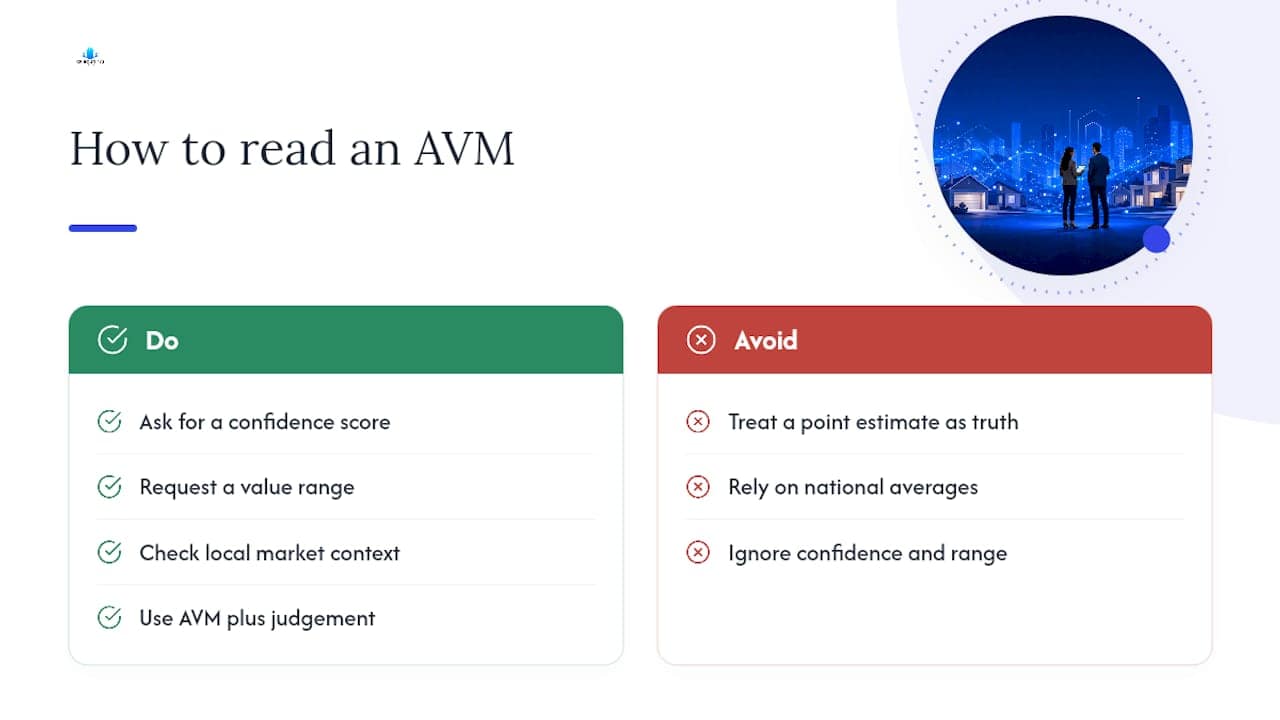
The more useful mental shift is to stop asking “is this AVM accurate?” and start asking “how confident is this AVM about this specific property, in this specific market, right now?” That reframing matters more in a market cycle like the current one, where regional price divergence has widened and a national accuracy average tells you almost nothing about your own zip code.
The evaluation checklist in this piece exists for a reason: an AVM’s real value comes from knowing exactly how much to trust it, not from treating it as a substitute for judgment.
— Robert
Get an Institutional-Grade Valuation Behind Your Next Deal
Speed without governance is a liability, not an advantage, when real capital is on the line. CR Equity Ai Inc underwrites the asset and the deal itself, not just a borrower’s paperwork, with published advance-rate grids you can review before you ever submit an application.

For investors moving on a rehab opportunity, the Fix & Flip loan program funds qualified sponsors up to 100% loan-to-value with closings built for speed, not months of back-and-forth. Ground-up builders and small-balance commercial borrowers get the same underwriting discipline, whether the collateral is a single rehab property or a multifamily acquisition. Check your eligibility and see your advance-rate grid today by starting an application on the Fix & Flip program page.
Key Takeaways
An automated valuation model delivers a fast, data-driven property estimate, but its reliability depends entirely on market data density and the governance controls behind the model.
| Point | Details |
|---|---|
| Speed vs. certainty tradeoff | AVMs generate estimates in milliseconds, but speed doesn’t replace the confidence score and value range attached to each output. |
| Accuracy is market-dependent | Quality AVMs land within about 10% of sale price for 80-90% of properties in stable, data-rich markets, and worse elsewhere. |
| Regulation shapes institutional use | Federal rules require random sample testing, anti-manipulation controls, and nondiscrimination checks for lending-grade AVMs. |
| Hybrid workflows reduce risk | Pairing an AVM with a desk review or confidence-triggered inspection covers gaps that a model alone can miss. |
| CR Equity Ai Inc applies institutional discipline | CR Equity Ai Inc underwrites on published advance-rate grids and asset-first review, treating valuation as governance, not just speed. |
Sources
- AVM vs Appraisals: How Technology is Transforming Property Valuation for Credit Unions — FirstClose
- What Is an Automated Valuation Model? A Modern AVM Guide — First American Data & Analytics
- Automated valuation model — HouseCanary blog
FAQ
Is Zillow’s Zestimate an AVM?
Yes, the Zestimate is a consumer-facing automated valuation model. It’s built for quick reference and general research, not for underwriting a loan, so it doesn’t carry the same governance and validation standards institutional AVMs must meet.
How Much Does an AVM Cost?
Consumer AVM tools are typically free, while professional-grade AVM reports used in lending run about $10 to $50, compared with $300 to $800 for a full appraisal.
How Long Does an AVM Take Compared to an Appraisal?
An AVM returns an estimate in milliseconds to minutes, while a traditional appraisal typically takes several days to a couple of weeks depending on scheduling and property complexity.
How Accurate Is an AVM Compared to a Full Appraisal?
In stable, high-volume markets, quality AVMs land within about 10% of the final sale price for 80-90% of properties, but accuracy drops noticeably in rural, unique, or volatile markets where a licensed appraisal remains more reliable.
Can an AVM Replace an Appraisal for a Purchase Loan?
No. Purchase-money loans generally require a defensible, human-certified valuation, so AVMs are better suited to portfolio checks, low-loan-to-value underwriting, and prequalification rather than final purchase decisions.