

The fastest, most defensible way to underwrite a deal is combining an institutional comps database, a private comp vault, and a modeling tool that turns comps into a proforma. Pull sale and lease comps, verify where each one came from, then run a quick cap rate and discounted cash flow (DCF) check before you trust the number. The sections below break down which tool class does what, how to vet a vendor, the six-step process to run on a live deal, and how a comps-driven workflow shows up in real underwriting.
TL;DR:
- Verifying the provenance and source of comps is essential, with verified broker submissions carrying more weight than estimates or public records.
- Running parallel searches across institutional, lease, and public record sources provides a more comprehensive and timely set of comparable data.
- Adjustments for timing, size, and quality differences are crucial to produce accurate, comparable valuation metrics for each property.
- Using comps in conjunction with DCF models and market cap rate ranges enhances accuracy and reduces the risk of valuation challenges.
- Speed-focused programs like fix-and-flip or small balance loans benefit from pre-sourced, provenance-tagged comps to enable loan decisions within hours.
Table of Contents
- What Are the Main Types of Commercial Comps Tools?
- How Do You Choose the Right Comps Tool for Your Workflow?
- What Is the Step-by-Step Process for Finding and Verifying Comps?
- How Does an AI-Native Lender Use Comps to Underwrite Faster?
- What Should CRE Professionals Prioritize When Adopting These Tools?
- Get Funded Faster With Comps-Backed Underwriting
- Where to Go Next for Comps Data and Modeling
- Sources
- FAQ
What Are the Main Types of Commercial Comps Tools?
Six tool categories cover almost every comps job a broker, appraiser, or investor faces. Picking the wrong one wastes hours; picking the right one for the specific task saves them.

Institutional platforms sit at the top of the data pyramid. CoStar reports access to millions of commercial sale comparables, with transaction-level fields like sale price, buyer and seller, financing terms, and cap rate at close. These platforms run on subscription licensing, usually priced per seat or per market, and they serve appraisers, institutional investors, and brokerage research teams who need deep transaction history rather than a one-off lookup. If your job is defending a valuation to a loan committee or an appraisal review board, this is the tier you need.
Lease comps and rent-prediction tools solve a different problem: what a tenant actually pays after concessions. Raw asking rent rarely tells you what closes. Tools built for lease underwriting parse lease abstracts to extract Net Effective Rent, free-rent periods, tenant improvement allowances, and escalation schedules, then feed that into rent-prediction models for underwriting a specific submarket. CompStak documents a hybrid workflow combining machine learning with human analyst verification specifically to keep lease comps accurate, because self-reported broker data has a way of drifting from what actually got signed.
Public-record aggregators are the free or low-cost option, pulling from county assessor and recorder data. They give you sale price, parcel size, and ownership history, which works fine for a quick gut check. The tradeoff is timeliness. Public records often lag actual closings by weeks or months, and they almost never include lease terms, concessions, or financing structure, so you’re working with a partial picture.
Private comp vaults, sometimes called closed systems, are internal databases a firm builds from its own closed deals. Practitioners keep these for a straightforward reason: a private vault protects deal confidentiality while still letting a shop fold proprietary transaction history into client-facing reports without exposing sensitive numbers to outside parties. A brokerage that has closed 40 deals in a submarket over five years has comps data no subscription service will ever match for that specific corridor.
Modeling and valuation software is where comps become a decision. PropertyMetrics and similar investment-analysis platforms let you convert comps into DCF models, proformas, and offering memorandums quickly, which matters because a comp is just a data point until it’s run through a cash flow model against the subject property’s actual numbers. On the enterprise end, Argus-style asset management tools link valuations to ongoing portfolio benchmarking, useful for mid-hold revaluations and investor reporting rather than a single acquisition underwrite.
Field apps and APIs round out the stack for the moment you’re standing in a parking lot trying to sanity-check a listing price. Address-level lookup apps and data feeds pull quick comps without opening a full desktop platform, and they matter for:
- On-site due diligence when you need a fast second opinion before an offer deadline
- Exporting a subset of transaction data into an internal CRM or deal-tracking system
- Feeding comps directly into a lender’s or broker’s own pricing model via API rather than manual entry
Most working CRE professionals end up running two or three of these categories in parallel rather than picking just one. An appraiser might use an institutional platform for the sale comps, a lease-comps tool for the income approach, and a private vault to cross-check against deals the firm has actually closed.
How Do You Choose the Right Comps Tool for Your Workflow?
Not every comps tool is built for the same job, and picking one based on brand recognition alone leads to gaps you won’t discover until a lender or appraisal reviewer pokes holes in your report. Run through this checklist before you sign a contract or commit a team to a platform.
- Data coverage and freshness. Ask how far back the transaction window goes. Three to ten years of history is the useful range for most asset classes, and update frequency matters more than headline record counts. A platform with 5 million comps updated quarterly is less useful for a hot submarket than one with fewer records updated weekly.
- Verification and provenance. Every comp should carry a source badge and a documented trail: was it a verified broker submission, a public record, a listing, or an estimate? Platforms like CompNinja put a source badge and citation on every comp precisely so the recipient of a report can judge confidence at a glance rather than taking a number on faith.
- Parsing and analytics depth. Offering memorandum (OM) parsing, rent predictors, and anomaly detection separate a modern platform from a static spreadsheet export. Insights from CompStak’s AI tooling show that OM parsing and semantic search extract structured lease and financial data from unstructured PDFs, cutting the manual data-entry step that used to eat a junior analyst’s week.
- Export and integration options. Confirm CSV or Excel export is available, along with OM-ready exports for marketing packages, and check whether an API or data feed exists for pulling comps directly into internal underwriting systems.
- Cost and licensing structure. Pricing shapes vary widely: per-seat subscriptions, enterprise site licenses, and pay-per-data-feed arrangements. Ask what a trial period actually includes, since some vendors strip export functionality or cap record counts during evaluation.
- Private vault and security controls. If you need to layer your own closed deals into a shared platform, check the granularity of sharing permissions. Can you upload a private comp visible only to your team, or does it enter a shared pool?
Before signing anything, ask the vendor directly: can you export raw transaction detail, not just a summary screen? Are lease terms parsed into structured fields, or just attached as a PDF? Is there an API, and what’s the data-delivery service-level agreement?
Pro Tip: Run the same subject property through two different comps platforms before committing to either one. If the cap-rate ranges diverge by more than half a point on the same asset class and submarket, dig into why before you trust either dataset for a live underwrite.
A comparison of real estate software categories is worth reviewing if you’re weighing broader CRM and workflow tools alongside dedicated comps platforms, since governance and integration questions often overlap.
What Is the Step-by-Step Process for Finding and Verifying Comps?
A repeatable process turns comps from a guessing game into a defensible number a lender or investment committee will actually accept. Here is the six-step version that works whether you’re underwriting a $2 million retail strip or a $40 million multifamily acquisition.
- Define the subject metrics to match. Lock down building size, unit count, use type, lot size, year built, and zoning before you search. Searching without these anchors produces a pile of loosely related comps instead of a tight comparable set.
- Run parallel searches across sources. Pull from an institutional sale-comps database, a lease-comps tool, and public records at the same time, then export raw transaction detail rather than relying on a summary view. Running these searches in parallel instead of sequentially typically saves a half day on a standard commercial deal.
- Verify provenance and assign weights. Not all comps deserve equal trust. Professional platforms categorize comps by source — verified broker submission, public record, listing, or estimate — and let you weight each accordingly. A verified broker submission should carry more weight in your final number than an estimate pulled from an old listing.
- Adjust for timing and size differences. Time-adjust older comps using a market index or annualized appreciation factor where one exists; where it doesn’t, document your assumption clearly for lender review. Normalize everything to price per square foot or price per unit so comps of different sizes are actually comparable, and adjust for quality differences like renovation status or amenity package.
- Run a quick valuation cross-check. Derive a cap rate from your adjusted comps and compare it against market cap-rate bands from an institutional dataset, flagging anything that falls outside the expected range for manual review. Follow with a three-to-five-year DCF or proforma check built on modeled net operating income (NOI), not just the trailing twelve months.
- Package and document the comps appendix. Every comp in your final report should show its source, its provenance badge, the adjustments applied, and the assumptions behind your model. Lenders and investors trust a report they can audit line by line far more than one that just states a number.
The gap most analysts underestimate is step 3. Treating every comp as equally reliable is the single most common reason a valuation gets challenged later, whether by an appraisal reviewer or a skeptical loan committee.
How Does an AI-Native Lender Use Comps to Underwrite Faster?
CR Equity Ai Inc underwrites the asset and the deal itself, which means comps quality feeds directly into how fast a loan decision comes back. A soft credit pull and no income verification on most real estate programs mean the property’s own numbers, backed by verified sale and lease comps, carry the underwriting weight that a borrower’s tax returns would carry elsewhere.
Published advance-rate grids paired with verified comps shorten the back-and-forth that typically stalls a commercial loan file. When the comps supporting a valuation are already sourced and provenance-tagged, there’s less time spent chasing down whether a number is real before sizing the loan against it.
This shows up most directly in a few programs:
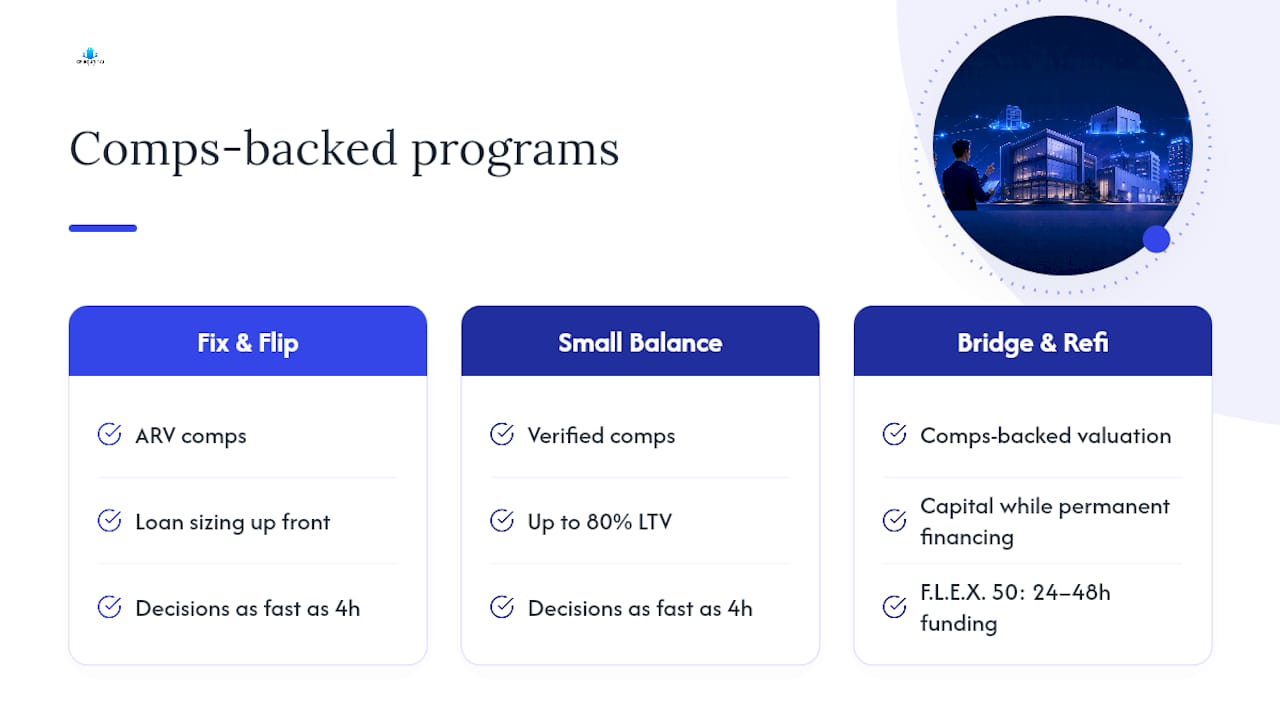
- Fix-and-flip financing, where after-repair value hinges on accurate, recent sale comps in the subject neighborhood.
- Small balance commercial lending ($100,000 to $100,000,000, up to 80% loan-to-value), where comp-driven valuation supports sizing across a wide range of deal sizes.
- F.L.E.X. 50™ bridge financing, funded in 24 to 48 hours, where speed depends on the property’s numbers being verifiable fast rather than reconstructed from scratch.
Decisions can come back in as little as four hours on qualifying files, a pace that only works when the comps behind the valuation are already clean.
What Should CRE Professionals Prioritize When Adopting These Tools?
OM parsing and AI-driven market summaries will keep getting faster at screening deals, but I’d treat any AI-generated comp or summary as a first draft, not a final answer. Human review still catches the anomaly the model missed.
Keep a private comp vault regardless of what platform you subscribe to, and audit its provenance tags on a schedule, not just when a deal goes sideways. Governance is the part firms skip until it costs them.
If you’re testing a new AI-enabled workflow, start it on a low-risk asset class you already understand cold, then check the output against three or four deals you’ve already closed. That comparison tells you more about a tool’s real accuracy than any vendor demo will.
— Robert
Get Funded Faster With Comps-Backed Underwriting
CR Equity Ai Inc turns the same verified comps and provenance discipline covered above into faster loan decisions, because we publish our advance-rate grids before you apply and underwrite the asset itself rather than waiting on tax returns or income documentation.
That structure matters most on the programs where valuation speed drives everything else. Fix-and-flip financing leans on accurate after-repair-value comps to set loan sizing up front, with funding turnaround built for investors who can’t wait weeks on a traditional lender’s committee cycle. Small balance commercial loans from $100,000 to $100,000,000 at up to 80% loan-to-value work the same way, and our bridge and refinance programs are built for borrowers who need capital moving while a permanent financing package comes together. Decisions can come back in as little as four hours, with F.L.E.X. 50™ bridge funding landing in 24 to 48 hours once the file is in order.
If you have a deal with solid comps behind it, visit our funding programs page to see which structure fits and request a valuation on your next acquisition.
Where to Go Next for Comps Data and Modeling
Each platform referenced in this guide serves a distinct part of the workflow, and worth a direct look before you commit budget to one.
- CoStar’s sale comps product, for institutional-depth transaction history. Check the export formats and how far back the transaction window runs before subscribing.
- TreppCRE, for machine-learning-driven comps tied to loan and property risk analytics. Worth reviewing if your work touches CMBS or loan-level data alongside straight sale comps.
- CompStak’s comps and AI tools, for hybrid ML plus analyst-verified lease and sale comps. Look at their sample reports to see how Net Effective Rent and concessions get parsed.
- PropertyMetrics, for turning comps into DCF models and offering memorandums. Their software walkthroughs show how quickly a proforma comes together once comps are loaded.
- Argus Intelligence, for portfolio-level benchmarking once you’re past acquisition and into asset management. Review the asset-manager module specifically if ongoing revaluation is the goal.
Sources
FAQ
How Do You Get Commercial Comps?
Pull them from an institutional platform, a lease-comps database, and public county records in parallel, then verify each comp’s source before using it in a valuation. Combining sources catches gaps that any single database misses on its own.
What Comps Are Used in a Commercial Appraisal?
Appraisers typically use recent sale comps adjusted for time and size, along with lease comps for the income approach, weighted by source reliability. Verified broker submissions generally carry more weight than public-record estimates or old listings.
Can You Pull Commercial Comps Yourself?
Yes. Public-record aggregators and several subscription platforms let brokers, investors, and appraisers pull comps directly without going through a third-party service. The tradeoff is that free public records lag actual closings and rarely include parsed lease terms, so a paid database still adds real value for time-sensitive underwriting.
What Is the Best Commercial Real Estate Software for Comps Analysis?
There’s no single best tool for every job. Institutional platforms like CoStar and TreppCRE offer the deepest sale-comps coverage, CompStak’s hybrid ML and analyst review strengthens lease-comps accuracy, and PropertyMetrics converts those comps into a working DCF or proforma. Most working professionals combine two or three tool categories rather than relying on one platform for the entire workflow.
How Does CR Equity Ai Inc Use Comps in Underwriting?
CR Equity Ai Inc underwrites the property and the deal using verified comps and published advance-rate grids rather than relying primarily on borrower income documentation. That structure supports decisions in as little as four hours on qualifying real estate files.