

A commercial loan finances a business purpose (buying property, purchasing equipment, or covering working capital) using either the asset or the business’s cash flow as repayment support. Your first move is matching the loan type to your actual use of funds, then assembling the documentation lenders ask for before you file anything. That single choice, term loan versus bridge loan versus SBA product, drives your timeline, your paperwork, and the underwriting metrics a lender will apply.
TL;DR:
- Most commercial loans depend heavily on debt-service coverage ratios and loan-to-value metrics, meaning borrowers must have strong income and collateral valuations.
- Short-term bridge loans and private financing often close within weeks, whereas traditional bank or SBA loans typically take 45 to 90 days to process.
- Collateral appraisal and title clearance are common delays, so ordering these early can significantly reduce closing times.
- Lenders’ eligibility heavily weighs on existing cash flow, credit history, and industry risk, especially for startups and businesses with limited financial history.
- Private direct lenders excel at quick approvals for time-sensitive deals or complex collateral, but usually carry higher rates than banks or SBA programs.
Table of Contents
- Types of Commercial Loans and When Each One Fits
- How Lenders Underwrite: The Metrics That Decide Approval
- What to Gather Before You Apply, and How Long It Takes
- SBA Loan Programs: 7(a), 504, and Microloans Compared
- Estimating Your Payment and the True Cost of Borrowing
- Choosing a Lender: What to Ask Before You Sign
- When a Direct Private Lender Makes Sense
- Impact of Credit Score and Business Financial History on Eligibility
- Common Reasons Commercial Loans Get Denied
- Role of Personal vs. Business Credit in Commercial Lending
- Startup Financing vs. Loans for Established Businesses
- How Economic Conditions and Industry Risk Shape Loan Terms
- What Actually Trips Up Borrowers
- Get Matched to the Right Program at CR Equity AI
- Sources
- FAQ
Types of Commercial Loans and When Each One Fits
Morgan’s overview of commercial lending](https://www.jpmorgan.com/insights/banking/commercial-loans-and-lines-of-credit/how-commercial-loans-and-lines-of-credit-work). Everything else—mortgages, equipment financing, bridge loans—is a variation built around a specific asset or timeline.
- Term loans provide a lump sum repaid over a fixed schedule, typically three to ten years, and work well for one-time investments like renovations or a business acquisition.
- Lines of credit revolve like a credit card for the business, drawn and repaid as working capital needs shift throughout the year.
- Commercial real estate loans finance the purchase or refinance of income-producing property, with terms often stretching to 25 years and the property itself serving as collateral.
- Equipment financing ties the loan directly to machinery or vehicles, using the equipment as collateral and usually matching the loan term to the asset’s useful life.
- Asset-based lending extends credit against receivables, inventory, or other balance sheet assets rather than relying primarily on historical profitability, which fits larger or collateral-rich borrowers.
- Bridge loans cover short gaps, often six to eighteen months, between an immediate need and permanent financing or a property sale.
- Construction loans fund ground-up projects through milestone draws tied to completion stages rather than releasing all capital upfront.
- Fix-and-flip loans finance the purchase and rehab of a property with an exit built around a fast resale, usually within twelve months.
A restaurant owner replacing kitchen equipment wants equipment financing, not a 25-year mortgage. An investor closing on a distressed multifamily property in three weeks needs a bridge loan, not a bank term loan that takes 60 days to underwrite. A developer building thirty townhomes needs construction financing with draw schedules tied to framing, roofing, and final inspection, not a single disbursement.
Banks and credit unions dominate conventional term loans and mortgages. Private direct lenders tend to handle bridge, construction, and fix-and-flip products because those deals hinge on speed and asset value more than years of tax returns. Matching the lender type to the loan type saves weeks of wasted applications.

How Lenders Underwrite: The Metrics That Decide Approval
Lenders decide on a handful of measurable factors, not gut feeling. The two that matter most are debt-service coverage ratio (DSCR) and loan-to-value (LTV), also called the advance rate.
DSCR measures net operating income against annual debt payments. Most conventional lenders want a DSCR of at least 1.20 to 1.25 for commercial real estate, though the threshold shifts by property type and lender appetite; construction loans use different math because they depend on projected lease-up or sale outcomes rather than existing income, as the OCC’s Comptroller’s Handbook on commercial real estate lending explains.
Underwriters typically evaluate:
- DSCR or projected cash flow against debt obligations
- LTV and collateral valuation, including third-party appraisals
- Personal and business credit history
- Time in business and industry risk profile
- Management experience and, for larger loans, personal guarantors
Lending volume context: Real estate loans held by all commercial banks totaled roughly $5.81 trillion as of July 2026, according to Federal Reserve data on FRED. That scale reflects a market where underwriting discipline, not loan availability, is usually the bottleneck for individual borrowers.
Federal regulators expect lenders to document a borrower’s actual capacity to repay and to maintain sound credit administration, and the FDIC’s guidance on commercial and industrial lending notes that documentation demands intensify for non-collateralized or specialized projects. That is why a startup asking for an unsecured line often faces tougher scrutiny than an investor putting up a stabilized apartment building as collateral.
What to Gather Before You Apply, and How Long It Takes
Getting organized before you submit an application shortens the entire process more than any single negotiating tactic.
- Two to three years of business tax returns and current-year financial statements (profit and loss, balance sheet).
- Personal tax returns and a personal financial statement for any owner with 20% or more equity.
- Business plan or use-of-proceeds memo explaining exactly how the funds will be spent.
- Rent roll and lease abstracts if the collateral is an income-producing property.
- Purchase contract or existing debt schedule, depending on whether this is an acquisition or refinance.
- Entity documents and government-issued ID for all owners and guarantors.
- Appraisal, environmental report, and title commitment, usually ordered once the lender issues a term sheet.
Timelines vary sharply by product. Conventional bank term loans and SBA loans often run 45 to 90 days from application to close. Commercial mortgages through traditional lenders can take 60 days or more once appraisal and title work are added in. Bridge loans and asset-based private financing move faster, sometimes closing within one to two weeks, because underwriting leans on the collateral itself rather than a multi-year cash flow history.
Appraisal scheduling and title clearance are the two steps that most often stretch a timeline past initial estimates, a pattern Bank of America’s commercial real estate lending page also flags as a common driver of delay.
Pro Tip: Order your appraisal and pull a preliminary title report the same week you submit your application, not after you get a term sheet. Running them in parallel with underwriting instead of after it can shave a week or more off closing.
SBA Loan Programs: 7(a), 504, and Microloans Compared
The Small Business Administration doesn’t lend money directly. It guarantees a portion of loans made by approved lenders, which lowers the lender’s risk and often translates into smaller down payments and longer terms for the borrower, according to the SBA’s own loan program overview.
- SBA 7(a) loans are the most flexible option, usable for working capital, equipment, debt refinancing, or real estate, with loan amounts up to $5 million.
- SBA 504 loans are built specifically for fixed assets, real estate and heavy equipment, structured with a bank, a Certified Development Company, and the borrower each contributing a portion of the capital stack.
- SBA microloans cover smaller needs, typically under $50,000, and are administered through nonprofit intermediary lenders rather than traditional banks.
The guarantee changes lender behavior more than it changes the loan itself. But the guarantee is not a blank check: the lender still makes the final credit decision and applies its own overlays on top of SBA minimums, meaning meeting baseline SBA eligibility does not guarantee approval, a point Hancock Whitney’s explainer on how SBA loans work makes clearly.
SBA lenders commonly require personal guaranties from any owner holding 20% or more equity, and larger loans often carry collateral requirements even though smaller 7(a) loans sometimes waive them, per Lendio’s breakdown of SBA loan requirements. Ownership structure also matters: recent SBA procedural updates have adjusted citizenship and residency requirements for borrowers, so it pays to confirm current rules through an SBA policy notice or a lender who actively originates SBA products before assuming eligibility.
Estimating Your Payment and the True Cost of Borrowing
Two loans with identical rates can cost very differently once fees and amortization structure enter the picture.
Rates come in fixed or variable form. Variable-rate commercial loans are usually priced as an index (commonly the Wall Street Journal Prime Rate or SOFR) plus a margin set by the lender based on risk. Amortization schedules matter as much as the rate itself: a 25-year amortization on a commercial mortgage keeps payments lower, but many commercial loans carry a balloon payment after five or ten years, meaning the full remaining balance comes due even though the payment was calculated on a longer schedule.
Fees to watch for across most commercial loan products:
- Origination fee, often 1% to 2% of the loan amount
- Appraisal and environmental report costs
- Title insurance and closing costs
- Exit or prepayment fees on shorter-term bridge products
- Annual servicing fees on some private lending programs
Worked example: A $1,000,000 commercial loan at a 25-year amortization schedule with a fixed rate around 7% produces a monthly principal-and-interest payment of roughly $7,070. Add a balloon at year ten, and the borrower still owes a substantial remaining balance that requires a refinance or sale to satisfy. Run your own numbers through a commercial mortgage calculator using your actual quoted rate, term, and amortization before comparing offers, since even a half-point rate difference moves the payment meaningfully at this loan size.
Compare offers on total cost, not headline rate alone.
Choosing a Lender: What to Ask Before You Sign
Speed, recourse, and fee structure matter as much as the headline rate when you’re comparing offers. A bank might quote the lowest rate but take 75 days and require a full personal guaranty. A direct lender might close in ten days at a higher rate with less recourse. Neither is automatically better; it depends on your timeline and risk tolerance.
Questions worth asking on first contact:
- What is your realistic closing timeline for a loan like mine, not your best-case scenario?
- Is this loan recourse or non-recourse, and what does that mean for my personal assets?
- What LTV or advance rate do you typically offer for this asset type?
- What fees apply beyond the interest rate: origination, exit, servicing, technology?
- Do you require a personal guaranty, and from which owners?
- What happens if I need to extend the term or pay off early?
Questions to ask once you have a term sheet:
- Are there financial covenants I need to maintain during the loan term?
- What triggers a default beyond missed payments?
- Is the rate locked, or can it move before closing?
Red flags include lenders unwilling to put fees in writing before you apply, pressure to sign before you’ve reviewed the term sheet with counsel, and advance-rate promises that shift once underwriting begins.
Pro Tip: Ask every lender for their advance-rate grid or pricing sheet before you submit a full application. A lender willing to publish those numbers upfront is signaling confidence in its own underwriting.
When a Direct Private Lender Makes Sense
A direct private lender often lends its own capital to real estate investors and business owners rather than brokering loans through a marketplace, which changes both the underwriting approach and the speed of a decision. The platform underwrites based on the asset and the deal rather than relying solely on borrower paperwork, using a soft credit pull and, on most real estate programs, no income verification.
Programs cover several distinct borrower needs:
- F.L.E.X. 50™ for emergency bridge financing funded in 24 to 48 hours
- DSCR cash-out refinance, qualified on rental income rather than tax returns, built for self-employed and 1099 investors
- Commercial bridge loans for acquisition or repositioning timelines
- Small balance commercial loans ranging from $100,000 to $100 million, up to 80% LTV
- Fix-and-flip and ground-up construction financing, with construction draws tied to project milestones
| Situation | Better fit |
|---|---|
| Time-sensitive acquisition or emergency capital need | Direct private lender |
| Self-employed borrower without clean tax returns | DSCR-based refinance program |
| Lowest possible rate, borrower can wait 60 to 90 days | Bank or SBA loan |
| Nonstandard collateral or unconventional deal structure | Direct lender underwriting the asset |
Some direct lenders publish advance-rate grids before applications are submitted, support ITIN and foreign national borrowers, and can state decisions in as little as four hours. A bank or SBA loan still makes sense when the borrower has time, clean historical financials, and wants the lowest possible long-term rate. A direct lender fits when speed, asset quality, or nonstandard income documentation are the deciding factors.
Impact of Credit Score and Business Financial History on Eligibility
Credit score sets the starting point for pricing and structure, but it rarely stands alone. Lenders read personal credit (often looking for scores above 680 for conventional products) alongside two to three years of business financial statements, tax returns, and bank statements showing consistent cash flow.
A strong credit score with thin business history still raises questions for a bank underwriter, particularly for a company under two years old. Conversely, a business with five years of steady revenue and a mid-600s owner credit score can still qualify, sometimes at a higher rate or with additional collateral required to offset the risk.
Lenders also look at trends, not just snapshots. A business showing three consecutive years of revenue growth reads differently than one with flat or declining revenue, even if the most recent year’s numbers look identical. Late payments on existing business debt, high credit utilization on business credit cards, and any recent bankruptcy filings all weigh heavily, sometimes more than the raw credit number itself.
Asset-based and collateral-heavy loans, like bridge financing secured by real estate, tend to weigh credit history less than DSCR-based or unsecured products because the underwriting leans on the asset’s value rather than the borrower’s repayment track record alone.
Common Reasons Commercial Loans Get Denied
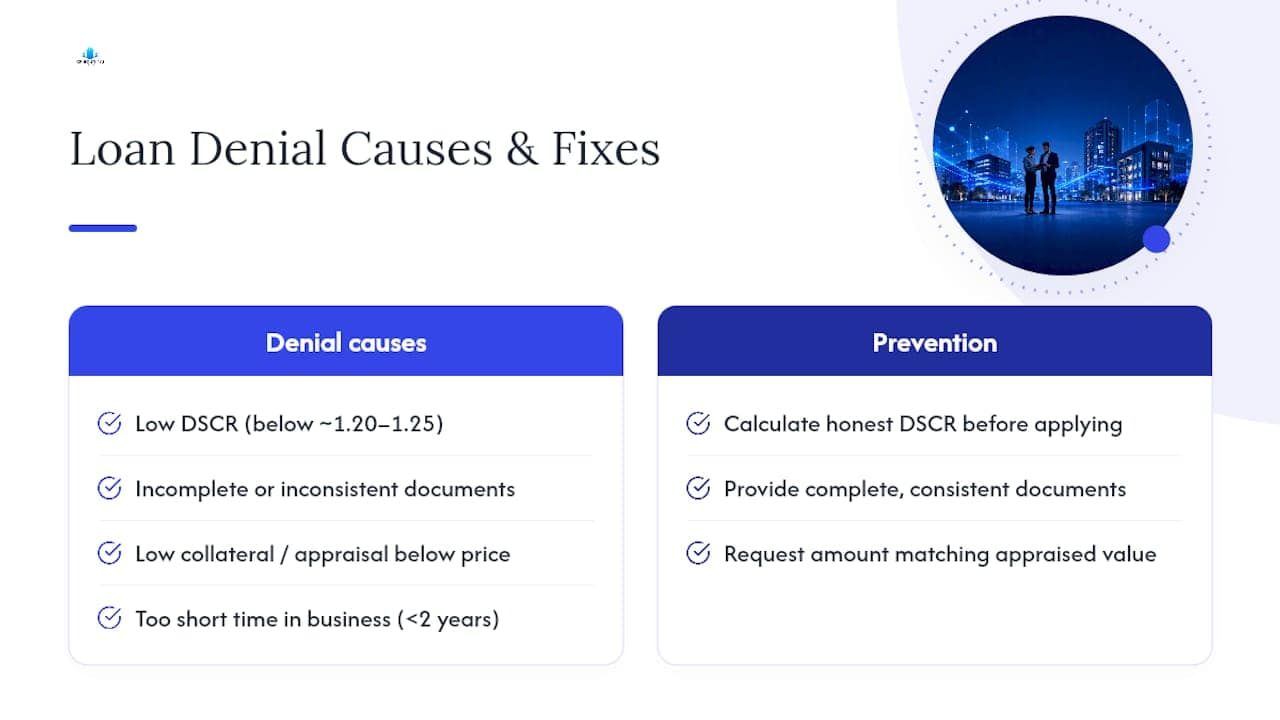
Insufficient cash flow tops the list. If projected or historical DSCR falls below a lender’s minimum, usually somewhere around 1.20 to 1.25 for real estate, the application typically stalls regardless of how strong the borrower’s credit looks.
Incomplete or inconsistent documentation causes more denials than borrowers expect. Tax returns that don’t match bank statements, missing years of financials, or an unclear use-of-proceeds explanation all raise red flags during underwriting.
Insufficient collateral value is another frequent cause, particularly when an appraisal comes in below the purchase price or the requested loan amount, which shifts the LTV outside the lender’s comfort range.
Thin time in business hurts applications for conventional bank products, since most banks want at least two years of operating history before extending unsecured or low-collateral credit.
Excessive existing debt, reflected in a high debt-to-income or debt-service ratio across all obligations, signals to underwriters that another loan payment could strain the business.
Avoiding these outcomes starts with an honest DSCR calculation before you apply, a complete and consistent document package, and a realistic loan amount request that matches your collateral’s actual appraised value rather than your hoped-for number.
Role of Personal vs. Business Credit in Commercial Lending
Personal credit and business credit play different roles depending on the loan structure and the age of the business. For smaller commercial loans and any product carrying a personal guaranty, which covers most SBA loans and many bank term loans, the owner’s personal credit score directly influences approval odds and pricing.
Business credit, tracked through agencies like Dun & Bradstreet and reflected in trade payment history and business credit card utilization, carries more weight for established companies applying for larger, unsecured, or revolving credit products. A business with strong trade credit history and five years of on-time vendor payments can sometimes secure financing with less reliance on the owner’s personal score.
Startups and newer businesses lean almost entirely on personal credit and personal financial statements because they haven’t built a business credit file yet. That’s part of why SBA lenders and most banks require personal guaranties from owners holding significant equity: the business track record alone isn’t sufficient evidence of repayment capacity in the early years.
Asset-based and DSCR-qualified loans shift this balance again, weighting the performance of the underlying asset or income stream more heavily than either personal or business credit alone, which is why self-employed borrowers with strong rental income but complicated personal tax returns often find these structures more accessible.
Startup Financing vs. Loans for Established Businesses
Startups face a fundamentally different underwriting conversation than businesses with an operating history. Lenders can’t evaluate two years of tax returns that don’t exist, so they lean on the founder’s personal credit, available collateral, industry experience, and sometimes a detailed business plan with realistic financial projections.
SBA microloans and certain 7(a) products are structured with startups in mind, since the SBA guarantee offsets some of the risk a lender would otherwise avoid. Equipment financing also works well for new businesses because the equipment itself secures the loan, reducing reliance on unproven cash flow.
Established businesses, by contrast, get evaluated primarily on historical performance: actual DSCR, trade payment history, and multi-year revenue trends. That track record generally unlocks better rates, higher loan amounts, and reduced collateral requirements compared to a startup seeking the same loan size.
The practical takeaway: a startup should expect to lean on personal financial strength and consider SBA or equipment-specific products, while an established business should expect underwriters to scrutinize actual operating numbers more than personal credit alone. Real estate investors buying their first income property sit somewhere in between, since DSCR-based programs qualify the deal on the property’s projected income rather than the sponsor’s business history.
How Economic Conditions and Industry Risk Shape Loan Terms
Interest rate cycles move commercial loan pricing directly, since most variable-rate commercial products are priced off an index like SOFR or the Prime Rate plus a margin. When the Federal Reserve raises benchmark rates, new commercial loans reprice upward almost immediately, and refinancing existing debt becomes more expensive.
Lenders also adjust LTV and DSCR thresholds based on broader market conditions. During periods of economic uncertainty, banks often tighten advance rates and raise minimum DSCR requirements across the board, regardless of an individual borrower’s specific financial strength, simply because portfolio-wide risk tolerance shifts.
Industry risk adds another layer on top of macroeconomic conditions. Lenders price loans to hospitality, retail, and certain office subsectors differently than they price loans to industrial, multifamily, or medical office properties, reflecting each industry’s historical default and vacancy patterns. A restaurant seeking a loan during a period of rising labor costs and thin margins faces more underwriting scrutiny than the same loan request from a logistics company with long-term leases in place.
Construction and acquisition, development, and construction (ADC) lending carry a distinct risk profile in any economic environment because repayment depends on project completion, lease-up, or sale outcomes rather than existing income, a distinction the OCC’s lending handbook addresses directly. That’s part of why construction loans use milestone-based draws instead of a single upfront disbursement, regardless of how strong the broader economy looks at closing.
What Actually Trips Up Borrowers
The biggest mistake I see repeated across commercial loan applications isn’t weak credit or thin collateral. It’s borrowers modeling cash flow around best-case revenue instead of realistic revenue, then discovering during underwriting that their own DSCR doesn’t clear the lender’s minimum. Run the conservative number first, not the number you’re hoping for. The second mistake is mismatching loan structure to loan purpose, chasing the lowest advertised rate for a bridge need when a slower closing kills the deal entirely. Match the financing to the timeline before you shop for rate.
— Robert
Get Matched to the Right Program at CR Equity AI
Direct lenders provide an alternative when a bank’s 60 to 90 day timeline doesn’t fit your deal. Rather than brokering your loan through a marketplace and waiting on someone else’s capital, these lenders may lend their own funds, publish advance-rate grids before you apply, and underwrite the asset and the deal instead of relying solely on years of tax returns.
Investors facing a fast-closing acquisition can look at investment property acquisition loans, while self-employed borrowers with strong rental income but messy personal tax returns often fit better with a DSCR cash-out refinance qualified on rent rather than income statements. If your need is a time-sensitive gap, review the commercial bridge loan program and its published terms directly. Business owners needing capital without pledging property can look at funding up to $10 million with no property required.
If your priority is the lowest possible long-term rate and your timeline allows 60 to 90 days, an SBA loan or conventional bank product through the SBA’s lender resources may still be the better fit. When speed, asset-based qualification, or nonstandard documentation matter more than shaving a point off the rate, start by reviewing the commercial lending matrix and submitting your deal directly for a same-day read on terms.
Sources
The SBA’s loan program directory explains 7(a), 504, and microloan eligibility directly from the agency. The FDIC’s commercial and industrial lending guidance outlines what regulators expect from sound underwriting. FRED’s real estate loan data tracks aggregate commercial bank lending levels. The OCC’s Comptroller’s Handbook details commercial real estate risk standards, and lenders handling KYC obligations can review AML training guidance for real estate for compliance context.
- Loans – Small Business Administration
- Commercial and industrial lending — FDIC guidance
- Real Estate Loans, All Commercial Banks (REALLNNSA) | FRED
FAQ
Are commercial loans hard to get?
Commercial loans require more documentation than consumer loans, including tax returns, financial statements, and collateral valuation, and approval hinges on DSCR, credit, and collateral strength; borrowers with thin business history or inconsistent financials face the most difficulty with conventional bank products.
When does a direct private lender make more sense than a bank?
A direct private lender like CR Equity Ai Inc fits time-sensitive deals, self-employed borrowers without clean tax returns, or nonstandard collateral situations, since decisions can come in as little as four hours against a bank’s typical 45 to 90 day timeline.