

A credit box is a lender’s pre-set range of underwriting and risk parameters, including minimum credit scores, loan-to-value limits, and debt service coverage thresholds, that determines which loans get approved and which get declined before anyone reads a full application. Knowing the specific box a lender uses lets you filter out mismatched lenders fast, avoid unnecessary credit inquiries, and route each deal toward terms that actually fit. A deal that fits closes faster and prices better; one that doesn’t gets rejected regardless of how strong the borrower’s story is.
TL;DR:
- Bank guidance cites DSCR floors of 1.25x to 1.70x and LTV ceilings of 60% to 70%, depending on property type.
- Banks favor lower leverage and higher coverage; bridge lenders accept more leverage and lower DSCR for speed, while CMBS emphasizes debt yield and nonrecourse loans.
- Calculate core metrics, verify a lender’s appetite through term sheets or recent funded deals, and submit to suitable lenders in parallel to avoid serial rejections.
- A narrow DSCR or LTV shortfall may be offset by extra reserves, a stronger partner, or a signed takeout commitment without switching lenders.
- A soft credit pull lets borrowers test fit without affecting their scores or appearing on their credit files, unlike serial hard inquiries.
Table of Contents
- The anatomy of a credit box: the metrics and rules lenders set
- How credit boxes differ by lender type and loan product
- Regulatory and market-cycle limits on credit box settings
- How to assess whether your deal or borrower fits a lender’s credit box
- Practical checklist and templates for a credit-box-friendly submission
- Consequences of mismatches and operational impacts
- How CR Equity AI’s credit box applies across our loan products
- Credit box implications for nontraditional income and foreign national borrowers
- How a soft credit pull changes borrower access to credit boxes
- Treat credit boxes as sorting tools, not personal verdicts
- Get your deal matched to the right lender fast
- FAQ
- Sources
The anatomy of a credit box: the metrics and rules lenders set
Every credit box is built from a handful of recurring inputs, each doing a specific job in the approval decision. A credit box typically combines FICO score floors, debt-to-income limits, loan-to-value ceilings, and debt service coverage minimums, and these four metrics together decide eligibility before a lender looks at anything else.
A FICO floor matters most on recourse loans and consumer-facing products, where personal credit history signals repayment behavior. Loan-to-value (LTV) and loan-to-cost (LTC) ratios cap the loan against either the appraised value or the total project cost, and the appraisal or valuation drives that ceiling directly. Debt service coverage ratio (DSCR) measures whether a property’s net operating income covers its debt payments, while debt yield expresses net operating income as a percentage of the loan amount, giving lenders a leverage check independent of interest rate assumptions. Beyond these numbers, most boxes carry non-numeric filters:
- Property type and condition, since many lenders exclude special-use or distressed assets.
- Geography, with some lenders restricting lending to specific states or metro tiers.
- Sponsor experience and track record on comparable deals.
- Minimum liquidity or reserve requirements held by the borrower.
- Recourse versus non-recourse structure, which shifts the weight placed on personal credit.
Some boxes are published as rate sheets and term grids; many others are implicit, built from internal risk appetite and tested only through submitted deals.
How credit boxes differ by lender type and loan product
The same deal can get a yes from one lender class and an automatic decline from another, simply because each operates a different box. Bank balance-sheet lenders tend to run the most conservative parameters: lower LTV ceilings, higher DSCR floors, and a strong preference for borrowers with an existing relationship, which also means slower closing timelines. CMBS and conduit programs work from standardized, program-driven boxes that emphasize debt yield and non-recourse structures, since these loans get pooled and sold to investors who need predictable risk bands.
Private debt and bridge lenders generally allow higher leverage and lower DSCR floors, trading a higher interest rate and faster execution for the added risk they absorb. Institutional and portfolio lenders often run the tightest boxes of all, restricting capital to top-tier assets, experienced sponsors, and primary markets only.
- Banks: lower LTV, higher DSCR, relationship-driven, slower close.
- CMBS/conduit: standardized rules, non-recourse norms, debt-yield focus.
- Private debt/bridge: higher leverage, lower DSCR floors, faster execution, higher cost.
- Institutional/portfolio: narrow eligibility, top-tier assets and sponsors only.
Within any of these institutions, individual loan officers often carry their own informal sub-box, shaped by personal experience and client relationships, so two bankers at the same shop can reach different conclusions on an identical file.
Regulatory and market-cycle limits on credit box settings
Credit boxes for regulated lenders don’t move freely. Federal supervisory guidance sets the outer boundaries that banks and other regulated institutions must respect when setting their own underwriting standards. Under Section 244.17, qualifying commercial real estate loans are held to specific collateral and underwriting principles, and qualifying CRE loan standards reference DSCR floors of roughly 1.25x to 1.70x, with LTV ceilings often capped at 60% to 70% depending on property type. That range is the backbone most bank credit boxes build around.
Examiners also push institutions toward portfolio-level discipline rather than deal-by-deal judgment alone. Concentration limits by property type and geography force banks to tighten specific segments of their box even when an individual deal looks sound, and interagency policy guidance on CRE accommodations and workouts shapes how restructured loans get treated during stress.
Boxes also breathe with the cycle. During periods of economic uncertainty, DSCR floors rise, LTV ceilings fall, and equity requirements climb; in competitive periods, the same institutions loosen those same dials to win volume. Expect depositories specifically to turn more conservative during stress, since supervisory pressure lands the hardest on regulated balance-sheet lenders.
How to assess whether your deal or borrower fits a lender’s credit box
Screening a lender’s box before you apply saves time and protects your credit profile from unnecessary inquiries. A structured sequence works better than submitting to a long list and waiting for answers.
- Calculate your core metrics first. Work out going-in DSCR, projected net operating income, LTV or LTC, debt yield, sponsor liquidity, and FICO score if the product requires it; these numbers define where your deal sits inside or outside a given box, and our DSCR loan guide breaks down the DSCR formula step by step.
- Check published terms or infer the box from funded deals. Published rate sheets, LTV grids, and term sheets tell you a lender’s stated appetite directly; where none exist, a lender’s list of recently funded deals is the next best signal, and our LTV benchmark guide lays out typical ranges by lender type.
- Assemble documentation that proves your numbers. A rent roll, appraisal or valuation, projected budget, and sponsor financial statements all need to back up the metrics you calculated in step one, not just restate them.
- Submit to suitable in-box lenders in parallel. Parallel submission creates competitive tension on pricing and terms, and it avoids the slow drip of serial rejections that can happen when you test lenders one at a time.
When a metric misses narrowly, a borrower still has options worth presenting upfront: additional cash reserves, a co-sponsor with stronger liquidity, or a signed takeout commitment can offset a DSCR or LTV shortfall without requiring a different lender entirely.
Pro Tip: Calculate your DSCR and LTV before you ever pick up the phone with a lender; knowing your own numbers lets you ask the right qualifying question in the first five minutes instead of the last.
Practical checklist and templates for a credit-box-friendly submission
A lender-ready packet gets read faster and declined less often, because it answers the box’s core questions before anyone has to ask. Build a one-page summary first that states the ask amount, target LTV or LTC, requested term, and recourse structure, all in plain numbers.
Pair that summary with a standard document set:
- Appraisal or valuation supporting the collateral value.
- Rent roll and lease schedule for income-producing assets.
- Profit-and-loss statement or pro forma showing net operating income.
- Sponsor resume and evidence of liquidity or reserves.
- Construction draw schedule, when the deal involves ground-up or renovation work.
A one-paragraph executive summary works best when it follows a fixed order: property type and location, requested loan amount and structure, key metrics (LTV, DSCR, debt yield), sponsor background in one sentence, and the reason the deal fits the lender’s stated box. That order mirrors how most underwriters read a file anyway.
Timeline expectations differ sharply based on fit. A deal that matches a lender’s published box typically moves to a term sheet in days; a mismatched submission often stalls for weeks while the lender either tries to restructure the request or declines it outright, and that delay compounds if the borrower then has to restart the process with a new lender.
Pro Tip: Keep your one-page summary and document checklist as a reusable template; updating four numbers for a new deal is faster than rebuilding a submission packet from scratch every time.
Consequences of mismatches and operational impacts
A credit-box mismatch rarely ends with a single clean rejection. More often, it triggers a round of rework: the lender asks for revised projections, a different appraisal scope, or additional sponsor documentation, all in an attempt to force a deal that doesn’t fit into a shape that might. That back-and-forth consumes weeks that a well-matched submission would never need.
Pricing absorbs the rest of the damage. A lender willing to stretch outside its stated box typically charges for that flexibility through a higher rate, a larger origination fee, or a lower proceeds amount than the borrower expected, since the extra risk has to show up somewhere in the economics. Borrowers who don’t recognize the mismatch early often accept these worse terms simply because they’ve already invested weeks into the process and don’t want to restart.
The slowest outcomes happen when a borrower submits to several lenders serially rather than in parallel, treating each rejection as a reason to try a slightly different variation of the same request instead of a different lender class entirely. A rejection usually signals a mismatch with that specific lender’s current appetite, not a flaw in the deal itself, and the fix is identifying which single metric caused the decline (DSCR, sponsor liquidity, geography) and pivoting to a lender whose box matches the deal as it actually stands.
How CR Equity AI’s credit box applies across our loan products
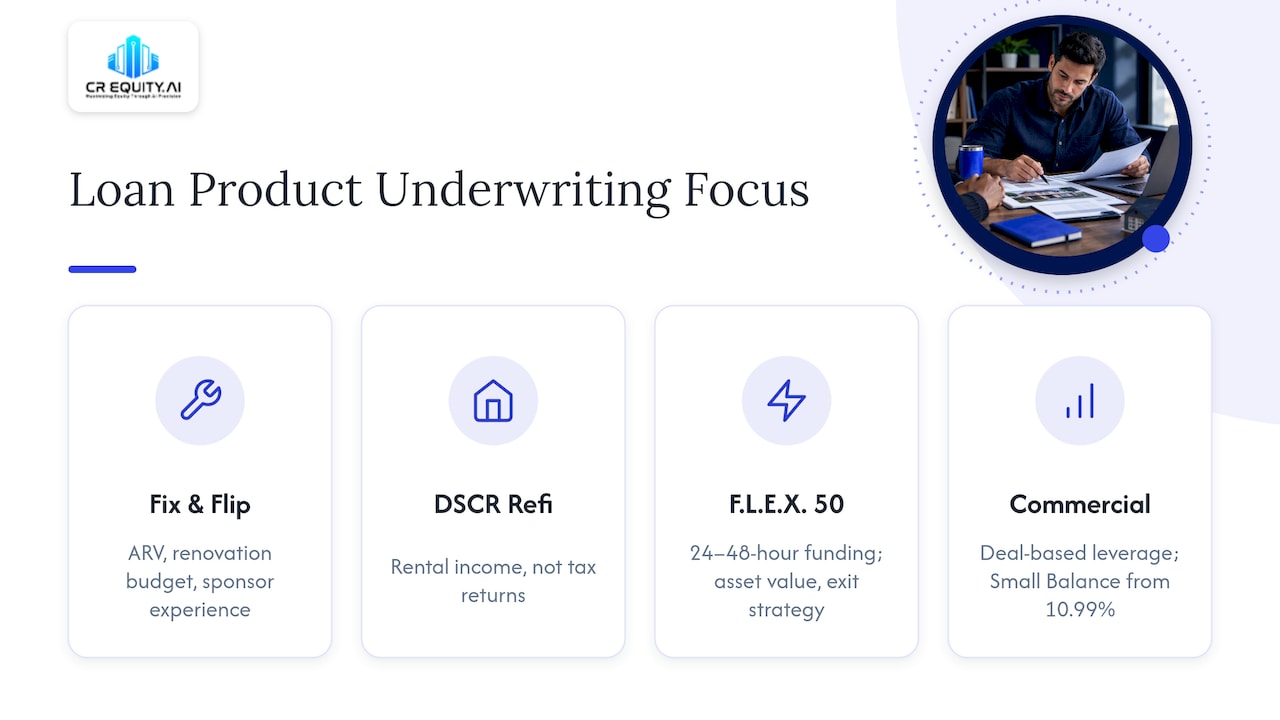
Our programs each run their own version of a credit box, built around the collateral and cash flow profile of the specific deal type rather than a single blanket standard. On Fix and Flip Loans, the box centers on after-repair value, renovation budget accuracy, and sponsor execution experience rather than personal income documentation.
Our DSCR Cash-Out Refinance program qualifies borrowers on in-place or projected rental income instead of tax returns, which shifts the box’s weight toward the property’s debt service coverage ratio and away from traditional income verification, a structure built specifically for self-employed and 1099 investors. The F.L.E.X. 50™ bridge product, priced according to the program’s published terms, runs a box built for speed: funding in 24 to 48 hours means the underwriting emphasis sits on asset value and exit strategy rather than extended documentation review.
Commercial Bridge Loans, with pricing listed in the program terms, and Small Balance Commercial Loans, also from 10.99%, both offer leverage based on the deal and borrower, reflecting a box calibrated for asset-based lending rather than strict bank-style conservatism. Across every program, we underwrite the deal and the asset rather than relying solely on a borrower’s paperwork, and we publish our advance-rate grids before application so sponsors can check fit before submitting.
Credit box implications for nontraditional income and foreign national borrowers
Most bank credit boxes are built around W-2 income, tax returns, and a strong domestic credit file, which automatically excludes a wide segment of real investors: self-employed sponsors, 1099 contractors, and international buyers without a US credit history. A borrower with nontraditional income doesn’t necessarily carry more risk, but a box built around traditional documentation has no way to measure that risk accurately, so the application gets declined on a documentation mismatch rather than an actual credit concern.
DSCR-based programs solve this by shifting the qualifying metric from personal income to property cash flow, which means a self-employed sponsor with strong rental income can qualify on the same terms as a W-2 borrower with equivalent cash flow. ITIN holders and foreign national investors face a similar structural gap in traditional bank boxes, since most depositories require a Social Security number and a US credit file as baseline inputs.
We support ITIN and foreign national investors directly, underwriting based on the asset and the deal’s cash flow. That approach widens the pool of qualified borrowers without lowering the underlying asset-level standards, since the collateral and income metrics still have to clear the same LTV and DSCR thresholds any other applicant would face.
How a soft credit pull changes borrower access to credit boxes
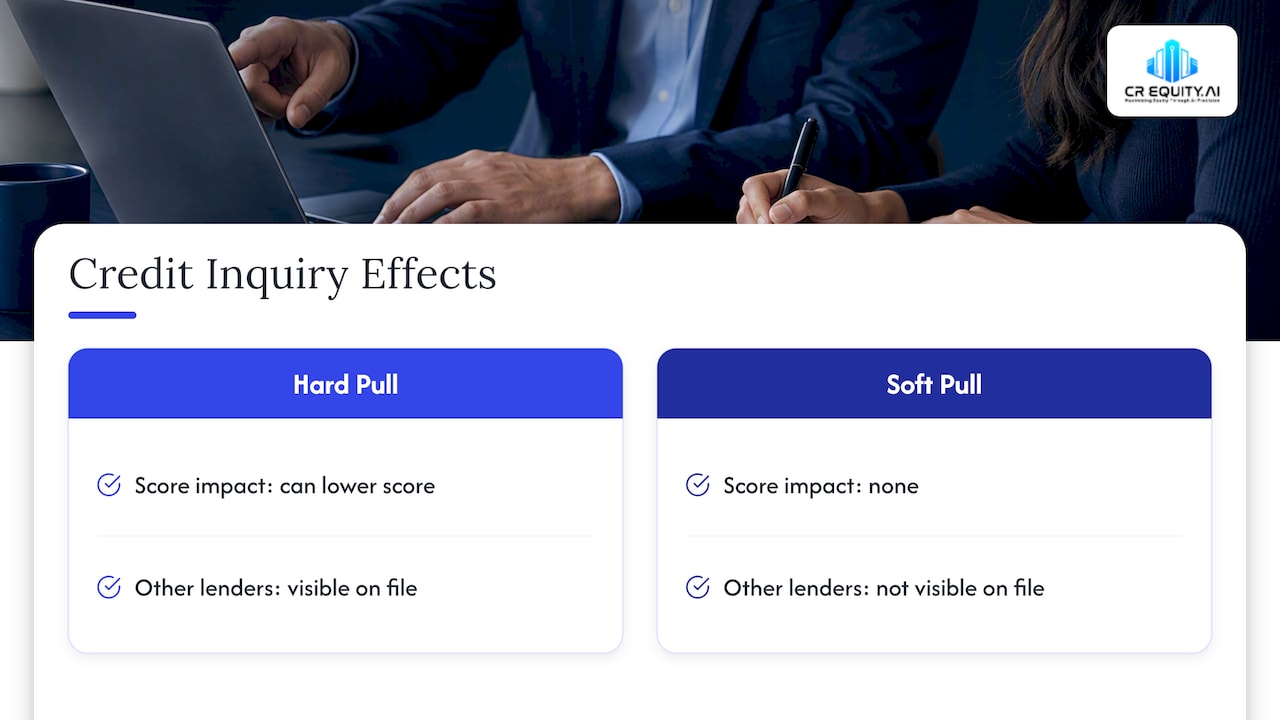
A hard credit inquiry dings a borrower’s score and leaves a visible mark that other lenders can see, which makes serial applications costly when a borrower doesn’t yet know which lender’s box actually fits. A soft credit pull avoids that cost entirely, letting a lender check general creditworthiness without affecting the score or appearing on the borrower’s credit file.
That distinction matters most for borrowers testing fit across multiple lender types before committing to a full application. We underwrite most real estate programs with a soft credit pull, which means a sponsor can get real feedback on whether a deal fits our box without the inquiry penalty that would come from testing several traditional lenders in sequence.
For borrowers juggling several potential financing sources at once, that flexibility compounds: testing fit with a soft pull preserves the credit profile for whichever lender ultimately extends the loan, and it removes one more reason to avoid shopping a deal properly before settling on terms.
Treat credit boxes as sorting tools, not personal verdicts
A credit box exists to sort deals quickly, not to judge borrowers personally, and treating a decline as a referendum on your creditworthiness misses the actual lesson. The faster read is almost always a specific metric mismatch: a DSCR that falls short by a few points, a geography the lender doesn’t currently serve, or an LTV request above the published ceiling.
The practical habit worth building is maintaining relationships across multiple lender classes, banks, private debt, and institutional balance-sheet lenders alike, and paying attention to the pattern in their recently funded deals rather than only their stated guidelines. Published boxes shift, and funded-deal patterns often reveal the real appetite faster than a rate sheet does.
— Robert Stewart Jr
Get your deal matched to the right lender fast
Shopping a deal against the wrong credit box wastes weeks and sometimes damages your credit profile along the way. We built our underwriting around the asset and the deal itself, with a soft credit pull and no income verification required on most real estate programs, so you get a real answer on fit according to the timing set out in the program terms, rather than being left uncertain.
Our programs span the full deal lifecycle: Investment Property Acquisition Loans for roughly a 10-day close, Fix and Flip Loans with advance rates that vary by deal and sponsor, DSCR Cash-Out Refinance qualified on rental income rather than tax returns, F.L.E.X. 50™ emergency bridge financing with expedited funding available according to program terms, Ground-Up Construction Loans with milestone draws on our own capital, Small Balance Commercial Loans, and business funding up to $10 million with no property required.
We lend our own capital rather than brokering someone else’s, and we publish our advance-rate grids before you ever apply. If you want to know exactly where your deal stands, submit your deal and get matched against our actual credit box today.
This article is general information, not a substitute for advice from a qualified financial advisor. Consult a qualified financial professional about your own circumstances before acting on anything here.
FAQ
What does “credit box” mean?
A credit box is a lender’s pre-set range of underwriting and risk parameters, such as FICO score floors, LTV limits, and DSCR minimums, used to decide which loans qualify for approval. It acts as a filter: deals that fall inside the published or implicit ranges move forward, while those outside get declined or re-priced.
How long does it take to raise a credit score from 500 to 600?
The timeline depends entirely on what’s dragging the score down, since paying off collections or reducing credit utilization moves faster than rebuilding a thin file from scratch. There’s no fixed industry timeline for this specific jump, so borrowers in this range are generally better served by DSCR-based or asset-based loan programs that don’t require a strong personal credit score, such as DSCR Cash-Out Refinance.
What credit score do you need to get a $30,000 loan?
The required score depends on the lender, the loan type, and whether the loan is secured against an asset or based on personal credit alone. Asset-based or DSCR-qualified programs often weigh property cash flow and collateral value more heavily than a specific credit score threshold, so a borrower’s documentation path matters as much as the number itself.
Is 700 a poor credit score?
No, a FICO score generally falls within the range lenders consider good to very good, not poor. Most conventional lender credit boxes set their minimum floors below typical borrower scores, so a borrower with a good-to-very-good score typically qualifies for competitive pricing on bank and conforming products.
How do published and implicit credit boxes differ?
A published credit box appears on a rate sheet or term grid showing exact LTV, DSCR, or FICO requirements, while an implicit box exists only in a lender’s internal risk appetite and gets revealed through the deals it actually funds. Borrowers assessing implicit boxes should review a lender’s recently funded-deal history rather than relying on general marketing claims.