

Debt yield equals net operating income divided by the loan amount, expressed as a percentage: Debt Yield = NOI ÷ Loan Amount × 100.
- Formula: NOI ÷ Loan Amount = Debt Yield
- Reading: Higher percentage means lower leverage and faster theoretical payback for the lender
- Consistency check: NOI and loan balance must reflect the same point in time and the same underwriting assumptions
Table of Contents
- How Do You Calculate Debt Yield Step by Step?
- Worked Examples: Debt Yield and Maximum Loan Sizing
- What Counts as a Good Debt Yield?
- Debt Yield vs DSCR, LTV, and Cap Rate: How Do They Connect?
- Where Debt Yield Falls Short as a Standalone Metric
- Sources
- FAQ
How Do You Calculate Debt Yield Step by Step?
Debt yield calculation starts with net operating income, not gross rent. NOI is what remains after collecting rental and ancillary income (parking, storage, laundry), subtracting a vacancy allowance, and paying operating expenses, property taxes, insurance, and replacement reserves. Debt service, capital expenditures, and depreciation stay out of the NOI line entirely.
Once you have a defensible NOI, the debt yield calculation is three steps:
- Confirm NOI. Use trailing twelve-month actuals or the lender’s underwritten NOI, whichever the deal calls for, and note which one you used.
- Divide by loan amount. Use the initial funded loan balance, not a projected payoff balance or a future draw amount.
- Convert to a percent. Multiply the result by 100.
The most common data issue is mixing trailing NOI (what the property actually produced) with underwritten NOI (what the lender projects after normalizing rents, vacancy, and expenses). The second issue is loan balance selection: construction and bridge loans often quote a “fully funded” balance that includes future draws, which is not the same as the balance outstanding at closing.
Pro Tip: Always label which NOI you used (trailing 12-month or underwritten) directly on your calculation sheet. A debt yield number without that label is not verifiable by anyone else reviewing the file.
Worked Examples: Debt Yield and Maximum Loan Sizing
Example 1: Calculate debt yield from NOI and loan amount.
- NOI: $750,000
- Loan amount: $9,375,000
- Debt yield: NOI divided by loan amount equals a typical single-digit percentage
- Years-to-recover interpretation: at 8%, the lender would need roughly 12.5 years of NOI at this level to recoup the loan principal
Example 2: Calculate maximum loan from a debt-yield floor.
- NOI: $750,000
- Lender’s debt-yield floor: 10%
- Max Loan is calculated by dividing NOI by the debt-yield floor, yielding the maximum loan amount the property can support (amount depends on the floor used)
Notice the floor in Example 2 caps the loan below the $9,375,000 amount used in Example 1. That gap is exactly what debt yield is built to catch: a loan amount that satisfies the borrower’s target LTV but fails the lender’s minimum return threshold.
What Counts as a Good Debt Yield?
There is no single “good” number. It depends on property type, sponsor track record, and where the lender sits in the capital stack. What matters is where your deal falls relative to that specific lender’s floor.
- Stabilized multifamily usually clears floors in a lower single-digit range, while hotels and other operationally volatile property types face correspondingly higher floors reflecting greater cash-flow risk.
- CMBS conduits tend to weight debt yield more heavily than balance-sheet lenders, since it is one of the few metrics rating agencies can apply uniformly across a securitized pool.
Debt yield’s real function: it sets a ceiling, not a target. Once you know the floor, Max Loan = NOI ÷ floor tells you the largest loan that property supports, full stop, regardless of what the sponsor wants to borrow.
Floors move with sponsor quality, market liquidity, and lender type. A strong sponsor with a clean operating history can sometimes negotiate a lower floor; a first-time borrower or a property with tenant concentration risk usually faces a higher one. Confirm current floors with your lender before modeling a deal, since these ranges shift with rate cycles and property-sector sentiment. CR Equity Ai Inc’s published debt benchmarks track how these floors move across cycles.
Debt Yield vs DSCR, LTV, and Cap Rate: How Do They Connect?
Four metrics answer four different underwriting questions, and confusing them is a common mistake.
- DSCR (net operating income ÷ annual debt service) measures whether cash flow covers the loan payment, including rate and amortization.
- LTV (loan amount ÷ property value) measures leverage against an appraised or purchase value.
- Cap rate (NOI ÷ property value) measures the market’s return expectation for the asset, independent of financing.
- Debt yield (NOI ÷ loan amount) measures lender return on the loan itself, ignoring rate and amortization entirely.
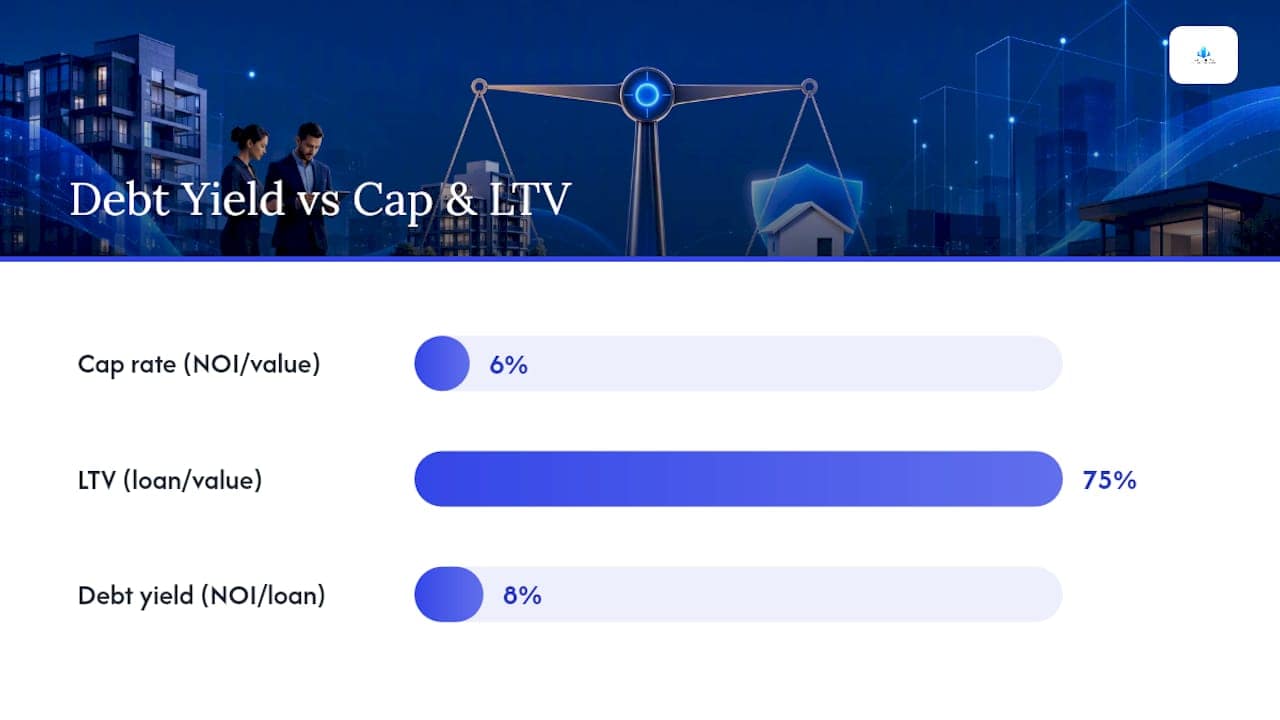
These four connect mathematically. Since debt yield divides NOI by loan amount, and cap rate divides NOI by value, dividing debt yield by cap rate cancels NOI and leaves loan amount over value, which is LTV inverted. Rearranged, that gives Debt Yield = Cap Rate ÷ LTV. A property trading at a 6% cap rate with 75% LTV produces a debt yield of 8% (6% ÷ 0.75).
This relationship explains why compressed cap-rate markets force lower LTVs: if the cap rate falls and the lender’s debt-yield floor stays fixed, LTV has to shrink to keep the equation balanced. DSCR still governs monthly payment coverage and often drives pricing, while debt yield tends to govern the maximum loan amount a lender will actually commit. For a deeper look at how DSCR is calculated and why lenders weight it separately, see this DSCR explainer.
Where Debt Yield Falls Short as a Standalone Metric
Debt yield is rate- and amortization-agnostic, which is its strength and its blind spot. It cannot be improved by stretching the amortization schedule or negotiating a lower rate, but it also tells you nothing about a property’s market value risk or how sensitive the deal is to a rate shock.
- NOI adjustments (vacancy assumptions, replacement reserves, one-time income) can swing debt yield without changing the underlying property.
- A healthy debt yield does not offset volatile cash flows, tenant concentration, or an approaching lease rollover cliff.
Pro Tip: *Run debt yield alongside DSCR and LTV, not instead of them.
Quick Checks Before You Submit a Loan Request
- Confirm your NOI and loan balance reflect the same time period and funding assumptions.
- Run the math twice: NOI ÷ Loan Amount, then Max Loan = NOI ÷ floor, and check they agree.
- Compare the debt yield result against DSCR and LTV outputs for the same deal before submitting to a lender.
Debt yield at or above a certain threshold generally clears the floor for many stabilized asset types; anything close to a lender’s stated minimum deserves a second look at NOI normalization before you submit the file.
Debt yield equals NOI divided by loan amount, and it sets the hard ceiling lenders use to size a maximum loan regardless of the borrower’s requested amount.
| Point | Details |
|---|---|
| Core formula | Debt Yield = NOI ÷ Loan Amount × 100, a rate- and amortization-independent lender metric. |
| Loan sizing | Max Loan = NOI ÷ debt-yield floor; this often caps the loan below LTV-based targets. |
| Typical ranges | Stabilized multifamily often clears mid-single digits to roughly 8%; hotels and volatile assets face higher floors. |
| Metric linkage | Debt Yield = Cap Rate ÷ LTV, connecting market pricing directly to lender return thresholds. |
| Standalone risk | A healthy debt yield does not offset tenant concentration or NOI volatility; pair it with DSCR and LTV. |
| CR Equity Ai Inc approach | CR Equity Ai Inc underwrites the asset and the deal against published advance-rate grids, with decisions in as little as four hours. |
Where to Verify Debt Yield Figures and Underwriting Steps
- Debt Yield | Formula + Calculator for the formula mechanics and calculator walkthrough.
- Step by Step Real Estate Underwriting: 2026 Guide for NOI normalization practices.
A Note on Using Debt Yield in Practice
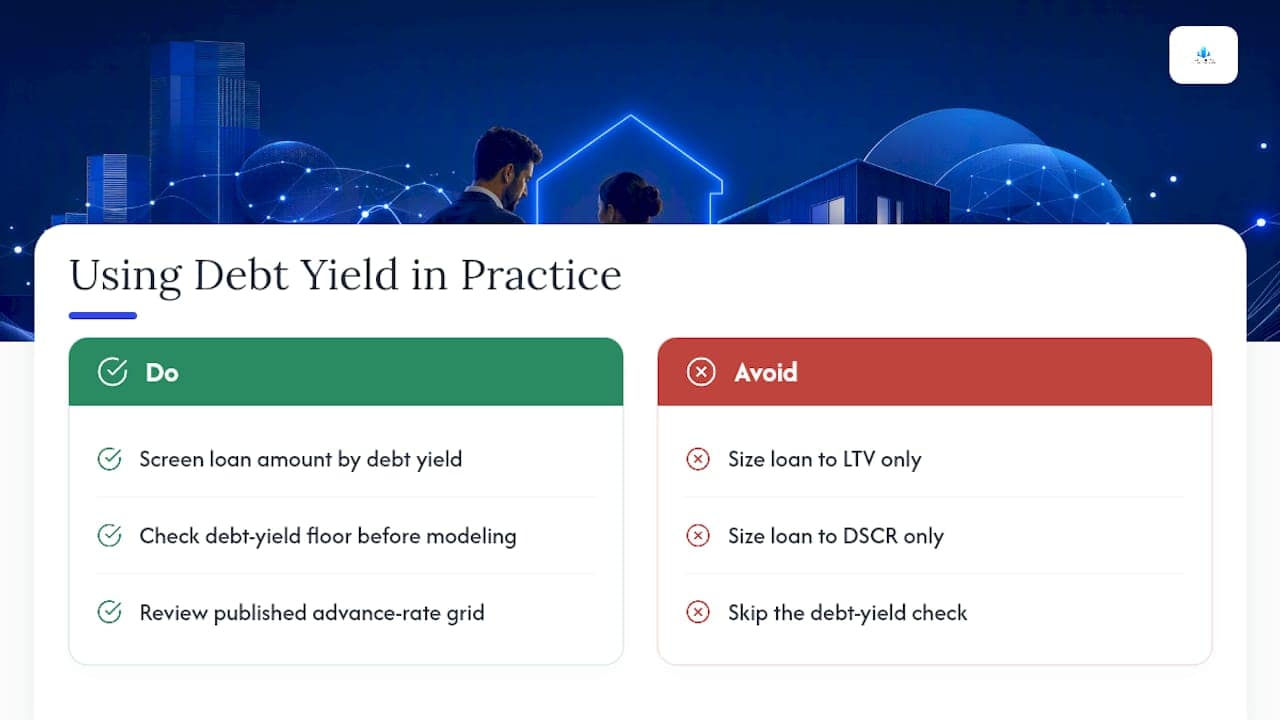
Debt yield is the fastest screen for whether a requested loan amount is realistic, before anyone builds a full model. The most frequent mistake borrowers make is submitting a loan amount sized to LTV or DSCR alone, without checking it against a debt-yield floor first. Reviewing a published advance-rate grid before you apply avoids that surprise entirely.
Get a Debt-Yield-Ready Loan Quote
Once you know your property’s debt yield, the next question is whether your target loan amount actually clears a lender’s floor, and that depends on the program. CR Equity Ai Inc underwrites the asset and the deal itself, with a soft credit pull and no income verification on most real estate programs, so a healthy debt yield can carry more weight than it would with a lender focused primarily on borrower paperwork.

Whether you need acquisition financing closing in about 10 days, a fix-and-flip loan, or small balance commercial financing between $100,000 and $100 million, run your numbers through the debt-yield math above first. Then request a loan quote to see how your deal sizes against current programs, with decisions possible in as little as four hours.
Sources
- Debt Yield | Formula + Calculator
- Cap Rate vs DSCR vs Debt Yield: Which Metric Matters Most? | PrimeCalcTools
FAQ
What Is a Good Debt Yield?
Confirm the specific floor with your lender, since it shifts with market conditions and sponsor quality.
What Is Debt Yield vs DSCR?
Debt yield (NOI ÷ loan amount) measures lender return on the loan amount itself and ignores rate and amortization; DSCR (NOI ÷ annual debt service) measures whether cash flow covers the actual loan payment. Lenders often use debt yield to cap the maximum loan and DSCR to test payment coverage and pricing.
What Does an 8% Debt Yield Mean?
It also means the loan amount equals roughly 12.5 times the property’s NOI.
What Does Debt Yield Tell a Lender?
Debt yield tells a lender its return on the loan amount independent of interest rate or amortization structure, making it a stable way to compare risk across deals with different financing terms. It also sets the maximum loan a property can support once a floor is applied: Max Loan = NOI ÷ floor.
How Does CR Equity Ai Inc Use Debt Yield in Underwriting?
CR Equity Ai Inc evaluates the asset and the deal directly, weighing debt yield alongside published advance-rate grids rather than relying solely on borrower income documentation. That approach lets sponsors see loan-sizing constraints tied to property performance before they apply.
Recommended
- Institutional Crypto-Backed Lending: Risk Models and Collateral Mechanics | CR Equity AI
- Private-Lender Loan to Value Ratio Benchmarks: 2026 Guide | CR Equity AI
- Commercial Real Estate Debt Benchmarks: 2026 Guide
- DSCR Loans Explained: How Investors Qualify on Rental Income, Not Tax Returns | CR Equity AI