

Document intelligence for lending is the combination of OCR, natural language processing, classification models, and rules automation that a lender uses to extract, validate, and route borrower and property documents during underwriting. Applied well, it means fewer document requests, faster conditional approvals, and cleaner files reaching the closing table. It does not replace judgment on complex deals, and it works only inside a governed model risk framework that lenders are expected to document and monitor.
TL;DR:
- Properly scanned PDFs with consistent naming and complete pages significantly improve automation accuracy and speed during underwriting.
- Automation excels at high-volume, repetitive tasks like classifying document types and extracting numeric fields, but complex judgments still require manual review.
- Lenders must continuously validate, document, and monitor their automation models to comply with federal regulations and maintain accuracy over time.
- Uploading high-quality, unedited documents and granting open-banking permissions reduces errors and reliance on static, easily outdated data sources.
- Transparency and published underwriting criteria help borrowers understand approval timelines and avoid black-box decision delays.
Table of Contents
- How Document Intelligence Works From Application to Funding
- What Automation Actually Changes About Speed and File Quality
- The Regulatory Rules Behind the Automation
- What to Upload First to Speed Up Your File
- Privacy and Data Security in an Automated Underwriting File
- Where Document Intelligence Is Headed Next
- Integration Challenges Lenders Face When Adopting Document Intelligence
- Why Transparent Documentation Beats a Faster Algorithm
- Get a Deal Underwritten With Published Terms Upfront
- Sources
- FAQ
How Document Intelligence Works From Application to Funding
Document intelligence enters the process the moment a borrower starts an application, not after a loan officer opens a file. At point-of-sale, automated needs lists ask for exactly the documents a given loan program requires, based on entity type, property type, and program rules, rather than a generic checklist that triggers extra rounds of requests.
Once documents arrive, OCR converts scanned paystubs, tax returns, bank statements, leases, and title reports into machine-readable text. Natural language processing then identifies what each document is and pulls out the fields underwriting actually needs, like gross rent, account balances, or entity ownership percentages. Classification models sort incoming files into the right bucket automatically, so a lease addendum doesn’t get filed as a bank statement.
Property valuation runs in parallel. Automated valuation model (AVM) outputs feed collateral assessment alongside extracted rent rolls and comparable sales data, giving underwriters a data-backed starting point rather than a blank file. From there, rules automation decides what happens next:
- Clean files with consistent data across documents route to auto-approval or a fast conditional approval.
- Files with mismatched income figures, unclear entity structures, or unusual property types route into an exception queue for manual underwriter review.
- Verification services and open-banking connections cross-check self-reported income and assets against live account data, reducing reliance on static, easily outdated paper documents.
The workflow only works when each stage feeds the next cleanly. A poor scan at intake creates a bad extraction, which creates a false exception, which slows the whole file down regardless of how good the automation is downstream.
What Automation Actually Changes About Speed and File Quality
The clearest gain shows up before underwriting even starts. Freddie Mac and broader GSE research show that upfront data collection at point-of-sale reduces defect risk and lowers cost-to-originate, because errors get caught and corrected before a file ever reaches an underwriter’s desk.
Industry finding: MBA research on AI-driven lending workflows documents lenders piloting agentic AI for document checks specifically because manual document review has historically been the single largest bottleneck in origination timelines.
Tasks that are mechanical and repetitive are the ones automation handles well:
- Reading and classifying document types (a W-2 versus a 1099 versus a K-1).
- Extracting numeric fields from paystubs, bank statements, and tax transcripts.
- Cross-referencing extracted data against loan application entries for mismatches.
- Flagging missing pages, expired documents, or unsigned forms before they reach a human queue.
Tasks that still require a person are the ones involving judgment calls: unusual entity structures, gift funds with ambiguous sourcing, self-employment income that doesn’t fit a standard template, or property conditions an AVM can’t see. The biggest return on automation shows up at the front end, in upfront validation and classification, because that’s where volume is highest and the decisions are the most binary. The failure modes cluster in predictable places, too. Blurry or cropped scans produce garbled extractions. Documents in nonstandard formats confuse classification models. Conflicting data between two documents, like a pay stub showing different year-to-date totals than a W-2, generates exceptions that need a human to resolve. None of that is a flaw unique to any one lender’s system. It’s a structural limit of automation applied to messy paper.
The Regulatory Rules Behind the Automation
Document intelligence doesn’t operate in a vacuum. Federal banking regulators treat automated underwriting tools the same way they treat any other model: something that must be inventoried, validated, documented, and monitored.
The OCC’s model risk management guidance calls for ongoing validation and documentation of both vendor and in-house models, and that standard applies whether the “model” is a credit scoring algorithm or a document classification engine deciding which files skip manual review. A lender can’t simply deploy an automation tool and assume it stays accurate over time; performance has to be monitored against outcomes on an ongoing basis.
Alternative data adds another layer of scrutiny. When lenders pull in bank transaction data or other nontraditional inputs to validate income or assets, the interagency statement on alternative data in credit underwriting calls for robust testing, monitoring, and compliance management to guard against disparate impact.
What examiners actually review, in practice:
- Model inventories listing every automated tool touching a credit decision.
- Exception logs showing which files were flagged, why, and how they were resolved.
- Sample testing across applicant profiles to check for disparate outcomes.
- Audit trails documenting who reviewed what, and when.
Pro Tip: Ask a prospective lender whether their exception logs are timestamped and reviewable on request. A lender that can produce that documentation immediately is almost always further along in model governance than one that has to “check with the tech team.”
What to Upload First to Speed Up Your File
The single biggest lever a borrower or broker controls is document quality at intake. Automated systems are only as good as what they’re fed.
- Upload complete, unedited PDFs rather than photos of paper documents. A properly scanned multi-page PDF, rather than five separate photo files, is dramatically easier for classification systems to read correctly.
- Name files by document type and date (for example, “2024_Bank_Statement_Checking.pdf”) rather than generic names like “scan001.pdf.”
- Grant open-banking or account-connect permissions where offered, so cash flow and asset verification happen against live data instead of static statements that go stale within weeks.
- Submit all pages of multi-page documents, including blank or “intentionally left blank” pages; a missing page is a common trigger for a manual exception.
- Respond to exception requests within the lender’s stated window, typically a business day or two, since a stalled exception holds up the entire file regardless of how fast the automated steps ran.
| Action | Why It Matters |
|---|---|
| Scan as PDF, not photo | Reduces OCR misreads and misclassification |
| Name files by type and date | Speeds automated routing into the right document bucket |
| Connect bank accounts directly | Replaces static statements with verifiable live data |
| Submit complete document sets | Prevents missing-page exceptions |
| Respond fast to exception requests | Keeps the file moving through the queue |
Privacy and Data Security in an Automated Underwriting File
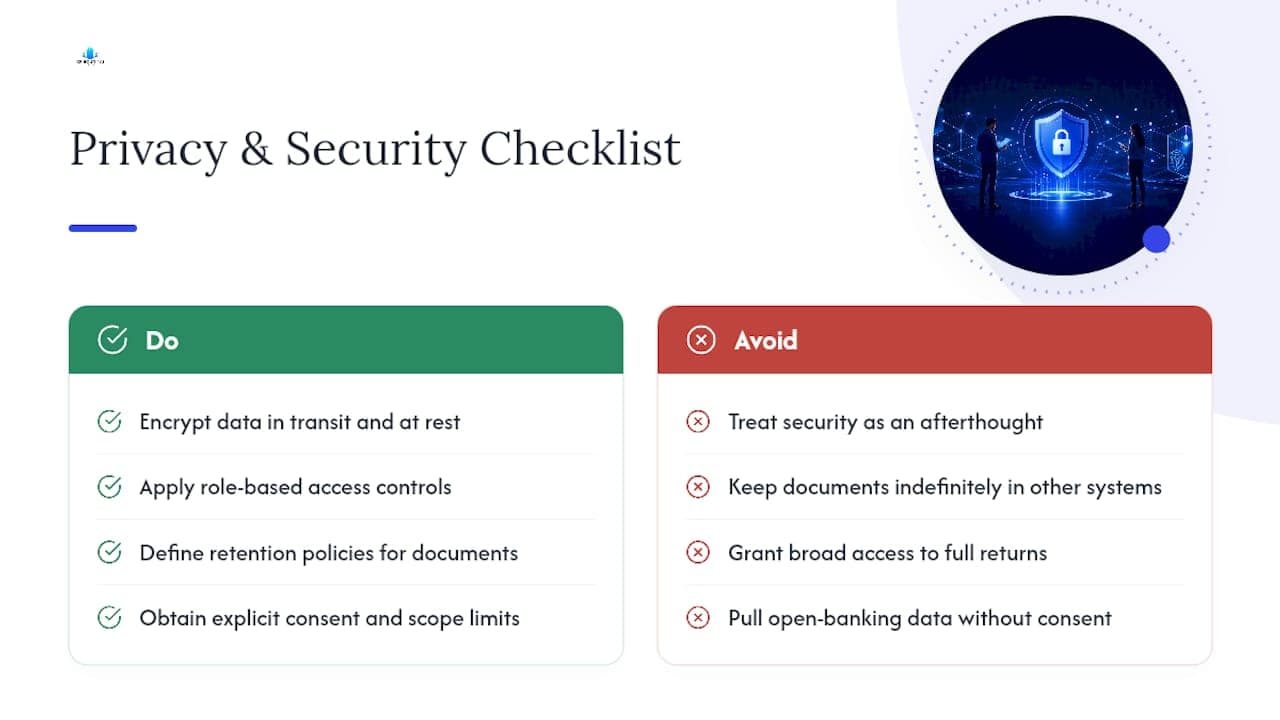
Every document a borrower uploads for underwriting, tax returns, bank statements, entity formation papers, contains sensitive personal and financial data. Automated systems that ingest that data at scale create both an efficiency gain and a security obligation that lenders can’t treat as an afterthought.
Encryption in transit and at rest is the baseline expectation for any platform handling loan documents, and that standard doesn’t change just because a document passes through an automated extraction step instead of a human reviewer’s inbox. What does change is the surface area: an automated pipeline touches more systems, more APIs, and more third-party verification services than a purely manual process did a decade ago. Open-banking connections, for instance, require explicit borrower consent and clear scope limits on what data gets pulled and how long it’s retained.
Access controls matter as much as encryption. Not every employee or system component needs to see a full tax return; role-based access limits exposure so that document intelligence tools process only the fields relevant to their function. Retention policies matter too. Documents collected for underwriting shouldn’t sit indefinitely in systems built for something else once a loan closes or a file is declined.
Borrowers and brokers should ask a direct question before uploading sensitive files anywhere: where is this data stored, who can access it, and how long is it kept? A lender with a mature document intelligence stack should be able to answer all three without hesitation.
Where Document Intelligence Is Headed Next
The next phase of document intelligence in lending is less about reading documents and more about reasoning across them. Current systems extract and classify; emerging systems cross-reference multiple documents simultaneously to catch inconsistencies a human reviewer might miss on a first pass, like a rent roll that doesn’t match a lease term or an entity name that’s spelled slightly differently across two filings.
MBA-affiliated research and member commentary describe lenders piloting agentic AI that can chain multiple document-checking steps together without a human triggering each one manually. Instead of a person routing a flagged file from classification to verification to exception review, an agentic system moves the file through that sequence on its own, escalating to a human only when it hits a genuine judgment call.
Standardization is the other trend worth watching. MISMO’s ongoing updates to its industry loan application dataset push the industry toward common data formats, which matters because automation performs best when documents and data fields arrive in predictable structures rather than a different layout from every originator. Expect continued movement toward real-time data validation at the point of upload, catching a mismatched figure the moment a borrower submits it rather than three days later in an underwriter’s queue.
Integration Challenges Lenders Face When Adopting Document Intelligence
Deploying document intelligence tools is rarely the hard part; making them work reliably across an entire loan book is. The most common failure isn’t a bad algorithm, it’s a mismatch between what the automation expects and what actually shows up in a borrower’s upload folder.
Legacy loan origination systems built for manual workflows often can’t pass data cleanly to newer automation layers, which forces lenders to build custom integration points that add cost and points of failure. A second challenge is data quality drift: a classification model trained on one set of document formats degrades in accuracy when borrowers start submitting documents from new sources, like a bank that redesigns its statement layout.
Best practice starts with narrow deployment. Lenders that succeed with document intelligence tend to automate the highest-volume, most standardized document types first, like W-2s and bank statements, before expanding to less standardized ones, like K-1s or foreign income documentation. Exception queues need real staffing, not a token reviewer checking in once a day; a queue that backs up defeats the entire purpose of automating the front end. Ongoing monitoring and outcome analysis catch model drift before it becomes an underwriting problem, and that monitoring has to be a permanent operational function, not a one-time deployment checklist.

Why Transparent Documentation Beats a Faster Algorithm
The lenders worth trusting with document intelligence aren’t the ones claiming the fastest processing speed. They’re the ones willing to publish exactly how their advance rates and underwriting criteria work before you ever apply. Speed without documentation is a black box; speed with published origination documentation is something you can actually verify.
Fast decisions make sense for straightforward files: standard property types, clean income documentation, consistent data across sources. Deeper manual review still belongs on complex entity structures, unusual income sourcing, or properties an AVM can’t confidently price. A lender who defaults to instant approval on every file, regardless of complexity, isn’t necessarily faster. They may just be skipping a step you’ll feel later.
Before you commit to a lender, ask three questions: What documentation do you publish before I apply? How do you handle exceptions, and how fast? What happens when your automated tools disagree with each other?
— Robert Stewart Jr
Get a Deal Underwritten With Published Terms Upfront
Some direct lenders offer an alternative to black-box lending for real estate investors and business owners who want to know the terms before they apply, not after. We publish our advance-rate grids and origination documentation in the document library so you can see exactly how a deal gets underwritten before you submit one.
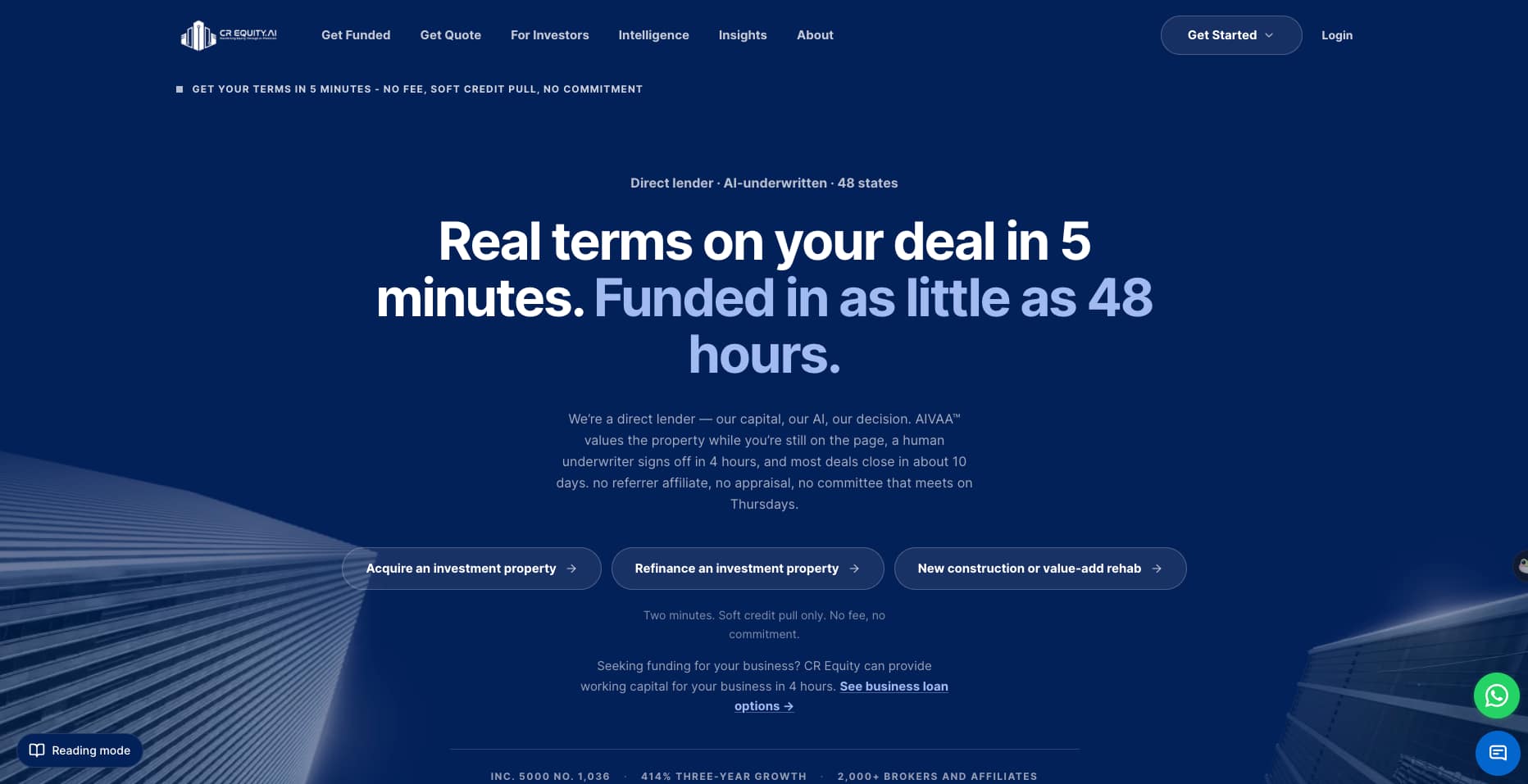
If speed and nontraditional income are your priority, the DSCR Cash-Out Refinance program qualifies on rental income rather than tax returns, built for self-employed and 1099 borrowers. For bridge financing on a time-sensitive deal, F.L.E.X. 50™ funds in 24 to 48 hours with a published lender fee. Brokers with a deal ready to move can submit it directly and get underwriting eyes on the file the same week.
This article is general information, not a substitute for advice from a qualified financial advisor. Consult a qualified financial professional about your own circumstances before acting on anything here.
Sources
- Model Risk Management – Revised Guidance
- Interagency statement on the use of alternative data in credit underwriting
- Upfront data collection improves loan quality, lowers origination costs – MBA Newslink
FAQ
What Is Document Intelligence for Lending?
Document intelligence for lending refers to the OCR, natural language processing, and rules automation a lender uses to extract and validate borrower and property documents during underwriting. It’s applied on the lender’s side of the file, not a tool borrowers use themselves.
Does Document Automation Replace Manual Underwriting?
No. Automation handles high-volume, standardized tasks like reading paystubs and classifying documents, but files with unusual income, entity structures, or property types still route to manual review through exception queues.
How Fast Can a Lender Decide With Document Intelligence?
Decision speed depends on file complexity and the lender’s own process. CR Equity Ai Inc publishes decisions in as little as 4 hours on qualifying real estate files with clean documentation.
What Documents Should I Prepare Before Applying?
Prepare complete, properly scanned PDFs of bank statements, tax documents, entity formation papers, and lease agreements, named by document type and date. Granting bank-connect access speeds asset and income verification significantly.
What Regulatory Rules Govern Automated Underwriting?
Federal banking regulators require model validation, documentation, and ongoing monitoring for any automated tool used in credit decisions, per OCC guidance. Alternative data use requires additional testing for disparate impact under interagency guidance.