

A down payment is the upfront cash portion of a home’s purchase price that you pay directly, and it becomes your initial equity in the property. For most home loans, that figure lands somewhere between 3.5% and 20% of the purchase price, depending on the loan program you qualify for. It is not the same as your total cash to close, which also includes closing costs, prepaid items, and any escrow deposits.
TL;DR:
- Conventional loans may require as little as 3% down, but crossing certain thresholds can significantly affect your interest rate and fees.
- Your total cash to close includes down payment, closing costs, prepaid items, and earnest money, which reduces your final amount needed at settlement.
- Using government-backed programs like VA and USDA can eliminate the down payment requirement for eligible buyers, but they come with specific fees and eligibility rules.
- Lowering your down payment increases your loan-to-value ratio, leading to higher interest rates and mandatory mortgage insurance until you acquire at least 20% equity.
- Underwriters scrutinize funding sources closely; having organized, verifiable documentation is crucial to ensure a smooth, timely closing.
Table of Contents
- How Much Down Payment Do You Need?
- What Counts Toward Your Down Payment vs. Cash to Close
- How Your Down Payment Size Affects Rate, LTV, and Insurance
- Low- and No-Down-Payment Options Worth Knowing
- A Practical Checklist for Deciding How Much to Put Down
- Tax Implications Tied to a Down Payment
- Common Down Payment Misconceptions That Trip Up Buyers
- What Underwriters Actually Check on Down Payment Funds
- A Lender’s Take on Down Payment Discipline
- Sources
- FAQ
How Much Down Payment Do You Need?
The honest answer depends entirely on the loan program, not on some universal rule. Conventional loans backed by Fannie Mae or Freddie Mac often allow as little as 3% down for qualifying first-time buyers, but lenders frequently price loans in 5% increments, meaning your rate or fees can shift noticeably as you cross the 5%, 10%, 15%, and 20% marks.
FHA loans require a minimum of 3.5% down for borrowers with qualifying credit scores, but that lower barrier comes with mortgage insurance premiums (MIP) that typically last for the life of the loan unless you refinance. VA and USDA loans can allow no down payment for eligible veterans, active-duty service members, and buyers in qualifying rural areas, though both programs carry their own funding fees and geographic or service-based eligibility rules. Jumbo loans and investment properties tend to require higher down payments, often well above typical conventional loan minimums, due to increased lender risk, since lenders view larger loan amounts and non-owner-occupied properties as higher risk.
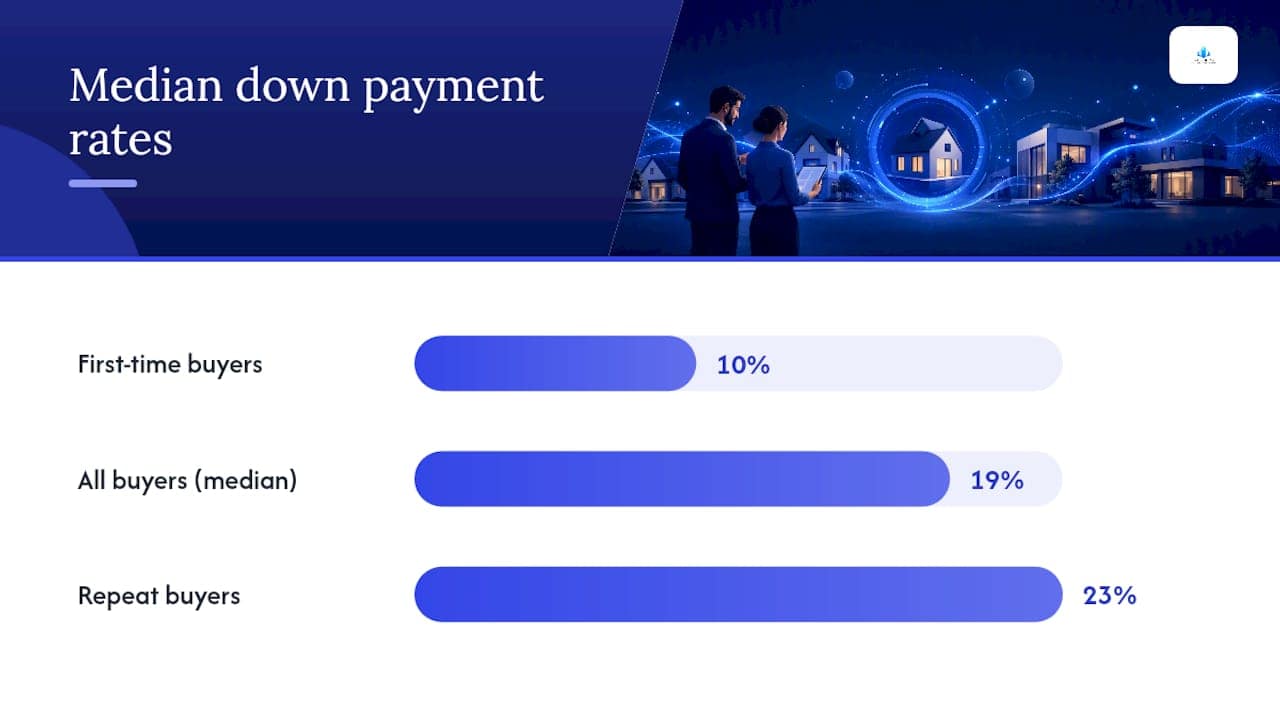
Real-world numbers back this up. The National Association of Realtors reports a median down payment of 19% across all buyers in 2025, but that figure splits sharply by buyer type: 10% for first-time buyers and 23% for repeat buyers who typically roll existing home equity into the next purchase.
- Conventional: as low as 3%, with pricing tiers at 5%, 10%, 15%, and 20%
- FHA: 3.5% minimum, plus ongoing mortgage insurance
- VA and USDA: no down payment required for eligible borrowers
- Jumbo and investment properties: commonly 15% to 25%
What Counts Toward Your Down Payment vs. Cash to Close
Your down payment is just one line item in a bigger total called cash to close, and confusing the two is one of the fastest ways to get blind sided at the closing table. Cash to close includes your down payment plus closing costs and prepaid items like homeowners insurance, property tax reserves, and title fees. According to the Consumer Financial Protection Bureau, closing costs typically run a few percent of the home’s purchase price on top of whatever you put down.
Earnest money you paid when you signed the purchase contract does not disappear. It gets credited toward your total cash to close at settlement, reducing the amount you need to bring on closing day.
- Down payment: your equity contribution
- Closing costs: lender fees, title work, recording fees (2%–5% of price)
- Prepaid items: insurance and tax escrow deposits
- Earnest money: already paid, credited back at closing
Final funds almost always need to arrive as certified funds, meaning a cashier’s check or a verified wire transfer, according to Chase’s guidance on cash to close. Confirm wire instructions directly with your settlement agent by phone, since wire fraud targeting home closings remains a real risk. Before closing day, request a line-by-line walkthrough of your Loan Estimate and Closing Disclosure from your lender. Reading a loan-to-cost breakdown alongside these documents helps you understand exactly how your total financed amount relates to what you owe at the table.
How Your Down Payment Size Affects Rate, LTV, and Insurance
A bigger down payment lowers your loan-to-value ratio, or LTV, which is simply the loan amount divided by the home’s value. Lower LTV generally means better interest rates and lower monthly payments, because you represent less risk to the lender.
Put down less than 20% on a conventional loan, and you’ll pay private mortgage insurance (PMI) until your equity crosses that threshold, per CFPB guidance. FHA loans work differently: their mortgage insurance premium (MIP) often sticks around for the full loan term regardless of how much equity you build. Because lenders price loans in bands, crossing from 9% down to 10%, or from 19% to 20%, can trigger a real rate or fee improvement, not just a marginal one.
None of this means you should drain your savings to hit the next threshold. The CFPB recommends keeping 3 to 6 months of living expenses in reserve as an emergency cushion, separate from your down payment funds. A home purchase that leaves you with zero financial slack is a fragile one, no matter how good the rate looks on paper.
Low- and No-Down-Payment Options Worth Knowing
Not every buyer needs to reach 20%, or even 10%, before buying. Several programs exist specifically to lower that barrier, though each comes with trade-offs worth understanding before you apply.
- VA loans: zero down for eligible veterans, active-duty members, and some surviving spouses, with a funding fee that varies by service history and down payment amount.
- USDA loans: zero down for buyers purchasing in eligible rural and suburban areas who meet income limits, according to Fannie Mae’s overview of down payment options.
- FHA loans: 3.5% minimum down for qualifying credit profiles, paired with mortgage insurance that lasts the loan’s life in most cases.
- State and local Down Payment Assistance (DPA) programs: grants, forgivable loans, and deferred second mortgages that vary widely by state and even by county, so check your state housing finance agency or a HUD-certified counselor for what’s actually available where you’re buying.
- Gifts and employer assistance: allowed on most loan programs, but lenders require documentation, typically a signed gift letter and a paper trail showing the funds moved from the giver’s account to yours.
Underwriters scrutinize gifted or assistance funds closely, since unexplained deposits are a common reason closings get delayed. Have that documentation ready before you apply, not after your lender asks for it.
A Practical Checklist for Deciding How Much to Put Down
Deciding your down payment amount is a math exercise, not a gut call. Work through these steps in order:
- Tally your available cash, then subtract 3 to 6 months of living expenses as an emergency cushion you won’t touch.
- Estimate closing costs separately, using the 2% to 5% range as a starting point, and subtract that from what’s left.
- Check which loan programs you qualify for and note their minimum down payment requirements.
- Model your monthly payment at a few different down payment levels, factoring in PMI or MIP where it applies.
- Request a Loan Estimate from your lender and verify the cash-to-close figure line by line before you commit.
Seeing the actual dollar gap in monthly payment, not just the percentage difference, makes the trade-off between liquidity and long-term cost far easier to judge.*
Tax Implications Tied to a Down Payment
A down payment itself is not tax-deductible. It is simply your own money converted into home equity, so there’s no separate write-off for the amount you put down. What can carry tax benefits is what happens after closing: mortgage interest and, in many cases, property taxes may be deductible if you itemize, though the loan amount and interest rate, not your down payment size, drive how much interest you pay each year.
There’s an indirect relationship worth understanding. A larger down payment means a smaller loan balance, which means less mortgage interest paid over time, which in turn means a smaller potential interest deduction. That’s not a reason to put down less purely for tax purposes. The interest you save by borrowing less almost always outweighs the tax benefit of paying more of it. If you’re using gift funds toward your down payment, the person giving the gift may have their own tax reporting obligations tied to annual gift-tax exclusion limits, which is a conversation for their tax preparer rather than your mortgage lender. Consult a tax professional for guidance specific to your situation before assuming any deduction applies.
Common Down Payment Misconceptions That Trip Up Buyers
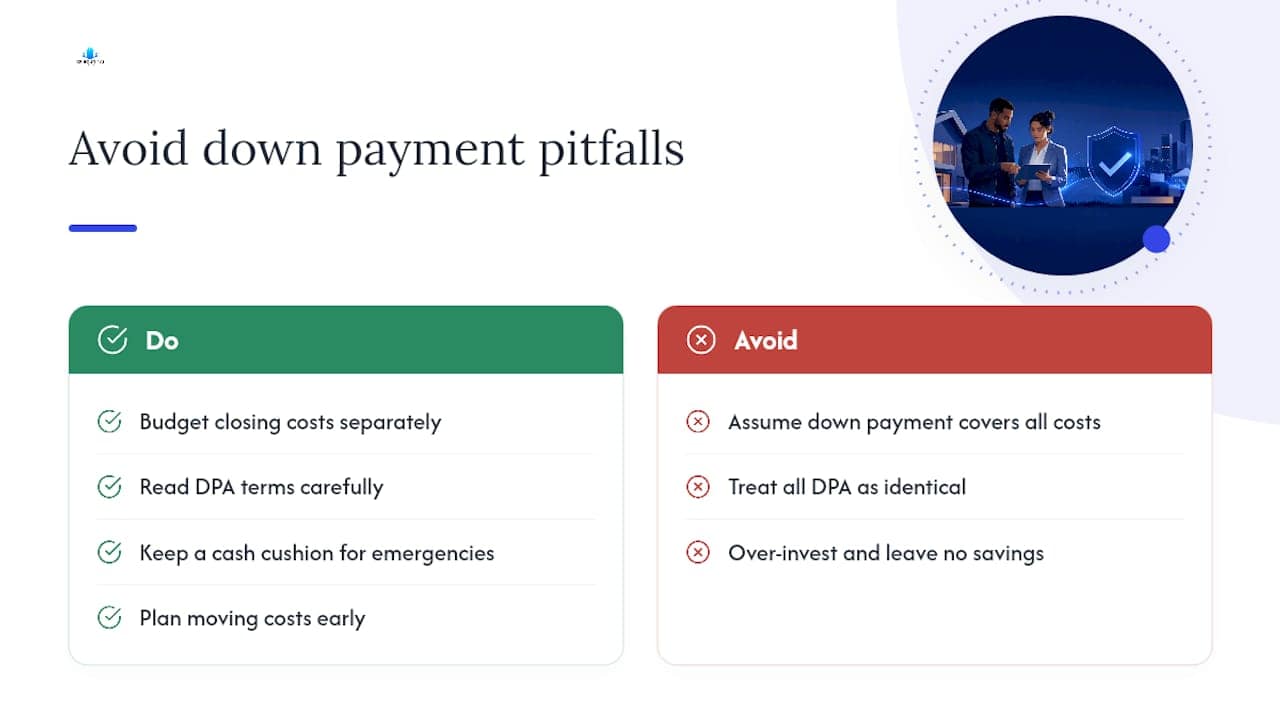
Another common mix-up: treating the down payment as your entire cash need at closing. As covered earlier, closing costs and prepaid items sit on top of that number, and skipping this math is how buyers show up short at the settlement table. A related pitfall is assuming all down payment assistance programs work the same way. Some are outright grants, others are loans you repay, and some are forgivable only if you stay in the home for a set number of years, so read the terms before counting on that money.
Finally, some buyers assume a larger down payment always wins. It often lowers your rate and payment, but not if it leaves you without a cash cushion for repairs, job loss, or moving costs. If you’re relocating for the purchase, budgeting realistically for the move itself, alongside your down payment and closing costs, helps avoid the same kind of last-minute cash crunch; resources like Good Stuff Moving’s tips for first-time buyers cover that side of the ledger. And for buyers with credit challenges affecting which programs they qualify for, understanding options for securing a mortgage with less-than-perfect credit can reset expectations before you start shopping.
What Underwriters Actually Check on Down Payment Funds
Underwriters care about three things with any down payment: the loan-to-value ratio it creates, whether the funds are verifiably yours, and whether the source is legitimate and properly documented. Bank statements, gift letters, and asset seasoning periods all exist to answer one question: is this money real, and is it clean.
At CR Equity Ai Inc, that same discipline applies across our real estate and business lending programs, whether you’re an individual borrower or working through a broker. We publish our advance-rate grids before you apply, so you can see LTV expectations upfront instead of guessing. Decisions often come in as little as 4 hours because the underwriting process focuses on the asset and the deal, not just paperwork, and the platform supports ITIN and foreign national borrowers alongside US-based applicants.
If you’re preparing to apply for financing, have certified funds ready, expect third-party fees like appraisal or title costs, and pull together your documentation in advance using a resource like our origination document library. It saves real time once your file is in underwriting.
A Lender’s Take on Down Payment Discipline
Most down payment advice online treats the decision as a single number to hit.
The bigger blind spot is documentation, not math. Underwriters do not reward good intentions. They reward a clean paper trail. If there’s one piece of overlooked advice worth taking seriously, it’s this: decide your funding sources first, gather the paperwork before you need it, and only then run the payment math across a few scenarios. The buyers who close smoothly are rarely the ones with the biggest down payment. They’re the ones whose funds nobody has to question.
— Robert
This article is general information, not a substitute for advice from a qualified financial advisor. Consult a qualified financial professional about your own circumstances before acting on anything here.
Sources
FAQ
What is a down payment, exactly?
A down payment is the upfront cash portion of a purchase price you pay directly, which becomes your initial equity in the property, typically ranging from 3.5% to 20% for homes depending on the loan program.
What is the down payment for a $200,000 house?
Most buyers land somewhere in between depending on their loan program and credit profile.
How much of a down payment do I need for a $300,000 house?
The national median down payment for first-time buyers sits closer to 10%.
How much down payment do you need on a $500,000 house?
FHA, VA, or USDA programs could lower that requirement significantly for eligible buyers.
Is a bigger down payment always better?
Not necessarily. A larger down payment lowers your monthly payment and can eliminate PMI, but not if it leaves you without the 3 to 6 months of emergency reserves that the CFPB recommends keeping on hand after closing.