A DSCR cash-out refinance is one of the most efficient ways for rental property investors to convert built-up equity into working capital — without selling the asset, without providing tax returns, and without disrupting the income stream. But the amount of cash you can actually pull is not as simple as multiplying your property value by a percentage. Two separate tests determine the number, and the lender uses whichever one produces the smaller loan.
That dual constraint is the concept most investors miss when running back-of-envelope math or plugging numbers into a generic DSCR loan calculator. Your equity position sets one ceiling. Your property’s rental income, measured against the new debt service at current rates, sets the other. Understanding both — and knowing which one is likely to bind on your specific deal — is the difference between realistic planning and discovering at underwriting that your cash-out is half of what you expected.
This guide breaks down how DSCR cash-out sizing actually works, where rates and terms stand in August 2026, the seasoning and entity requirements that can affect timing, and the strategic scenarios where pulling equity makes financial sense.
Two Tests Determine Your Cash-Out Amount
Every DSCR cash-out refinance runs through two independent calculations. The lender approves whichever amount is lower.
The LTV Ceiling
Most DSCR cash-out programs cap the new loan at 70% to 75% of the property’s current appraised value. A small number of lenders will stretch to 80% for borrowers with exceptional credit profiles — typically 740-plus FICO and a DSCR well above 1.25 — but 75% is the realistic ceiling for the majority of deals. This cap is lower than a rate-and-term refinance, which commonly allows 75% to 80% LTV, because pulling cash out adds risk to the lender’s position.
The math is straightforward: multiply the appraised value by the maximum LTV, then subtract your existing loan payoff. The remainder is the most you can receive from the equity side.
The DSCR Ceiling
Separately, the lender calculates the maximum loan size that keeps the property’s debt service coverage ratio at or above its minimum threshold — commonly 1.0 to 1.25, depending on the program. This calculation works backward from the property’s gross monthly rent: at the quoted interest rate and factoring in taxes, insurance, and any HOA, how large can the new loan be before the rent no longer covers the payment at the required coverage level?
In practice, this means a property with strong equity but modest rent can hit its DSCR ceiling before its LTV ceiling. Conversely, a property with strong rent but limited appreciation may hit the LTV cap first. The binding constraint varies deal by deal — and that is precisely why a reliable estimate requires both tests, not just an equity percentage.
How the Sizing Math Works in Practice
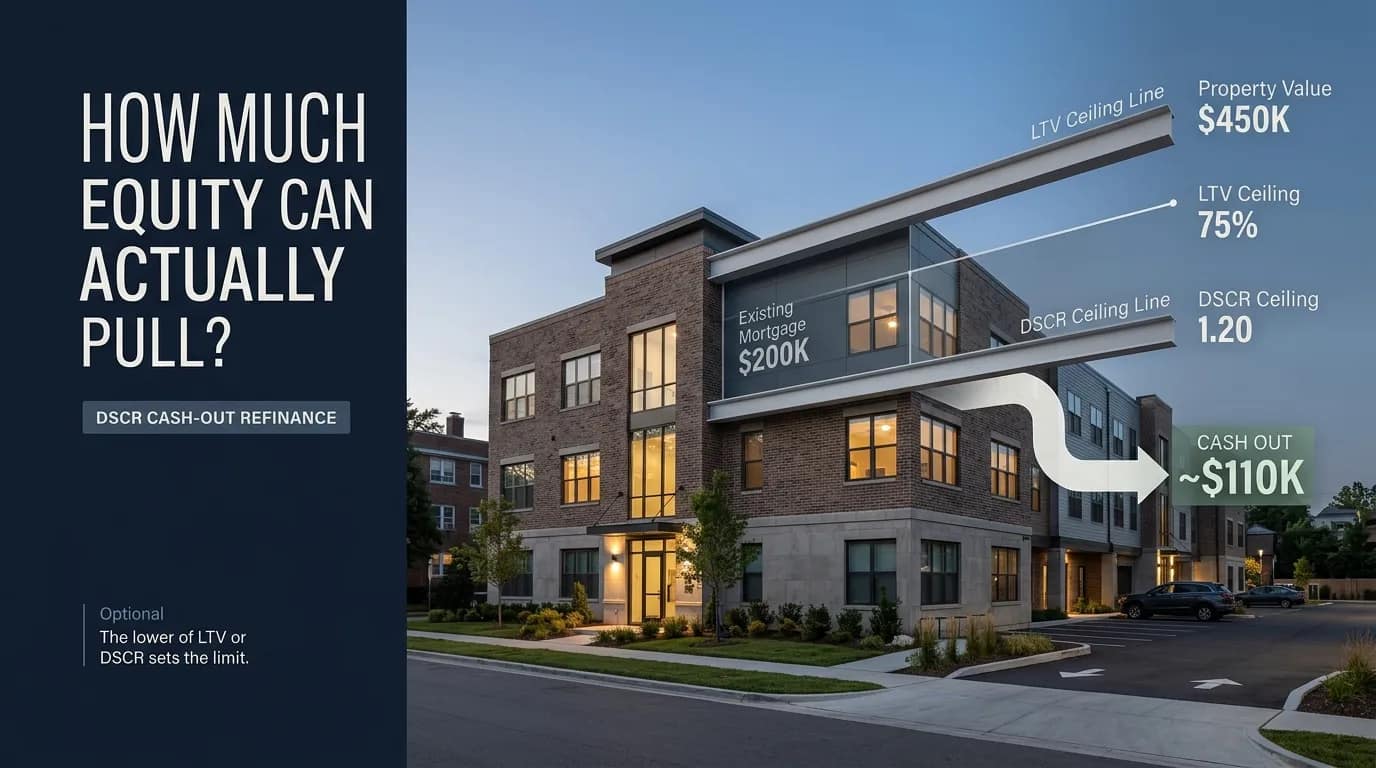
Consider a single-family rental appraised at $450,000, carrying an existing $200,000 mortgage, renting at $3,000 per month.
LTV test at 75%: $450,000 multiplied by 0.75 equals $337,500 maximum new loan. Subtract the $200,000 payoff, and the equity-side ceiling is $137,500 in potential cash out.
DSCR test at 1.20 required coverage: At a given rate, once taxes, insurance, and HOA are layered onto the debt service, $3,000 in monthly rent might only support a total loan of roughly $310,000 while maintaining a 1.20 DSCR. That would cap the cash-out at $110,000 — below the LTV-side number.
Result: the DSCR test binds, and the approved cash-out is closer to $110,000 than $137,500. This is a common pattern: the income constraint, not the equity constraint, is the one that limits the deal — especially when rates are elevated and the required coverage ratio is above 1.0.
These numbers are illustrative. Your actual cash-out depends on the specific appraised value, rent, rate, and program terms — which is why running your deal through a real lender quote, rather than a generic calculator, matters.
DSCR Cash-Out Refinance Rates in August 2026
DSCR cash-out refinances carry a pricing adjustment above standard purchase or rate-and-term transactions — typically 25 to 50 basis points, reflecting the additional risk the lender takes by advancing cash against equity. For well-qualified borrowers with 740-plus credit and LTV at 65% to 70%, cash-out rates in mid-2026 are running in the range of roughly 6.50% to 7.50% on 30-year fixed products. Broader profiles — lower credit, higher LTV, or sub-1.25 DSCR — price higher, with the full range extending to approximately 8.50% or above.
The Federal Reserve has held its benchmark rate at 3.50% to 3.75% through all of its 2026 meetings, following three quarter-point cuts in late 2025. The 10-year Treasury yield, which influences longer-term mortgage pricing more directly, has been trading near 4.70% in August 2026. Rate stability has been one of the more favorable features of the current environment for refinance planning: term sheets quoted at the start of underwriting are holding through closing, which makes the cash-out math reliable enough to act on.
Why the 2023–2024 Vintage Is the Prime Refinance Candidate
If your existing DSCR loan was originated during the 2023–2024 rate cycle — when many investors locked fixed rates in the high 7% to 9% range — the current market represents a meaningful rate improvement, even without additional Fed cuts. Investors in this cohort are often refinancing into rates 75 to 150 basis points below their existing note, which both lowers their monthly debt service and improves their DSCR on the new loan.
By contrast, investors who locked DSCR loans during 2020–2022 at sub-5.5% rates generally should not refinance for rate improvement — the existing rate is structurally below today’s market. For that cohort, a cash-out refinance only makes sense if the capital being pulled is being deployed into a higher-yielding use that outperforms the increase in debt service cost.
The practical takeaway: don’t wait for a future rate cut that may not arrive. If your existing rate was set at the 2023–2024 peak and the refinance math works at today’s levels, the opportunity cost of waiting is the equity sitting idle in a property that could be generating returns elsewhere.
Seasoning Requirements: How Long Before You Can Cash Out
Seasoning refers to the time you must hold a property before a lender will allow a cash-out refinance using the current appraised value rather than the original purchase price. The standard in 2026 is six months from the deed recording date for most DSCR cash-out programs, though a minority of lenders accept three months for borrowers with strong profiles.
Before the seasoning threshold, lenders typically cap the loan amount based on the original acquisition cost — which limits how much equity you can access on a property that has appreciated or been improved since purchase. Rate-and-term refinances, by contrast, often carry no seasoning requirement at all.
For BRRRR-strategy investors — buy, rehab, rent, refinance, repeat — the six-month seasoning clock is a critical planning variable. At CR Equity AI, our AI underwriting engine evaluates seasoning and after-repair value in the same pass as the DSCR and LTV calculations, so borrowers know within hours whether a deal qualifies and at what level, rather than discovering a seasoning issue weeks into the process.
LLC Titling and Entity Structure on a Cash-Out Refinance
DSCR cash-out refinances are routinely closed in an LLC, trust, or other entity — it is the standard structure on this product, not an exception. Unlike conventional loans, which generally require personal-name title, DSCR programs are designed for entity-level ownership and do not impose a rate penalty for LLC titling.
To avoid delays at closing, there are a few things to have in order before you apply. The entity should hold clear title with no undisclosed liens or judgments. The operating agreement should match the individual signing the loan application. If the property is being transferred from a personal name into an LLC as part of the refinance, the lender will require a deed transfer and updated title work — build that into the timeline so it doesn’t hold up closing.
What Investors Typically Do With Cash-Out Proceeds
- Fund the next acquisition. The most common use case: pulling equity from a stabilized rental to cover the down payment, rehab, or closing costs on the next property in a BRRRR cycle or a portfolio expansion.
- Retire higher-cost debt. Paying off a bridge loan, hard money note, or merchant cash advance using lower-cost real estate equity — converting short-term, revenue-based financing into long-term, fixed-rate debt.
- Build reserves. Establishing a capital cushion ahead of a portfolio-wide refinance, a construction draw, or an anticipated market shift where having liquidity provides optionality.
- Consolidate across properties. Using proceeds from one high-equity asset to reduce leverage or pay down balances on other properties in the portfolio, improving the overall coverage profile.
One important note on taxes: cash-out refinance proceeds are not taxable income. The IRS treats loan proceeds as debt, not earnings, so the cash itself does not trigger a tax event. Interest on the new loan is generally deductible to the extent the proceeds are traced to investment use.
Frequently Asked Questions
How much equity can I pull from a rental property?
The maximum is typically 70% to 75% of the current appraised value minus your existing payoff — but your actual number is capped by whichever test comes in lower: the LTV limit or the maximum loan your rental income supports at the required coverage ratio.
Do I need to show income for a DSCR cash-out refinance?
No. Qualification is based entirely on the property’s rental income relative to the new debt service payment. There are no tax returns, W-2s, or personal debt-to-income calculations involved.
Can I do a cash-out refinance on a property held in an LLC?
Yes. LLC-titled properties are the standard structure on DSCR programs, and entity ownership does not carry a rate penalty. The entity needs clean title and a matching operating agreement.
How soon after buying can I do a cash-out refinance?
Most DSCR lenders require six months of seasoning from the deed recording date before they will use the full appraised value for cash-out purposes. Some programs allow three months for strong-profile borrowers. Delayed financing exceptions can allow faster access for all-cash purchases, capped at the original acquisition cost.
Are DSCR cash-out refinance rates higher than purchase rates?
Yes, by approximately 25 to 50 basis points. For strong-credit borrowers at moderate LTV, cash-out rates in mid-2026 are running roughly 6.50% to 7.50% on 30-year fixed products.
Key Takeaways
- DSCR cash-out sizing is governed by two independent tests — LTV and debt service coverage — and the lender uses whichever produces the smaller loan amount.
- Most programs cap cash-out at 70–75% LTV, with a 25-to-50-basis-point rate premium over purchase transactions.
- The DSCR test, not the equity test, is often the binding constraint — especially when rates are elevated and coverage requirements are above 1.0.
- Loans originated at 2023–2024 cycle-high rates are the strongest candidates for refinance in the current environment, even without further Fed action.
- LLC titling is standard, seasoning is typically six months, and cash-out proceeds are not taxable income.
See What Your Rental Portfolio Can Pull
CR Equity AI sizes DSCR cash-out refinances with AI-powered underwriting and delivers term sheets within 24 hours — both the LTV and DSCR calculations run in a single pass, so you get a real number, not an estimate that changes at the term-sheet stage.
CR Equity AI, Inc. — crequity.ai | support@crequity.ai | (949) 328-6622
Sources
- Federal Reserve — FOMC Statement, July 29, 2026: federalreserve.gov/newsevents/pressreleases/monetary20260729a.htm
- DSCR Authority — Cash-Out Refinance 2026 Playbook: dscrauthority.com/loan-types/cash-out-refinance/
- DSCR Capital Partners — DSCR Rates by Scenario 2026: dscrcapitalpartners.com/dscr-rates/
- RefiGuide — Can You Refinance a DSCR Loan in 2026: refiguide.org/can-you-refinance-a-dscr-loan/
- AHL — 2026 DSCR Refi Decision Framework: ahlend.com/dscr-cash-out-refinance-decision-framework-2026/
- Easy Street Capital — DSCR Loan Cash-Out Refinance Guide: easystreetcap.com/dscr-loan-cash-out-refinance-guide/