
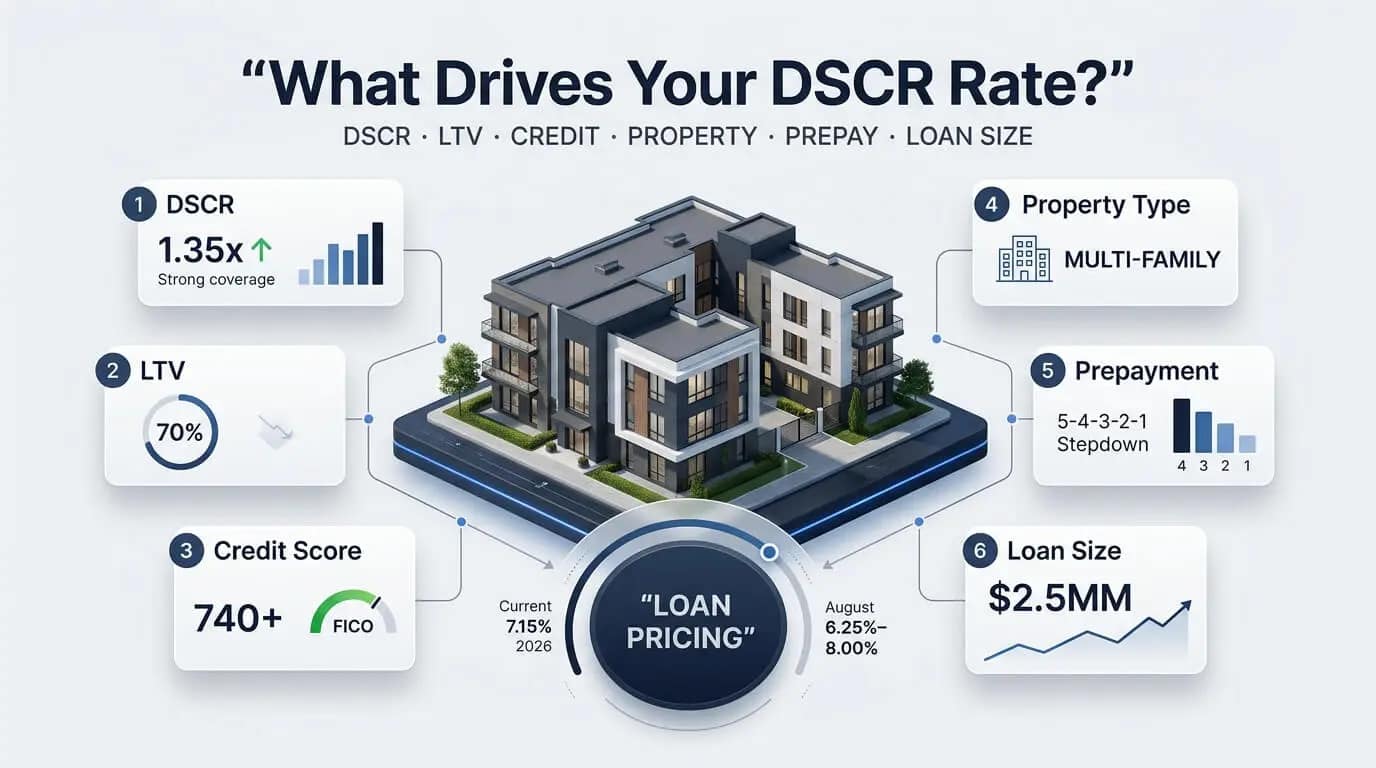
Most investors searching for DSCR loan rates today expect to find a single number. They won’t. DSCR loan pricing is built on a matrix of deal-level inputs — the property’s cash flow coverage, your equity position, your credit profile, and several structural choices you make before or during the application. Two borrowers with identical credit scores can receive meaningfully different rates on the same day because their debt service coverage ratios and loan-to-value positions are different.
That distinction matters because it means DSCR rates are more controllable than most borrowers assume. Unlike conventional mortgage pricing, where your personal income and debt-to-income ratio dominate the equation, DSCR lending ties the rate to the asset and the deal structure. If you understand the six inputs that drive the number, you can position a deal for better pricing before a lender ever pulls your file.
Below is a clear breakdown of what those inputs are, where rates sit as of mid-August 2026, and the practical moves that shift pricing in your favor.
How DSCR Loans Differ from Conventional Investment Loans
A DSCR loan qualifies a borrower based on the rental income a property generates rather than the borrower’s personal income, tax returns, or W-2 forms. The lender calculates a debt service coverage ratio by dividing the property’s gross monthly rent by the total monthly housing payment — principal, interest, taxes, insurance, and any HOA dues. A DSCR of 1.0 means rent exactly covers the payment; a ratio above 1.0 means the property cash-flows after debt service.
Most DSCR programs require a minimum ratio of 1.0, with some lenders offering sub-1.0 programs at higher rates or lower leverage. Programs that target a 1.25 ratio or above typically offer the most favorable pricing because the lender’s risk cushion is larger.
Because there is no personal income documentation, DSCR loans close faster and work well for self-employed investors, borrowers who hold properties in LLCs, and portfolio investors who have already maxed out conventional Fannie Mae or Freddie Mac financing slots. The trade-off is a modest rate premium over conventional investment-property loans — typically in the range of 50 to 150 basis points — in exchange for speed, flexibility, and entity-level title.
The Six Inputs That Determine Your DSCR Rate
DSCR pricing is not arbitrary. Lenders use a structured rate matrix driven by a short list of measurable deal characteristics. Here are the six that carry the most weight.
1. Debt Service Coverage Ratio
The ratio itself is the single most important pricing input beyond baseline market conditions. A property with a 1.30 DSCR presents less default risk than one at 1.0, and lenders price that difference into the rate. Moving from a ratio of 1.0 to 1.25 or higher can shift pricing by 25 to 50 basis points on some rate sheets — before any other factor is considered.
2. Loan-to-Value Ratio
Every DSCR program has a rate curve that adjusts by LTV band. Standard programs cap at 75% to 80% LTV, and dropping your LTV by even five to ten points — say from 80% down to 70% — typically earns a meaningful rate improvement. At CR Equity AI, our AI-powered underwriting engine factors the LTV-to-DSCR relationship in real time, so borrowers get precise term sheets within hours rather than waiting days for manual pricing.
3. Credit Score
DSCR lenders do not use your credit score to verify income, but they absolutely use it to tier your pricing. Most programs set credit bands in 20- to 40-point increments. The best pricing tier generally starts at 720 to 740 FICO, with usable programs available for borrowers scoring as low as 620 to 660 — the credit score shifts your rate, not whether you can qualify at all. Each 20-point move can translate to roughly 12.5 to 25 basis points of rate difference depending on the lender’s matrix.
4. Property Type
Single-family rentals and two- to four-unit residential properties tend to price better than short-term rentals or five-plus-unit multifamily in most DSCR programs. The reason is income stability: a long-term lease on a single-family home is considered more predictable than Airbnb revenue subject to seasonal swings. Short-term rental DSCR programs exist but typically carry a premium of 25 to 75 basis points over standard long-term rental rates.
5. Prepayment Penalty Structure
A longer prepayment penalty period gives the lender certainty that the loan will remain on its books, and lenders reward that certainty with a lower rate. A five-year stepdown prepayment penalty will typically price better than a three-year or no-prepay option. If you plan to hold the property for several years and don’t expect to refinance soon, accepting a longer prepay in exchange for a lower rate is one of the simplest levers available.
6. Loan Size
Very small loan balances and very large ones both tend to price outside the rate sweet spot. The most competitive pricing usually falls in the mid-six-figure to low-seven-figure range, where the loan is large enough to justify the lender’s fixed origination costs but small enough to stay within standard non-QM secondary market appetite.
Where DSCR Rates Stand in August 2026
As of mid-August 2026, 30-year fixed DSCR loan rates for well-qualified domestic investors generally range from roughly 6.25% to 8.00%, according to multiple lender rate sheets and market aggregators. Borrowers with strong profiles — credit above 720, DSCR above 1.25, and LTV at 75% or below — are finding rates in the low-to-mid 6% range. Adjustable-rate DSCR products are available starting in the mid-5% range for shorter reset periods.
Those numbers sit approximately 50 to 150 basis points above conventional investment-property mortgage rates. Freddie Mac’s 30-year conventional average was running near 6.5% through mid-2026, making the DSCR premium relatively modest for borrowers who gain speed, LLC eligibility, and no income documentation in return.
The pricing backdrop is shaped by a Federal Reserve that has held its benchmark rate steady at 3.50% to 3.75% through all of its 2026 meetings so far, following three quarter-point cuts in late 2025. The July 2026 FOMC meeting produced a 9-to-3 hold vote, with three regional presidents dissenting in favor of a rate increase — a signal that policymakers are divided and that further easing is far from guaranteed. The 10-year Treasury yield, which drives longer-term mortgage pricing more directly than the Fed funds rate, has been trading near 4.70% in August 2026, close to its highest levels of the year.
The practical implication: waiting for a rate cut to magically lower your DSCR pricing is a bet, not a strategy. The deal-level inputs you can control — DSCR, LTV, credit, and prepay structure — will move your rate more reliably than any single Fed decision.
Five Practical Ways to Improve Your DSCR Rate Before You Apply
- Increase the DSCR before submitting. Renewing a lease at current market rent, adding a legally permitted accessory dwelling unit, or converting unused space into rentable square footage can push your ratio into a better pricing tier. Even a small improvement — from 1.05 to 1.25 — can meaningfully reduce your rate.
- Bring more equity to the table. If you’re refinancing, consider whether shifting equity between properties or injecting additional capital can drop your LTV by five to ten points. On many rate sheets, the difference between 80% LTV and 70% LTV is worth a quarter-point or more.
- Accept a longer prepayment penalty if your hold period supports it. A five-year stepdown prepay will typically price better than a three-year or no-prepay option. If you don’t plan to sell or refinance within that window, the rate savings compound over every month of the loan.
- Close in the right entity. LLC-titled loans are standard on DSCR programs and do not carry the rate penalty that some borrowers expect. The entity needs to be clean — no outstanding liens, an operating agreement that matches the property ownership — but titling in an LLC is a structural advantage on DSCR deals, not a cost.
- Work with a direct lender that prices off its own capital. A direct lender can issue a term sheet and hold a rate with fewer intermediary layers than a broker shopping your file after the fact. At CR Equity AI, our 24-hour AI underwriting and two-hour valuation process means borrowers get real terms fast — not a preliminary estimate that shifts at the term-sheet stage.
DSCR Rates vs. Conventional Investment-Property Rates
Conventional agency loans — Fannie Mae or Freddie Mac products for investment properties — will typically carry a lower base rate than a DSCR loan. But that comparison misses several structural costs on the conventional side. Agency investment-property loans come with loan-level price adjustments (LLPAs) that add to the effective rate. They require full personal income documentation, which can delay closing by 30 to 45 days. They count against your personal debt-to-income ratio, limiting how many properties you can finance. And they generally require title in your personal name, complicating asset protection.
For investors who are self-employed, who already hold multiple financed properties, or who need to close within days rather than weeks, the 50-to-150-basis-point premium on a DSCR loan is often the smaller cost when measured against the opportunity cost of a delayed close, the tax return complexity, or the portfolio financing ceiling.
Frequently Asked Questions
What credit score do I need for the best DSCR rates?
Most DSCR lenders reserve their best pricing tier for borrowers with FICO scores of 720 to 740 or above. Usable programs are available for scores as low as 620 to 660, with compensating factors like higher down payments or stronger DSCR ratios offsetting the lower score. Credit moves your pricing tier — it doesn’t necessarily disqualify you.
Does a higher DSCR ratio lower my rate, or does it just help me qualify?
Both. A stronger ratio signals lower default risk, and most lender rate matrices reward that with better pricing — not just approval. Improving your DSCR from 1.0 to 1.25 or above is one of the few variables you can actively improve before applying.
Can I buy down my DSCR rate with discount points?
Yes. Most DSCR programs allow borrowers to pay discount points at closing to reduce the interest rate, the same way conventional loans do. Whether that makes sense depends on your intended hold period — the longer you plan to keep the loan, the more value you extract from the buydown.
Are DSCR rates always higher than conventional investment loans?
In raw rate terms, typically yes — by roughly 50 to 150 basis points. But once you factor in conventional loan-level price adjustments, closing timeline costs, and the limitation on how many properties you can finance conventionally, the effective cost gap narrows. For many active investors, the DSCR premium is outweighed by the operational benefits.
Key Takeaways
- DSCR loan rates are set by six deal-level inputs — the DSCR ratio, LTV, credit score, property type, prepayment structure, and loan size — not your personal income.
- As of August 2026, 30-year fixed DSCR rates range from roughly 6.25% to 8.00%, with the strongest profiles landing in the low-to-mid 6% range.
- The Fed has held rates steady through 2026 after three cuts in late 2025, and the path forward is uncertain — waiting for lower rates is a bet, not a plan.
- The most reliable way to improve your DSCR pricing is to strengthen the deal: raise the DSCR, lower the LTV, and choose the right prepayment structure for your hold period.
- Working with a direct lender that prices off its own capital avoids the intermediary markups and delays that can erode the terms you were quoted.
Get Your Real DSCR Terms
CR Equity AI underwrites DSCR loans with AI-powered valuation and 24-hour term sheet delivery — no tax returns, no income docs, and no guessing where your rate will land. See your actual terms based on your deal, not a generic rate table.
CR Equity AI, Inc. — crequity.ai | support@crequity.ai | (949) 328-6622
Sources
- Federal Reserve — FOMC Statement, July 29, 2026: federalreserve.gov/newsevents/pressreleases/monetary20260729a.htm
- CNBC — Fed Rate Decision July 2026: cnbc.com/2026/07/29/fed-rate-decision-july-2026.html
- Trading Economics — U.S. 10-Year Treasury Yield: tradingeconomics.com/united-states/government-bond-yield
- Griffin Funding — DSCR Loans August 2026: griffinfunding.com/non-qm-mortgages/dscr-loans/
- OfferMarket — DSCR Loan Rates 2026: offermarket.us/blog/dscr-loan-rates
- HomeAbroad — DSCR Loan Rates August 2026: homeabroadinc.com/mortgages/dscr-loan-interest-rates/