

An EMD, or earnest money deposit, is a sum a buyer puts into escrow to show good faith when making an offer on a property. A title company or escrow agent typically holds the funds, and the purchase contract decides whether the buyer gets the money back or forfeits it. In most deals, a buyer who meets every contingency keeps the right to a refund if the sale falls through.
TL;DR:
- Financing, inspection, and title contingencies can protect a refund, but buyers risk forfeiture if they abandon documented financing efforts or breach the contract.
- Use a traceable payment method and request a signed receipt within 24 to 48 hours of wiring funds; retain proof of funds and escrow instructions.
- Before signing, name the escrow company, set a specific deposit deadline, and state who receives any interest, since state rules and contract terms vary.
- At closing, the deposit usually reduces the buyer’s down payment or closing costs; if forfeited, the seller generally reports it as income.
- In competitive bidding, a larger or partly nonrefundable deposit can strengthen an offer, but it raises exposure if financing fails; secure financing before weakening contingencies.
Table of Contents
- What an Earnest Money Deposit Is and Why It Matters
- How Earnest Money Is Handled: Escrow, Title Companies, and Documentation
- Typical Amounts, Timing, and Payment Methods for Earnest Money
- Contingencies: When Buyers Keep the Deposit and When They Risk Forfeiture
- How Earnest Money Is Applied at Closing and How Interest Is Handled
- Practical Best Practices: A Documented Checklist for Buyers, Brokers, and Escrow Officers
- Implications of EMD in Residential, Commercial, and Fix-and-Flip Deals
- How EMD Practices Vary by State and What That Means Legally
- The Role of EMD in Competitive Bidding and Negotiation
- Common EMD Disputes and How They Are Typically Resolved
- Tax Implications of EMD for Buyers and Sellers
- Why We Built Our Process Around Documented, Traceable Funding
- How We Help You Meet EMD Deadlines and Strengthen Your Offer
- FAQ
- Sources
What an Earnest Money Deposit Is and Why It Matters
An earnest money deposit is a good-faith sum a buyer places into a neutral account when submitting an offer on real estate. It differs from a down payment because the latter is a portion of the purchase price paid at closing. The EMD is submitted earlier, during the offer or contract stage, and acts as a signal that the buyer intends to follow through.
Sellers rely on this deposit because it discourages buyers from submitting offers they do not intend to honor. Without an EMD, a seller taking a property off the market has little assurance the buyer will not walk away without consequence. The American Bar Association frames earnest money as a commitment device rather than a penalty, a distinction that helps brokers explain forfeiture risk to clients without suggesting the deposit exists to punish buyers.
Purchase contracts typically spell out who holds the deposit, whether it sits in an interest-bearing account, and who receives any interest earned. Common contract language includes:
- The escrow or title company designated to hold the funds until closing or termination.
- The deadline by which the buyer must deliver the deposit.
- Whether the account bears interest and who is credited that interest.
How Earnest Money Is Handled: Escrow, Title Companies, and Documentation
Once a buyer and seller sign a purchase agreement, the earnest money moves into the custody of a neutral third party. According to the American Bar Association, an escrow agent, often the title company, holds funds and documents until contract conditions are satisfied, then distributes them according to written escrow instructions. In many states, the entire closing process runs through this escrow relationship.
The handling process generally follows these steps:
- The buyer delivers the deposit to the escrow agent named in the contract.
- The escrow agent issues a receipt confirming the funds were received and deposited.
- The agent holds the money in a separate account, which may be interest-bearing depending on the contract and local practice.
- At closing or termination, the agent disburses the funds according to the signed escrow instructions.
Essential paperwork includes the escrow instructions themselves, a deposit receipt showing the date and amount received, and proof of funds documentation that confirms the source of the deposit.
Pro Tip: Always request a signed deposit receipt within 24 to 48 hours of wiring funds, and keep it with your transaction file in case a dispute arises later.
Typical Amounts, Timing, and Payment Methods for Earnest Money
Earnest money amounts vary by market and property type, but residential contracts commonly call for a modest initial deposit with the offer, sometimes followed by a larger deposit after acceptance. According to the American Bar Association, offers often include a short validity window, sometimes as brief as 24 hours, paired with an initial deposit that can range from several hundred to a few thousand dollars depending on local custom.
Timing matters as much as amount. Contracts generally specify one of the following delivery points:
- Deposit due at the time the offer is submitted.
- Deposit due within a set number of hours or days after acceptance.
- A split structure, with a small deposit at offer and a larger one after contingencies clear.
Acceptable payment methods typically include a certified check, a wire transfer, an escrow company check, or a digital transfer through the title company’s verified portal. Each method should produce a paper trail, since traceability protects both the buyer and the escrow agent if a dispute over receipt or timing comes up later.
Contingencies: When Buyers Keep the Deposit and When They Risk Forfeiture
Contingencies are the conditions written into a purchase contract that must be satisfied before the deal becomes binding, and they are the primary mechanism that protects a buyer’s right to a refund. The most common contingencies cover financing, inspection, and title.
- A financing contingency protects a buyer who cannot secure a loan despite genuine, documented effort.
- An inspection contingency allows a buyer to cancel or renegotiate after discovering material property defects.
- A title contingency protects a buyer if the seller cannot deliver clear ownership.
The American Bar Association notes that a buyer who cannot obtain financing despite good-faith efforts is generally entitled to the deposit back, while a buyer who abandons those efforts or otherwise breaches the contract risks forfeiting it.
A contract, not a courtroom, decides most outcomes. The purchase agreement controls whether a deposit is returned, and buyers generally must show they acted in good faith to preserve that right, as outlined in the ABA’s guidance on the purchase contract.
When a seller refuses to release funds, the dispute usually moves through one of a few paths: a written demand from the buyer’s agent, an escrow interpleader action where the title company asks a court to decide who is entitled to the funds, or, in rarer cases, litigation. Most disputes resolve well before reaching a courtroom.
How Earnest Money Is Applied at Closing and How Interest Is Handled
At closing, the earnest money deposit is credited toward the buyer’s total obligation, typically applied to the down payment or closing costs rather than treated as a separate, forfeited cost. This credit reduces the amount of new funds the buyer needs to wire at closing.
The accounting flow generally works as follows:
- The title or escrow company records the original deposit against the final settlement statement.
- Any contract-specified interest is credited to the buyer, the seller, or split, depending on the signed agreement.
- The remaining balance due from the buyer reflects the EMD credit already applied.
The American Bar Association notes that offers should specify an interest-bearing account with interest credited to the buyer, which makes clear contract language on this point worth confirming before signing. A buyer evaluating how a deposit interacts with other closing costs may find it useful to review what lenders verify at closing alongside the escrow settlement statement.
Practical Best Practices: A Documented Checklist for Buyers, Brokers, and Escrow Officers
Clear documentation at every stage of the EMD process prevents the majority of disputes before they start. Each party in the transaction has a distinct role to play.
- Buyers should provide a clear proof of funds letter, insist on explicit contingencies in the offer, use traceable payment methods, and track every deadline in the contract.
- Brokers should deliver escrow instructions to the title company promptly, confirm receipt of funds in writing, and maintain a complete record of all communications tied to the deposit.
- Escrow officers should place funds in the correct account immediately, document any interest instructions in writing, and follow the signed escrow instructions exactly, with no verbal deviations.
Pro Tip: Draft offer language that names the deposit deadline, the interest-handling terms, and the exact escrow recipient by name. Ambiguity on any of these three points is the most common source of EMD disputes.
Sample clauses worth including in any offer: a firm deposit deadline tied to a specific date and time, a sentence specifying whether the account is interest-bearing and who receives that interest, and the full legal name of the escrow or title company designated to hold the funds.
Implications of EMD in Residential, Commercial, and Fix-and-Flip Deals
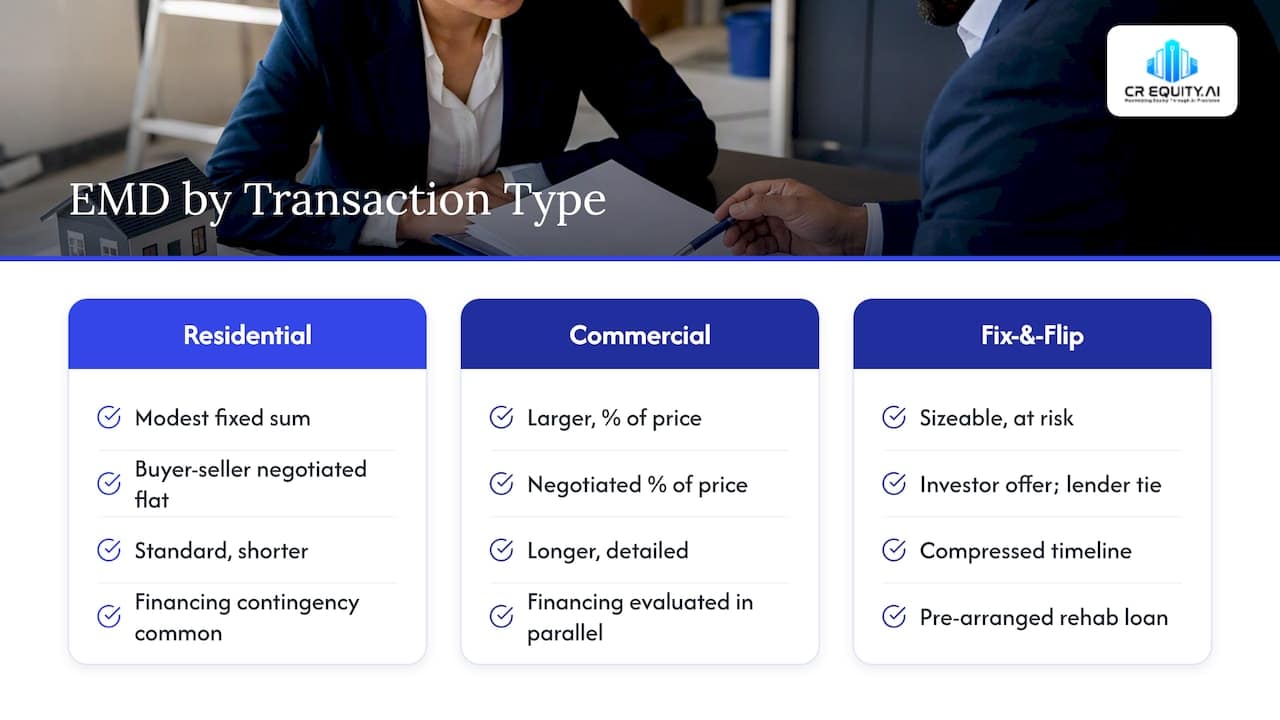
Earnest money functions differently depending on the type of transaction. In a standard residential purchase, the deposit is usually a modest, fixed sum negotiated between buyer and seller, with contingencies for financing and inspection built in as a matter of course.
Commercial transactions tend to involve larger deposits, often negotiated as a percentage of the purchase price rather than a flat amount, and the due diligence period is typically longer and more detailed. Commercial buyers evaluating a property for income potential may also be weighing financing structures such as small balance commercial loans in parallel with their due diligence timeline.
Fix-and-flip buyers face a different set of pressures. Because these deals often involve investor financing with compressed timelines, the EMD serves the same good-faith function but carries added weight: a flip buyer who cannot close quickly risks losing the deposit on a property that may already be under contract with a lender for rehab funds. Investors in this category frequently pair their offer with a pre-arranged fix and flip loan to avoid financing delays that could jeopardize the deposit. Across all three transaction types, the core principle from the purchase contract remains the same: the written agreement, not the property type, governs whether the deposit is returned or forfeited.
How EMD Practices Vary by State and What That Means Legally
Earnest money practices are not uniform across the country. States differ in how escrow accounts must be structured, whether interest must be credited to the buyer, and how disputes are adjudicated when a deposit is contested.
Some states require earnest money to sit in a separate, interest-bearing account by law, while others leave that decision entirely to the contract. The American Bar Association notes that in some states, the entire closing happens through an escrow agent, which centralizes deposit handling and reduces the number of parties who touch the funds.
Dispute resolution procedures also vary. Some states have statutory frameworks that allow an escrow agent to interplead disputed funds into court relatively quickly, while others rely more heavily on the specific remedies spelled out in the purchase contract itself. Because these rules differ by jurisdiction, buyers, brokers, and escrow officers should treat the written contract, reviewed with a local real estate attorney where the stakes are significant, as the controlling document rather than assuming a national standard applies. This is particularly important for buyers working across state lines, such as investors purchasing in a market where they do not regularly transact.
The Role of EMD in Competitive Bidding and Negotiation
In a competitive market with multiple offers on a single property, the size and terms of an earnest money deposit become a negotiating tool in their own right. A larger deposit signals financial strength and seriousness, which can make an offer more attractive to a seller even when the purchase price is comparable to a competing bid.
Buyers in multiple-offer situations sometimes increase their EMD, shorten contingency periods, or offer to make a portion of the deposit non-refundable after a certain date, all as ways to stand out without raising the purchase price itself. Sellers evaluating competing offers often weigh these deposit terms alongside price because a buyer willing to put more at risk is statistically less likely to walk away.
For buyers, the trade-off is real: a larger or less-protected deposit increases leverage in negotiation but also increases the buyer’s exposure if the deal later falls apart. A buyer stretching to compete on deposit terms should have financing lined up well before submitting an offer, since weakening a financing contingency to win a bidding war only pays off if the loan actually closes on schedule.
Common EMD Disputes and How They Are Typically Resolved
The most frequent earnest money disputes arise when a deal falls apart and both parties believe they are entitled to the deposit. A seller may claim the buyer breached the contract, while the buyer may argue a contingency protected their right to a refund.
Resolution typically follows a predictable sequence. The buyer’s agent or attorney sends a written demand to the escrow agent requesting release of the funds. If the seller objects, the escrow agent generally cannot release the money to either party without written agreement from both sides or a court order. At that point, the escrow agent may file an interpleader action, asking a court to determine the rightful recipient, which removes the agent from liability while the dispute is resolved.

In practice, most disputes resolve through negotiation before reaching litigation. Partner guidance on what happens when buyer financing falls through offers a useful look at how sellers evaluate their options when a financing contingency is invoked. The strength of a buyer’s documentation, including proof of a good-faith financing attempt, often determines how quickly these disputes get resolved without a court’s involvement.
Tax Implications of EMD for Buyers and Sellers
For most buyers, an earnest money deposit that is credited toward the purchase price at closing carries no separate tax consequence. It becomes part of the property’s purchase price basis, the same as any other portion of the down payment or closing costs.
The tax picture changes when a deposit is forfeited rather than applied to a completed purchase. A seller who keeps a forfeited deposit generally must report that amount as income, since it represents compensation received outside the context of a completed sale. A buyer who forfeits a deposit typically cannot deduct the loss, since it relates to a personal residence purchase that did not close, though the treatment can differ for a deposit tied to an investment or business property. Because tax treatment depends on the buyer’s specific situation and the nature of the property involved, buyers and sellers facing a forfeited deposit should confirm the correct reporting approach with a qualified tax professional before filing.
Why We Built Our Process Around Documented, Traceable Funding
We see firsthand how often a closing stalls not because of the loan itself, but because of missing escrow paperwork or an untraceable deposit. Clear EMD documentation speeds underwriting because it gives us a verified funding trail to work from instead of a gap to chase down. We publish our advance-rate grids before you apply for exactly this reason: fewer surprises mean faster decisions on both sides.
— Robert Stewart Jr
How We Help You Meet EMD Deadlines and Strengthen Your Offer
Our financing decisions do not wait on a committee or a third-party investor. When an EMD deadline is tight or a seller wants proof a buyer can close, a documented funding path from us gives your offer more weight at the table.

A few of our programs are built for exactly this kind of timeline pressure:
- F.L.E.X. 50™ funds in 24 to 48 hours, useful when an EMD or closing deadline is days away, not weeks.
- Investment property acquisition loans close in roughly 10 days, helping you line up financing before you ever submit an offer.
- DSCR cash-out refinance qualifies on rental income rather than tax returns, which suits self-employed and 1099 investors juggling multiple deals.
We also support ITIN and foreign national borrowers alongside U.S. buyers, and brokers working on behalf of clients can submit a deal directly to start the underwriting conversation before the next offer deadline hits.
This article is general information, not a substitute for advice from a qualified financial advisor. Consult a qualified financial professional about your own circumstances before acting on anything here.
FAQ
What does EMD stand for in real estate?
EMD stands for earnest money deposit, the sum a buyer places into escrow when submitting an offer to show good-faith intent to purchase. A title company or escrow agent typically holds the funds until the deal closes or terminates under the contract’s terms.
Who holds the earnest money deposit during a transaction?
An escrow agent, often the title company named in the purchase contract, holds the earnest money deposit according to the American Bar Association.
Can a buyer get their earnest money back?
A buyer who meets the contingencies in the purchase contract, such as a financing or inspection contingency, is generally entitled to a refund of the deposit if the deal falls through. According to the American Bar Association, a buyer who abandons good-faith efforts or otherwise breaches the contract risks forfeiting the deposit instead.
How much earnest money is typically required?
Earnest money amounts vary by market, but offers often include a modest initial deposit, sometimes followed by a larger one after acceptance, based on local custom and the property type. The American Bar Association notes that initial deposits can range from several hundred to a few thousand dollars depending on the market.
Does CR Equity AI offer loans that help with earnest money timelines?
We offer programs like F.L.E.X. 50™, which can fund in 24 to 48 hours, and investment property acquisition loans, which typically close in about 10 days, both of which can support a buyer working against a tight EMD or closing deadline.