
A direct private lending platform delivers three things a bank or a syndicate of individual private lenders rarely can together: decisions in hours instead of weeks, published advance-rate and pricing grids you can review before you apply, and underwriting built on institutional discipline rather than a single loan officer’s judgment. Because the lender funds its own capital, there’s no third-party approval layer slowing down closing.
That combination matters most to borrowers who can’t afford to lose a deal to timeline risk. The core advantages break down into three categories:
- Speed — AI-assisted document review and underwriting can cut time to decision by roughly 50% to 75% compared with manual review, with funding in as little as 24 to 48 hours on some programs.
- Transparency — advance-rate and pricing grids are published before you apply, so you know the deal economics before you submit paperwork.
- Underwriting quality — asset-based, cash-flow-first review reduces the guesswork and inconsistency common with ad-hoc private capital sources.
Key Takeaways
Speed, published pricing, and asset-first underwriting from a direct lender who funds its own capital reduce execution risk more reliably than pooled or third-party-dependent private financing.
| Point | Details |
|---|---|
| Speed changes outcomes | AI-assisted underwriting can cut decision time by 50% to 75%, expanding negotiating room on tight deals. |
| Transparency reduces friction | Published advance-rate and pricing grids let borrowers compare terms before applying, not after underwriting. |
| Underwriting quality protects everyone | Asset-first, cash-flow underwriting with human credit ownership reduces default and workout risk. |
| Prepare a debt-specific package | Sponsors who tailor their underwriting file to debt terms get faster, better-fitted term sheets. |
| CR Equity AI covers the full lifecycle | CR Equity Ai Inc funds its own capital across acquisition, fix-and-flip, DSCR, bridge, construction, small-balance commercial, and business loans. |
This article is general information, not a substitute for advice from a qualified financial advisor. Consult a qualified financial professional about your own circumstances before acting on anything here.
Table of Contents
- What Are the Real Benefits of a Direct Private Lending Platform?
- Which Loan Programs Fit a Direct Lending Platform Best?
- How Does Underwriting Differ From a Traditional Bank?
- What Timelines and Fees Should You Expect?
- How Do You Choose the Right Platform?
- How CR Equity AI Delivers on These Benefits
- What Risks Come With Crowdfunded and Pooled Private Capital?
- What Liquidity and Exit Options Do Investors Have?
- What Legal and Regulatory Rules Apply?
- How Do Fees Compare Across Private Lending Platforms?
- Why Speed and Published Terms Matter More Than the Lowest Rate
- Get Faster, More Transparent Financing With CR Equity AI
- Sources
- FAQ
What Are the Real Benefits of a Direct Private Lending Platform?
Speed is the benefit borrowers notice first, but it’s the underwriting discipline behind it that makes the speed trustworthy rather than reckless. Document extraction tools that read a T12, a rent roll, and lease abstracts automatically can turn a process that used to take days into one that takes minutes, and platforms using this kind of automation report loan preparation time falling by around 40%. That’s not a marginal gain. It’s the difference between missing a seller’s closing deadline and hitting it.
Faster decisions also expand your options mid-negotiation. A sponsor who can get a term sheet in four hours instead of four days has room to negotiate purchase price, extend due diligence, or walk from a bad deal without burning the relationship. Lenders using AI-enabled underwriting workflows report cost savings approaching 40% in loan processing, and those savings often show up as tighter spreads or lower fees passed to the borrower rather than absorbed entirely by the lender.
Transparency changes the negotiation dynamic in a different way. When a platform publishes its advance-rate and pricing grid up front, you’re not negotiating blind. You know the maximum loan-to-value for your program, the rate band, and the fee structure before you submit a package. That eliminates the back-and-forth that stretches out traditional private lending relationships, where terms often get revealed only after you’ve already invested weeks in the process.
Underwriting quality is the piece borrowers underestimate. A platform lending its own capital has direct incentive to underwrite the asset correctly, not just originate volume and pass the risk downstream. That asset-first approach, paired with institutional underwriting discipline, tends to produce more predictable covenants and clearer paths if a loan needs to be restructured.
Pro Tip: Build a debt-specific underwriting package before you approach any direct lender. A repurposed equity pitch deck signals to underwriters that you haven’t thought through the debt structure, and sponsors who prepare debt-specific packages instead typically get faster term sheets and better-tailored terms.
Which Loan Programs Fit a Direct Lending Platform Best?
Not every deal needs a direct lender, but certain deal stages benefit disproportionately from speed and asset-based underwriting. The fit generally breaks down like this:
- Investment property acquisition — closings in roughly 10 days work well when you’re competing against cash buyers or facing a tight contract deadline.
- Fix-and-flip financing — rehab budgets funded on a draw schedule suit projects where a bank’s slower construction-lending process would blow the renovation timeline.
- Emergency bridge financing — cash needs inside 24 to 48 hours fit situations like a maturing loan, a lost extension, or a closing that moved up unexpectedly.
- Ground-up construction — milestone-based draws on the lender’s own capital keep a build moving without waiting on a syndicate of participants to release funds.
- DSCR cash-out refinance — qualification on rental income rather than tax returns suits self-employed and 1099 investors who don’t show conventional income.
- Small-balance commercial — deals from roughly $100,000 to $100 million fill a gap banks often ignore because the deal size is too small to justify their overhead.
- Business loans without real estate collateral — up to $10 million in funding for operators who need capital the balance sheet, not the property, has to support.
A large wave of maturing commercial real estate debt is pushing more sponsors toward faster underwriting options, with industry estimates pointing to hundreds of billions in loans requiring refinancing. Direct lending fills the gap when a bank’s timeline or a mezzanine provider’s structure doesn’t match the deal’s urgency.
How Does Underwriting Differ From a Traditional Bank?
Traditional banks lean heavily on borrower income history, tax returns, and relationship banking. A direct lending platform underwrites the deal itself first.
That means reviewing:
- The T12 and rent roll — twelve months of operating income and current lease terms, to establish actual cash flow.
- DSCR and LTV — debt service coverage ratio and loan-to-value are calculated against the asset’s performance, not the borrower’s W2 income.
- Guaranty packages and completion reserves — construction and value-add deals typically carry interest reserves and staged draws tied to verified progress.
- Photos and cost schedules — visual documentation and itemized budgets replace some of the paperwork a bank would otherwise require from the borrower’s personal finances.
Automated extraction of rent rolls and lease data has cut what used to take hours of manual entry down to minutes in some case studies, which improves both consistency and auditability. The safest version of this process keeps a human underwriter accountable for the final credit decision even when software handles the data extraction and initial modeling. Regulators and institutional capital partners expect that audit trail, and platforms that can’t produce one are taking on reputational risk they may not fully understand.
What Timelines and Fees Should You Expect?
Timelines vary by program, but borrowers should generally expect a decision within hours on straightforward asset-based deals and funding within days rather than weeks. What speeds the process: a complete document package upfront, a clean title, and a debt-specific underwriting file. What slows it: incomplete rent rolls, unresolved title issues, or a borrower still assembling entity documentation after applying.
On fees, expect to see:
- Origination fees — typically a percentage of the loan amount, disclosed upfront on a published pricing grid.
- Servicing fees — ongoing costs tied to loan administration, especially on construction draws.
- Exit or refinance fees — charged if the loan is paid off or refinanced before a set term.
- Rate premiums — some bridge and construction products carry a spread premium reflecting execution speed and risk.
Published advance-rate grids reduce negotiation risk because the fee structure is set before due diligence starts, not after.
How Do You Choose the Right Platform?
Start with what’s published, not what’s promised. A platform confident in its underwriting shows you the advance-rate grid before you apply. One that won’t is asking you to underwrite them on faith.
Run through this checklist:
- Does the platform publish its advance-rate and pricing grid before application?
- Does it lend its own capital, or does funding depend on a third party you can’t verify?
- Can it produce a sample term sheet and a clear audit trail for how the credit decision was made?
- Does it run KYC/AML verification consistently, or does the process feel improvised?
- Does it service the loan itself, or hand it off after closing with no continuity?
Red flags include opaque fee structures, no published terms, funding that depends entirely on unnamed third-party capital, and underwriting standards that shift from deal to deal.
The real tradeoff isn’t speed versus cost. It’s execution certainty versus the risk of a deal falling apart at week six because the “lender” never actually had committed capital. A slightly higher rate from a platform lending its own money is often cheaper, in real terms, than a lower rate from a source that cannot close.
Weigh cost against certainty. If a deal’s economics only work at the absolute lowest rate available, that’s a sign the deal is too thin to survive normal underwriting friction.
How CR Equity AI Delivers on These Benefits
CR Equity Ai Inc covers the full deal lifecycle rather than a single niche product. That range matters because sponsors rarely need just one type of financing across a multi-year hold period.
| Program | Speed / Structure |
|---|---|
| Investment property acquisition | Roughly 10-day close |
| Fix-and-flip financing | Up to 100% LTV for qualified sponsors |
| F.L.E.X. 50™ emergency bridge | Funded in 24 to 48 hours |
| DSCR cash-out refinance | Qualified on rent, not tax returns |
| Ground-up construction | Milestone draws on the lender’s own capital |
| Small-balance commercial | $100,000 to $100 million |
| Business funding | Up to $10 million, no property required |
Beyond program breadth, the trust signals borrowers should look for are baked into how the platform operates:
- Publishes advance-rate and pricing grids before application, not after.
- Lends its own capital rather than depending entirely on outside syndication.
- Uses a soft credit pull with no income verification required on most real estate programs.
- Supports ITIN and foreign-national investors alongside US borrowers where permissible.
Borrowers evaluating funding options can compare program terms directly, and sponsors weighing debt against giving up equity can review how capital stack gaps get filled without dilution.
What Risks Come With Crowdfunded and Pooled Private Capital?
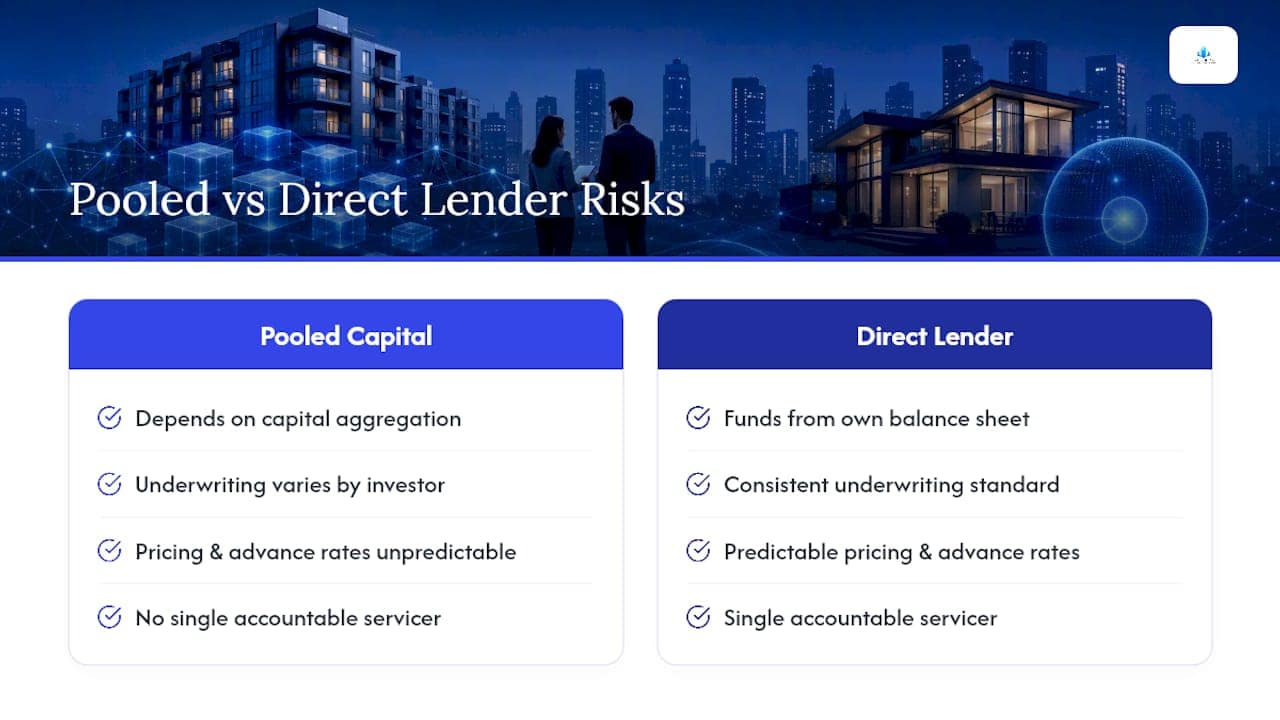
Compared with a direct lender putting its own capital behind a deal, pooled or crowdfunded private lending structures carry a distinct set of risks. When multiple individual investors fund a single loan through an intermediary platform, execution depends on that platform successfully aggregating enough capital before closing. If the raise falls short, the deal can stall or collapse at the worst possible moment, weeks after a borrower thought financing was secured.
There’s also less standardization. A pooled structure may underwrite each deal differently depending on which investors are participating and what terms they’ll accept, which makes pricing and advance rates harder to predict upfront. Traditional bank financing, by contrast, follows fairly rigid underwriting guidelines, and a direct lender funding its own balance sheet applies one consistent standard across deals.
Servicing after closing is another gap. Pooled structures sometimes lack a single accountable party managing the loan through its life, which becomes a real problem if a borrower needs a modification, an extension, or a draw released quickly during construction. Institutional investors have been shifting more capital toward private credit structures partly because of the more predictable, centrally underwritten cash flow they offer relative to pooled retail capital arrangements.
None of this means pooled capital is unusable. It means borrowers and capital partners should ask who actually owns the credit decision and who’s accountable if the deal needs to change mid-stream.
What Liquidity and Exit Options Do Investors Have?
Liquidity is the least glamorous part of private lending and the one investors ask about too late. A loan funded through a direct lending platform is generally illiquid until it’s repaid, refinanced, or sold. Capital partners investing alongside a platform should treat the hold period as the full loan term unless a secondary sale market exists for that specific instrument.
Exit typically happens one of three ways: the borrower pays off the loan at maturity, the borrower refinances into permanent debt, or the loan is sold to another capital provider before term. Bridge and fix-and-flip products tend to have shorter exit windows, often six to eighteen months, while small-balance commercial and construction loans run longer given the underlying project timelines.
Some platforms are exploring tokenized structures to create secondary liquidity for real estate-backed instruments, which could eventually give investors an exit path before maturity. That technology is still developing across the industry, and readers evaluating tokenization frameworks should treat any secondary-market liquidity claim as forward-looking rather than a guaranteed feature of today’s products. The safest assumption for now: plan around the stated loan term, not a hoped-for early exit.
What Legal and Regulatory Rules Apply?
Direct private lending operates under a different regulatory framework than public securities offerings, and borrowers and capital partners should understand which rules actually govern their transaction. Loan origination is generally subject to state lending licensing requirements, usury limits where applicable, and federal consumer protection rules when a loan touches owner-occupied residential property.
KYC and AML verification isn’t optional paperwork. It’s a legal requirement tied to federal anti-money-laundering rules, and a platform skipping or shortcutting this step is a warning sign, not a convenience. Borrowers should also confirm how a platform handles ITIN and foreign-national applicants, since documentation requirements differ from those for US citizens and vary by state and loan type.
Capital partners funding deals through a platform should understand whether they’re participating as a direct lender of record or through a pooled or assigned interest, since that distinction affects legal recourse if a loan defaults. Always review the actual loan documents and any offering materials rather than relying on marketing language, and consult a qualified attorney for guidance specific to your state and transaction structure before committing capital.
How Do Fees Compare Across Private Lending Platforms?
Fee structures vary more across private lending platforms than most borrowers expect, and the differences rarely show up until late in the process unless the platform publishes terms upfront.
Origination fees are the most visible cost and typically run as a percentage of loan amount, but that percentage can shift based on loan program, LTV, and borrower profile. Some platforms disclose this range before application; others quote it only after underwriting is complete, which limits your ability to comparison shop.
Servicing fees and exit fees are where cost structures diverge the most. A platform charging a low origination fee but a steep prepayment penalty may cost more over an eighteen-month hold than one with a higher upfront fee and no exit penalty. Rate spreads on bridge and construction products also reflect execution speed. A borrower paying a premium for 24 to 48 hour funding is trading cost for certainty, and that tradeoff only makes sense when the deal genuinely requires that speed.
The clearest way to compare platforms is a published advance-rate and pricing grid available before you submit a full application. Anything less forces you to underwrite the platform’s fee structure the same way it’s underwriting your deal, on incomplete information.
Why Speed and Published Terms Matter More Than the Lowest Rate
Borrowers fixate on rate because it’s the easiest number to compare. It’s also often the least important number when a deal has a real deadline. A sponsor who loses an acquisition because financing took three weeks instead of three days didn’t save money by chasing the cheapest quote. They lost the deal entirely.
Prioritize speed and published terms when the timeline is tight, the asset needs to close before a competing offer does, or the deal structure depends on a bridge that has to fund before a permanent loan can take over. Prioritize the lowest headline rate only when timeline pressure is genuinely low and you have room to shop multiple lenders without risking the deal itself.
Get Faster, More Transparent Financing With CR Equity AI
CR Equity Ai Inc is built for exactly the borrowers this article covers: sponsors and business owners who need a decision in hours, not weeks, and who want to see the advance-rate grid before they submit a package rather than after. Because CR Equity Ai Inc funds loans with its own capital across the full deal lifecycle, from acquisition through construction to DSCR refinance and business funding, you get one underwriting standard and one accountable lender instead of a patchwork of third-party capital sources.
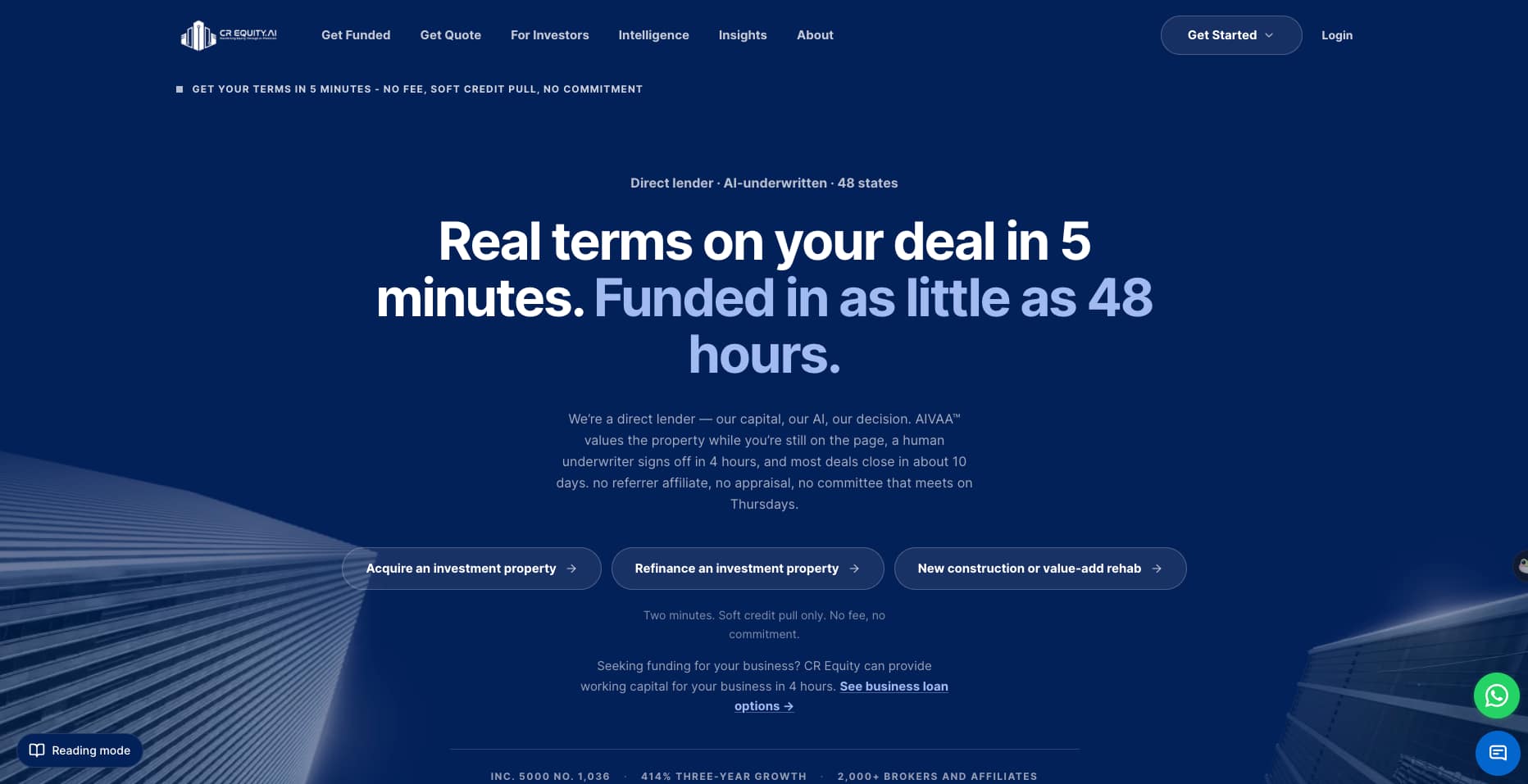
If you’re weighing a fix-and-flip project, a small-balance commercial deal, or a bridge you need funded before a closing deadline, start by getting a loan quote to see published terms against your specific deal before you commit to any lender.
Sources
- AI in CRE underwriting: A community bank guide — LenderBox
- Close CRE deals 40% faster with AI loan origination — Smart Capital Center
- Private credit primer — Callan blog
FAQ
What makes a direct private lending platform faster than a bank?
Automated document extraction and AI-assisted underwriting can cut time to decision by 50% to 75%, while a human underwriter still owns the final credit decision.
Are published advance-rate grids actually reliable?
A published grid reflects the platform’s standard underwriting criteria, but final terms still depend on the specific deal’s LTV, DSCR, and documentation, so treat the grid as a starting benchmark, not a guaranteed quote.
Does CR Equity AI verify income for real estate loans?
CR Equity Ai Inc uses a soft credit pull with no income verification required on most real estate programs, qualifying deals like DSCR refinances on rental income instead of tax returns.
What’s the biggest risk with pooled private lending versus a direct lender?
Pooled structures depend on aggregating enough investor capital before closing, which can stall or collapse a deal if the raise falls short, while a lender funding its own capital removes that dependency.
How fast can emergency bridge financing actually close?
CR Equity Ai Inc’s F.L.E.X. 50™ emergency bridge program is designed to fund in 24 to 48 hours for qualifying deals, compared with weeks for typical bank bridge financing.