

ITIN holders can finance investment property today, mainly through non-QM wholesale programs or direct private lenders built for borrowers without a Social Security number. Expect a larger down payment, tax returns filed under your ITIN, and proof of reserves in place of standard W-2 underwriting. If you are ready to move, start by pulling your ITIN-filed tax returns and running a preflight check with a lender that names its terms up front.
TL;DR:
- Investment purchases typically require 20% to 30% or more down, several months of mortgage payments in verifiable reserves, and fees beyond the interest rate.
- DSCR loans qualify rentals on projected or actual rent, while flips need short term financing based on renovation plans and after repair value.
- A soft credit pull does not affect your score, and lenders may consider rent or utility payment records when your US credit history is limited.
- Gather two years of tax returns filed under your ITIN, bank statements, identity documents, proof of reserves, and a rental plan before applying.
- Wholesale brokers can shop multiple programs but add approval layers; direct private lenders may move faster when they publish terms upfront.
Table of Contents
- What an ITIN loan is and who uses ITINs
- Eligibility and documentation lenders typically require from ITIN borrowers
- Can ITIN loans be used for investment properties and typical lender constraints
- Typical terms, costs, and timeline for ITIN investor lending
- How to find and apply to lenders that accept ITINs
- How CR Equity AI underwrites ITIN investor loans and what it means for you
- Post-loan servicing and repayment expectations for ITIN loan borrowers
- Detailed explanation of soft credit pull process and its impact on ITIN loan applications
- Comparison of ITIN loan programs for different real estate investment types
- Specific underwriting criteria unique to ITIN loan real estate investors
- Practical steps to prepare an application (credit, tax returns, reserves)
- Author perspective: prioritized next steps for ITIN investors
- Financing your next deal through CR Equity AI
- FAQ
- Sources
What an ITIN loan is and who uses ITINs
An ITIN, or Individual Taxpayer Identification Number, is a nine-digit number the IRS issues to people who must file a US tax return but do not qualify for a Social Security number. An ITIN loan is simply a mortgage underwritten against that number instead of an SSN, using tax returns, bank records, and other documentation the lender can verify independently.
Federal loan programs generally will not accept this path. HUD mortgagee guidance requires a valid Social Security number or specific work authorization and residency documentation for FHA-insured loans, which rules out most ITIN-only borrowers for FHA, and the same restriction applies in practice to Fannie Mae, Freddie Mac, and VA programs. That gap is why ITIN financing lives almost entirely outside the conforming world, in three main channels:
- Wholesale broker programs that package ITIN loans for non-QM investors.
- Direct private lenders who underwrite and fund ITIN deals with their own capital.
- DSCR-style programs that qualify the property’s rental income rather than the borrower’s personal income.
Eligibility and documentation lenders typically require from ITIN borrowers
Lenders working with ITIN borrowers replace the standard SSN-based file with a different stack of proof. The goal is the same: confirm identity, income, and the ability to repay, just through alternative documents.
- Tax returns filed under your ITIN, usually two years, showing consistent income.
- W-2s, 1099s, or bank statements that support the income shown on those returns.
- A valid passport or other government-issued photo ID.
- Your ITIN assignment letter or other IRS proof of issuance.
- Evidence of reserves, typically several months of the mortgage payment held in a verifiable account.
- Proof of the down payment source, whether savings, a gift, or sale proceeds.
- For investment purchases, a lease or a written rental plan showing how the property will perform.
Most ITIN lenders rely on a soft credit pull or alternative credit references rather than a traditional score-driven decision, which helps borrowers with thin US credit files still get evaluated fairly.
Pro Tip: Before applying anywhere, search the lender on NMLS Consumer Access to confirm it is licensed in the state where the property sits.
Can ITIN loans be used for investment properties and typical lender constraints
Yes. Many ITIN programs are built specifically for investment purchases, not just owner-occupied homes, though they come with tighter terms than a conventional loan would. The tradeoff for flexible documentation is usually a larger down payment, deeper reserve requirements, and sometimes a cap on how many financed properties you can hold at once.
A growing share of these programs qualify the deal on the property’s own economics rather than your personal tax returns. Under a DSCR, or debt service coverage ratio, approach, the lender compares projected rental income against the proposed mortgage payment, so a strong-performing rental can qualify even when the borrower’s personal income documentation is thin.
Common constraints to watch for:
- Higher minimum down payments on investment units than on primary residences.
- Reserve requirements that scale with the number of properties you already own.
- Property-type restrictions, with some programs excluding rural land, raw land, or certain condo structures.
- Loan amount caps that vary by lender and by whether the deal is purchase, refinance, or cash-out.
Typical terms, costs, and timeline for ITIN investor lending
Down payments on ITIN investment loans commonly require a substantial percentage, with the exact figure set by the lender, the property type, and your reserve position. Pricing sits above conventional rates because these are non-QM or private products, and you should plan for origination fees, underwriting fees, and sometimes a servicing fee layered on top of the interest rate.
- Down payment: typically 20% to 30%+ for investment purchases, lender-dependent.
- Pricing: higher than conventional rates, reflecting non-QM and private-capital risk pricing.
- Fees: origination, underwriting, and sometimes technology or servicing charges on top of rate.
- Timeline: wholesale broker channels can take longer due to multiple approval layers, while direct private lenders that publish their own terms can move faster once the file is complete.
ITIN and non-permanent resident borrowers remain outside FHA-insured financing under HUD’s updated residency requirements, which took effect for case numbers assigned on or after May 25, 2025. That single rule is the reason most ITIN investment lending routes through private capital rather than government-backed programs, and it makes a lender’s published advance-rate grid worth checking before you submit a file, since it tells you upfront what loan-to-value range you are working with.
How to find and apply to lenders that accept ITINs
Two paths exist, and the right one depends on what you value most. Brokers plug into wholesale ITIN programs and can shop multiple lenders on your behalf, which is useful if your deal does not fit a standard box. Direct private lenders skip that layer, underwrite with their own capital, and tend to move faster when they publish their terms in advance.
- Gather two years of ITIN-filed tax returns and recent bank statements.
- Pull together your passport, ITIN documentation, and proof of reserves.
- Prepare property details: purchase contract, rent roll or lease, and renovation scope if applicable.
- Ask each prospective lender its advance rate, reserve requirement, decision timeline, and accepted income documentation.
- Confirm licensing through NMLS Consumer Access before sending sensitive financial documents.
A broker often gives you the broadest shelf of ITIN products since many wholesale lenders only originate through that channel, while a direct lender can win on speed and transparency once you know your numbers.
How CR Equity AI underwrites ITIN investor loans and what it means for you
We underwrite the asset and the deal first and support ITIN and foreign national investors alongside US borrowers on most real estate programs. Advance-rate grids are published before application so loan-to-value ranges can be seen without submitting a full file first.
Programs relevant to ITIN investors include:
- Investment Property Acquisition Loans for purchase transactions, with closings targeted around 10 days for qualified files.
- Fix and Flip Loans for rehab deals, with advance rates up to 100% LTV for qualified sponsors.
- DSCR Cash-Out Refinance, qualified on rental income rather than tax returns.
- F.L.E.X. 50™ emergency bridge financing, typically funded in 24 to 48 hours.
- Small Balance Commercial Loans, ranging from $100,000 to $100 million at up to 80% LTV.
A soft credit pull, tax returns filed with the ITIN, and proof of reserves are typically requested rather than standard income verification. You can review the full ITIN and foreign national loan program details before submitting a deal.
Post-loan servicing and repayment expectations for ITIN loan borrowers
Once an ITIN loan closes, servicing works much like any other investment property loan: you make scheduled payments, maintain the property, and keep required insurance and tax escrows current where applicable. Many non-QM and private lenders service loans in-house or through a dedicated servicing arm rather than selling the note to a secondary-market buyer, so your point of contact for payment questions, payoff requests, or draw schedules on construction and rehab loans often stays with the original lender.
Bridge and short-term products commonly carry a servicing fee layered into the loan’s overall cost structure, separate from the interest rate itself, and borrowers should read the note’s terms for exit fees or prepayment conditions before signing. DSCR loans, since they are qualified on rental income, usually expect continued documentation of lease activity if you refinance or request a loan modification later.
For foreign investors who eventually sell, FIRPTA withholding becomes relevant at closing. The IRS FIRPTA rules require a buyer to withhold a portion of the sale proceeds when a foreign person disposes of US real property, which is separate from mortgage servicing but affects net proceeds planning. Building that withholding into your exit math early, rather than discovering it at the closing table, keeps your repayment and sale timeline realistic from the start.
Detailed explanation of soft credit pull process and its impact on ITIN loan applications
A soft credit pull checks your credit history without generating a hard inquiry that could lower your score, which matters for ITIN borrowers who are actively shopping multiple lenders or programs. Lenders use the soft pull to get a general read on payment history and debt load, then lean more heavily on alternative documentation, such as bank statements, rental payment history, or utility records, to round out the picture.
This approach changes the application experience in a practical way. Instead of a single credit score gatekeeping your file, the lender weighs reserves, down payment strength, and property performance alongside whatever credit signal the soft pull provides. For ITIN borrowers who may have thin or limited US credit files, this matters because a short credit history does not automatically disqualify a strong deal.
Because a soft pull does not affect your score, you can reasonably compare offers from a broker and a direct lender side by side without the cumulative inquiry damage that hard pulls would cause. That makes early-stage shopping lower risk and gives you more room to negotiate terms before committing to a full underwriting file with any single lender.
Comparison of ITIN loan programs for different real estate investment types
Fix-and-flip ITIN borrowers generally need a program that moves fast and funds renovation draws, since the underwriting focus sits on the after-repair value and the sponsor’s execution plan rather than long-term rental income. Rental-property investors, by contrast, are usually better served by a DSCR structure, where the lender qualifies the loan against projected or actual rent, which plays to the strength of an income-producing asset rather than personal tax documentation.
Commercial ITIN financing, such as small-balance commercial loans, tends to involve more extensive property-level underwriting: lease terms, tenant quality, and net operating income all factor into the decision, and loan sizes can range meaningfully higher than a typical single-family rental file. The down payment and reserve expectations also shift upward as the asset class becomes more complex, since commercial properties carry different vacancy and market risk than a single rental unit.
Choosing the right program starts with naming the deal type honestly. A flip that gets forced into a long-term DSCR structure will carry costs that do not match its short holding period, and a rental that gets financed through a short-term bridge product will face refinance pressure before it has had time to stabilize. Matching the loan type to the investment strategy from the outset avoids both problems.
Specific underwriting criteria unique to ITIN loan real estate investors
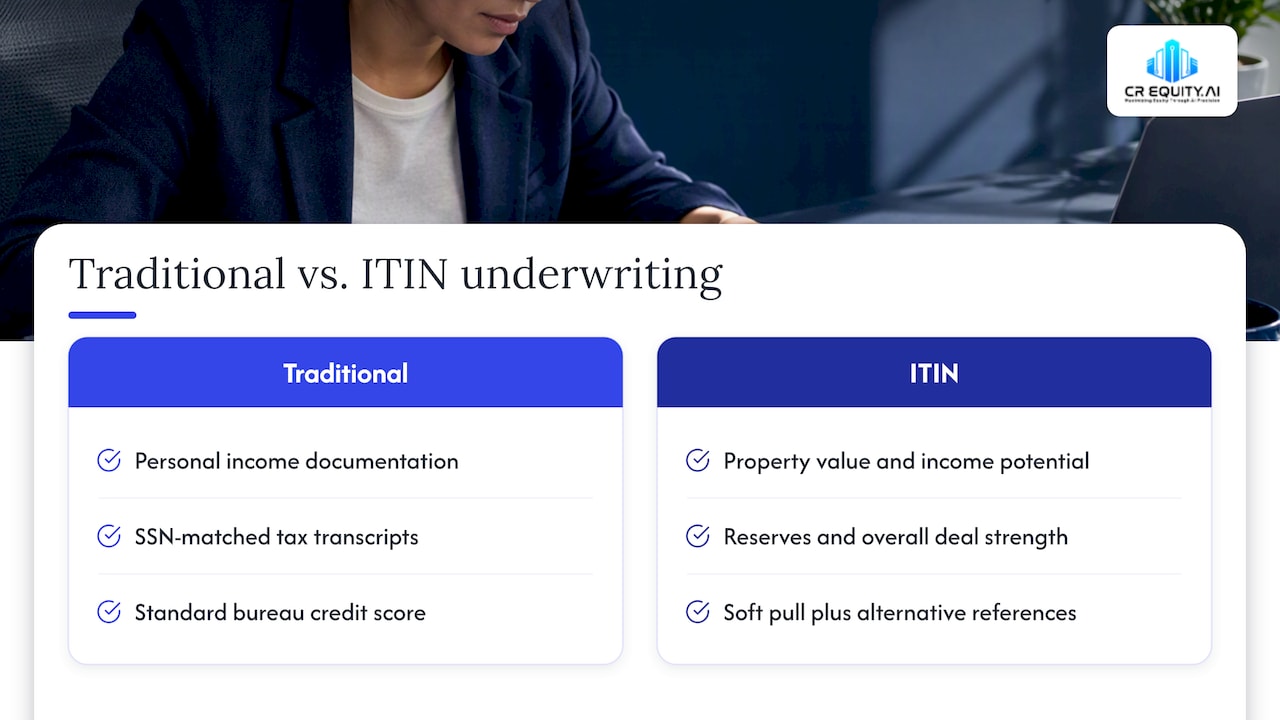
Traditional mortgage underwriting leans heavily on a borrower’s personal income documentation, tax transcripts matched against an SSN, and a credit score pulled through the standard bureaus. ITIN underwriting shifts much of that weight onto the deal itself: the property’s value, its income potential, and the sponsor’s reserves carry more of the decision than a single income figure.
This asset-and-deal approach means a lender will often spend more time on the property’s rent roll, comparable sales, or renovation budget than on parsing a borrower’s full financial history. Reserves play an outsized role here, since they signal the borrower can absorb a vacancy or a cost overrun without missing payments, which matters more when personal income documentation is less standardized.
Credit evaluation also differs. Rather than a hard score cutoff, many ITIN programs use a soft credit pull alongside alternative references, such as rental payment history or existing loan performance, to build a fuller picture of repayment behavior. The combined effect is an underwriting process that looks at the whole deal, not just the applicant’s paperwork, which is why two ITIN borrowers with similar tax returns can land very different terms depending on the strength of the property and the reserves behind it.
Practical steps to prepare an application (credit, tax returns, reserves)
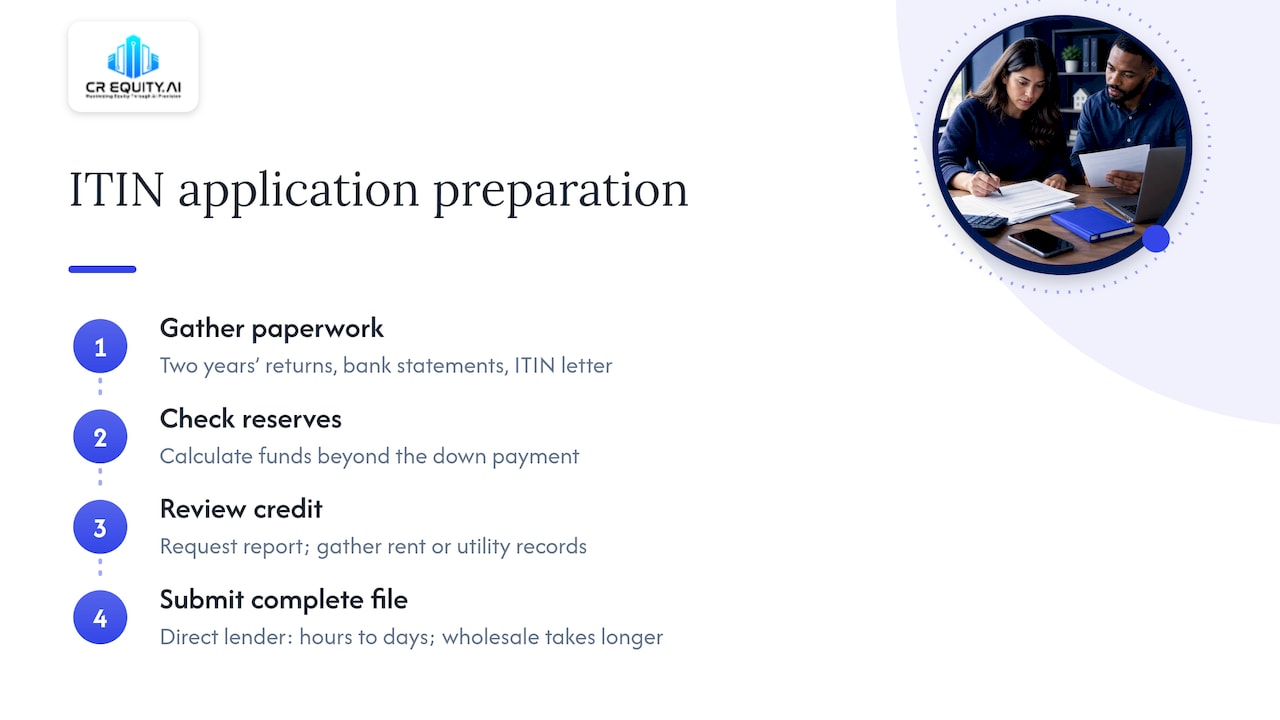
Start with your paperwork, not your property search. Pull two years of tax returns filed under your ITIN, request current bank statements for every account you plan to use for reserves or down payment, and confirm your ITIN assignment letter is on hand. Lenders move faster when this documentation arrives complete rather than in pieces.
Next, take stock of your reserves. Most ITIN investment programs expect several months of mortgage payments held in a verifiable account beyond the down payment itself, so calculate that figure before you start shopping lenders, not after you find a property. If your reserves fall short, decide whether to wait, adjust the loan amount, or target a smaller property.
On credit, request your own report ahead of time so you know what a soft pull will reveal, and gather any alternative payment history, such as rent or utility records, that could support a thin file. Timeline-wise, a complete file submitted to a direct lender can move through decisioning in a matter of hours to a few days, while broker-originated wholesale files often take longer because they pass through additional underwriting layers. Building your documentation package before you contact any lender is the single biggest factor in how fast your file moves.
Author perspective: prioritized next steps for ITIN investors
The borrowers who move fastest are not the ones with perfect credit. They are the ones who show up with ITIN-filed tax returns, documented reserves, and a clear rental or exit plan already assembled. That preparation does more for approval odds than chasing the lowest advertised rate.
Choosing between a broker and a direct lender is a tradeoff between program breadth and speed. If asset-based underwriting and a fast decision matter more to your deal than shopping every wholesale option, a direct private lender workflow is usually the more efficient route.
— Robert Stewart Jr
Financing your next deal through CR Equity AI
We built our underwriting around the asset and the deal, which is why ITIN and foreign national investors can access the same programs we offer US borrowers: acquisition loans, DSCR cash-out refinance, fix-and-flip financing, and emergency bridge capital. Our advance-rate grids are published before you apply, so you know the loan-to-value range before committing time to a full file.

If you have a property under contract or a refinance in mind, submit your deal through our Investment Property Acquisition Loans page. After submission, expect a fast preflight review, a soft credit pull, and a decision timeline that moves in hours rather than weeks once your documentation is complete. For deals already photographed or ready to present to partners, professional property imagery can strengthen the file you send us.
This article is general information, not a substitute for advice from a qualified financial advisor. Consult a qualified financial professional about your own circumstances before acting on anything here.
FAQ
Can I get a mortgage if I am not a US citizen?
Yes, non-citizens without a Social Security number can qualify for a mortgage through non-QM or private lending programs, though FHA, Fannie Mae, Freddie Mac, and VA loans generally require a valid SSN under HUD guidance. ITIN and foreign national programs fill that gap using tax returns, bank statements, and other verifiable documentation instead.
How much income do I need to qualify for a $250,000 mortgage?
Income requirements vary by lender, interest rate, down payment, and whether the loan is qualified on personal income or on the property’s rental performance through a DSCR structure. Rather than a fixed income figure, ITIN lenders typically weigh your debt-to-income position, reserves, and the deal’s cash flow together, so the answer depends on your specific file.
What is the $100,000 loophole for family loans?
This question refers to a provision in US tax law around below-market family loans, which falls under IRS rules on imputed interest rather than mortgage underwriting. It is not a lending program and does not substitute for a mortgage, so ITIN investors should treat it as a tax planning topic separate from property financing.
Is it hard to get a mortgage for an investment property?
Investment property mortgages generally require larger down payments and deeper reserves than owner-occupied loans, regardless of whether the borrower uses an SSN or an ITIN. For ITIN borrowers specifically, the process is manageable once documentation such as ITIN-filed tax returns, proof of reserves, and a rental plan is organized in advance, since many non-QM and private lenders are built around exactly this profile.
Sources
- Subject Eligibility Requirements for Certain Non-Permanent Resident Borrowers (HUD Mortgagee Letter)
- Individual Taxpayer Identification Number (ITIN) (IRS)