

Lender onboarding automation replaces manual document collection, identity checks, and underwriting handoffs with connected digital workflows, cutting approval timelines while keeping compliance intact. For lenders, this means faster funding decisions, fewer drop-offs, and a borrower experience that meets expectations set by mobile banking. Platforms like CR Equity AI illustrate how a direct lender structures these workflows in practice.
TL;DR:
- Map all six automated tasks to specific systems, and confirm every verification tool writes results back to the lender’s system of record automatically.
- For legal entity borrowers, retain beneficial owner records for five years after account closure, and tie decline notices to the actual decision factors.
- Begin with document ingestion and identity checks, then pilot one loan program before expanding; rule based checks are easier to audit than predictive scoring.
- Use a phased rollout: pilot one program for three months, refine through month six, and scale by month twelve after governance and KPIs are proven.
Table of Contents
- Why Lenders Must Automate Onboarding
- What Lender Onboarding Automation Covers
- Core Components and Tech Architecture
- Compliance Checkpoints Built Into Automation
- Implementation Best Practices: A Prioritized Checklist
- Measuring Success: KPIs and Timelines
- CR Equity AI: Automation Aligned to Underwriting Speed
- Case Studies: Automation in Practice
- Where to Start Without Losing Compliance Discipline
- How CR Equity AI Can Help You Move Faster
- FAQ
- Sources
Why Lenders Must Automate Onboarding
Manual onboarding breaks down at the exact points where lenders lose the most deals. Borrowers abandon applications when forms ask for information twice or require mailing physical documents. Loan officers re-key the same data into three or four systems, introducing errors that trigger compliance reviews later.
Beneficial ownership verification under the FFIEC Beneficial Ownership Rule adds friction when legal-entity borrowers cannot immediately produce ownership documentation. Each manual touchpoint adds days to a process borrowers increasingly expect to complete on a phone.
The operational gaps show up consistently across lending shops of every size:
- Application forms that do not pre-fill or validate data cause incomplete submissions and borrower drop-off.
- Manual document review creates bottlenecks that scale poorly as loan volume grows.
- Disconnected systems force staff to re-enter borrower data, raising error rates and rework.
- Compliance checks performed late in the process, rather than at intake, delay funding decisions.
- Borrowers expect digital, mobile-first onboarding comparable to consumer banking apps, and abandon lenders that cannot deliver it.
Each of these problems compounds. A data entry error from manual intake can resurface three steps later as a compliance exception, adding another review cycle to a loan that should have closed in days. Automation addresses the root cause: capturing clean data once, validating it immediately, and routing it to the right checkpoint without human re-entry.
What Lender Onboarding Automation Covers
Lender onboarding automation is the use of connected software to handle the repeatable steps between a borrower’s first application and a funded loan: capturing information, verifying identity, ingesting documents, and routing files to underwriting without manual handoffs. It splits into two layers that lenders need to evaluate separately.
The borrower-facing layer governs the application experience: what the borrower sees, uploads, and signs. The back-office layer orchestrates what happens after submission: how data moves between systems, which checks run automatically, and where a human underwriter has to intervene.
Commonly automated tasks fall into a predictable sequence:
- Application capture, pre-filling known fields and validating entries in real time.
- Identity proofing, confirming the borrower or entity matches government or business registry records.
- Document ingestion, extracting data from uploaded bank statements, tax returns, or entity formation documents.
- Income or cash flow verification, pulling bank-transaction data instead of requiring manual statement review.
- Initial underwriting signals, flagging deals that meet program criteria before a human underwriter opens the file.
- Adverse-action routing, triggering compliant notices when an automated or hybrid decision results in a decline.
Lenders evaluating vendors or building in-house tools should map each of these six tasks to a specific system, rather than assuming a single platform covers the full sequence.
Core Components and Tech Architecture
A working onboarding stack rests on five interlocking components, and gaps in any one of them create the bottlenecks described above.
- Document intelligence extracts and validates data from uploaded files, flagging missing pages or inconsistent figures before a human ever opens the document. See how this works in practice in our overview of document intelligence for lending.
- Digital identity verification confirms borrower identity through documentary methods (government ID scans) or non-documentary methods (database checks against credit bureaus or public records).
- Account aggregation pulls bank-transaction data directly, replacing manual statement uploads and giving underwriters verified cash flow signals faster.
- Workflow orchestration routes each file through the correct sequence of checks, holding exceptions for human review instead of forcing every file through the same linear path.
- APIs and event-driven integrations connect the loan origination system, credit bureaus, AML screening providers, and servicing platforms so that data entered once propagates everywhere it is needed.
A single system of record matters as much as any individual tool. When identity data lives in one platform, document data in another, and underwriting notes in a third, reconciling them becomes its own manual task, undoing much of the automation’s value.
Pro Tip: Before adding a new verification tool, confirm it writes back to your system of record automatically. A tool that requires manual export just moves the bottleneck instead of removing it.
Compliance Checkpoints Built Into Automation
Automation does not bypass regulatory requirements. It needs to encode them as explicit, auditable steps.
The FFIEC Customer Identification Program requirements call for risk-based procedures that verify each customer’s identity using documentary or non-documentary methods, with records and notices kept so the customer can see what identification was required. Automated onboarding should apply stronger verification to higher-risk borrower profiles and lighter friction to lower-risk ones, rather than a single flat procedure for every applicant.
Customer due diligence goes further than identity verification. FFIEC guidance on customer due diligence requires understanding the nature and purpose of each relationship and performing ongoing monitoring, with beneficial owner information updated on a risk basis rather than only at account opening.
For legal-entity borrowers, the beneficial ownership rule adds its own recordkeeping standard: banks must identify and verify beneficial owners and retain records for five years after an account closes. Our guide to beneficial ownership verification walks through what documentation that requires in practice.
When automation or AI contributes to a credit decision, the CFPB’s circular on adverse action notices requires lenders to disclose the specific principal reasons behind a decline, not a generic sample checklist that does not reflect the actual factors used. Practical automation needs to:
- Log which data points and rules triggered each decision, not just the outcome.
- Generate adverse-action notices that map directly to the disclosed reasons, not boilerplate language.
- Preserve an audit trail connecting every automated step back to the original borrower submission.
- Apply stronger identity checks to higher-risk profiles, consistent with FFIEC’s risk-based approach.
Implementation Best Practices: A Prioritized Checklist
Lenders rolling out onboarding automation get the best results by sequencing changes rather than replacing every system at once.
- Pick high-frequency, low-risk workflows first. Document ingestion and identity verification tend to deliver the fastest measurable wins.
- Build a canonical data model before adding tools. Every system needs to reference the same borrower and entity fields, or integration work multiplies later.
- Automate rules before models. Deterministic checks (does this document exist, does this ID match) are easier to audit than predictive scoring.
- Design human-in-the-loop exceptions. Route only genuine edge cases to underwriters, with the minimal context needed to resolve them quickly.
- Vet third-party integrations for compliance, not just speed. Confirm vendors can support audit trails and recordkeeping requirements before signing.
- Assign cross-functional governance. Compliance, IT, and underwriting leadership should review pilot results together, not in separate silos.
Pro Tip: Run the pilot on one loan program, such as a single bridge loan or acquisition product, before expanding automation across your full portfolio. A narrow scope makes exceptions easier to diagnose.
Measuring Success: KPIs and Timelines
Five metrics tell lenders whether automation is working: time-to-complete onboarding, completion rate (applications started versus funded), cost-per-onboard, exception or error rate, and time-to-funding from application to closed loan. Baseline each metric before the pilot begins, since without a starting point, improvement claims are unverifiable.
- Time-to-complete onboarding: measured from first application touch to a fully verified file ready for underwriting.
- Completion rate: the share of started applications that reach submission without abandonment.
- Cost-per-onboard: total staff and vendor cost divided by onboarded files in a given period.
Many lenders structure rollout in three phases: a pilot running the first zero to three months on a single program, refinement from months three to six as exception patterns become clear, and broader scaling from months six to twelve once governance and KPIs are proven. Federal Reserve research on algorithmic underwriting notes that efficiency gains from automation require ongoing validation as models and volumes change, which supports building a review cadence into the timeline rather than treating the rollout as a one-time project.
CR Equity AI: Automation Aligned to Underwriting Speed
Our platform reflects the components outlined above. We underwrite against the asset and the deal, using a soft credit pull rather than full income documentation on most real estate programs, with decisions possible in as little as four hours. Our AI underwriting maturity overview describes how rapid decisioning connects to document intelligence on the front end. We also publish advance-rate grids before borrowers apply, giving applicants visibility into terms before they submit a file, consistent with the audit-trail and explainability principles described in the compliance section above.
Case Studies: Automation in Practice
Lenders that automate onboarding in sequence, rather than all at once, tend to report the clearest gains. A pattern that shows up across industry case studies: lenders who start with document ingestion and identity verification see measurable improvement in completion rates and time-to-funding before they touch underwriting automation at all. That ordering matters because document and identity checks are rule-based and easy to validate, while underwriting automation involves judgment calls that need more governance before they scale.
One funded example from our own portfolio illustrates the pattern on a smaller commercial deal: a $199,000 ground-up construction loan on Maryland’s Eastern Shore moved through document intake, identity verification, and milestone-based draw structuring without the borrower needing to resubmit paperwork at each draw stage. Construction loans are a useful test case for onboarding automation because they involve repeated verification touchpoints (one per draw) rather than a single intake event, so friction at onboarding compounds across the life of the loan if it is not resolved early.

Commercial real estate sponsors face a similar readiness challenge before a lender can even begin automated intake. A commercial real estate underwriting checklist for sponsors outlines the borrower-side documentation that needs to be ready before a deal can move through any underwriting process, automated or manual, which is worth reviewing before assuming an automation tool alone will fix a slow pipeline. The lesson from these examples is consistent: automation delivers the most value when the borrower-facing and back-office layers are designed together, not bolted onto an existing manual process after the fact.
Where to Start Without Losing Compliance Discipline
Prioritize borrower experience and measurable outcomes over tool novelty. Start with high-frequency, low-risk workflows like document intake, and instrument every step so you can prove improvement. Build explainability and audit trails into any model-driven decision from day one, not after a regulator asks for one.
— Robert Stewart Jr
How CR Equity AI Can Help You Move Faster
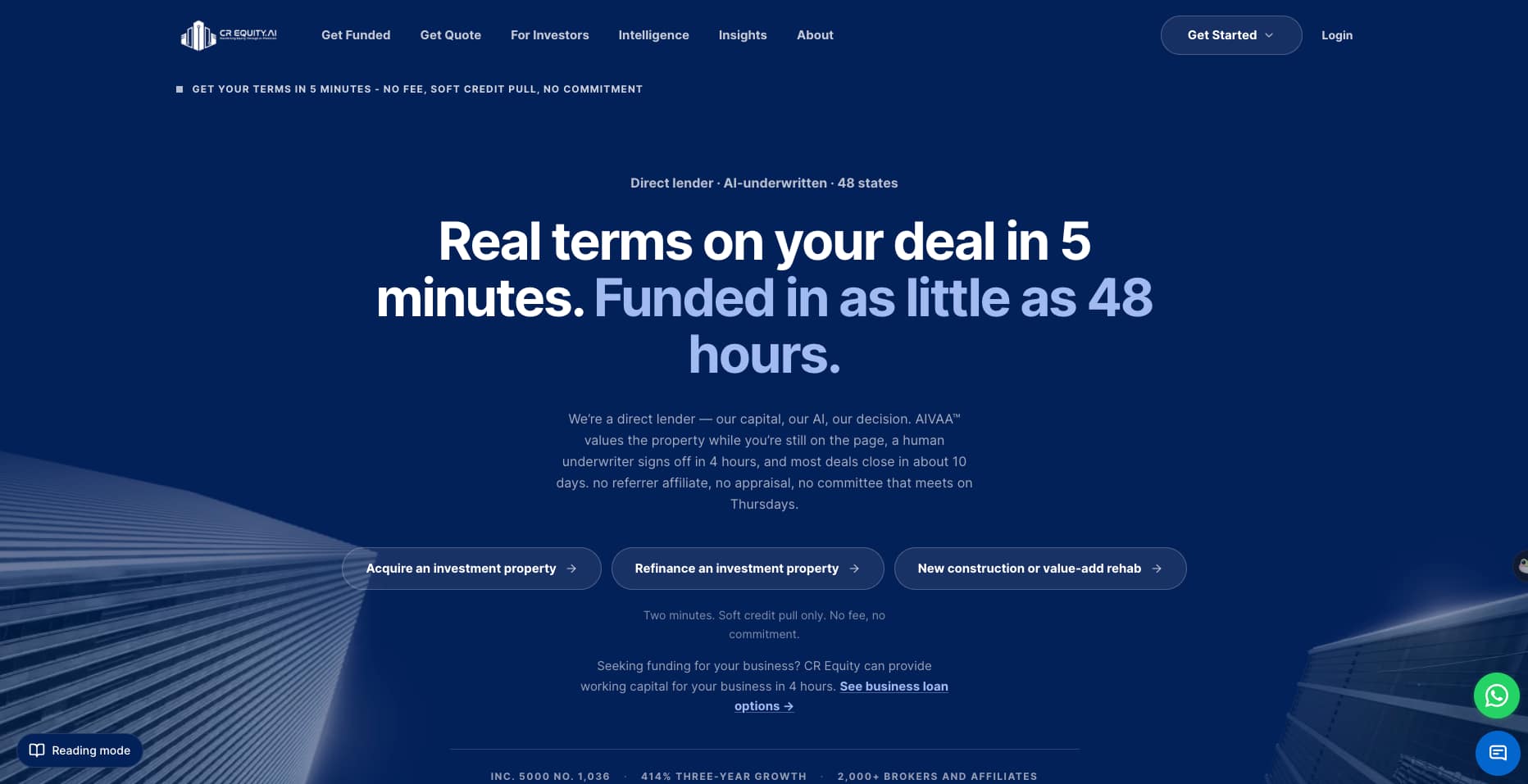
If the checklist above points to gaps in your current onboarding process, we built CR Equity AI around the same principles: fast decisions, document intelligence at intake, and advance-rate grids published before you apply, so there are no surprises mid-file. Whether you need a commercial bridge loan, DSCR cash-out refinance, or funding for a ground-up build, our platform applies the same underwriting discipline across programs. Brokers ready to move a file can submit a deal directly and see how our onboarding compares in practice.
This article is general information, not a substitute for advice from a qualified financial advisor. Consult a qualified financial professional about your own circumstances before acting on anything here.
FAQ
How do you automate the onboarding process?
Start by mapping your current manual steps, then automate document ingestion and identity verification first, since these are rule-based and deliver fast, measurable gains. Layer in workflow orchestration and compliance checkpoints before adding any model-based underwriting automation.
What are the five C’s of lending?
The five C’s are character, capacity, capital, collateral, and conditions, a traditional framework lenders use to evaluate a borrower’s creditworthiness. Automated onboarding typically speeds up the data collection behind capacity and collateral assessment, such as income and property data, while character and conditions often still involve underwriter judgment.
Is AI replacing mortgage loan officers?
AI is handling more data collection, verification, and initial underwriting signals, but CFPB guidance notes that AI-driven credit decisions still require explainable, specific adverse-action reasons, which keeps human oversight embedded in the process. Loan officers are shifting toward reviewing exceptions and complex files rather than handling every routine task manually.
What should lenders look for in onboarding software?
Lenders should prioritize software that supports document intelligence, risk-based identity verification consistent with FFIEC CIP standards, and a single system of record so data entered once does not need re-entry across platforms. Audit trail and adverse-action notice support are also essential for any tool that influences credit decisions.
Sources
- FFIEC BSA/AML Assessing Compliance with BSA Regulatory Requirements – Beneficial Ownership Requirements for Legal Entity Customers
- CFPB Circular: Adverse action notification requirements and the proper use of the CFPB’s sample forms
- Federal Reserve research on algorithmic underwriting and fairness