

LTC (loan-to-cost) tests your loan against total project cost; LTV (loan-to-value) tests it against appraised value. LTC governs construction and value-add deals because the lender is financing a budget that doesn’t exist yet. LTV governs stabilized acquisitions and refinances because there’s a finished asset to appraise. On most deals, the lender advances whichever ratio produces the lower loan amount, then checks that number against debt yield and DSCR before issuing a term sheet.
TL;DR:
- Construction and value-add deals are primarily limited by LTC, which is capped around 80 to 85 percent of total project costs, excluding profit projections and sunk costs.
- LTV becomes the main constraint after completion when the property can be appraised based on stabilized income, with typical bands from 65 to 80 percent of appraised value.
- A project’s LTC often depends on tight cost controls and accurate classification of expenses; overruns or misclassified soft costs can cause funding gaps.
- During stabilization and refinancing, lenders switch to assessing the loan against LTV, making the appraisal premise and valuation accuracy critical.
- Sponsors should clarify valuation assumptions and cost inclusions with lenders early to avoid funding surprises when switching from LTC to LTV constraints.
Table of Contents
- LTC vs LTV: What Each Ratio Measures and Why It Matters
- LTC vs LTV: How Loan-to-Cost Is Calculated and What Counts
- Worked Examples: Seeing LTC and LTV Side by Side
- When Lenders Apply LTC vs LTV Across the Loan Lifecycle
- Sizing Equity and Negotiating Around LTC and LTV
- Avoiding the Most Common LTC and LTV Mistakes
- How CR Equity Ai Inc Publishes Advance-Rate Grids for LTC and LTV
- Why the LTC vs LTV Debate Misses the Real Point
- Sources
- FAQ
LTC vs LTV: What Each Ratio Measures and Why It Matters
Loan-to-value is the loan amount divided by the property’s appraised value. That single sentence hides a complication most first-time borrowers miss: “value” isn’t one number. Appraisers assign value under different premises depending on the deal’s stage, and each premise produces a different LTV.
- As-is value: what the property is worth in its current condition, used for bridge loans and acquisitions of distressed assets.
- As-complete value: what the property will be worth once construction or renovation finishes, used to size construction loans against a future outcome.
- As-stabilized value: what the property will be worth once it’s leased up and generating market-rate income, used for permanent financing and refinances.
Lenders prioritize LTV for permanent loans, refinances, and purchases of income-producing assets because LTV is the primary metric for stabilized acquisitions and permanent financing, where the appraisal reflects a real, observable market comparable rather than a projection.
Typical LTV bands run from 65% to 80% for stabilized commercial and multifamily assets, tightening for riskier asset classes like hospitality or specialty industrial. A lower LTV usually buys a better interest rate and looser covenants, because the lender’s cushion against a market downturn is wider. Push LTV toward the top of that band and expect the reverse: higher pricing, tighter reporting requirements, and sometimes a requirement for recourse.
LTC vs LTV: How Loan-to-Cost Is Calculated and What Counts
Loan-to-cost is the loan amount divided by total project cost, sometimes called total development cost or TDC. Unlike LTV, there’s no appraisal premise to argue about. The denominator is a budget, and LTC measures the percentage of a project’s total cost that a lender will finance, which makes it the default test for construction and heavy value-add deals where no finished asset exists yet to appraise.
A defensible total project cost typically includes:
- Land or acquisition cost
- Hard costs (materials, labor, site work)
- Soft costs (architecture, engineering, permits, legal)
- Financing costs (loan fees, interest reserve, carry)
- Contingency reserve (usually 5% to 10% of hard costs)
Lenders commonly cap LTC financing around 80% of total project costs, which forces the sponsor to fund the remaining 20% or more in equity. Most lenders exclude the developer’s promote or profit projection from TDC, along with sunk costs incurred before the loan closes, since financing a sponsor’s anticipated profit defeats the purpose of the cost test. Push LTC toward 85% or higher and expect a lender to demand a completion guarantee or a larger sponsor balance sheet to offset the thinner equity cushion.
Worked Examples: Seeing LTC and LTV Side by Side
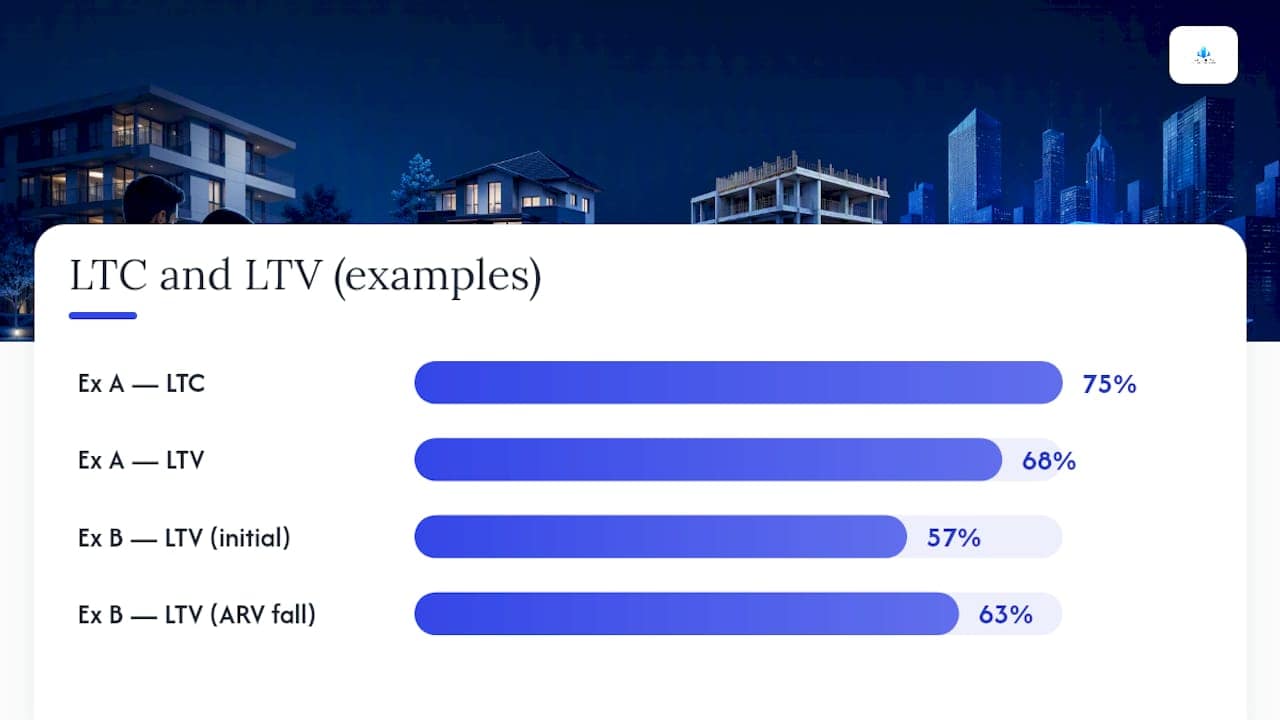
Example A: Ground-up development. A sponsor budgets total project cost at $10 million (land, hard costs, soft costs, financing, and contingency combined) and requests a $7.5 million loan. That’s 75% LTC. The projected as-complete value once the building is leased is $11 million. Here, LTC binds. The lender caps proceeds at 75% of cost even though 68% LTV would technically support a bigger loan, because the cost side is the more reliable number this early in the deal.
Example B: Value-add rehab. A sponsor buys a property for $1.2 million, budgets $300,000 in renovation costs, and projects an after-repair value (ARV) of $2.1 million. Total cost is $1.5 million. LTC binds again, capping the loan well below what the ARV alone would justify.
- Both examples show the same pattern: early-stage deals get capped by the budget, not the eventual value.
- Cost inflation changes the math immediately. If Example A’s hard costs rise 8%, total project cost climbs toward $10.5 million, and the same $7.5 million loan drops to roughly 71% LTC, tightening the sponsor’s proceeds without the appraisal moving at all.
- Appraisal shortfalls hit the other side. If Example B’s ARV comes in at $1.9 million instead of $2.1 million, LTV jumps from 57% to 63%, which usually still passes but erodes the exit cushion the sponsor was counting on.
The binding-constraint takeaway: in both worked examples, LTC governs at close. LTV only becomes the active constraint once the asset stabilizes and the lender (or a takeout lender) re-underwrites against real income.
When Lenders Apply LTC vs LTV Across the Loan Lifecycle
Underwriters don’t pick one ratio and ignore the other. Institutional practice runs LTC and LTV in parallel, then sizes the loan to whichever produces the smaller number. Which one binds shifts as the deal moves through its lifecycle.
- Construction and heavy value-add: LTC governs, because there’s a verified budget but no finished asset to appraise reliably.
- Stabilization: both ratios get retested; LTC becomes less relevant as the budget closes out and actual costs replace projections.
- Refinance or permanent takeout: LTV governs almost exclusively, since the asset now has trailing income and a defensible as-stabilized appraisal.
Bridge loans illustrate the handoff directly. At peak draw, the loan is measured against LTC because construction isn’t finished. The takeout lender who refinances that bridge loan measures the payoff against LTV, using the as-stabilized value once the property is leased. A sponsor who models only LTC at the front end and ignores the LTV test the takeout lender will apply is setting up a financing gap at exactly the moment the project needs certainty most.
Neither ratio operates alone. Debt yield and debt service coverage ratio (DSCR) run alongside LTC and LTV as independent checks, and sponsors should model all four constraints simultaneously rather than assume the collateral tests alone determine proceeds.
Sizing Equity and Negotiating Around LTC and LTV
LTC sets your equity check directly. There’s no free version of that trade.

LTV drives your exit sensitivity. If comparable sales or rent growth soften between application and closing, the appraised value can come in lower, and the takeout loan shrinks with it, sometimes leaving a funding gap the sponsor has to cover out of pocket.
A few negotiating levers are worth pushing on before signing a term sheet:
- Tighten the contingency line item so the lender sees a realistic cost buffer, not padding.
- Get written clarity on what counts toward total project cost before the lender finalizes the LTC calculation.
- Secure a takeout letter of intent early, so the LTV test at refinance doesn’t surprise you.
- Consider mezzanine or preferred equity to bridge the gap between what senior debt will fund at 75% to 80% LTC and what the deal actually needs.
Pro Tip: Ask the lender in writing which valuation premise (as-is, as-complete, or as-stabilized) they’ll use for the takeout LTV test before you finalize the construction budget. A mismatch discovered at refinance is far more expensive to fix than one caught at term sheet stage.
Avoiding the Most Common LTC and LTV Mistakes
Most sizing errors trace back to a handful of repeatable mistakes, not bad luck.
- Mixing denominators. Sponsors sometimes quote LTC using a stale budget while the lender is calculating against an updated, verified total project cost. Confirm which cost figure the lender is actually using before you compare numbers.
- Misclassifying costs. Contingency, interest reserve, and soft costs get left out of TDC calculations more often than they should, which inflates the apparent LTC and understates the equity requirement.
- Assuming ARV always covers overruns. A rising appraisal doesn’t rescue a deal where hard costs blew through contingency; the two numbers move independently.
That three-step pass catches most surprises before they become funding gaps.
How CR Equity Ai Inc Publishes Advance-Rate Grids for LTC and LTV
CR Equity Ai Inc publishes advance-rate grids ahead of application across its lending programs, which lets you slot your deal into an expected LTC or LTV band before you submit paperwork. The ground-up construction program funds against milestone draws on the lender’s own capital, with LTC governing proceeds through completion. The fix-and-flip program supports qualified sponsors up to 100% LTV on the right deal profile, and the small-balance commercial program covers $100,000 to $100 million at up to 80% LTV.
Because CR Equity Ai Inc underwrites the asset and the deal with a soft credit pull and no income verification on most real estate programs, decisions come back in as little as four hours, which matters most when a cost overrun or appraisal shortfall forces a fast recalculation of which ratio is binding.
Why the LTC vs LTV Debate Misses the Real Point
The conventional framing treats LTC and LTV as competing metrics investors need to choose between. That’s backwards. Every institutional underwriter runs both, every time, and sizes to whichever number is smaller. The real skill isn’t picking a ratio to favor. It’s knowing which one is about to bind on your specific deal, at your specific stage, and building your budget with enough discipline that the answer doesn’t change when material costs move or an appraisal comes in soft.
Most sponsors who get burned aren’t wrong about the formulas. They’re wrong about timing. They model LTC at application and forget that a takeout lender will apply an entirely different LTV test eighteen months later, against a valuation premise that assumes a stabilized income stream nobody has locked in yet. That gap between construction financing and permanent financing is where deals actually die, not in the spreadsheet.
If there’s one thing worth prioritizing above formula memorization, it’s this: get your lender’s exact cost inclusions and valuation premise in writing before you finalize a budget, not after a cost overrun forces a renegotiation.
— Robert
Sources
FAQ
What Does 80% LTC Mean?
Lenders commonly cap LTC financing around 80% to keep sponsors with real equity at risk in the deal.
Are LTC and LTV the Same Thing?
No. LTC divides the loan by total project cost, while LTV divides the loan by appraised value. They can produce very different percentages on the same deal, and lenders typically size the loan to whichever ratio is lower.
What Is LTC in Mortgages?
In construction and development lending, LTC (loan-to-cost) is the loan amount divided by total project cost, including land, hard costs, soft costs, financing costs, and contingency. It’s the primary sizing metric for construction and heavy value-add loans, where LTV can’t be reliably calculated because the finished asset doesn’t exist yet.