

Having “no FICO” means the credit bureaus don’t have enough recent activity in your file to calculate a score at all, not that your score is low. Lenders faced with a blank score field typically ask for more paperwork or lean on alternative data like bank cash flow instead. Your first move is to pull your three bureau reports and confirm whether the gap is a reporting problem or a real lack of history.
TL;DR:
- Most no FICO score cases result from no recent activity, accounts not reporting to all three bureaus, or accounts being too new or too few.
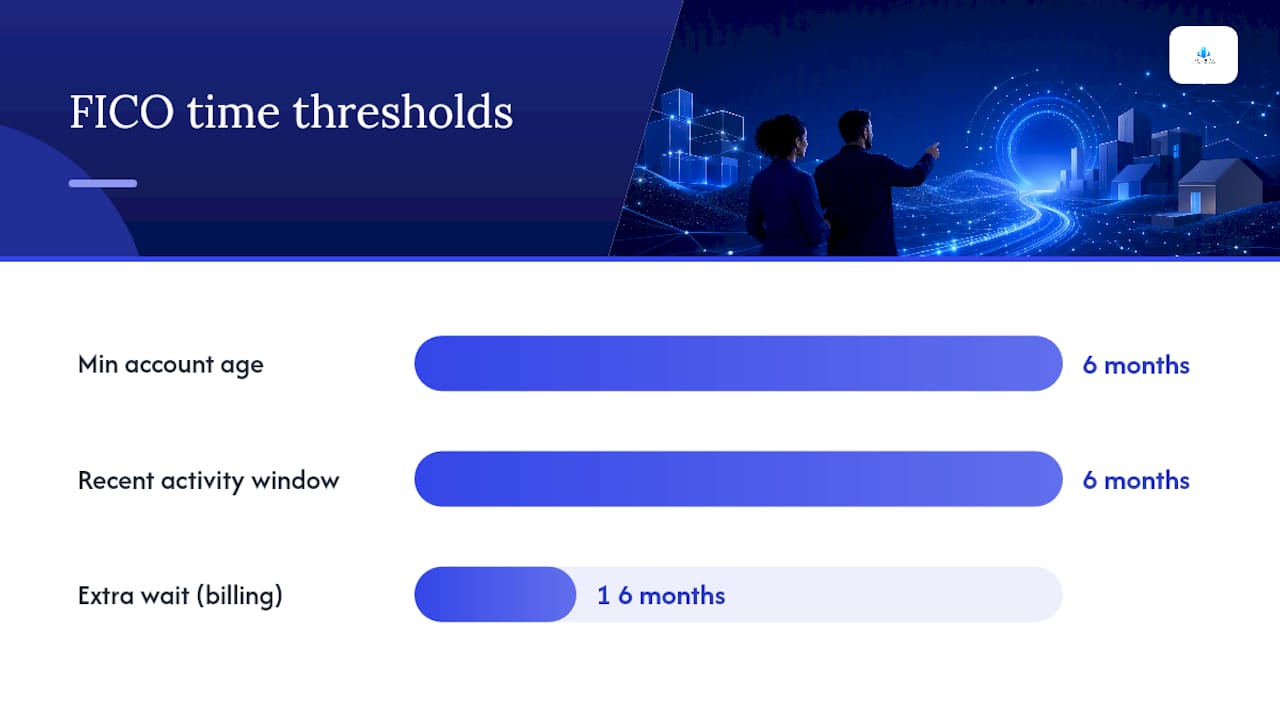
- Confirm your bureau reports meet the minimum requirements of one open account for at least six months and recent activity within the past six months.
- Lenders often rely on alternative data like bank cash flow, rent payments, and employment stability, especially when no credit score exists.
- Building a tradeline through secured cards, credit-builder loans, or rent reporting typically takes about six months to generate a score.
- Some lenders, like CR Equity AI, evaluate assets and deals directly, offering quick decisions without requiring a traditional FICO score.
Table of Contents
- What “No FICO Score” Actually Means
- Why Your File Might Be Unscorable
- The Formal Minimum Requirements FICO Sets
- How Lenders Evaluate Applicants Without a FICO Score
- Safer Borrowing Routes When You Have No Credit Score
- Building a Credit File and Getting Your First FICO Score
- How CR Equity AI Assesses Borrowers With Limited Credit Histories
- How CR Equity AI Can Help Borrowers Without a Traditional Score
- Why the “No Credit Check” Marketing Pitch Deserves Skepticism
- Sources
- FAQ
What “No FICO Score” Actually Means
A FICO score is calculated from data your creditors send to the three major credit bureaus, Equifax, Experian, and TransUnion. Without enough active tradelines reporting, there’s nothing for the formula to work with, so no number gets generated.
That’s different from having a low score or a “thin file.” A low score means you have history, but some of it is negative. A thin file means you have a little history, just not much. No FICO score means the file doesn’t clear the minimum bar to be scored at all.
FICO scores are built from five categories of bureau data:
- Payment history — whether accounts were paid on time
- Amounts owed — balances relative to credit limits
- Length of credit history — how long accounts have been open
- New credit — recent applications and account openings
- Credit mix — the variety of account types (cards, loans, mortgages)
Consumers often assume a closed account, an old address mismatch, or a “credit-invisible” label from a lender means something is legally wrong. Usually it just means the file lacks current, qualifying data.
Why Your File Might Be Unscorable
A handful of specific gaps explain most no-score cases, and identifying which one applies to you determines the fix.
- No account has reported activity in the past six months. Even a long credit history goes stale if nothing has posted recently.
- No account is old enough. If your oldest tradeline is under six months, FICO doesn’t have enough data yet.
- Accounts aren’t reporting to all three bureaus. A card issuer that only reports to one bureau leaves the other two files empty.
- Data errors or flags. A deceased flag placed in error, a credit freeze, or an SSN mismatch can block scoring entirely.
- You belong to a group with structurally thin files. Young adults, recent immigrants, cash-preferring consumers, and people rebuilding after long account gaps are disproportionately affected.
Most of these are fixable once you know which one applies. A quick bureau pull usually narrows it down fast.
The Formal Minimum Requirements FICO Sets
FICO publishes exact criteria for when a score can be calculated, and it’s worth checking your reports against them line by line. According to myFICO’s own scoring requirements, a credit file needs:
- At least one account open for six months or longer
- At least one account reported to a bureau within the past six months
- No indication that the consumer is deceased on file
To check these yourself, pull your report from each bureau and look at the “date opened” and “date of last activity” fields on every tradeline. If one bureau shows a qualifying account and another doesn’t, that bureau simply isn’t receiving updates from that creditor.
The fix is often simple. Call the creditor and ask whether they report to all three bureaus, since some smaller lenders and credit unions only report to one or two. If an account is close to the six-month mark, waiting a billing cycle or two may be all it takes.
How Lenders Evaluate Applicants Without a FICO Score
Roughly 90% of top US lenders reference FICO scores in some part of their process, according to myFICO’s data on credit score usage, but each lender sets its own approval bar. When no score exists, underwriters shift to other signals.
Common alternative data points include:
- Bank account cash flow and average balances
- Payroll direct deposits and income consistency
- Rent and utility payment history
- Gig-platform or 1099 income patterns
Lenders often use soft credit pulls, which don’t affect your score, to verify identity and screen for fraud before deciding whether a hard inquiry is needed. From there, they translate your bank statements into a debt-to-income ratio and judge income stability from deposit patterns rather than a three-digit number. Alternative data from sources like rent and utility payments is increasingly used to extend credit decisions to thin-file consumers, and tools like Plaid’s LendScore apply real-time cash-flow signals alongside traditional data.
Pro Tip: Before applying anywhere that skips a FICO check, ask directly what data they do use. A lender who can’t explain their underwriting method in plain terms is usually pricing you into a higher APR to cover risk they can’t otherwise measure.
Safer Borrowing Routes When You Have No Credit Score
Not every no-credit option carries the same risk. Work through these roughly in order of safety before considering anything marketed purely as “no credit check.”
- Add a co-signer. A creditworthy co-signer lets a lender underwrite against someone else’s file while yours builds up.
- Check credit unions and CDFIs. Community development financial institutions often have programs built specifically for thin-file borrowers.
- Open a secured card or credit-builder loan. These report to bureaus and directly create the tradeline history you’re missing.
- Try peer-to-peer or marketplace lenders. Some platforms weigh income and employment alongside credit history, though approval odds and terms vary and can be less favorable than traditional loans.
- Consider community-based lenders as a last resort before high-cost options.
Before accepting any offer, verify the APR and full fee schedule, confirm the lender is licensed in your state, ask for a written underwriting policy, and search the CFPB complaint database for the lender’s name. Walk away from anything that won’t put terms in writing before you apply.
Building a Credit File and Getting Your First FICO Score
Getting scored isn’t instant, but the timeline is predictable if you take the right steps in order.
Start by pulling your free reports at AnnualCreditReport.com and disputing any errors you find. Then confirm with any current creditor that they actually report to all three bureaus.
To build the tradelines FICO needs, consider:
- A secured credit card
- A credit-builder loan through a credit union
- Becoming an authorized user on someone else’s well-managed account
- Rent-reporting services that add your lease payments to your file
- Experian Boost or similar add-on services
Expected timing: typically, new accounts post their first reporting cycle within a few weeks. After a few months, you may have enough recent activity to be scoreable if the account stays open and active. Within half a year, most meet FICO’s minimum age requirement outright. After about a year, most consumers who stayed consistent have a stable score with room to improve. Experian Boost users have seen measurable average point increases from adding positive payment history like utility bills. Avoid closing old accounts during this window. Even inactive ones help your file’s average age once they start reporting again.
How CR Equity AI Assesses Borrowers With Limited Credit Histories
CR Equity AI approaches this problem differently than a conventional bank underwriter would. As a direct private lending platform focused on real estate and business funding, it evaluates the asset and the deal rather than treating a missing FICO score as an automatic disqualifier.
That means a soft credit pull, often no income verification, and decisions in as little as four hours across programs like fix-and-flip and small balance commercial lending. If you’re weighing options with a thin file, verify current program details and published advance-rate grids directly on the CR Equity AI site before applying.
How CR Equity AI Can Help Borrowers Without a Traditional Score
If you’re a real estate investor or business owner stuck because your file won’t produce a score, a traditional bank underwriting process is likely to request documentation you may not have. Some lenders take a different starting point: underwriting the deal and the asset first, using a soft credit pull instead of demanding a clean FICO history before reviewing your file. This approach can include support for ITIN and foreign national investors who often have no US credit history at all.

If that fits your situation, here’s where to start:
- Submit your deal for review and get a response without a hard credit inquiry upfront
- Explore fix-and-flip financing if you’re funding a rehab project
- Review the commercial lending matrix to see published terms before you apply
Submitting a deal costs nothing and gives you a real answer instead of a guess about whether your file will qualify.
Why the “No Credit Check” Marketing Pitch Deserves Skepticism
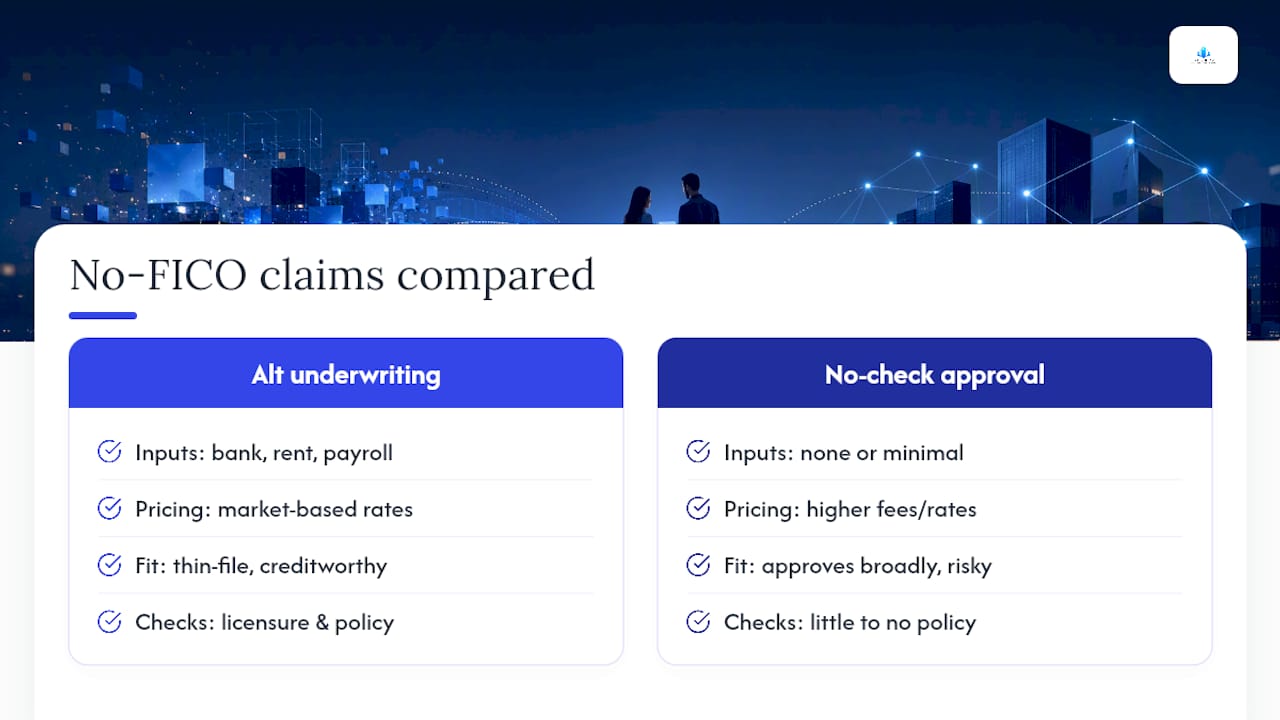
The phrase “no FICO required” gets marketed as a convenience, and sometimes it is. But the framing hides a tradeoff worth stating plainly: a lender that isn’t checking your score isn’t ignoring risk, it’s pricing around it differently, usually through a higher rate. That’s not automatically bad. For a thin-file borrower who’s creditworthy but invisible to the bureaus, alternative underwriting can be the fairer option, not the riskier one.
What gets overlooked is that “no FICO” and “no credit check” aren’t the same thing, and conflating them costs consumers money. A lender using bank cash flow, rent history, and payroll deposits to underwrite you responsibly is doing real underwriting, just with different inputs. A lender who checks nothing and approves everyone is doing something else entirely, and that gap almost always shows up in the fee schedule. The diagnostic work of figuring out which category you’re dealing with, licensure, written policy, CFPB complaint history, matters more than whether the word “FICO” appears anywhere in the marketing copy.
— Robert
Sources
For the underlying rules cited above, go directly to the source. myFICO explains the minimum scoring criteria in full, the CFPB covers consumer rights around credit reports, and Experian’s overview of alternative data explains how rent and utility payments factor into modern underwriting. For a practical primer on building history from scratch, Rate Grove’s guide on credit score impact walks through the fundamentals.
FAQ
What does “no FICO score” mean?
It means your credit file doesn’t have enough qualifying data for the bureau to calculate a score, usually because no account is old enough or none has reported recently.
Why does Experian say I have no FICO score?
Experian generates no score when your file lacks an account open at least six months with recent reporting activity, or when a data issue like a freeze or mismatch blocks calculation, per myFICO’s stated criteria.
Why do I not have a FICO score?
The most common causes are a thin or new file, accounts that stopped reporting, or accounts that only report to one bureau instead of all three.
How rare is a 900 credit score?
FICO scores are calculated based on your credit data, with no scores generated if the file doesn’t clear minimum criteria; high scores are seen in well-managed files but exact maximums vary by model.
Can I get financing with no FICO score at all?
Yes. Options range from secured credit-builder products to lenders like CR Equity AI that underwrite the asset and deal using alternative data instead of requiring a traditional score upfront.