

Origination fees are flat or percentage-based charges lenders collect for processing your loan, and they don’t touch your interest rate. Discount points work the opposite way: you pay cash upfront, and the lender lowers your rate in exchange. Both show up on your Loan Estimate, but only one of them ever changes your monthly payment.
TL;DR:
- Paying a high origination fee may be justified if it results in a lower overall APR, but a fee above 1% of the loan amount is generally above market norms.
- Discount points typically reduce your interest rate by about 0.25% per point on a $400,000 loan, and are only beneficial if you plan to keep the loan long enough to recoup the upfront cost through monthly savings.
- Comparing APR across offers provides a more accurate measure of total loan cost than just looking at interest rates or fees alone, especially when fees are structured differently.
- Borrowers should run the break-even calculation for buying points before committing, especially if they plan to sell or refinance before the expected break-even period of several years.
- Negotiating fees, requesting itemized breakdowns, and verifying disclosures can prevent paying unnecessary or inflated charges at closing.
Table of Contents
- Origination Fee vs Points: The Core Definitions
- Discount Points vs Origination Points: What a Point Actually Buys
- How APR Reveals the Real Cost Behind Fees and Points
- The Break-Even Math Behind Buying Discount Points
- Negotiating and Avoiding Unnecessary Fees and Points
- Where to Find These Charges on Your Loan Paperwork
- An Editor’s View on Fee Transparency in Mortgage Lending
- Compare a Transparent Fee Structure Before You Sign
- Sources
- FAQ
Origination Fee vs Points: The Core Definitions
A loan origination fee compensates the lender for underwriting, processing, and funding your loan. It’s the cost of doing business with that lender, regardless of your rate. Origination fees typically run about 0.5% to 1% of the loan amount, though the format varies. Some lenders charge a flat dollar fee. Others charge a percentage, and some let you roll the cost into the loan balance instead of paying it at closing.
Discount points are different. They’re prepaid interest you hand over voluntarily to buy down your rate. No borrower is required to pay them, and no lender can substitute them for an origination charge without your agreement.
Here’s how lenders typically break the money down:
- Processing and underwriting costs: covered by the origination fee, regardless of rate.
- Rate buy-down: covered by discount points, purchased separately.
- Lender behavior to watch: a lender advertising a rock-bottom origination fee sometimes offsets it with a higher rate elsewhere in the offer.
If your origination fee looks high, ask for an itemized breakdown, request a lender credit, or compare the full APR against a competing Loan Estimate before you sign anything.
Discount Points vs Origination Points: What a Point Actually Buys
On a $400,000 mortgage, one point costs $4,000. What that $4,000 buys depends entirely on which kind of point you’re looking at.
Discount points buy a lower interest rate. Origination points are simply the origination fee expressed as a percentage instead of a flat number, an administrative charge with no effect on your rate.
One point, roughly a quarter percent: Buying one discount point typically lowers your rate by about 0.25%, though the exact reduction varies by lender and market conditions.
A few things worth knowing before you write that check:
- Discount points reduce your monthly payment for the life of the loan.
- Origination points do not reduce your payment at all.
- Discount points may be deductible in the year paid if you meet IRS conditions for a primary residence, while origination points generally are not deductible as interest.
Talk to a tax professional before assuming either treatment applies to your situation. The rules hinge on specific IRS criteria, not on what the loan officer tells you at closing.
How APR Reveals the Real Cost Behind Fees and Points
Your nominal interest rate tells you what you’ll pay in interest. Your APR tells you what the loan actually costs once fees and points get factored in. Because origination charges and points are both included when computing APR, APR is the single best number for comparing two offers with different fee structures.
Consider two offers on a loan amount of several hundred thousand dollars:
- An offer with a typical origination fee, no points, and a higher rate resulting in a certain monthly principal and interest.
- An offer with no origination fee, one discount point, a lower rate, and a lower monthly principal and interest payment.
Same upfront cash outlay, but Offer B saves about $65 a month and carries a lower APR, because that $4,000 actually bought a rate reduction instead of covering paperwork.
Use APR to judge total cost over the loan’s life. Use the monthly payment line to judge whether you can afford the cash-flow hit today.
The Break-Even Math Behind Buying Discount Points
Buying points only makes sense if you keep the loan long enough for the monthly savings to outweigh the upfront cost. The CFPB frames this directly as a break-even calculation: divide the point’s cost by your monthly savings to get the number of months to recoup it.
- Calculate the cost of one point as one percent of your loan amount.
- Estimate your monthly savings from the rate reduction.
- Divide the cost by your monthly savings to find the break-even number of months.
If you sell or refinance before that five-year mark, the point cost you money. If you stay past it, every additional month is savings in your pocket.
Before buying points, run through this checklist:
- How long do you realistically expect to keep this loan?
- Does paying points eat into cash you need for your down payment or push you into PMI territory?
- Are you likely to refinance in the next few years regardless of today’s rate?
- Have you confirmed the tax treatment with a professional rather than assuming a deduction?
Pro Tip: Ask your loan officer to show you the break-even math on paper for every point option they offer, not just the one they recommend. A lender comparing 0, 1, and 2 points side by side will show you exactly where the math stops favoring you.
Short-stay borrowers, especially anyone planning to move or refinance within three to four years, rarely come out ahead on points. Long-term buyers who plan to stay put for a decade or more are the ones who typically benefit.

Negotiating and Avoiding Unnecessary Fees and Points
Both origination fees and points are negotiable, and lenders expect you to push back. Not every lender charges origination points, and many offer flat-fee or no-fee structures with the difference absorbed into the rate instead.
Tactics worth trying before you accept the first number:
- Request an itemized breakdown of every line item under “origination charges.”
- Ask for a lender credit to offset closing costs, understanding this usually raises your rate slightly.
- Ask the seller to cover part of your closing costs as a concession, where market conditions allow.
- Get at least three Loan Estimates and compare APR, not just the headline rate.
Watch for red flags along the way. A Closing Disclosure that doesn’t match your original Loan Estimate, unexplained line items, or a loan officer pressuring you to sign before you’ve reviewed the numbers are all reasons to pause and ask questions.
Where to Find These Charges on Your Loan Paperwork
Origination charges and points appear in the same place on every Loan Estimate: under the “Origination Charges” section near the top of page one. On the Closing Disclosure, they show up in Section A on page 2, listed line by line.
Federal rules give you real protection here. Lenders must clearly itemize origination charges and points, and most of those charges cannot increase at closing beyond narrow tolerances allowed under CFPB disclosure rules.
Before you close, run through this:
- Compare your Closing Disclosure against your original Loan Estimate line by line.
- Confirm the origination fee and any points match what you were quoted, not a revised figure.
- If a number changed without explanation, ask your lender for a written justification before signing.
- Know that unexplained increases beyond disclosed tolerances may need to be refunded by the lender.
An Editor’s View on Fee Transparency in Mortgage Lending
Most borrowers lose the origination fee versus points negotiation before they ever open a Loan Estimate, because they’re comparing the wrong number. They fixate on the rate quoted over the phone and treat the fee section as fine print. That’s backwards. The fee section is where lenders quietly claw back the margin they can’t get away with charging on the rate line, because the rate is the number everyone shops around.

The industry doesn’t make this easy to catch. Nobody advertises that gap. You only see it if you ask for the APR and read the Loan Estimate line by line, which is exactly why the break-even math on points matters more than most closing checklists suggest.
CR Equity Ai Inc built its own underwriting process around the assumption that borrowers, brokers, and capital partners all deserve to see the math before they commit, not after. That means publishing advance-rate grids and maintaining an origination document library that readers can check against whatever quote lands in their inbox. If a fee looks unusual, the fix isn’t to trust the loan officer’s explanation. It’s to compare it against a published standard somewhere else.
— Robert
Compare a Transparent Fee Structure Before You Sign
Some lenders publish their fee policies and advance-rate grids before you apply, which means you can compare real numbers instead of a verbal quote that may shift later. Direct private lenders may underwrite deals themselves, with soft credit pulls and decisions in as little as several hours on certain real estate programs.
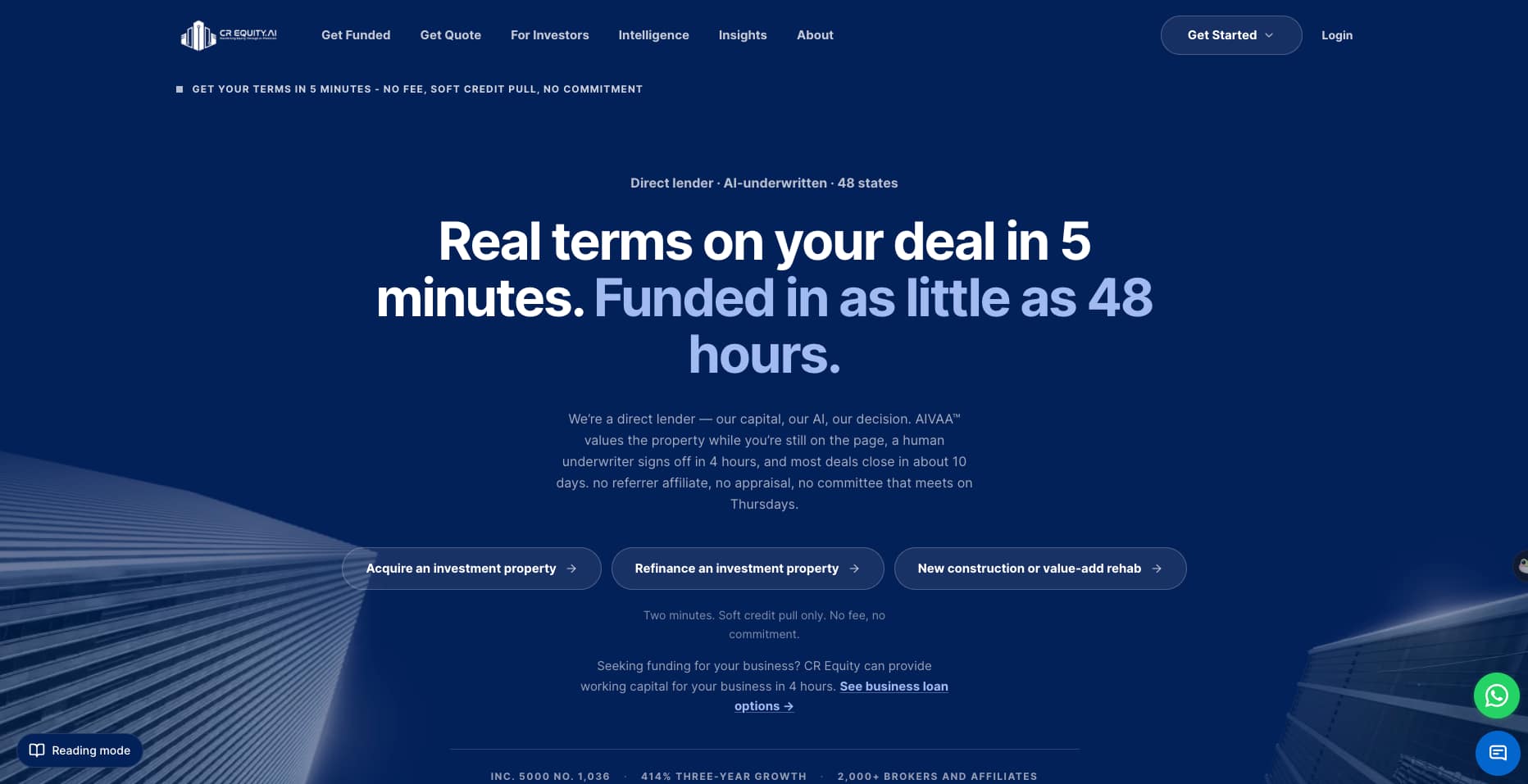
For investors weighing whether an origination fee or a point structure makes sense on a specific deal, the third-party fee policy lays out exactly what gets charged and why, before you commit any cash. If you’re evaluating a fix-and-flip, bridge, or acquisition loan and want to see how fees compare against a lender with published terms, submit your deal and request a quote. Compare the resulting Loan Estimate and APR against whatever else you’re considering before you decide.
Sources
Check the CFPB’s origination fee guidance for disclosure rules, Investopedia’s points explainer for market norms, and the NMLS Consumer Access registry to verify any lender’s license before you sign.
This article is general information, not a substitute for advice from a qualified financial advisor. Consult a qualified financial professional about your own circumstances before acting on anything here.
- Investopedia — Origination fee: Definition, average cost, and ways to save
- Consumer Financial Protection Bureau — How should I use lender credits and points (discount points)?
FAQ
Should I pay points or a higher origination fee?
Neither is inherently better. Discount points lower your rate and pay off if you stay in the loan past the break-even point, usually several years; a higher origination fee doesn’t touch your rate, so it’s only worth accepting if the lender’s overall APR still beats the competition.
Is a 2% origination fee high?
Yes, generally. Origination fees typically run 0.5% to 1% of the loan amount, so 2% sits well above the norm and is worth challenging with an itemized breakdown or a competing Loan Estimate.
Is it better to pay an origination fee or not pay one at all?
A no-fee loan usually carries a higher rate to offset the lender’s lost revenue, so the real question is which combination produces the lower APR and monthly payment for how long you plan to keep the loan.
How much is a 1 point origination fee?
One point origination fee is equal to one percent of your loan amount, so it varies based on the size of your loan.