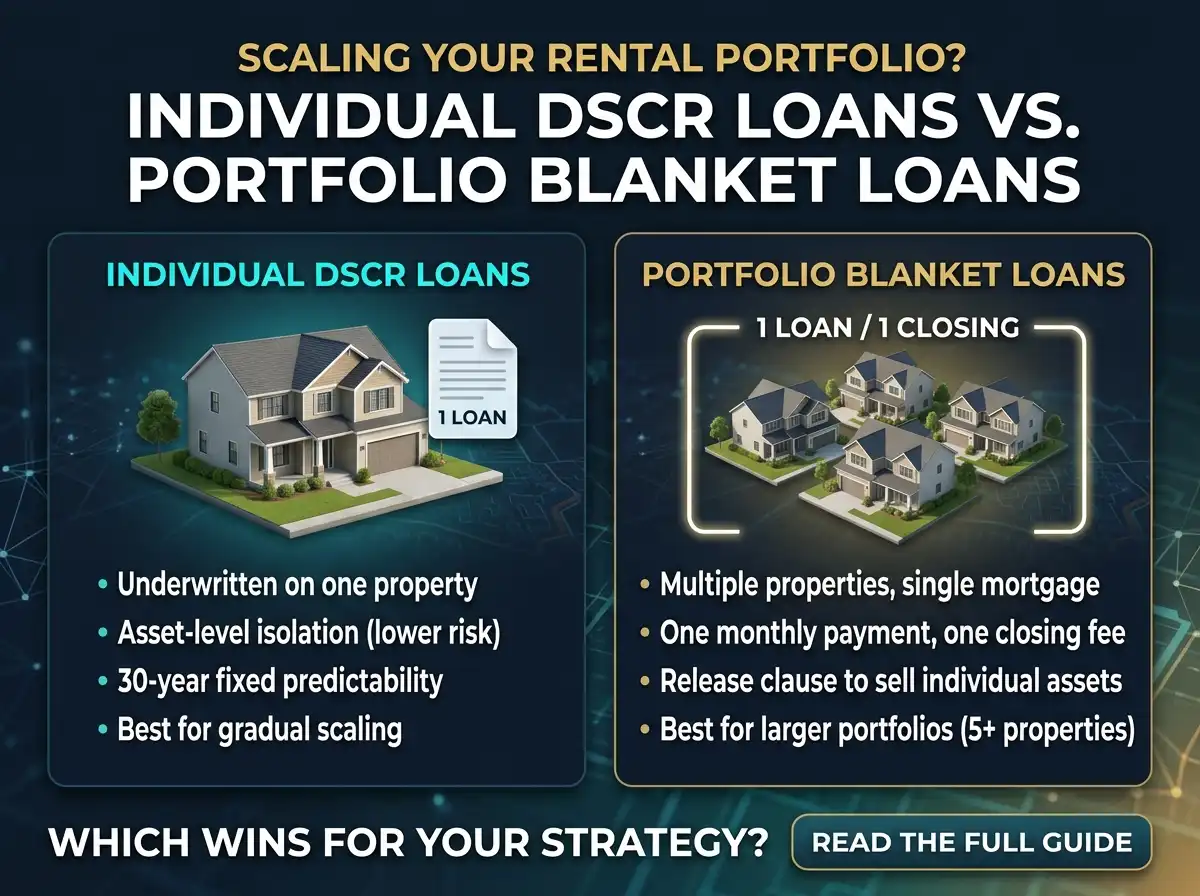
Scaling a rental portfolio puts you in front of a real financing decision: keep stacking individual DSCR loans one property at a time, or consolidate everything into a single portfolio blanket loan? Both structures qualify on rental income — no W-2s, no tax returns, no employment history. But they suit different stages of growth, and picking the wrong one costs real money in fees, rate drag, and lost flexibility.
This guide breaks down how each structure works, runs the numbers side by side, and tells you which wins for your investing strategy. If you need the fundamentals first, start with what a blanket mortgage is before continuing.
How DSCR Loans Work
Start here: both loan types share the same qualification logic. A DSCR loan underwrites on the property’s rental income — not the borrower’s personal income, W-2s, or tax returns. This makes DSCR financing the default structure for LLC investors, self-employed landlords, and anyone whose income is spread across multiple holdings.
Lenders calculate qualification using the debt service coverage ratio formula:
DSCR = Monthly Rental Income ÷ PITIA
PITIA covers principal, interest, taxes, insurance, and association dues. A DSCR of 1.0 means rent exactly covers the payment. A 1.25 means the property generates 25% more than it costs to carry — most lenders treat this as the threshold for strong credit quality.
Typical DSCR loan requirements:
- 660+ FICO score
- 20–25% down payment
- DSCR ≥ 1.0 (some lenders accept lower with compensating factors)
- Eligible property types: SFR, condos, townhomes, 2–4 units
- Investment property only — no primary residences, owner-occupied homes, or fix-and-flip use
Both individual and portfolio DSCR loans follow this same logic. The difference is whether the lender evaluates one property or a blended group of properties together.
Why Real Estate Investors Choose a Portfolio Loan
A portfolio blanket loan — also called a blanket mortgage — places two or more properties under a single mortgage. One closing, one monthly payment, one lender relationship. Every property in the bundle is cross-collateralized, meaning each one secures the same loan.
The math makes sense at scale. If you hold six properties and each closing costs $4,000–$6,000, you have spent up to $36,000 in closing costs alone. A blanket loan collapses that to a single closing fee, typically $8,000–$12,000 depending on total loan size.
The release clause is the key mechanic behind the portfolio blanket loan. Most blanket loans include a release clause that lets you sell one property without paying off the entire loan. You receive the sale proceeds, apply a required portion to reduce the outstanding balance, and the remaining properties stay financed. Developers and flippers rely on this constantly: acquire a portfolio, sell assets individually, recycle capital into new acquisitions.
Best fit for:
- Investors with 5+ properties ready to consolidate
- Developers subdividing and selling lots individually
- Borrowers who want a single debt-service payment across a portfolio
- Short-term rental operators running multiple Airbnb or VRBO units under one entity
Watch out for: Balloon payments (common at 3–5 years), higher LTV requirements, and cross-collateralization risk — if one property underperforms and you default, all properties in the blanket are exposed to the lender.
Why Some Investors Prefer Individual DSCR Loans
Each individual DSCR loan is underwritten on its own. The lender applies the DSCR formula to that specific address — dividing monthly gross rent by PITIA — and closes a standalone 30-year fixed mortgage against it. A minimum 1.0 DSCR is typical; 1.25 or above unlocks better pricing and more favorable terms.
Individual DSCR loans give you asset-level isolation. If one property goes vacant or the market softens, that loan stands on its own. You are not dragging five other properties into the same risk pool.
They also offer 30-year amortization, which means no balloon payment forcing a refinance or sale at an inconvenient time. For a buy-and-hold investor with a 10–20 year horizon, that predictability is worth more than the closing cost savings of a blanket structure.
Best fit for:
- Buy-and-hold investors who want long-term fixed rates
- Investors building a portfolio slowly (adding 1–2 properties per year)
- Borrowers who want clean asset separation for liability or estate planning purposes
- Properties with strong individual DSCR (1.25+) that underwrite well on their own
Watch the fine print: Stacking loans means multiple servicers, multiple closing costs, and separate prepayment penalty schedules per property — which matters if you plan to sell or refi any asset within the first 3–5 years. Most lenders also enforce a 10-property cap per borrower; once you reach it, a portfolio blanket loan becomes the only practical path to keep scaling.
Portfolio Loan vs Individual DSCR Loans: Side-by-Side
Which One Wins?
Neither structure is universally better. The right answer depends on where you are in your investing cycle.
Choose a portfolio blanket loan if:
- You already hold 5+ properties and want to consolidate into one payment
- You are actively buying and selling — the release clause gives you flexibility
- Closing cost savings across multiple acquisitions outweigh the balloon payment risk
- You are a developer financing land to subdivide and sell
Choose individual DSCR loans if:
- You are buying one or two properties per year and building slowly
- You want 30-year fixed rates with no balloon event risk
- Asset isolation matters — estate planning, liability separation, or partner buyout scenarios
- Each property underwrites strongly on its own DSCR
The honest math on consolidation at current rates: If you are refinancing individual 6.5–7% DSCR loans into a blanket loan at 8.5%+, the closing cost savings rarely justify the rate increase. Run your DSCR numbers first before committing to a consolidation. CR Equity AI structures portfolio loans only where the math actually works — not every consolidation makes sense, and we will tell you that upfront.
Ready to structure the right financing for your portfolio? Use the DSCR calculator to check your numbers, or submit your deal directly and we will build the right structure around what you are building.