

Recourse debt lets a lender chase your other assets after foreclosure or repossession; nonrecourse debt limits the lender to the collateral itself. That single distinction decides whether a defaulted deal ends with a lien on your paycheck or a clean walkaway, and it’s the practical tradeoff behind every “recourse vs nonrecourse” comparison: cheaper money now versus asset protection later.
TL;DR:
- Nonrecourse loans generally have higher interest rates and more stringent underwriting requirements compared to recourse loans due to increased lender risk.
- State laws and specific loan clauses, such as “bad boy” guarantees, can alter whether a loan is truly nonrecourse or recourse, regardless of its label.
- Foreclosure on a recourse loan allows the lender to pursue deficiency judgments and assets beyond the collateral, while nonrecourse loans typically limit recovery to the collateral alone.
- Tax implications differ: recourse debt cancellations are taxable as income, whereas nonrecourse sales may trigger taxable gains if the loan exceeds the property’s basis.
- Borrowers should carefully review guaranty clauses, carve-outs, and governing law before signing to understand potential personal liabilities and risks.
Table of Contents
- Recourse vs Nonrecourse Loans at a Glance
- What Happens When a Borrower Defaults?
- How Loan Pricing and Underwriting Differ
- Does State Law Change Who’s on the Hook?
- What Are the Tax Consequences of Foreclosure?
- Recourse and Nonrecourse in Everyday Loan Types
- Your Pre-Signing Checklist for Recourse and Nonrecourse Terms
- How CR Equity AI Approaches Recourse and Nonrecourse Structuring
- Check Real Terms Before You Assume Recourse or Nonrecourse
- Sources
- FAQ
Recourse vs Nonrecourse Loans at a Glance
Both structures secure a loan against collateral, but they diverge sharply on what happens when a borrower can’t pay. A recourse loan gives the lender two paths to recovery. A nonrecourse loan gives it one.
- Who the lender can collect from: Recourse loans allow pursuit of the collateral plus other personal or business assets, including wages, bank accounts, and additional property, after a deficiency balance remains. Nonrecourse debt caps recovery at whatever the collateral is worth.
- Pricing direction: Nonrecourse loans typically carry higher interest rates and stricter underwriting because the lender absorbs more loss risk if values fall.
- Common loan types: Recourse dominates auto loans, personal loans, and most small business credit. True nonrecourse structures cluster in commercial real estate, certain mortgage products, and some factoring arrangements.
The rate gap and the qualification gap both trace back to the same fact: a nonrecourse lender cannot pursue other assets if the collateral falls short.
What Happens When a Borrower Defaults?
Default plays out differently depending on which side of the recourse line the loan sits on, and state law shapes both outcomes.
On a recourse loan, the lender forecloses or repossesses, sells the collateral, and applies the proceeds to the balance. If the sale doesn’t cover the debt, the lender can pursue a deficiency judgment for the shortfall, then attach wages or other assets to collect it. The process, timeline, and even the availability of that judgment vary by state.
On a nonrecourse loan, the lender still forecloses and sells the collateral, but the borrower’s exposure typically ends there. If the sale price doesn’t cover the loan, the lender absorbs the loss rather than chasing the borrower for it, subject to carve-outs discussed below.
Lenders don’t always chase deficiencies even when they legally can. Collection costs, the borrower’s collectability, and reputational considerations often make pursuing a small shortfall not worth the effort, which is part of why underwriting for recourse loans still weighs the borrower’s balance sheet closely.
How Loan Pricing and Underwriting Differ
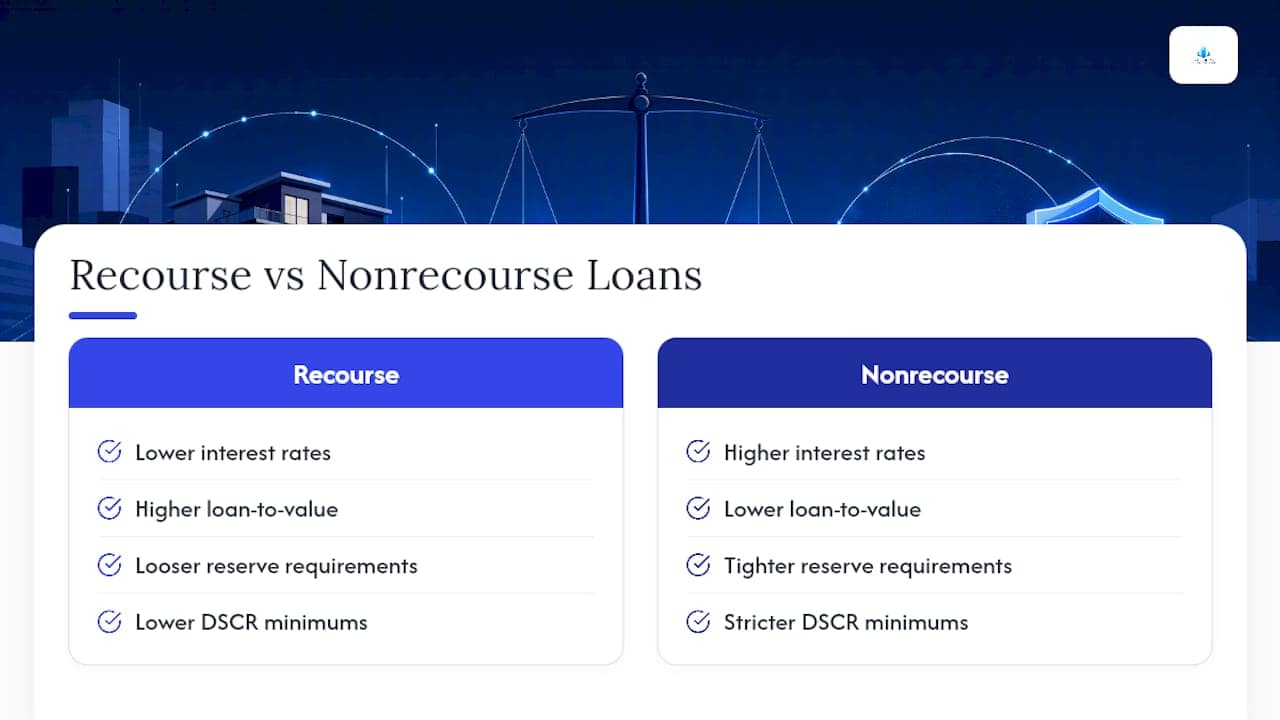
Nonrecourse financing costs more, and the reasons show up directly in the term sheet. Because the lender can’t fall back on personal assets, it prices in the added risk through rate, leverage limits, or both. Nonrecourse loans commonly carry higher interest rates and lower loan-to-value ratios than comparable recourse deals on the same asset class.
Lenders offset that risk with tighter covenants, too. Expect reserve requirements, stricter debt-service coverage minimums, and more detailed asset-performance underwriting on nonrecourse deals than a recourse loan on the same property would draw. Reviewing published loan-to-value benchmarks before applying helps set realistic expectations for either structure.
Borrowers do have negotiation levers. A larger down payment, a stronger credit profile, or higher-quality, more liquid collateral can shift a lender toward nonrecourse terms or a better rate on either structure. Sponsor track record matters more here than most borrowers assume; a lender extending nonrecourse terms is underwriting the deal almost as much as the asset.
Does State Law Change Who’s on the Hook?
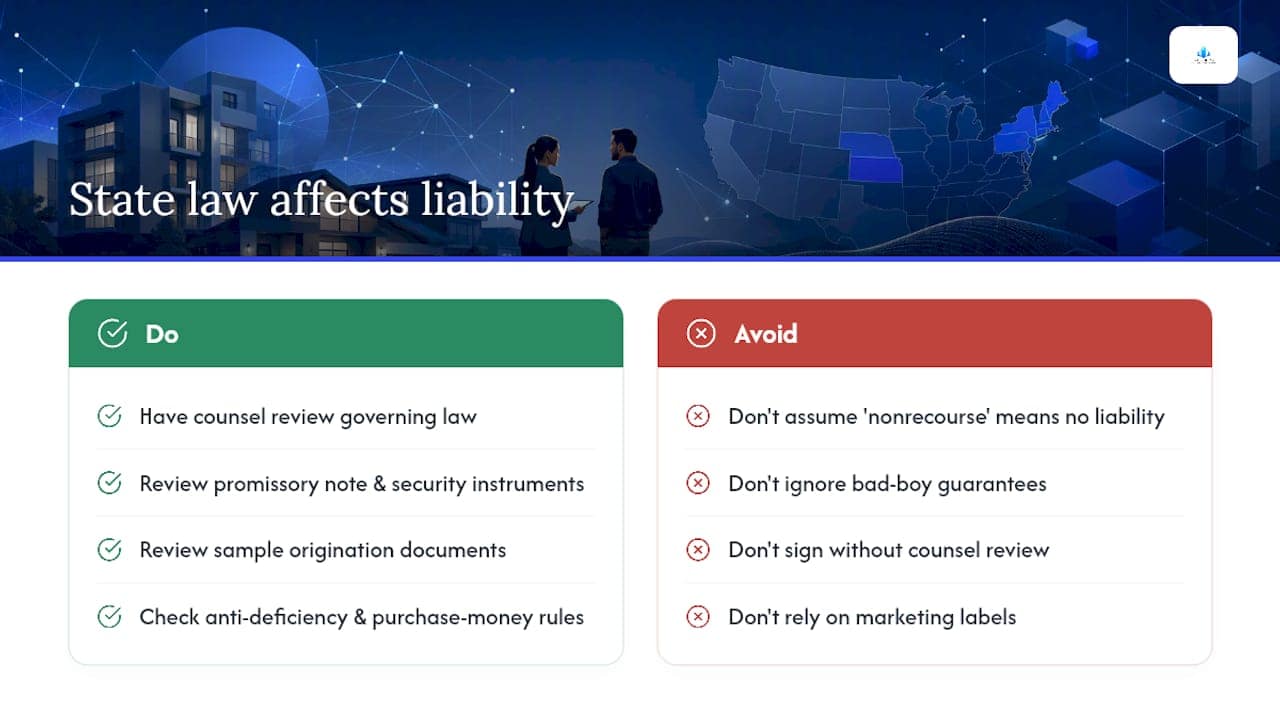
Yes, and this is where the simple recourse/nonrecourse label stops telling the whole story. Whether a loan is genuinely recourse or nonrecourse depends on the language in the debt instrument and the law of the state governing the deal, since courts look at the actual clauses in the note and security instrument, not just how the loan was marketed.
Several states apply anti-deficiency statutes or purchase-money mortgage rules that limit a lender’s remedies after foreclosure, even on a loan that reads as recourse on paper. These rules commonly apply to owner-occupied residential purchase loans, and they can make certain mortgages effectively nonrecourse in specific foreclosure scenarios, though the exact scope varies significantly by state.
The reverse trap catches more investors off guard: “bad boy” guarantees. These are carve-outs written into otherwise nonrecourse commercial loans that reintroduce personal liability if the borrower commits specific acts, such as fraud, unauthorized transfers of the property, environmental violations, or filing bankruptcy in bad faith. A loan can be marketed as nonrecourse and still expose a sponsor personally if one of those triggers fires.
Given how much weight sits in the fine print, have counsel review the governing law, the promissory note, and every guaranty and security instrument before signing, not after a default forces the question. Reviewing sample origination documents beforehand also helps you spot where these clauses typically live.
What Are the Tax Consequences of Foreclosure?
Foreclosure and debt cancellation both carry tax exposure that catches borrowers off guard, and the recourse status of the loan determines how the IRS treats it. On recourse debt, forgiven amounts beyond the collateral’s value generally count as cancellation of debt income, which is taxable in the year it’s forgiven.
Nonrecourse foreclosure gets treated differently: the transaction is generally treated as a sale of the asset for the outstanding loan balance, rather than a cancellation-of-debt event. That distinction doesn’t mean nonrecourse borrowers are automatically safe from tax exposure. If the loan balance exceeds the property’s tax basis, the disposition can still trigger taxable “phantom income” with no cash changing hands to cover the bill.
If a lender issues a Form 1099-C after cancellation, don’t assume it’s wrong just because the loan felt nonrecourse. Get it and loop in a tax advisor early, before filing, not after receiving a notice.
Recourse and Nonrecourse in Everyday Loan Types
Most consumer and small business credit is recourse by default. Auto loans, personal loans, and the typical small business term loan all allow the lender to pursue you personally if the collateral sale falls short, unless state anti-deficiency rules intervene on specific mortgage categories.
Factoring, where a business sells its accounts receivable for immediate cash, comes in both flavors. Recourse factoring requires the seller to buy back any invoice the factor can’t collect. Nonrecourse factoring shifts that collection risk to the factor, typically at a higher fee, since the factor now owns the credit risk on the buyer’s invoice, not just the financing.
Commercial real estate is where true nonrecourse structures show up most often, particularly on stabilized, income-producing assets with strong sponsors. Even there, lenders frequently pair the nonrecourse loan with limited guaranties tied to specific acts, so “nonrecourse” on a CRE term sheet rarely means zero personal exposure. It means conditional exposure, negotiated clause by clause.
Your Pre-Signing Checklist for Recourse and Nonrecourse Terms
Before you sign anything, run through these questions with your loan documents in hand:
- Is there a personal guaranty attached, and does it cover the full balance or a limited amount?
- Does the note contain carve-outs or “bad boy” triggers that could convert nonrecourse terms into personal liability?
- What state law governs deficiency judgments on this loan, and does it apply anti-deficiency protection to this asset type?
- How much extra rate, fee, or down payment are you willing to accept in exchange for nonrecourse protection?
- Have you flagged the guaranty, carve-out, and governing-law clauses for counsel and your tax advisor before closing?
Pro Tip: Price the tradeoff in dollars, not just risk tolerance. Calculate the rate spread between a recourse and nonrecourse quote over your expected hold period, then compare that dollar cost against what you’d actually lose if the deal went sideways. Sometimes the “protection” costs more than the exposure it’s insuring against.
How CR Equity AI Approaches Recourse and Nonrecourse Structuring
A direct private lending platform underwrites the asset and the deal, not just a borrower’s credit file, using a soft credit pull and published advance-rate grids. Nonrecourse consideration on any deal depends on collateral quality, sponsor strength, and deal documentation. Borrowers who want to be evaluated for limited-recourse terms should come prepared with clean title, realistic valuations, and a clear exit plan, since asset-based underwriting rewards deal strength over paperwork volume.
— Robert
Check Real Terms Before You Assume Recourse or Nonrecourse
Reading about recourse and nonrecourse structures only gets you so far. Every deal’s actual terms depend on the asset, the sponsor, and the program, which is why Advance-rate grids are published before application so borrowers know the leverage and cost tradeoffs going in instead of only at the term sheet.

If you’re weighing a bridge loan on an investment property, the Commercial Bridge Loans program starts at a 10.99% rate with published origination, exit, and servicing fees, so you can compare the true cost against any nonrecourse premium you’re being quoted elsewhere. Investors dealing with a time-sensitive gap between deals can also look at F.L.E.X. 50™, An emergency bridge product is available with funding in 24 to 48 hours. Self-employed borrowers refinancing out of a recourse construction loan into a rental-income structure should review the DSCR Cash-Out Refinance program, which qualifies on rent rather than tax returns.
Whatever structure fits your deal, submit it directly through the deal submission page to get program-specific terms rather than guessing from general rules.
Sources
This article draws on IRS guidance on cancellation of debt, Investopedia’s recourse and nonrecourse definitions, Cornell Law School’s Wex entry on nonrecourse debt, Nolo’s legal overview of deficiency rules, and the Corporate Finance Institute’s risk-allocation framing of recourse versus nonrecourse lending.
This article is general information, not a substitute for advice from a qualified financial advisor. Consult a qualified financial professional about your own circumstances before acting on anything here.
- Non-Recourse vs. Recourse Loans – Difference, Overview | Investopedia
- Non-Recourse vs. Recourse Debt Explained: Definitions and Examples | Investopedia
- Nonrecourse | Wex | Cornell Law School
- What’s the difference between recourse and nonrecourse loan? | Nolo
- Cancellation of Debt—Basics | IRS
FAQ
Are LLC Liabilities Recourse or Nonrecourse?
It depends on the specific debt, not the entity type. An LLC’s liabilities can be either recourse or nonrecourse, and many commercial loans to LLCs pair nonrecourse debt with a personal guaranty from the members, which reintroduces personal exposure despite the entity structure.
Is Accounts Payable Recourse or Nonrecourse?
Accounts payable itself isn’t classified as recourse or nonrecourse; that distinction applies to factoring arrangements built around receivables, not payables. In recourse factoring, the business selling its invoices must buy back any it can’t collect, while nonrecourse factoring shifts that collection risk to the factor.
What Is the Difference Between Recourse and Nonrecourse Loans?
A recourse loan lets the lender pursue the borrower’s other assets if collateral doesn’t cover the balance after default. A nonrecourse loan limits the lender strictly to the collateral, though carve-outs and state law can shift that boundary.
What Are Common Examples of Recourse Debt?
Most auto loans, personal loans, and small business term loans are recourse. Many commercial real estate loans that are marketed as nonrecourse also carry limited personal guaranties, sometimes called “bad boy” guarantees, that make them partially recourse if specific triggers occur.
Does CR Equity AI Offer Nonrecourse Loans?
CR Equity Ai Inc evaluates recourse and nonrecourse structuring on a deal by deal basis, based on asset quality, sponsor strength, and program terms. Current program pricing and advance rates are published on each program page, including Commercial Bridge Loans and Small Balance Commercial Loans.