
Developers financing new self-storage projects typically choose among four paths: SBA 7(a) or 504 loans, conventional construction loans, bridge financing from a private direct lender, or (for larger portfolios) CMBS. The right choice depends on project size, timeline, and your exit strategy. Before applying anywhere, stress-test your pro forma against slower lease-up scenarios and get a specialist lender or direct private lender to run a pre-check on the deal.
TL;DR:
- Most lenders require a debt service coverage ratio of at least 1.20x to 1.25x at stabilization to approve permanent financing.
- SBA 7(a) loans offer single-close construction-to-permanent financing, often requiring around 10% down for qualified operators.
- Construction periods typically last 12 to 24 months with milestone-based draws, and lease-up can be the riskiest phase due to market absorption delays.
- Private bridge loans provide faster funding with higher rates, ideal for time-sensitive deals or when SBA timelines are too slow.
- Lenders emphasizing conservative absorption modeling and clear occupancy and DSCR thresholds help mitigate lease-up risk, especially for SBA 504 projects.
Table of Contents
- What Loan Types Work Best for Self-Storage Development?
- What Do Lenders Require to Underwrite a Storage Construction Loan?
- How Much Do Construction Loans Cost and How Long Do They Take?
- Why Is Lease-Up the Riskiest Part of a Storage Project?
- How Do You Choose the Right Lender for a Storage Development Loan?
- Author Perspective: Practical Tradeoffs and Rules of Thumb
- CR Equity Ai Inc: A Direct Lender for Construction and Small-Balance Deals
- Sources
- FAQ
What Loan Types Work Best for Self-Storage Development?
Self-storage construction financing splits into a handful of well-worn paths, and picking the wrong one costs you time and leverage.
SBA 7(a) works as a single-close construction-to-permanent loan for many ground-up and expansion projects. It can roll land, hard costs, contingency, and even interest reserves and ramp-up reserves into one structure, which cuts out the need for a separate bridge phase on many deals under $7 million.

SBA 504 splits the capital stack into a 50% senior conventional first mortgage, a 40% CDC debenture, and a 10% borrower injection. It delivers a large, fixed-rate debenture tranche that suits owner-operators planning to hold long-term, but 504 eligibility depends on an active-operation test: you or your W-2 staff generally need to run leasing and collections yourself, not outsource management entirely.
Conventional construction loans fit stabilized sponsors with strong balance sheets who want a faster path to permanent financing without SBA paperwork. Bridge loans from private direct lenders trade a higher rate for speed and lease-up flexibility, useful when entitlements or a closing window won’t wait for an SBA timeline. CMBS enters the picture for larger portfolio refinances, and USDA Business & Industry loans matter mainly for rural projects that meet USDA’s population thresholds.
- SBA 7(a): single-close construction-to-perm, flexible use of proceeds
- SBA 504: 50/40/10 stack, fixed-rate debenture, active-operation test applies
- Conventional construction: faster permanent takeout for stabilized sponsors
- Bridge/private direct: speed and flexible underwriting for time-sensitive deals
- CMBS/USDA B&I: portfolio scale or rural qualifying projects
What Do Lenders Require to Underwrite a Storage Construction Loan?
Every self-storage construction lender is underwriting the same core question: will this facility generate enough stabilized income to service the debt? That means your debt service coverage ratio (DSCR), the ratio of net operating income to annual debt payments, needs to clear a threshold before anyone signs off. Most lenders want to see a projected DSCR of roughly 1.20x to 1.25x at stabilization, meaning your facility generates at least 20% to 25% more income than your debt payments require.
Beyond DSCR, lenders build their underwriting file around a specific sequence of evidence:
- Third-party market and feasibility study showing local supply, demand, and realistic absorption timelines
- Sponsor track record and contractor qualifications, including bonding capacity and prior storage builds
- Detailed construction budget with contingency line item, signed contracts, and permits in hand
- Pro forma with conservative lease-up assumptions and personal financial statements from all guarantors
- Evidence of reserves covering interest payments during construction and the early lease-up period
Documentation quality often determines your timeline as much as your credit profile does. A packet with a clean draw schedule, a realistic contingency line, and a lender-ready interest reserve moves faster through underwriting than one that arrives incomplete and gets sent back for revisions.
Pro Tip: Build your interest reserve to cover 12 to 24 months of debt service, not just the construction period. Lease-up rarely hits pro forma on schedule, and a thin reserve is the most common reason developers scramble for emergency capital mid-project.
How Much Do Construction Loans Cost and How Long Do They Take?
Construction terms, draw cadence, and down payment requirements vary meaningfully by program, and modeling these correctly is the difference between a feasible deal and a cash crunch six months in.
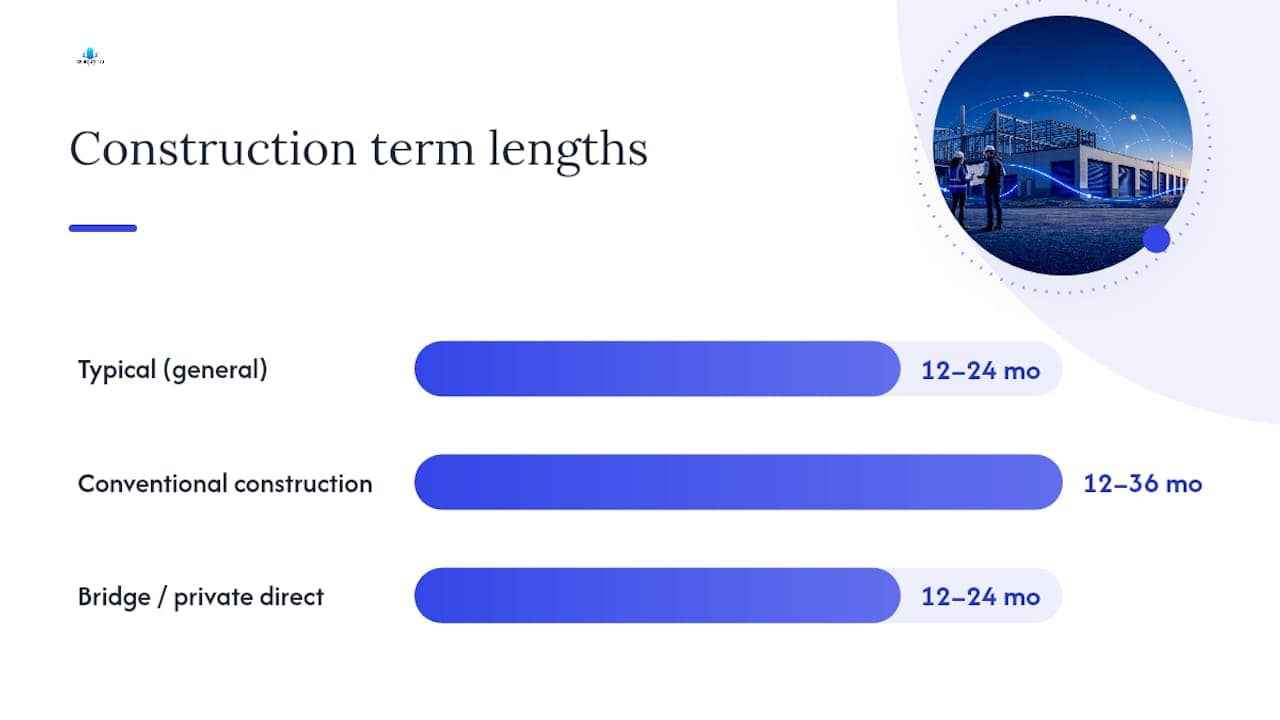
Construction loans for self-storage generally run 12 to 24 months, sometimes extending to 36 months on larger builds, with funds released through milestone draws tied to completed construction phases rather than handed over as a lump sum. You pay interest only on the funds actually disbursed at each draw, not on the full committed amount.
| Program | Typical Term | Down Payment / LTV | Interest Structure |
|---|---|---|---|
| SBA 7(a) construction-to-perm | Single-close, 25-year amortization | Often 10% for qualified owner-operators | Interest-only on disbursed draws during construction |
| SBA 504 | 20 to 25-year debenture | 10% borrower injection (50/40/10 stack) | Fixed-rate debenture after construction period |
| Conventional construction | 12 to 36 months construction, 25-year permanent takeout | Program-dependent, generally higher equity than SBA | Interest-only on disbursed funds |
| Bridge / private direct | 12 to 24 months | Program-dependent advance rate | Interest-only, often higher rate for speed |
Plan your timeline in stages: entitlement and permitting first, then construction draws over the loan term, followed by lease-up and stabilization before you can convert to permanent financing. Most lenders won’t consider a permanent takeout until occupancy and DSCR hit their trigger points, which is exactly where the next stage of risk lives.
Why Is Lease-Up the Riskiest Part of a Storage Project?
The gap between construction completion and stabilized occupancy is where more self-storage projects run into trouble than at any other stage. Slower-than-projected absorption or unexpected rent pressure from new competing supply can leave you short of the occupancy and DSCR triggers your permanent lender requires, and construction debt doesn’t wait for the market to cooperate.
- Build a lease-up reserve sized to cover 12 to 24 months of debt service if absorption runs behind schedule
- Line up bridge financing options before you need them, not after occupancy stalls
- Confirm your take-out lender’s occupancy and DSCR triggers in writing before you break ground
- Negotiate extension options on your construction loan in case lease-up runs past the original term
- Track guaranty burn-down provisions so you know when personal guarantees step down as the asset stabilizes
Confirming your take-out commitment early matters more than most developers realize. Get the occupancy percentage, DSCR hurdle, and documentation requirements for conversion in writing during the construction loan closing, not when you’re six months into lease-up and hoping the numbers work out.
Pro Tip: If your exit strategy depends on SBA 504 refinancing, verify the active-operation occupancy test with your CDC before you sign the construction loan. Outsourcing property management too aggressively can disqualify you from 504 eligibility later.
How Do You Choose the Right Lender for a Storage Development Loan?
Not every bank that offers construction loans understands self-storage lease-up curves, and that gap shows up in underwriting decisions that don’t match how the asset class actually performs. Specialist lenders and CDCs who work regularly in this space tend to model absorption more realistically than generalist banks, which matters when your deal is sensitive to local supply.
Evaluate any lender candidate on four things: their self-storage track record, how disciplined their draw process is, what their interest reserve policy actually covers, and how clearly they define take-out triggers. A specialist SBA or CDC route often makes sense for owner-operators planning a long fixed-rate hold. When speed matters more, or your project needs advance-rate flexibility a traditional bank won’t offer, a direct private lender becomes the more practical route.
CR Equity Ai Inc underwrites the asset and the deal directly, with published advance-rate grids and construction programs built around milestone draws on its own capital. Ask any lender you’re vetting these questions during pre-check:
- What’s your typical decision timeline once you receive a complete deal packet?
- How do you structure interest reserves relative to my projected lease-up?
- What documentation do you require to confirm the take-out at stabilization?
Author Perspective: Practical Tradeoffs and Rules of Thumb
Developers underestimate lease-up risk more than any other variable in this business. Paying a slightly higher rate for a lender who models absorption conservatively beats chasing the cheapest quote and hoping occupancy cooperates. If SBA 504 is your planned exit, confirm the active-operation rules before you break ground, not after your first draw.
— Robert
CR Equity Ai Inc: A Direct Lender for Construction and Small-Balance Deals
If speed and clear terms matter more than working through a generalist bank’s committee process, a direct lender provides capital directly against the asset and the deal, not just borrower paperwork.
Our ground-up construction loans fund with milestone draws against published advance-rate grids you can review before you apply, and decisions can come back in as little as four hours. For projects that fit a smaller footprint, small balance commercial loans cover $100,000 to $100 million with up to 80% LTV, and we support ITIN and foreign national borrowers alongside US sponsors. Review our best practices for managing vertical construction draws while you’re preparing your package, then bring us a short deal packet including your budget, timeline, and pro forma through our submit-deal page to request a quote.
Sources
- SBA 504 Loan for a Self-Storage Facility 2026: 90% Financing, Fixed-Rate Debenture | PeerSense
- Understanding Self-Storage Construction Loans | Inside Self Storage
This article is general information, not a substitute for advice from a qualified financial advisor. Consult a qualified financial professional about your own circumstances before acting on anything here.
FAQ
Can SBA Loans Fund a New Self-Storage Build?
Yes. SBA 7(a) offers single-close construction-to-permanent financing that can include land, hard costs, and reserves, while SBA 504 provides a fixed-rate debenture tranche for owner-operators who meet the active-operation occupancy test.
What Down Payment Should I Expect on a Storage Construction Loan?
Down payment ranges by program: SBA 7(a) often requires around 10% for qualified owner-operators, SBA 504 uses a 10% borrower injection within its 50/40/10 stack, and conventional or bridge financing generally requires higher equity depending on the lender’s advance rate.
When Should I Use Bridge Financing Instead of an SBA Loan?
Bridge financing from a private direct lender fits situations where timing matters more than rate, such as a closing deadline an SBA process can’t meet, or a project needing flexible terms during lease-up before refinancing into permanent debt.
What’s the Single Most Important Underwriting Metric?
Debt service coverage ratio (DSCR) drives most lending decisions, with lenders typically requiring a projected DSCR of 1.20x to 1.25x at stabilization before approving permanent takeout financing.
How Long Does the Process Take From Application to Stabilization?
Expect entitlement and permitting first, then 12 to 24 months (sometimes up to 36) of construction draws, followed by a lease-up period before occupancy and DSCR triggers allow conversion to permanent financing.