

Senior debt is the highest-priority debt in a company’s capital structure. It gets repaid first in default or liquidation, and it’s typically secured by a first lien on specific assets, which lowers the lender’s risk and, in turn, the borrower’s interest cost. For borrowers, investors, and finance students alike, that repayment priority is the single fact that explains almost everything else about how senior debt is priced, structured, and enforced, making a commercial lending lawyer in St. Petersburg a valuable resource for understanding enforcement and remedies.
TL;DR:
- Secured senior debt is backed by a first lien on specific collateral, giving it priority over unsecured and subordinated claims during liquidation.
- Maturities for senior debt vary from short-term bridge loans of months to long-term real estate mortgages up to 30 years, depending on the asset type and purpose.
- In a restructuring, senior lenders with collateral often retain their priority, but super-senior financing can be granted to new money during bankruptcy, complicating repayment hierarchies.
- Senior debt is best suited for established companies with steady cash flow and tangible assets, while early-stage firms typically access equity or mezzanine financing.
- The real-world priority of senior debt depends on the deal structure, including cross-entity guarantees and legal defaults, not just its label in the term sheet.
Table of Contents
- What Makes Debt “Senior”? Liens, Security, and Enforcement
- Common Forms Senior Debt Takes in Practice
- Where Senior Debt Sits in the Capital Stack
- Pricing Mechanics and the Covenants That Protect Lenders
- Why Senior Status Isn’t Always Absolute
- Matching Borrower Profiles to Senior Debt
- What a Direct Senior Lender Actually Underwrites
- How Senior Debt Shapes Credit Ratings and Financial Health
- Maturity Structures: How Senior Debt Gets Repaid Over Time
- Senior Debt’s Role in Bankruptcy and Restructuring
- Who Actually Lends Senior Debt
- Bonds vs. Bank Loans vs. Direct Lending
- The Gap Between the Textbook Definition and the Deal
- Get Senior Debt Financing Through a Direct Lender
- Sources
- FAQ
What Makes Debt “Senior”? Liens, Security, and Enforcement
Seniority is a matter of contract, not reputation. A credit agreement explicitly ranks the lender’s claim above other creditors, and that ranking only means something if it’s backed by a perfected security interest. Perfection is the legal process, usually a filing under the Uniform Commercial Code for personal property or a recorded mortgage for real estate, that gives a lender’s lien priority over later claims.
When a borrower defaults, secured senior lenders can seize and liquidate the pledged collateral, whether that’s real estate, equipment, or receivables, without waiting for a bankruptcy court to sort out every other creditor first. Unsecured senior debt still sits ahead of subordinated debt in the repayment line, but it has no specific asset to seize. It only claims a share of whatever assets remain after secured creditors are paid.
- Secured senior debt: backed by a first lien on identified collateral, first in line to recover value from that asset.
- Unsecured senior debt: ranks above subordinated debt in payment priority, but recovers only from unpledged assets in a general claim.
- Perfection: the filing or recording step that makes a lien enforceable against third parties.
A secured loan structure is what turns a promise to repay into a legal claim on a specific piece of property.
Common Forms Senior Debt Takes in Practice
Senior debt shows up in a handful of recognizable instruments, each suited to a different funding need.
- Senior notes (bonds): issued by larger companies directly to bond investors, often used to refinance existing debt or fund large capital projects.
- Bank term loans: originated by a single bank or syndicate, structured with a fixed repayment schedule tied to projected cash flow.
- Revolving credit facilities: a line of credit the borrower draws and repays repeatedly, usually carrying a commitment fee on the unused portion in addition to interest on drawn amounts.
- Mortgage loans: real-estate specific senior debt secured by the property itself, among the longest-dated instruments in the senior debt market.
Maturities vary by instrument. Term loans frequently run 3 to 25 years, while secured real-estate loans stretch from short-term bridge financing measured in months to 30-year mortgage structures. Revolvers are typically shorter, often renewed annually or every few years, because they’re built for working capital swings rather than long-term asset financing. Understanding a commercial bridge loan structure helps illustrate how short-duration senior debt fits alongside these longer instruments.
Where Senior Debt Sits in the Capital Stack
Picture a company’s financing as a stack, and senior debt sits at the bottom, which in this context means first in line for repayment. Above it sits subordinated debt (sometimes called junior debt), then mezzanine financing, then preferred equity, and finally common equity at the top, absorbing losses first and gains last.
- Senior debt: repaid first, lowest return, lowest risk to the lender.
- Subordinated debt: repaid after senior claims are satisfied, higher interest rate to compensate for that gap.
- Mezzanine debt: often unsecured or lightly secured, frequently carries equity-like features such as warrants.
- Equity: last in line, but captures unlimited upside if the business performs.
This hierarchy explains the pricing gap directly. Senior lenders accept a lower spread because their first-lien claim and repayment priority reduce expected losses, an insight the Carta guide to senior debt lays out clearly. Borrowers still choose subordinated or mezzanine debt when they’ve already pledged available collateral to senior lenders, need more capital than the senior tranche allows, or want to avoid diluting ownership the way a larger equity raise would.
Pricing Mechanics and the Covenants That Protect Lenders
Senior debt is priced as a benchmark rate, such as the Secured Overnight Financing Rate, plus a spread. The spread reflects the lender’s assessed risk, and because senior claims recover first, that spread runs consistently lower than subordinated or mezzanine pricing for the same borrower.
Covenants are the contractual terms that back up the pricing advantage. Wall Street Prep’s breakdown of senior debt identifies four main types:
- Affirmative covenants: require the borrower to take specific actions, like maintaining insurance or delivering financial statements.
- Negative covenants: restrict actions, such as taking on additional debt or selling major assets without lender consent.
- Maintenance covenants: require the borrower to meet financial ratio tests on an ongoing basis, regardless of any new transaction.
- Incurrence covenants: only test compliance when the borrower takes a specific action, like issuing new debt.
Covenant-lite loans have become more common in competitive lending markets, meaning they strip out regular maintenance testing in favor of incurrence-only triggers. That gives borrowers more day-to-day flexibility but weakens the early-warning system lenders rely on to catch trouble before default.
Pro Tip: Read the covenant package before you compare rates. A slightly higher spread with real maintenance covenants often signals a lender who will work with you through a rough quarter, rather than one who only checks in when it’s already too late.
Why Senior Status Isn’t Always Absolute
Senior debt’s priority claim is powerful, but it has real limits that catch some investors off guard.
Structural subordination is the biggest one. If you lend to a holding company while operating subsidiaries carry their own debt, your “senior” claim on the parent can rank behind the subsidiary lenders in practice, because those subsidiary lenders have a direct claim on the assets that actually generate cash. The Wikipedia entry on senior debt points to the Washington Mutual collapse as a case where seniority assumptions didn’t play out as expected once regulators stepped in.
Bankruptcy and regulatory processes can also reorder priority outright. Debtor-in-possession financing in Chapter 11 cases can be granted “super-senior” status, ranking ahead of pre-existing senior lenders to keep a distressed company operating. FDIC-directed asset transfers in bank failures have similarly disrupted expected recovery order for creditors who assumed their senior claim was untouchable.
- Structural subordination at the holding-company level.
- Debtor-in-possession super-senior financing in bankruptcy.
- Regulatory seizures that transfer assets outside the normal creditor waterfall.
There’s also a quieter cost: every asset pledged to a senior lender is an asset you can’t pledge again. Borrowers who over-collateralize early can find themselves with no room to raise additional secured financing later, forcing a shift to costlier subordinated or mezzanine debt when growth capital is needed most.
Matching Borrower Profiles to Senior Debt
Senior debt fits best when a business has stable, predictable cash flow and hard assets to pledge. Lenders want to see revenue history, not projections, and collateral they can value with confidence.
- Established operating companies with steady cash flow. These borrowers qualify for the lowest senior spreads because lenders can model repayment against a real track record.
- Real estate owners and developers. Mortgage loans and construction financing are classic senior-debt use cases, since the property itself serves as collateral throughout the loan term, an approach detailed in guidance on asset-based lending for real estate.
- Acquirers and CAPEX spenders. Term loans sized to a specific acquisition or equipment purchase let borrowers match the loan maturity to the asset’s useful life, a principle OpenStax’s finance curriculum treats as a core rule of long-term financing.
Early-stage companies without collateral or cash-flow history usually don’t fit the senior debt profile. Equity, venture debt, or mezzanine financing tend to serve that stage better, since those structures don’t depend on the asset base or repayment history senior lenders require.
What a Direct Senior Lender Actually Underwrites
Direct private lenders like CR Equity Ai Inc typically underwrite the asset and the deal itself, not just the borrower’s tax returns and pay stubs. That means the property’s value, rent roll, or business cash flow carries more weight than a borrower’s personal income documentation on many real estate programs.
Decision speed varies by lender and program, but faster senior-debt decisions and funding are possible when a deal has clean title, current property data, and a clear exit strategy already in hand. Borrowers who want to move quickly should have these ready before applying:
- A recent property valuation or appraisal, and photos if the asset needs rehab work.
- A rent roll or lease summary for income-producing property.
- A clear statement of loan purpose (acquisition, refinance, construction, or bridge).
- Questions for the lender about advance rates, published LTV benchmarks, and any maintenance covenants attached to the loan.
Asking a lender to publish its advance-rate grid before you apply is a reasonable ask, and it tells you a lot about how transparent the underwriting process will be.
How Senior Debt Shapes Credit Ratings and Financial Health
Senior debt directly affects two things credit analysts watch closely: leverage ratios and interest coverage. Adding senior debt increases total liabilities, which raises debt-to-EBITDA and lowers the cushion available to absorb a downturn. Rating agencies weigh this heavily because senior lenders, being first in line, are the ones a rating largely protects.
Because senior debt is repaid before other obligations, moderate amounts of it don’t necessarily hurt a credit rating the way an equivalent amount of subordinated debt would. A company with $50 million in senior debt secured by real estate looks different to a rating analyst than one with $50 million in unsecured subordinated notes, even if the dollar amount is identical, because the collateral and repayment priority change the loss-given-default calculation.
The interest cost itself also affects financial health beyond the balance sheet. Lower senior spreads mean more free cash flow stays available for operations, growth, or additional debt service, which is part of why senior debt is often the cheapest source of external capital for established businesses. That said, covenant breaches, even technical ones tied to a maintenance test, can trigger rating downgrades faster than the underlying financial performance would suggest, since covenant violations signal to the market that a lender itself has lost confidence.
Companies that layer too much senior debt onto a thin cash-flow base face a different problem: reduced financial flexibility. Every dollar of debt service is a fixed obligation, and heavy senior leverage can push a company toward covenant violations during ordinary business cycles, not just during genuine downturns.
Maturity Structures: How Senior Debt Gets Repaid Over Time
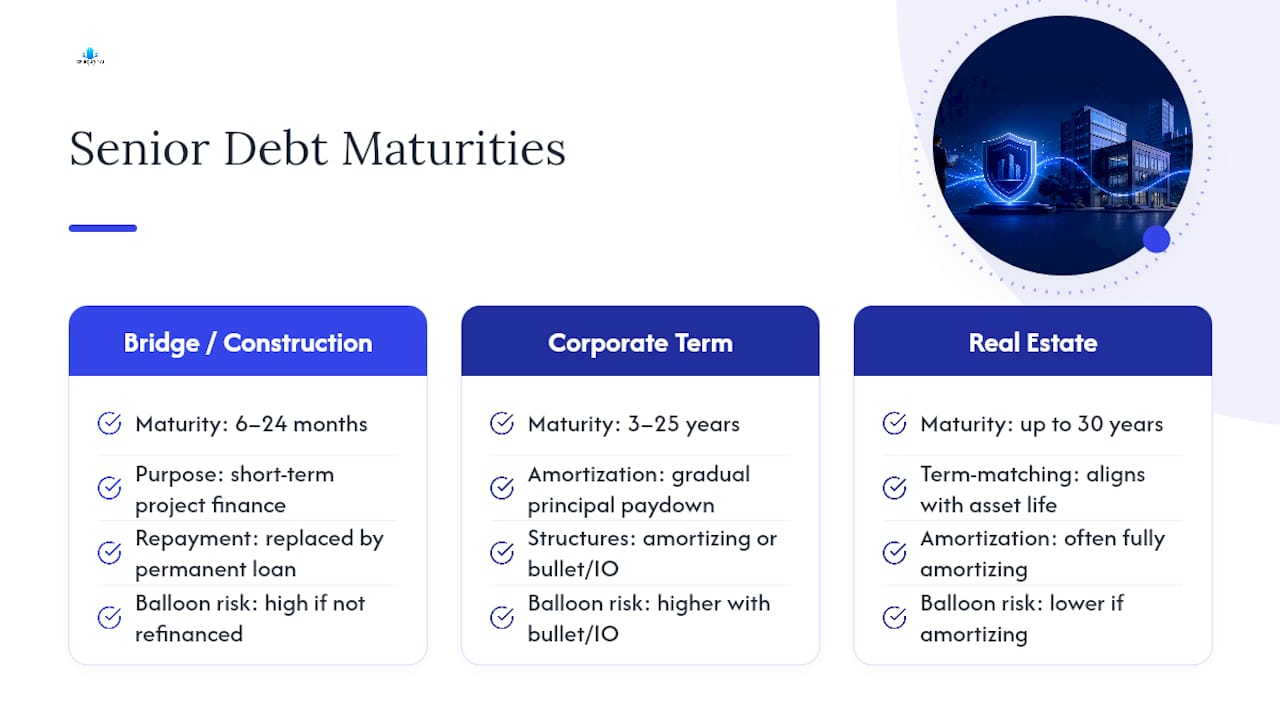
Senior debt maturities range from a few months to three decades, and the structure depends entirely on what the loan finances. Bridge loans and short-term construction facilities typically run six months to two years, built to be replaced by permanent financing once a project stabilizes or a property sells.
Bank term loans for corporate purposes commonly run 3 to 25 years, with amortization schedules that pay down principal gradually alongside interest. Some term loans carry a “bullet” structure instead, where the borrower pays interest-only for the term and repays the full principal at maturity, often through refinancing.
Real estate mortgage loans sit at the long end of the spectrum, sometimes stretching to 30 years, because the underlying asset has a correspondingly long useful life. This is the term-matching principle at work: financing a building with a five-year loan creates unnecessary refinancing risk, since the borrower must find new capital before the asset has generated enough cash to justify it. OpenStax’s finance framework treats this alignment between asset life and debt maturity as a foundational rule, not a nice-to-have.
Amortization structure matters as much as maturity length. A fully amortizing loan reduces principal every period, lowering the lender’s exposure over time and reducing the balloon payment risk at maturity. A partially amortizing or interest-only structure keeps monthly payments lower but leaves a larger balance due at the end, which raises refinancing risk if credit markets tighten before that date arrives. Borrowers evaluating commercial real estate debt benchmarks should weigh amortization structure alongside the headline rate, since a lower rate with a large balloon payment can carry more real risk than a slightly higher, fully amortizing alternative.
Senior Debt’s Role in Bankruptcy and Restructuring
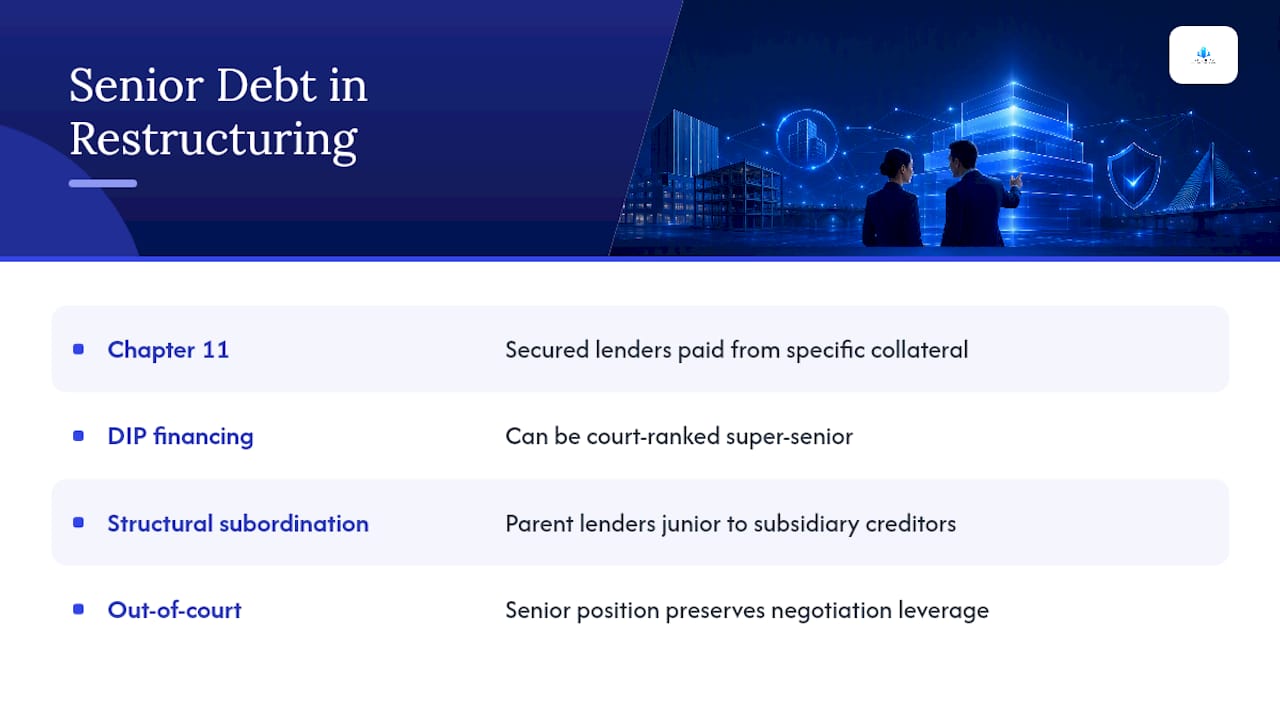
Senior debt’s entire value proposition gets tested in a restructuring, which is exactly when the repayment waterfall matters most. In a Chapter 11 filing, secured senior lenders generally get paid from the value of their specific collateral before unsecured creditors, subordinated lenders, or equity holders see anything.
That said, restructuring introduces complications that a clean textbook waterfall doesn’t capture. Debtor-in-possession financing, new money extended to keep a distressed company operating during bankruptcy, can be granted super-senior status by the court, meaning it gets repaid ahead of even pre-existing senior lenders. This exists because without fresh capital, a company in Chapter 11 often can’t survive long enough to restructure at all, and courts weigh that practical need against existing creditors’ priority claims.
Structural subordination becomes especially visible in restructuring. If a parent holding company’s senior lenders don’t have direct claims or guarantees against operating subsidiaries, they can find themselves negotiating from a weaker position than “senior” would suggest, since subsidiary-level creditors have first claim on the assets actually generating value. The Wikipedia overview of senior debt notes this dynamic played out in several notable financial-crisis-era collapses.
Outside of formal bankruptcy, out-of-court restructurings and loan modifications often preserve senior lenders’ negotiating leverage precisely because of their priority position. A senior lender can typically force a more painful outcome on subordinated creditors and equity holders than the reverse, which is why distressed-company negotiations usually start with senior lenders and work down the capital stack from there.
Who Actually Lends Senior Debt
The senior debt market is dominated by institutions built to tolerate lower returns in exchange for lower risk. Banks and other regulated depository institutions are the most common senior lenders, partly because bank capital regulations favor holding lower-risk, senior-secured assets over unsecured or subordinated exposure.
Beyond traditional banks, the market includes several other recurring participants:
- Institutional lenders and insurance companies, which favor senior debt’s predictable, lower-volatility cash flows to match against long-dated liabilities.
- Syndicated lending groups, where multiple banks share a single large term loan to spread risk on bigger transactions.
- Direct private lenders, which underwrite and fund loans using their own capital rather than originating for resale, often moving faster than traditional bank processes for real estate and business financing.
- Bond investors, who purchase senior notes issued by larger, established companies directly in public or private debt markets.
Private markets have their own senior debt applications worth noting. Secured senior debt frequently anchors leveraged buyouts and large acquisitions, providing the bulk of transaction financing against the target company’s assets and cash flow. Venture debt, meanwhile, can function as a senior claim for later-stage startups that lack the traditional collateral base but have revenue predictable enough to support debt service, a niche the Carta guide to senior debt covers directly.
Bonds vs. Bank Loans vs. Direct Lending
Choosing between a bond issuance, a bank term loan, and a direct private loan comes down to company size, speed requirements, and how much structuring flexibility a borrower needs.
Senior notes (bonds) work best for larger, established companies that can access public or private debt markets and want a fixed rate locked in for a long term. The process is slower, often taking weeks to months given underwriting and marketing requirements, but pricing can be attractive for well-known issuers.
Bank term loans suit mid-sized companies with an existing banking relationship and straightforward collateral. Banks typically offer competitive pricing but apply conservative underwriting standards, heavier documentation requirements, and slower decision timelines than direct lenders, since bank credit committees usually require extensive income verification and multiple approval layers.
Direct private lenders occupy a different niche: speed and asset-focused underwriting for borrowers who need certainty of close over the lowest possible rate. This matters most for time-sensitive transactions such as a fix-and-flip purchase with a tight closing window or a ground-up construction project requiring milestone-based draws rather than a single lump-sum disbursement.
None of these three routes is universally “better.” A stabilized apartment building refinance might be perfectly suited to a bank term loan, while a distressed-property acquisition with a 10-day closing deadline realistically only works with a direct lender’s faster underwriting process. Borrowers evaluating commercial real estate debt benchmarks should weigh timeline and certainty of close alongside headline rate, since a lower rate that closes too late to matter isn’t actually the cheaper option.
The Gap Between the Textbook Definition and the Deal
Most explainers stop at the waterfall diagram: senior debt gets paid first, subordinated debt gets paid second, equity gets what’s left. That’s true, and it’s the right starting point. But treating “senior” as a fixed, permanent rank is where a lot of otherwise sophisticated investors get burned.
The real lesson from structural subordination and debtor-in-possession financing is that seniority is a claim against specific assets and specific entities, not a magic word in a term sheet. A senior lender to a holding company with no direct claim on operating subsidiaries can end up worse off than a subordinated lender with a direct guarantee from the entity that actually holds the cash-generating assets. Structure beats label, every time.
The other underrated point is speed of underwriting versus depth of underwriting. Borrowers often assume a faster process means a shallower one, but asset-and-deal underwriting, evaluating the property, the cash flow, and the collateral directly, can actually surface risk that paperwork-only underwriting misses entirely. A borrower’s tax return tells you about last year. A current rent roll and property valuation tell you what’s happening now.
If there’s one thing to prioritize before signing anything, it’s this: know exactly which entity holds the collateral, and get the covenant package before you compare rates.
— Robert
Get Senior Debt Financing Through a Direct Lender
Some direct lenders give real estate investors and business owners a faster path to senior secured financing than the multi-week bank underwriting process this article just described. Decisions on qualifying programs can sometimes come within hours, and some real estate programs skip income verification entirely, relying instead on the property and the deal itself.

The programs cover the transactions covered throughout this piece: investment property acquisitions with roughly 10-day closings, bridge loans funded in 24 to 48 hours under the F.L.E.X. 50™ program.
Ground-up construction loans with milestone draws, small-balance commercial loans from $100,000 to $100 million, and business funding up to $10 million with no property required. CR Equity Ai Inc lends its own capital and publishes advance-rate grids before you apply, so you know the terms before submitting documentation. ITIN and foreign national investors are supported alongside US borrowers.
If you have a deal that needs senior debt financing, whether it’s an acquisition, a refinance, or a construction draw schedule, submit your deal to get a decision started.
Sources
- Understanding Senior Debt: Risks and Payment Priorities — Investopedia
- Senior debt: Definition, benefits, & impact on capital structure — Carta
- What is a secured loan? — Bankrate
- Senior Debt | Definition + Loan Characteristics — Wall Street Prep
FAQ
What Does “Senior Debt” Mean?
Senior debt is debt that has the first claim on repayment in a company’s capital structure, meaning it gets paid before subordinated debt and equity in default or liquidation, and it’s usually secured by a first lien on specific collateral.
What Is the Average Debt of a Person Around Age 70?
Household debt levels for older Americans vary widely by mortgage status, medical costs, and regional cost of living, and no single figure applies universally; readers should consult primary sources like the Federal Reserve’s Survey of Consumer Finances for current household debt data by age group rather than relying on a single average.
Is There Debt Forgiveness Available for Elderly Borrowers?
There’s no blanket “elderly debt forgiveness” program in the United States; specific relief options like federal student loan discharge, Medicaid planning, or bankruptcy protections exist for particular debt types and circumstances, and eligibility depends entirely on the debt category and the borrower’s specific situation.
How Many Americans Are Completely Debt Free?
The share of Americans carrying zero debt fluctuates with economic conditions and varies significantly by age and homeownership status; readers should check current Federal Reserve household debt data for the most accurate figure rather than a single fixed number, since this changes year to year.
How Is Senior Debt Different From Subordinated Debt?
Senior debt is repaid before subordinated debt in default or liquidation and typically carries a lower interest rate because of that priority and its secured status, while subordinated debt sits behind it in the repayment order and charges a higher rate to compensate lenders for the added risk.