

A term loan works best for a single, planned expense with a known price tag, such as new equipment or a buildout, because you repay it on a fixed schedule at a predictable cost. A line of credit works best for recurring or unpredictable needs, like payroll gaps or seasonal inventory, because you draw only what you need and pay interest on that balance. Many small businesses eventually use both, matched to different jobs inside the same operation.
TL;DR:
- A term loan provides a fixed lump sum with predictable payments, but lacks flexibility if plans change or early repayment is desired.
- A line of credit offers revolving access to funds, with interest only on the drawn amount, but may increase credit utilization and impact credit scores.
- Combining both options is common, with a term loan covering major investments and a line of credit managing seasonal or unpredictable cash needs.
- Accurate purpose definition, detailed lender questions, and proper documentation speed up approval and help avoid costly fee surprises.
- Matching the product to specific needs prevents overborrowing or underutilization, ensuring lower total costs and better financial management.
Table of Contents
- Term Loan vs Line of Credit: What a Term Loan Actually Offers
- Term Loan vs Line of Credit: What a Line of Credit Actually Offers
- Term Loan vs Line of Credit: Side-by-Side Comparison
- How to Choose Between a Term Loan and a Line of Credit
- Real Situations: Matching the Product to the Job
- How Each Option Affects Your Credit Score and Utilization
- Tax Treatment: Deducting Interest on Each Option
- An Editorial Take on Matching Debt to Purpose
- Get Funded Without the Bank Runaround
- Primary Sources and Further Reading
- Sources
- FAQ
Term Loan vs Line of Credit: What a Term Loan Actually Offers
A term loan delivers a lump sum up front, repaid in fixed installments over a set period, usually with a fixed or set interest rate applied to the full amount from day one. The SBA 7(a) program is a familiar example of this structure, though most term loans come from banks, credit unions, or direct lenders rather than the government itself. Lenders underwriting a term loan look at time in business, annual revenue, cash flow, personal and business credit scores, available collateral, and whether a personal guarantee is required.
The appeal is predictability: you know your payment, your payoff date, and your total interest cost before you sign. The tradeoff is rigidity. Once funded, you owe the full balance regardless of whether your plans change, and prepayment penalties sometimes apply.
Expect lenders to request:
- Two to three years of business and personal tax returns
- Recent bank statements and a profit and loss statement
- A written explanation of how the funds will be used
Pro Tip: Ask for the amortization schedule before you sign. A shorter term with a higher payment often costs less in total interest than a longer term marketed as “more affordable.”
Term Loan vs Line of Credit: What a Line of Credit Actually Offers
A business line of credit gives you a revolving credit limit you can draw against repeatedly, and interest applies only to the amount you’ve actually drawn, not the full limit. Lines can be secured against receivables or inventory or unsecured based on cash flow and credit strength, and most carry a variable rate tied to a benchmark like prime.
Fees matter more here than with a term loan. Draw fees, maintenance or unused-line fees, and annual renewal charges can meaningfully raise your all-in cost beyond the stated rate. Lenders typically size your limit using average daily bank balance, trailing revenue, or receivables aging rather than a single credit-score cutoff.
- Draw what you need, repay, and draw again without reapplying
- Rates are usually variable, so payments can shift with the market
- Carrying a balance for months at a time often signals a cash-flow problem worth addressing
Pro Tip: A line of credit sitting at zero most of the year and only spiking during a known seasonal gap is exactly the use case it was built for. A line that consistently carries a balance without returning to zero may indicate financial strain rather than convenience.
Term Loan vs Line of Credit: Side-by-Side Comparison
| Dimension | Term Loan | Line of Credit |
|---|---|---|
| Best for | One-time, planned investments | Recurring or unpredictable working capital |
| Repayment structure | Fixed installments over a set term | Revolving; repay and redraw as needed |
| Interest accrual | On the full disbursed amount from day one | Only on the amount currently drawn |
| Rate type | Often fixed, sometimes lower headline rate | Usually variable, often higher nominal rate |
| Collateral | Common for larger amounts; personal guarantee typical | Varies; unsecured options exist based on cash flow |
| Funding speed | Days to a few weeks depending on lender | Often faster once approved; draws are near-instant |
| Fees | Origination fee, possible prepayment penalty | Draw fees, maintenance fees, renewal fees |
| Typical size | Larger, matched to a specific project cost | Sized to monthly cash-flow variance |
The core distinction comes down to how interest behaves: a term loan charges you on money you’ve already spent, while a line only charges you on money you’re currently using. That difference shapes which one costs less for your specific pattern of spending.
Quick checklist:
- Need a fixed amount for a defined purchase? Lean term loan.
- Need a cushion for irregular cash timing? Lean line of credit.
- Need both a big purchase and ongoing flexibility? Consider pairing them.
How to Choose Between a Term Loan and a Line of Credit
1. Define the purpose first. A specific dollar amount tied to a specific asset points toward a term loan. A recurring, harder-to-predict expense points toward a line of credit.
2. Size your repayment capacity. Look at your monthly cash flow, not just your revenue, and estimate what you can commit to a fixed payment without straining operations.
3. Compare quotes on all-in cost, not headline rate. Ask each lender to model a sample month of actual usage so fees and rate combine into one real number.
Exact questions to ask every lender:
- What is the all-in cost per draw or per month at my expected usage level?
- What fees apply beyond the interest rate, including draw, maintenance, and renewal charges?
- Is collateral or a personal guarantee required, and under what terms?
- Are there prepayment penalties or mandatory renewal terms?
- What financial covenants, if any, apply once funded?
Red flags worth walking away from: unclear or shifting fee structures, mandatory rollover clauses that trap you into renewing, and blanket liens the lender can’t explain in plain terms. If a bank turns you down, community lenders and CDFIs are a legitimate alternative worth exploring before assuming financing isn’t available.
Pro Tip: Prepare your profit and loss statement, three to six months of bank statements, an aged receivables report, and a one-page summary of what the funds will do. Lenders move faster when you hand them what they need before they ask twice.
Real Situations: Matching the Product to the Job
A landscaping company buying a $40,000 truck fleet has a known cost and a known asset life, so a term loan repaid over three to five years fits cleanly. A retailer stocking up before the holiday season has a temporary, recurring need, so a line of credit drawn in October and repaid by January fits better than tying up capital in a long-term loan.
Many owners pair the two: a term loan covers the capital asset, like equipment or a leasehold improvement, while a line of credit absorbs the payroll and inventory swings that come with running the business day to day. Pairing both is common precisely because the two products solve different timing problems, not competing versions of the same one.
- Equipment or expansion cost → term loan
- Seasonal inventory or short payroll gap → line of credit
- Ongoing growth with periodic big purchases → both, used for their separate purposes
How Each Option Affects Your Credit Score and Utilization
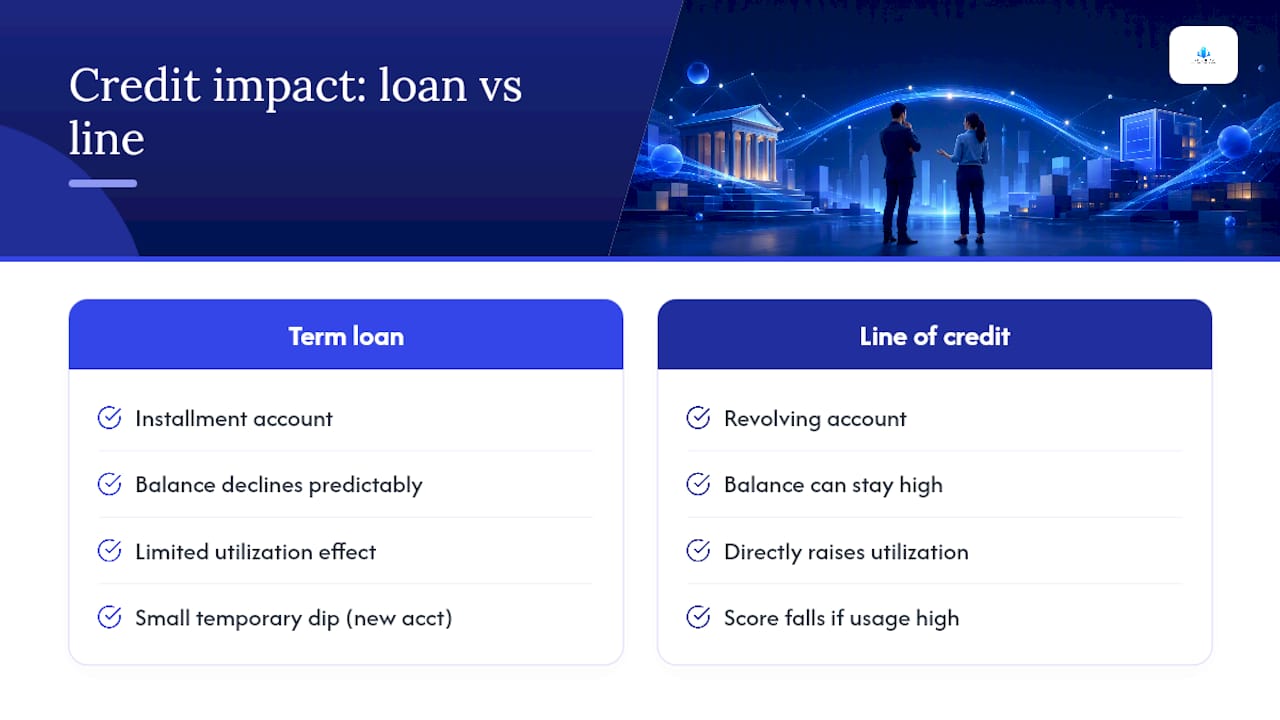
A term loan reports as an installment account. Your balance declines predictably each month as you pay it down, and that declining balance has a limited direct effect on your credit utilization ratio, since utilization calculations focus on revolving accounts.
A line of credit reports differently. It’s revolving debt, so your outstanding balance relative to your credit limit factors directly into your utilization ratio, one of the more heavily weighted inputs in most credit scoring models. Carrying a high balance on a business line, especially one tied to your personal guarantee or reported to personal credit bureaus, can push your utilization up and your score down even if you’re making every payment on time.
The practical takeaway: if you’re planning to apply for additional financing soon, a fully or mostly drawn line of credit can hurt your approval odds more than a term loan with the same total balance, because the line signals ongoing dependence on credit rather than a single, amortizing obligation. Paying a line down to a low balance before applying elsewhere is a reasonable, low-cost move. On the term-loan side, opening one adds a new account and a hard inquiry, which can cause a small, temporary dip, but the ongoing structure tends to be gentler on your score than a revolving balance sitting near its limit month after month.
Tax Treatment: Deducting Interest on Each Option
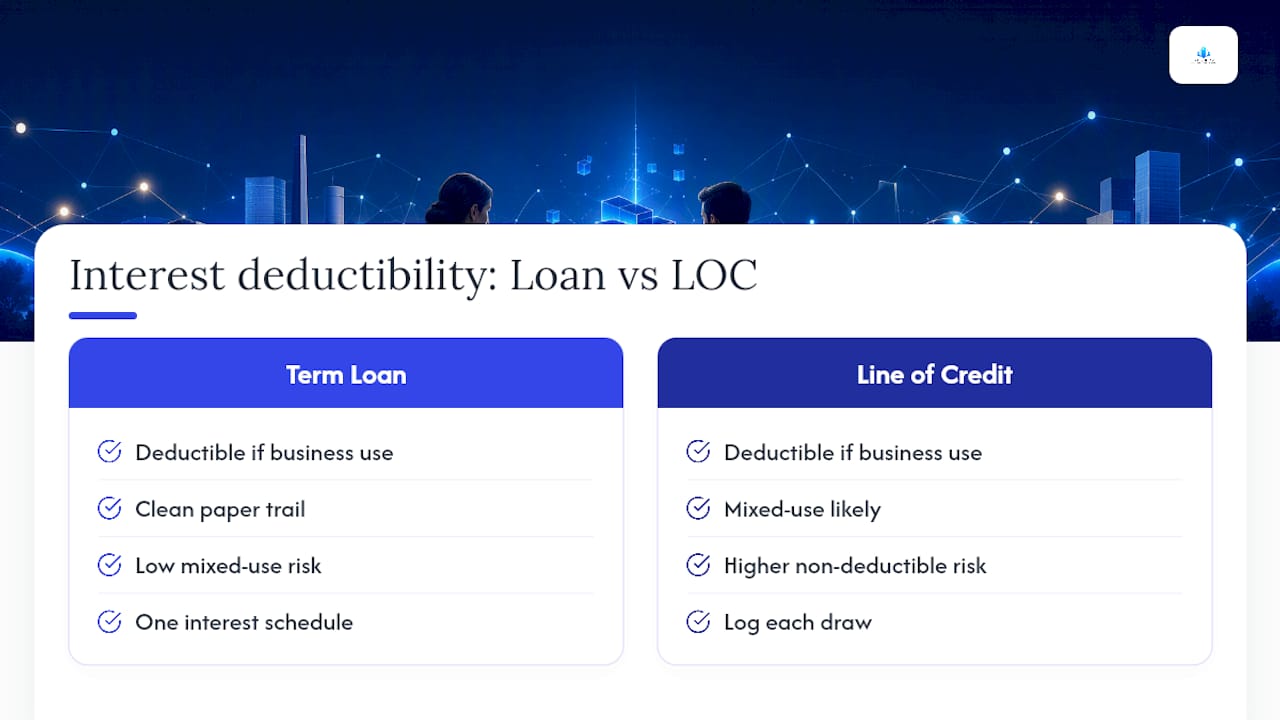
Interest paid on both term loans and business lines of credit is generally deductible as a business expense, provided the funds are used for legitimate business purposes rather than personal spending. The IRS distinguishes based on use, not on the label of the product, so the deductibility rule itself doesn’t favor one structure over the other.
Where it gets practical is recordkeeping. A term loan used entirely to buy one piece of equipment creates a clean paper trail: one loan, one purpose, one interest schedule to reference at tax time. A line of credit that gets tapped for payroll one month, a vendor payment the next, and an owner draw the month after creates a mixed-use headache. If any portion of a draw goes toward something other than the business, that portion of the interest isn’t deductible, and separating business use from personal use after the fact is far harder than tracking it at the time of each draw.
Keep a simple log of what each draw funded as you go. It costs a few minutes and it’s the difference between a straightforward deduction and a reconstruction project with your accountant in April. This applies to federal deductibility; state tax treatment can vary, so confirm specifics with a tax professional familiar with your state’s rules before filing.
An Editorial Take on Matching Debt to Purpose
The mistake we see most often isn’t picking the wrong product. It’s picking the right product for the wrong amount, then stretching it to cover something it wasn’t built for. A term loan padded 20% “just in case” becomes a fixed payment on money you didn’t need. A line of credit used to fund a major expansion because the draw was easy becomes revolving debt that never resets to zero.
Match the shape of the financing to the shape of the need, then compare all-in cost across real lenders before you commit capacity you might want later. CR Equity Ai Inc underwrites both real estate and business deals against the asset and the deal itself, with decisions in as little as four hours, which matters when the difference between a term loan and a line of credit ultimately comes down to timing as much as structure.
— Robert
Get Funded Without the Bank Runaround
Traditional banks can take weeks to decide on a term loan or a line of credit, and much of that time goes to underwriting your paperwork rather than your actual deal. CR Equity Ai Inc underwrites the asset and the deal, with decisions in as little as four hours and no income verification required on most real estate programs.

If you need working capital without pledging property, business funding up to $10 million is available with no collateral required. If your need is time-sensitive, like covering a gap between a purchase and a refinance, the F.L.E.X. 50™ bridge program funds in 24 to 48 hours. Real estate investors and brokers with a deal ready to move can submit it directly and get a same-day read on structure and pricing.
Primary Sources and Further Reading
- Fit Small Business: Term Loan vs Line of Credit
- Investopedia: Loan vs. Line of Credit
- Chase: Business Loan vs. Line of Credit
- Federal Reserve: Senior Loan Officer Opinion Survey
- FDIC
This article is general information, not a substitute for advice from a qualified financial advisor. Consult a qualified financial professional about your own circumstances before acting on anything here.
Sources
- Term loan vs line of credit — Fit Small Business
- Loan vs. line of credit — Investopedia
- Federal Reserve — SLOOS (small-business lending context)
FAQ
Which Is Better, a Line of Credit or a Term Loan?
Neither is universally better. A term loan fits a single, planned expense with predictable repayment, while a line of credit fits recurring or unpredictable cash-flow needs where you only want to pay interest on what you actually draw.
Which Is Better, a Line of Credit or a Loan in General?
The same logic applies: compare the purpose, not just the product. If you need one lump sum for a specific investment, a loan usually costs less over time; if your need repeats or varies month to month, a line of credit avoids paying interest on money sitting unused.
What Are the Cons of a Term Loan?
The biggest drawbacks are inflexibility once funded, interest charged on the full amount from day one even if plans change, and possible prepayment penalties. Missing the fixed monthly payment also carries more immediate consequences than an underused line of credit.
What Not to Tell a Lender?
Avoid vague or shifting answers about how you’ll use the funds. Underwriters like CR Equity Ai Inc and traditional banks alike move faster and offer better terms when your stated purpose, financials, and repayment plan are consistent and specific.
Can I Have Both a Term Loan and a Line of Credit at the Same Time?
Yes. Pairing a term loan for a capital purchase with a line of credit for working capital is a common structure precisely because the two products solve different timing problems rather than compete for the same use.