

Recourse carve-outs, prepayment structure, covenant definitions, and borrowing-base advance rates move total deal cost far more than a quarter-point of rate. The immediate step is to get two or three competing term sheets and build a side-by-side comparison matrix before writing a single counter. Lock the protections you cannot live without into the term sheet itself, and push everything else to the definitive documents, so you don’t stall the closing timeline.
TL;DR:
- Focus on negotiating prepayment penalties, guaranty carve-outs, and covenant definitions, as these have a greater impact on total deal cost than the interest rate itself.
- Use a comparison matrix to evaluate all competing term sheets side by side, emphasizing structural asks before rate concessions.
- Present specific, measurable counteroffers on key clauses, such as burn-off schedules or reserve caps, rather than vague requests or rate-only negotiations.
- Confirm lender advance-rate grids and approval timelines beforehand to reduce uncertainty and expedite the negotiation process.
- When possible, work with direct lenders that publish their leverage limits and can make quick decisions, especially if speed is a priority.
Table of Contents
- What Is Term Sheet Negotiation and Why Does Timing Matter?
- The Seven Clauses Borrowers Must Prioritize in the Term Sheet
- Step-by-Step Playbook: Compare, Counter, and Close Without Losing Leverage
- Pre-Counter Checklist: What to Decide Before You Hit Send
- When a Direct-Lender Route Reduces Negotiation Friction
- Matching Negotiation Priorities to Your Risk Tolerance
- Realistic Counteroffers: What to Actually Say to a Lender
- Negotiation Discipline That Protects Returns
- Start Here: Submit Your Deal to a Direct Lender With Published Rate Grids
- Sources
- FAQ
What Is Term Sheet Negotiation and Why Does Timing Matter?
Term sheet negotiation is the process of reviewing and revising a lender’s preliminary loan offer, the document that sets rate, leverage, fees, covenants, and repayment terms before anyone drafts a loan agreement. It is distinct from negotiating an investment agreement for an equity stake in a company; this is about debt terms on a property or business asset, not ownership.
The term sheet stage is the borrower’s single highest-leverage moment in the entire deal. Once signed, most detailed provisions default to the lender’s standard form and get materially harder to move. Negotiating a commercial loan term sheet typically runs three days to three weeks, with closing after signature taking another four to eight weeks. Long-lead items like environmental reports and surveys, not the negotiation itself, usually drive most of that delay.
That narrow window is why speed and preparation both matter. A borrower who spends the first week gathering competing offers instead of reacting to the first term sheet that lands almost always negotiates from a stronger position.
The Seven Clauses Borrowers Must Prioritize in the Term Sheet
Rate gets the attention. It is rarely the term that costs the most money over the life of the loan. Experienced borrowers and their counsel routinely find that structural levers save six figures on a typical commercial loan, while chasing a small rate reduction saves comparatively little.
Seven clauses deserve attention before anything else:
- Recourse and guaranty carve-outs. Full recourse, partial recourse, and non-recourse loans carry very different risk profiles. Push for a burn-off schedule that reduces personal guaranty exposure as the loan performs, and narrow “bad-boy” trigger language so it only applies to fraud or intentional misconduct, not routine covenant slips.
- Prepayment structure. Step-downs, yield maintenance, and make-whole provisions produce wildly different exit costs, and lockout periods determine when you can even ask. If you expect to refinance or sell within a few years, the exit math on prepayment penalties often matters more than the note rate itself.
- Covenants and the EBITDA definition. Which expenses count as permitted add-backs and whether an equity cure right exists can decide whether you pass or fail a covenant test in a soft quarter.
- Borrowing base, advance rates, and discretionary reserves. Advance rates and eligibility rules frequently determine your effective loan proceeds more than the headline LTV does, and discretionary reserves can quietly shrink availability after close.
- Interest-rate structure, floors, and interest-only periods. A rate floor or a short interest-only window changes your cash flow math even at an identical headline rate.
- Extension options and conditions precedent. Confirm exactly what triggers an extension and what documentation the lender requires to grant one.
- Reporting requirements and operational covenants. Frequency of financial reporting, field exam costs, and other operational obligations add real dollars and staff time over the loan term.
Pro Tip: Ask the lender for the exact EBITDA add-back list in writing before you counter on rate. A vague covenant definition today becomes a hard default risk in year two.
Step-by-Step Playbook: Compare, Counter, and Close Without Losing Leverage
Negotiating term sheets rewards sequence as much as substance. Work through these steps roughly in order:
- Standardize every offer into one comparison matrix. List all-in economics, covenant headroom, reporting burden, call protection, and closing conditions side by side. A structured comparison matrix is what makes competing term sheets comparable instead of just different.
- Lead your counter with structural asks, not rate. Open with guaranty burn-off, a step-down prepayment schedule, a cap on discretionary reserves, and a tightened EBITDA definition. Save rate for last.
- Trade concessions deliberately. A slightly wider spread in exchange for a guaranty burn-off, or a larger equity contribution in exchange for a lower reserve requirement, are common trades. Non-monetary levers like deposit relationships can also work as negotiating currency when cash concessions are limited.
- Use silence as a tool. After you make a specific, documented ask, stop talking. Negotiation research from Harvard’s Program on Negotiation shows that pausing after an ask forces the other side to respond on your terms instead of letting you talk yourself into a worse position.
- Bring in underwriting or counsel early on anything structural. Ownership transfers, major guaranty carve-outs, and known title or environmental flags need a second set of eyes before you sign, not after.
- Set deadlines and run parallel tracks. Give each lender a specific response window and keep more than one live until terms are locked. Optionality is what makes every other tactic on this list work.
Pro Tip: Never send a counter that only changes rate. It signals you didn’t read the covenant package, and it wastes your one high-leverage conversation on the term that matters least.
Pre-Counter Checklist: What to Decide Before You Hit Send
A rushed counter is a weak counter. Before you respond to any term sheet, confirm you have:
- Two to three competing term sheets in hand, plus a downside-case covenant stress test run against each.
- Rent rolls, borrowing-base schedules, Phase I environmental flags, title exceptions, and any appraisal triggers assembled and ready to send.
- A clear internal list of non-negotiables versus tradeable items, with an explicit walk-away point written down before negotiations start.
- Specific questions drafted for the lender on reserve mechanics, approval timing for any ownership or transfer rights, and underwriting prerequisites that could delay closing.
Borrowers who skip this step tend to negotiate reactively, term by term, instead of trading strategically across the whole package. That usually costs more than it saves.
When a Direct-Lender Route Reduces Negotiation Friction
Some of the friction in term sheet negotiation comes from uncertainty: unclear advance rates, slow conditional approvals, and underwriting that depends on a chain of third-party investors. Certain direct lenders structure their programs to remove several of those unknowns.
- Some lenders can make decisions in as little as four hours on many programs, often focusing underwriting on the asset and the deal rather than exhaustive borrower paperwork.
- Published advance-rate grids available before you apply, so borrowers know the leverage ceiling going into negotiation instead of guessing.
- Programs may span the deal lifecycle, including investment property acquisition, fix-and-flip, DSCR cash-out refinance, ground-up construction with milestone draws, small balance commercial lending, and business funding without property requirements.
- A documented 17-day execution from term sheet to wire on a $28.5 million Dallas multifamily bridge loan.
A direct-lender path fits best when speed is the priority, when a specific program (fix-and-flip, DSCR, ground-up construction) matches the deal, or when a borrower wants fewer underwriting variables to negotiate around in the first place. Because CR Equity Ai Inc lends its own capital, fewer approval layers stand between the term sheet and the wire.
Matching Negotiation Priorities to Your Risk Tolerance
Not every borrower should fight the same fight. A borrower planning to hold and refinance in eighteen months should focus negotiating capital on prepayment structure and extension conditions, since those clauses determine the real cost of exiting early. A borrower planning to hold long term should weight covenants and the EBITDA definition more heavily, because those provisions govern default risk across years, not months.
Risk tolerance changes the calculus too. A well-capitalized sponsor with strong liquidity can often trade a tighter guaranty for a lower rate, since the guaranty is unlikely to ever get triggered. A thinly capitalized borrower should do the opposite: protect the guaranty carve-outs first, even if it means accepting a slightly higher rate or fee, because that borrower has less room to absorb a bad-boy trigger or a full recourse event.
Brokers structuring deals for multiple capital partners should rank clauses by which party bears the downside. If the sponsor carries the guaranty, the sponsor’s negotiating priorities should drive the term sheet redline, not the broker’s preference for a faster close. Write down the ranking before the first call with the lender. Negotiating on the fly, term by term, without a stated priority order is how borrowers end up trading away a prepayment carve-out to save half a point on rate, then regretting it eighteen months later when they need to refinance.
Realistic Counteroffers: What to Actually Say to a Lender
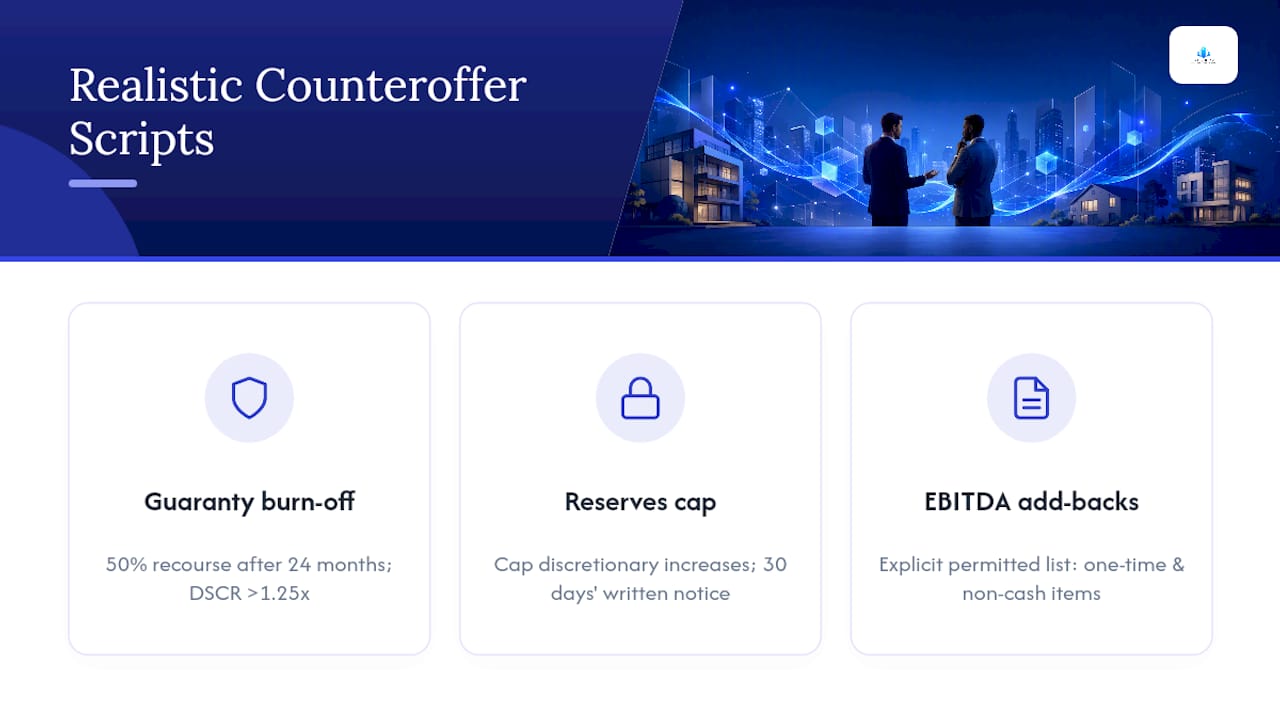
Vague pushback rarely moves a term sheet. Specific, numbered asks do. A few realistic scripts:
On guaranty burn-off: “We can accept full recourse at close, but we’re asking for burn-off to 50% recourse after twenty-four months of on-time payments and a debt service coverage ratio above 1.25x.” This gives the lender a measurable trigger instead of an open-ended request.
On reserves: “We’re comfortable with an initial tax and insurance reserve, but we need a cap on discretionary reserve increases and thirty days’ written notice before any change.” This is a direct response to overly broad reserve language that lets a lender adjust availability at will.
On EBITDA add-backs: “Can we get an explicit list of permitted add-backs in the term sheet, including one-time transaction costs and non-cash items, rather than leaving it to lender discretion at the covenant test?” This closes the single biggest source of covenant surprises later.
Each of these works because it pairs a specific number with a specific condition. A lender can say yes, no, or counter with a number of their own. “Can you improve the terms?” invites nothing but a form response.
Negotiation Discipline That Protects Returns
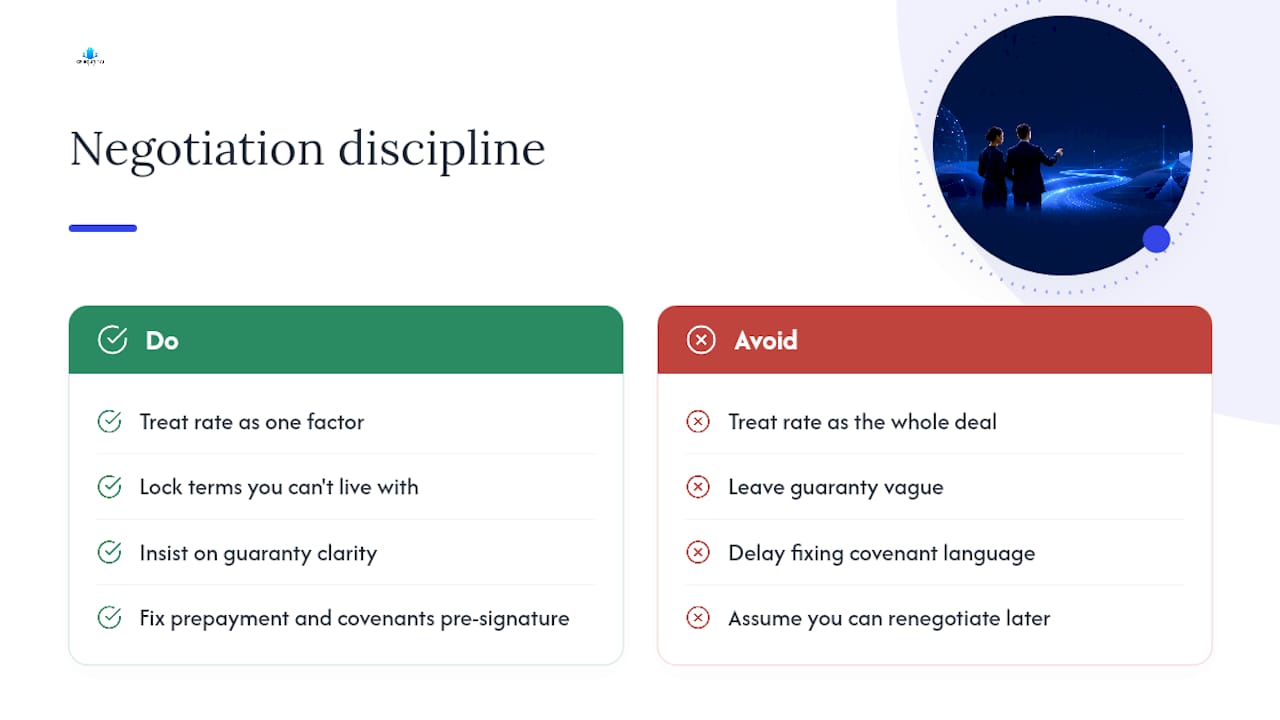
The biggest mistake borrowers make at the term sheet stage is treating rate as the whole negotiation. It is one line among a dozen that determine what a loan actually costs. Guaranty structure, prepayment penalties, and covenant definitions routinely swing total deal economics more than a quarter point ever will, and they are far easier to fix before signature than after.
If there’s one mantra worth carrying into every term sheet call, it’s this: lock what you can’t live without, and trade the rest.
— Robert
Start Here: Submit Your Deal to a Direct Lender With Published Rate Grids
Term sheet negotiation goes faster when the lender’s leverage ceiling isn’t a mystery. Certain direct lenders publish advance-rate grids before application, lend their own capital, and can issue decisions in as little as four hours on many real estate and business programs. That combination removes a lot of the guesswork borrowers usually negotiate around: you know the maximum advance rate going in, so the conversation can focus on structure, guaranty terms, and prepayment instead of fishing for a number the lender won’t confirm.

If you’re ready to move, the next step is straightforward. Pull together your existing term sheet or loan request, your rent roll or business financials, and any competing offers you’ve collected, then submit your deal directly. Programs cover acquisition, fix-and-flip, DSCR cash-out refinance, ground-up construction, small balance commercial lending, and business funding up to $10 million with no property required, so most borrowers reading this will find a program built for their exact situation.
Sources
- Negotiating a Commercial Loan Term Sheet | MC Law
- How to Negotiate a Commercial Real Estate Loan — The Cauble Group
- How to Navigate the Term Sheet Process in Private Credit | Private Equity Bro
- CRE Term Sheets in 2026: The 7 Clauses That Actually Determine Your Deal
FAQ
What Is the Difference Between a Term Sheet and a Commitment Letter?
A term sheet is a preliminary, often non-binding outline of proposed loan terms used to negotiate; a commitment letter is a more formal, typically binding document issued after underwriting confirms the deal will close on stated terms.
How Long Does Term Sheet Negotiation Usually Take?
Negotiating a term sheet typically takes three days to three weeks, with closing after signature taking another four to eight weeks depending on third-party reports.
Which Term Sheet Clause Matters Most If I Plan to Refinance Early?
Prepayment structure, specifically the type of call protection and any lockout period, usually matters more than headline rate if you expect to exit or refinance within a few years.
Should I Negotiate Rate or Covenants First?
Covenants, guaranty carve-outs, and prepayment terms typically outweigh small rate differences in total cost, so lead with structural asks and treat rate as a secondary negotiating point.
Can a Direct Lender Speed Up Term Sheet Negotiation?
A direct lender that publishes its advance-rate grids and underwrites with its own capital, like CR Equity Ai Inc, can reduce the guesswork in negotiation because the leverage ceiling and decision timeline are known upfront.