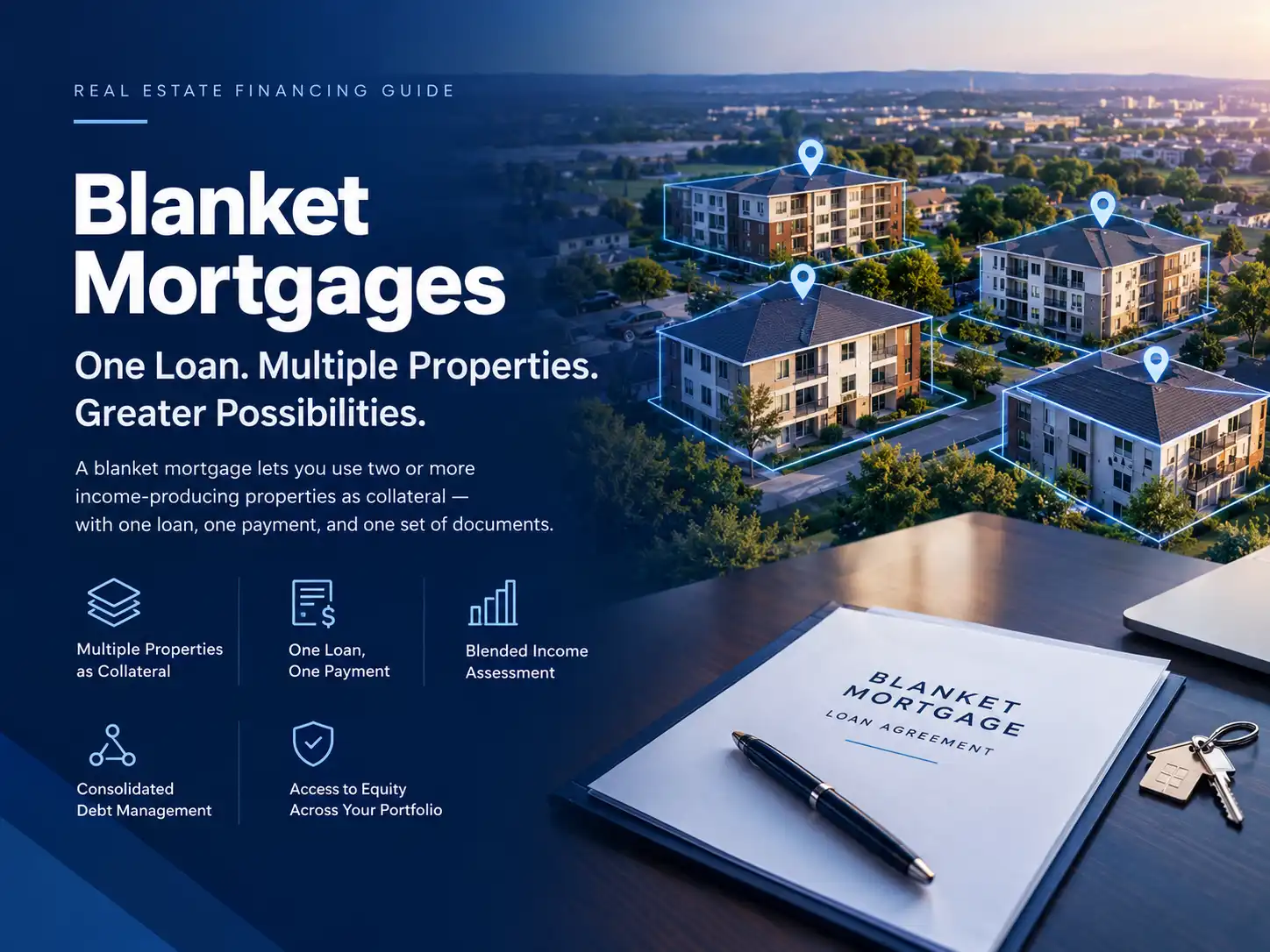
A blanket mortgage is a single loan that uses two or more real estate properties as collateral simultaneously. Instead of maintaining a separate mortgage on each property, the investor holds one loan with one lender, one monthly payment, and one set of documents — while all properties in the portfolio secure the full loan balance.
The word “blanket” describes the way the mortgage covers multiple properties at once. Each property in the blanket is pledged as collateral — a concept called cross-collateralization. The lender holds a lien on every property in the pool. If you default, the lender can pursue any or all of the collateral properties, not just one.
For the investor building and holding a rental portfolio long-term, the blanket structure offers real advantages: consolidated debt management, blended income assessment, and potential access to equity across the entire portfolio at once.
Blanket mortgages go by several names: portfolio loan, blanket loan, blanket DSCR loan, cross-collateralized loan, or multi-property mortgage. The terms are used interchangeably, though there are subtle distinctions covered in Section 5 below.
2. How a Blanket Mortgage Works
- Identify your property pool. The investor assembles two or more income-producing properties — existing holdings being refinanced, properties being purchased together, or a combination.
- Submit to a blanket lender. Not every lender offers blanket mortgages. Most conventional lenders and banks do not. Private lenders and portfolio lenders are the primary source.
- Properties are evaluated. Each property receives an individual value assessment covering rental income, occupancy, condition, and local market data.
- Blended income is calculated. The lender aggregates net operating income (NOI) across all properties and compares it to the proposed total debt service. The resulting ratio — the blended DSCR — determines whether the portfolio qualifies.
- Loan documents are drafted. One set of loan documents covers all properties. A deed of trust or mortgage lien is recorded on each property in each state.
- Closing. The investor signs once and receives one loan. Going forward: one monthly payment, one annual escrow statement, one servicer.
- Ongoing management. Rents are collected. The single loan payment is made monthly. If the investor wants to sell one property, the release clause governs how that works.
3. Cross-Collateralization: What It Means and Why It Matters
Cross-collateralization is the defining legal and financial feature of a blanket mortgage. It means each property in the pool secures not just its own allocated share of the loan — it secures the entire loan balance.
In practice: If you have a five-property blanket mortgage and you default, the lender does not just foreclose on the one property whose “share” of the loan is delinquent. They have a lien on all five.
Why lenders like it: More collateral coverage. A lender holding five properties as security for one loan has significantly more recovery options than a lender holding one property for one loan. This is part of why lenders can offer blended DSCR underwriting.
Why investors should think it through: Cross-collateralization means that a financial problem — unrelated to any specific property — creates risk for your entire portfolio simultaneously if you fall behind on the single payment. With individual mortgages, a problem with one property affects that mortgage only. Under a blanket, it affects all pledged collateral.
This is not a reason to avoid blanket mortgages. It is a reason to maintain adequate reserves and keep a clean payment record.
4. The Release Clause: Your Exit Hatch Explained
The release clause — also called a partial release provision — is the mechanism that allows an investor to sell or free one property from the blanket lien without paying off the entire loan.
Without a release clause, every property is locked into the blanket until the full loan is retired. With a release clause negotiated at origination, the process works like this:
- The investor identifies a property they want to sell or release.
- They notify the lender and request a partial release.
- The investor pays a defined paydown amount — typically 100–125% of that property’s allocated loan balance — from the sale proceeds.
- The lender releases the lien on that property.
- The blanket loan continues on the remaining properties with a reduced balance and proportionally lower monthly payment.
The release percentage — 100%, 110%, 120%, 125% — is negotiated before closing. Always negotiate the release clause before you close. If a lender’s term sheet does not include one, ask for it.
5. Blanket Mortgage vs. Portfolio Loan vs. Individual DSCR Loan
Blanket mortgage: Emphasizes the multi-property collateral structure. Any loan secured by multiple properties simultaneously is a blanket mortgage.
Portfolio loan: Has two meanings. (1) A lender-side term: a loan the lender keeps on its own balance sheet. (2) An investor-side term: a loan that covers multiple properties — used interchangeably with “blanket loan.”
Individual DSCR loan: A Debt Service Coverage Ratio loan structured for a single property. Qualifies on the rental income of that property alone. No cross-collateralization.
For the purposes of this guide: blanket mortgage = portfolio loan = multi-property DSCR loan. They describe the same structure.
6. Who Uses Blanket Mortgages?
- The accumulation-phase investor (5–20 properties): An investor who has been buying SFRs with individual DSCR loans and now wants to stop juggling multiple servicers and payment dates.
- The portfolio builder (20–50 properties): A larger operator who wants to use portfolio-level equity to fund acquisitions rather than pulling cash-out property by property.
- The STR operator: Short-term rental income fluctuates seasonally. A blended DSCR across five or six vacation rentals smooths out the variance that would kill individual property loans in slow months.
- The bulk acquirer: Investors who purchase properties in packages of 10–30 at a time need blanket structures because originating 30 individual DSCR loans simultaneously is not practical.
- The LLC portfolio holder: Investors operating inside legal entities who want clean, business-purpose financing structured at the entity level.
7. Pros of a Blanket Mortgage for Investors
- One payment, one servicer. Instead of logging into four different loan portals, making four ACH payments, and tracking four escrow accounts, you have one.
- Blended DSCR absorbs weak properties. A property that produces a DSCR of 0.85 on its own cannot get an individual DSCR loan. Inside a blanket where three other properties produce 1.30+, the blended DSCR may easily clear 1.10.
- Portfolio-level cash-out. Rather than refinancing individual properties one at a time, a blanket cash-out refinance pulls equity from the entire portfolio in a single transaction.
- Multi-state portfolio in one loan. A blanket mortgage can cover properties in different states under one loan, subject to lender licensing.
- Economies of scale on closing costs. One blanket loan for ten properties typically costs less in total than ten individual loans.
8. Cons and Risks
- Cross-collateralization risk. If you default on a blanket mortgage, the lender holds a lien on every property in the pool. This risk is manageable with adequate reserves (3–6 months of debt service) and sustainable leverage.
- Release clause complexity. Selling one property from a blanket requires lender cooperation and a paydown that may exceed what you get from the sale. Frequent traders are better served by individual DSCR loans.
- Less lender competition. Blanket mortgages are not agency products. You are limited to portfolio lenders and private lenders.
- Complexity at origination. Documenting ten properties simultaneously requires more due diligence than documenting one.
- Prepayment penalties. Blanket loans typically carry step-down prepayment penalties (e.g., 5-4-3-2-1) that make early payoff expensive.
9. Blanket Mortgage Requirements in 2026
| Requirement | Typical Range / Detail |
|---|---|
| Entity structure | LLC, LP, or corporate borrower preferred |
| Minimum properties | Typically 2+; some lenders require 3+ |
| Minimum blended DSCR | 1.0x–1.25x depending on lender and LTV |
| LTV — Purchase | Up to 70–75% of combined property value |
| LTV — Cash-Out Refinance | Up to 65–75% |
| LTV — Rate/Term Refinance | Up to 75–80% |
| Credit score | 640–680 minimum; rates tiered above 720 |
| Documentation | Rent rolls, executed leases, entity docs, insurance — no personal tax returns |
10. Typical Rates, Terms, and LTVs in 2026
Blanket DSCR loans from private lenders are typically priced in the 7.5–10.5% range in 2026, depending on DSCR, LTV, credit, loan term, and rate type. Loans with strong blended DSCR (1.25x+), low LTV (65% or below), and strong credit (720+) access the lower end of that range.
Common term structures are 5-year, 7-year, 10-year, and 30-year. Most blanket loans amortize over 30 years. Step-down prepayment penalties (5-4-3-2-1) are standard.
11. Step-by-Step: How to Apply for a Blanket Mortgage
- Assemble your property list. Create a spreadsheet with every property address, estimated current value, current rent, monthly expenses, and outstanding mortgage balance if refinancing.
- Calculate your blended DSCR estimate. Add up total monthly NOI and divide by an estimated monthly payment on the loan amount you want. Above 1.0x means you are in range.
- Contact a blanket lender. Fill out the form below to get in touch with the CR Equity AI team. A loan officer will review your portfolio and come back to you within one business day. CLICK HERE
- Receive a term sheet. Review LTV, rate, DSCR requirement, release clause terms, prepayment structure, and fees.
- Provide due diligence. Rent rolls, executed leases, entity documents, insurance certificates. No tax returns required.
- Property evaluation. The lender assesses each property individually.
- Close. One mortgage. One payment going forward.
Frequently Asked Questions
Can I include properties in different states in one blanket mortgage?
Yes. A single blanket mortgage can cover properties across multiple states, provided the lender is licensed in each state. Title work and lien recording must occur in each jurisdiction.
Is a blanket mortgage the same as a portfolio loan?
For practical investor purposes, yes. Both terms refer to a single loan covering multiple properties.
Do I need a release clause?
Not legally required, but strongly recommended. Without one, every property in the blanket is locked until the full loan is paid off. If you anticipate selling any property during the loan term, negotiate a release clause at origination.
Can I add properties to my blanket mortgage later?
Some lenders allow additions via substitution clauses. This must be negotiated at origination. Not all lenders offer this feature.
What happens if I miss a payment?
A missed payment puts the entire blanket loan — and all collateral properties — in default. Maintain reserves equal to 3–6 months of your combined monthly payment.