

What is working capital financing?
Working capital financing is short-term funding designed to cover a business’s immediate operational expenses when cash flow timing creates a gap between money going out and revenue coming in. It is not for purchasing equipment, acquiring real estate, or funding long-term growth projects. The purpose is narrower and more urgent: keeping the lights on, the payroll funded, and the shelves stocked while the business waits on receivables or works through a slow season.
The expenses working capital financing typically covers include:
- Payroll and benefits for employees during revenue lulls
- Rent and utilities to maintain operational continuity
- Inventory purchases ahead of peak demand periods
- Vendor payments to preserve supplier relationships
- Short-term project costs that precede client payment
Common structures include revolving lines of credit, term loans, and invoice financing facilities. Each addresses the same core problem from a different angle, and the right choice depends on how a business generates cash and what assets it holds.
Types of working capital financing solutions available
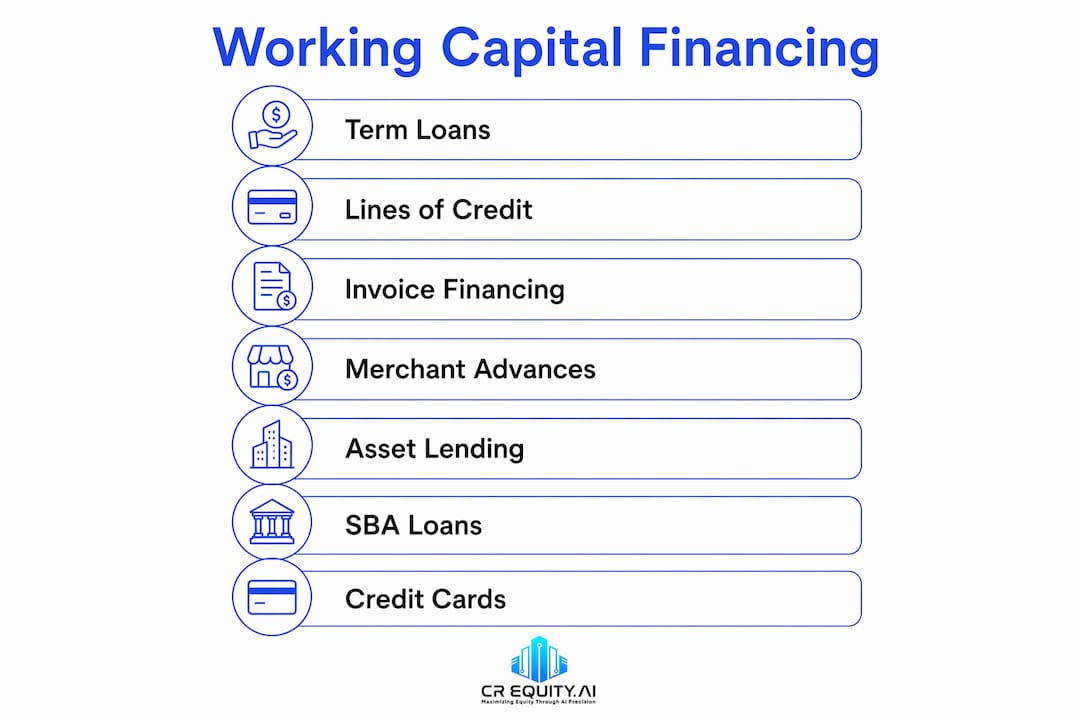
1. Working capital term loans
A term loan delivers a lump sum upfront, which the business repays over a fixed period, typically six to 24 months. Repayment schedules can run monthly, weekly, or even daily depending on the lender and loan structure. Term loans suit businesses that need a defined amount for a specific, time-bound purpose, such as covering operating costs during a construction project or bridging a known seasonal gap.
2. Business lines of credit
A revolving line of credit lets a business borrow up to a preset limit, repay, and borrow again as needed. Interest accrues only on the outstanding balance, not the full credit limit. This structure suits businesses with recurring but unpredictable cash flow needs, since the facility stays available without requiring a new application each time funds are needed.

3. Invoice financing and factoring
Invoice financing uses outstanding receivables as collateral. The lender advances a percentage of the invoice value, and the business repays when the customer pays. Factoring is a variation where the lender actually purchases the invoices and takes on collection responsibility. Both options are particularly effective for B2B companies with long payment cycles, since they convert receivables into immediate liquidity without waiting 30, 60, or 90 days for customer payment.
4. Merchant cash advances
A merchant cash advance (MCA) provides a lump sum in exchange for a percentage of future credit and debit card sales. Repayment is automatic and fluctuates with daily revenue, which can ease pressure during slow periods. MCAs carry higher effective costs than most other structures and are best suited to businesses with consistent card-based sales volume, such as retail or food service operations.
5. Asset-based lending
Asset-based lending (ABL) ties borrowing capacity directly to the value of collateral, typically accounts receivable, inventory, or equipment. As asset values change, so does the available credit line. Lenders require regular reporting and periodic appraisals. ABL works well for asset-rich businesses or those with uneven cash flow, such as manufacturers or seasonal retailers that carry significant inventory.
6. SBA loan programs
The U.S. Small Business Administration guarantees loans through approved lenders, reducing lender risk and expanding access for businesses that might not qualify for conventional credit. SBA 7(a) loans can fund operating capital among other purposes. Eligibility is based on business size, revenue, creditworthiness, and the nature of the business’s operations.
7. Business credit cards
Business credit cards provide revolving access to short-term capital with the added benefit of rewards programs. They are most practical for smaller, recurring expenses rather than large working capital needs. Credit limits are generally lower than dedicated credit lines, and interest rates can be high if balances carry month to month.
How working capital financing operates in practice
The application process for most working capital facilities follows a predictable sequence. A business submits financial documentation, including bank statements, tax returns, and sometimes accounts receivable aging reports. The lender then evaluates two primary dimensions: cash flow strength and asset value.
How lenders set borrowing limits:
- Cash-flow-based lines are sized according to the business’s demonstrated ability to generate recurring revenue and service debt.
- Asset-based lines fluctuate with collateral value. As receivables are collected and inventory turns, the available borrowing base adjusts accordingly.
- Lenders assess both dimensions even for primarily cash-flow-based facilities, since assets often serve as secondary support.
Repayment structures vary significantly by product type:
- Term loans: fixed monthly, weekly, or daily payments over the loan term
- Lines of credit: interest charged only on drawn balances, with principal repaid as cash flow allows
- MCAs: automatic daily or weekly deductions as a percentage of card sales
- Invoice financing: repayment triggered by customer payment of the underlying invoice
Interest on revolving credit lines is typically variable and charged only on what the business actually borrows. J.P. Morgan notes that borrowers may have the option to lock in a rate for 30 to 90 days, which provides cost certainty when a business plans to keep its line drawn rather than paying it down daily.
Operational use cases where working capital financing delivers direct value:
- Covering payroll during a slow quarter while waiting on a large receivable
- Purchasing bulk inventory ahead of a peak season at a supplier discount
- Paying vendors on time to preserve early-payment discount eligibility
- Funding a short-term project before the client’s first milestone payment arrives
The speed of funding varies by product. Some lenders approve and fund within 24 hours. Traditional bank lines of credit take longer but typically carry lower rates. The trade-off between speed and cost is one of the most consequential decisions a business owner faces when choosing a facility.
Benefits of using working capital financing for business operations
1. Operational continuity during revenue gaps
Cash flow timing rarely aligns perfectly with expense schedules. Working capital financing fills that gap without forcing a business to delay payroll, miss rent, or defer vendor payments. The ability to meet obligations on time protects both operations and relationships.
2. Ability to seize growth opportunities
A retailer offered a bulk purchase discount from a supplier needs capital available immediately, not after a two-week underwriting process. An established line of credit makes that kind of opportunistic buying possible. As J.P. Morgan’s Matt Brennan has noted, expanding an existing line is far faster than starting from scratch when an unexpected need arises.
3. Stronger vendor relationships
Vendors extend better terms, larger orders, and priority service to buyers who pay reliably. Maintaining a working capital facility signals financial stability to suppliers, even when the business itself is navigating a slow period. J.P. Morgan describes this dynamic directly: a line of credit provides vendor payment comfort that supports larger future orders.
4. No equity dilution
Working capital financing is debt, not equity. A business owner who draws on a line of credit retains full ownership and control of the company. This matters particularly for businesses that are growing and do not want to give up a stake in exchange for short-term liquidity.
5. Scalable borrowing capacity
A well-structured line of credit can be adjusted as the business grows. Lenders who already understand a business’s financials and industry can increase a facility more quickly than a new lender could underwrite from scratch. This relationship-based scalability is one of the practical advantages of establishing credit before it is urgently needed.
6. Access to early-payment discounts
When vendors offer discounts for paying invoices early, a line of credit lets a business capture those savings while preserving its own cash. In many cases, the discount rate exceeds the cost of borrowing, producing a net financial benefit from using the facility.
How to choose the right working capital financing for your business
The right facility depends on three variables: how the business generates cash, what assets it holds, and how much the financing will actually cost over the repayment period.
Assess your cash flow profile first. Businesses with stable, recurring revenue, such as subscription-based services or long-term contract operations, typically qualify for cash-flow-based lines of credit at competitive rates. Seasonal businesses, manufacturers, and distributors with significant inventory or receivables are often better served by asset-based structures, where borrowing capacity expands precisely when operational needs are highest.
J.P. Morgan’s guidance is direct on this point: match financing structure to your asset profile. A seasonal retailer ramping up inventory before the holiday season benefits from an ABL facility that grows with that inventory, not a fixed cash-flow line that stays static.
Understand total repayment cost, not just the rate. Bankrate’s analysis of working capital loans highlights that total repayment amount is a more meaningful comparison metric than APR alone, particularly when payments are daily or weekly. A facility with a lower stated rate but daily automated deductions can create more cash flow pressure than a higher-rate product with monthly payments.
Review credit requirements carefully. Many working capital loans require personal credit backing from the business owner. According to CNBC Select, missed payments on these facilities can negatively affect personal credit scores, directly linking the owner’s personal financial health to the business’s borrowing behavior. Business owners should review their personal credit profile before applying and understand the guarantee terms in any loan agreement.
Watch for structural warning signs. Consistent reliance on expensive short-term financing often signals an underlying profitability or operational problem rather than a simple timing gap. If a business is repeatedly drawing on high-cost facilities to cover basic expenses, that pattern warrants a review of cost structure and revenue before adding more debt. Responsible loan use, including understanding when borrowing is appropriate versus when it masks deeper issues, is a discipline that protects both business and personal financial health. For more guidance, see this lista de usos responsables de préstamos en México.
Pro Tip: If your cash flow needs are unpredictable, prioritize a revolving line of credit over a term loan. You pay interest only on what you draw, and the facility stays available for future needs without requiring a new application each time.
How AI-driven platforms are changing working capital financing
The working capital financing market is growing. The global working capital loan market is expected to expand at over 10% CAGR from 2024 to 2032, driven in part by technology platforms that reduce friction across the full credit lifecycle.
Traditional underwriting requires manual document review, sequential lender outreach, and days or weeks of back-and-forth before a borrower receives an offer. AI-driven platforms compress that timeline significantly by automating the most time-consuming steps.
CR Equity Ai Inc combines machine learning underwriting, automated document intelligence, and real-time lender matching to deliver faster approvals and more transparent terms across working capital and business financing products. Borrowers submit documentation once and receive multiple offers simultaneously, rather than applying to lenders sequentially. The platform’s risk scoring models evaluate cash flow patterns, asset values, and creditworthiness in real time, producing pre-underwritten opportunities that lenders can act on immediately.
Key capabilities that AI-driven platforms bring to working capital financing:
- Automated document analysis that extracts and verifies financial data without manual review delays
- Real-time lender matching that surfaces the most relevant offers based on the borrower’s specific profile
- AI-enhanced risk scoring that evaluates both cash-flow and asset-based underwriting criteria simultaneously
- KYC/AML compliance automation that reduces friction without sacrificing regulatory accuracy
- Offer optimization that presents borrowers with multiple structures so they can compare total cost, repayment frequency, and term length side by side
The practical result for business owners is faster access to capital with greater transparency about what each offer actually costs. For lenders, it means access to pre-qualified, pre-underwritten borrowers rather than raw applications requiring full manual processing.
Speed has always come with a cost in working capital financing. Higher APRs on fast-funding products reflect the risk and operational overhead lenders absorb to move quickly. AI-driven underwriting reduces that overhead, which creates the conditions for faster approvals without the same rate premium that historically accompanied them.
Key Takeaways
Working capital financing is short-term debt that covers operational expenses during cash flow gaps, and choosing the wrong structure or cost metric can create more financial pressure than it relieves.
| Point | Details |
|---|---|
| Core purpose | Working capital financing covers operational expenses like payroll, rent, and inventory, not long-term investments. |
| Match structure to cash flow | Seasonal businesses benefit from asset-based lines; stable revenue businesses are better served by cash-flow-based credit lines. |
| Total cost over APR | Compare total repayment amounts, not just APR, since daily or weekly payments affect liquidity more than the rate alone suggests. |
| Personal credit at risk | Many working capital loans require personal guarantees; missed payments can damage the owner’s personal credit score. |
| AI accelerates access | AI-driven platforms like CR Equity Ai Inc automate underwriting and lender matching, reducing approval timelines across working capital products. |
Ready to explore your working capital financing options?
CR Equity Ai Inc brings AI-driven underwriting and real-time lender matching to business owners who need working capital financing without the delays of traditional credit processes. Whether you need a revolving line of credit, a term loan, or an asset-based facility, the platform evaluates your profile across multiple lenders simultaneously and delivers transparent, comparable offers.
Use the loan quote calculator to model your financing costs before you apply, or explore the full range of business financing programs available through CR Equity Ai Inc to find the structure that fits your cash flow profile.