
True zero down, meaning 100% loan-to-value, is not something mainstream commercial or fix-and-flip lenders offer investors. Some lenders underwrite high-funding structures directly and provide advance-rate grids so sponsors know the ceiling before they apply. The sections below cover how these structures actually work, who qualifies, what cash still shows up at closing, and the exact questions to bring to any lender.
TL;DR:
- True 100% loan-to-value loans are almost nonexistent outside niche, first-loss structures, but layered capital sources can finance near-zero down deals.
- Most high-funding deals rely on combining senior debt with subordinate financing like mezzanine, seller carry, JV equity, or third-party lenders, each with different control and cost trade-offs.
- Proven sponsors with prior successful projects and strong credit profiles typically qualify for higher financing, but even then, closing costs and reserves usually require $20,000 to $50,000 in cash.
- Excessive reliance on no down payment claims can conceal costs such as interest reserves, contingency funds, and fees rolled into the loan, making upfront transparency essential.
- It’s critical to review the lender’s advance-rate grid and draw mechanics before applying to ensure the deal aligns with the funding limits and reduces application waste.
Table of Contents
- What “Zero Down” Actually Means: 100% LTV vs. 100% LTC
- How Sponsors Get Close to Full Funding: Layered Capital and Special-Case Structures
- Who Qualifies for High-Funding Deals, and What Cash Still Shows Up at Closing
- The Real Risks Behind “No Money Down” Deals
- How to Package a Zero Down Proposal Lenders Will Actually Fund
- How CR Equity Ai Inc Underwrites High-Funding Deals
- Ready to Structure a High-Funding Deal? Start Here
- Sources
- FAQ
What “Zero Down” Actually Means: 100% LTV vs. 100% LTC
Loan-to-value (LTV) measures the loan against the property’s appraised value. Loan-to-cost (LTC) measures the loan against total project cost, meaning the purchase price plus rehab or construction budget. The two ratios sound similar but answer different questions, and confusing them is where most “no money down” pitches fall apart.
Lenders avoid true 100% LTV because it removes the sponsor’s financial stake entirely, leaving the lender as the only party exposed if the deal underperforms. Underwriters lean on debt yield, debt service coverage ratio (DSCR), and hard LTV caps precisely to keep skin in the game on the borrower’s side. That’s why true 100% LTV commercial loans are virtually nonexistent outside of niche, first-loss-covered structures.
A lender can fund the entire purchase and rehab budget, but the total loan still has to clear the LTV cap measured against after-repair value (ARV). If the numbers don’t clear that ceiling, the “zero down” structure collapses back into a partial-funding deal.
How Sponsors Get Close to Full Funding: Layered Capital and Special-Case Structures
The realistic path to near-zero down financing runs through stacking capital sources rather than finding one lender willing to cover everything. Layered capital stacks combine a senior loan with one or more subordinate pieces that fill the equity gap.
Common combinations include:
- Senior debt plus mezzanine or preferred equity — the mezz or pref layer sits behind the senior lender and absorbs early losses, at a materially higher cost of capital.
- Seller carry — the seller finances a slice of the purchase price, reducing the cash the buyer needs to bring.
- Joint venture equity — a capital partner contributes cash in exchange for a share of profit, replacing the sponsor’s own down payment.
- Third-party mezzanine lenders — specialty firms fund the gap between senior debt and total cost, usually for a fixed return plus fees.
Each layer trades control or margin for funding. A JV partner wants profit participation. A mezz lender wants covenants and often a personal guarantee. Seller carry works only when the seller has flexibility and confidence in the buyer’s exit.
A handful of narrow loan types can also push advance rates higher than standard underwriting allows. Credit-tenant lease financing works when a single, investment-grade tenant’s rent stream effectively guarantees debt service. Leasehold financing and C-PACE programs (Commercial Property Assessed Clean Energy, which funds specific energy or resiliency upgrades through a property tax assessment) can stretch proceeds for the qualifying scope, but only that scope.
Bridge loans and construction loans behave differently from fix-and-flip products on this point. Fix-and-flip financing commonly funds against LTC on a rehab budget with a single draw schedule. Bridge and construction loans, on the other hand, typically release funds through milestone-based draws tied to completed work, which limits how much capital a sponsor can access before a lender confirms progress on the ground.

Who Qualifies for High-Funding Deals, and What Cash Still Shows Up at Closing
Lenders reserve their highest advance rates for sponsors who have already proven they can execute. A track record of completed flips or stabilized projects, strong personal credit, verifiable liquidity, and a credible general contractor or cost estimator all factor into how far a lender will stretch.
- Experience threshold. Repeat sponsors with multiple completed exits typically access higher LTC than first-time investors, who face more conservative caps regardless of deal quality. First-time investor programs exist, but the advance rate reflects the added risk.
- Credit and liquidity. Most private lenders want evidence of reserves beyond the deal itself, since a sponsor with no liquidity cushion is a weak first-loss buffer even when the loan structure looks fully funded on paper.
- Underwriting caps. Fix-and-flip and bridge lenders commonly cap loans around 70% to 75% of ARV, with points in the low-to-mid single digits for stronger sponsors and higher for first-timers or thin files.
Even on a 100% LTC deal, cash at closing rarely hits zero. Closing costs, origination points, interest reserves, insurance, and a rehab contingency typically land somewhere between $20,000 and $50,000 on a mid-size fix-and-flip, according to industry figures from Axiant’s breakdown of no-down-payment claims. Some of that gets rolled into the loan; some doesn’t, depending on the lender’s structure.
Pro Tip: Ask upfront whether interest reserves and contingency funds are held back from loan proceeds or expected as cash at closing. That single distinction changes how much money you actually need on hand.
The Real Risks Behind “No Money Down” Deals
A capital stack that reaches full funding also concentrates risk in specific places. A failed exit, meaning the sponsor can’t sell or refinance on schedule, hits harder when the sponsor has little cash invested and less incentive to work through a slow market. Cost overruns on rehab or construction eat into the margin faster when there’s no equity cushion absorbing the overage. Vacancy or slow lease-up on a stabilized asset can strain DSCR the same way. And when sponsor equity is minimal, moral hazard becomes a real underwriting concern: the sponsor has less to lose if the deal goes sideways.
Lenders build in safeguards to offset that exposure:
- Higher rates and points to price in the added risk of low or no sponsor equity.
- Interest reserves held back from proceeds rather than paid from the sponsor’s pocket.
- Recourse covenants and personal guarantees tied to the loan.
- Staged draws instead of a single lump-sum disbursement.
- Third-party appraisals, cost reviews, and DSCR or debt-yield testing before and during the loan term.
Before signing anything, ask the lender directly: What does your published advance-rate grid show for this asset type? Where do interest reserves and contingency funds come from? Who takes the first loss if the exit underperforms? What exit assumptions did you stress test against? And which fees get rolled into the loan versus collected at closing? Marketing claims of “no down payment” often hide costs in exactly these categories, so vague answers are a red flag worth pressing on.
How to Package a Zero Down Proposal Lenders Will Actually Fund
- Build the valuation and scope package first. Pull comparable sales or an appraisal supporting your ARV, get a detailed rehab or construction scope with contractor bids attached, and build a conservative pro forma. Lenders back conservative ARV scenarios, not optimistic ones, when evaluating high-LTC requests.
- Design the capital stack before you apply. Decide whether the gap gets filled with mezzanine debt, preferred equity, seller carry, or a JV partner, and price each layer into your return projections so you know the deal still works after those costs.
- Negotiate structure, not just rate. Ask for the lender’s advance-rate grid in writing. Clarify which reserves are held back from proceeds versus required in cash. Weigh points against rate depending on your hold period, since a higher-point, lower-rate structure often costs less on a short bridge loan.
- Understand the draw and closing mechanics. Confirm what counts as funded proceeds at closing versus released through inspection-based draws during construction or rehab, and build your contractor payment schedule around that timeline.
Pro Tip: Request the advance-rate grid before you submit the deal, not after. It tells you the real funding ceiling before you’ve spent time and fees on an application that won’t clear underwriting.
Resources like CR Equity Ai Inc’s guide to preparing a funding-ready deal walk through exactly what a lender-ready package should contain before submission.
How CR Equity Ai Inc Underwrites High-Funding Deals
Certain lenders underwrite the asset and the deal itself, not just a borrower’s tax returns, following the principle that lenders fund what a deal can support, not what a marketing page promises. Some lenders also lend their own capital and publish advance-rate grids before applications, providing transparency borrowers should seek from any lender.
Brokers and sponsors can submit a deal directly for review against these programs.
— Robert
Ready to Structure a High-Funding Deal? Start Here
A direct-lender alternative can offer access to advance-rate grids upfront, decisions within hours, and capital from their own balance sheet, avoiding reliance on third-party marketplaces.
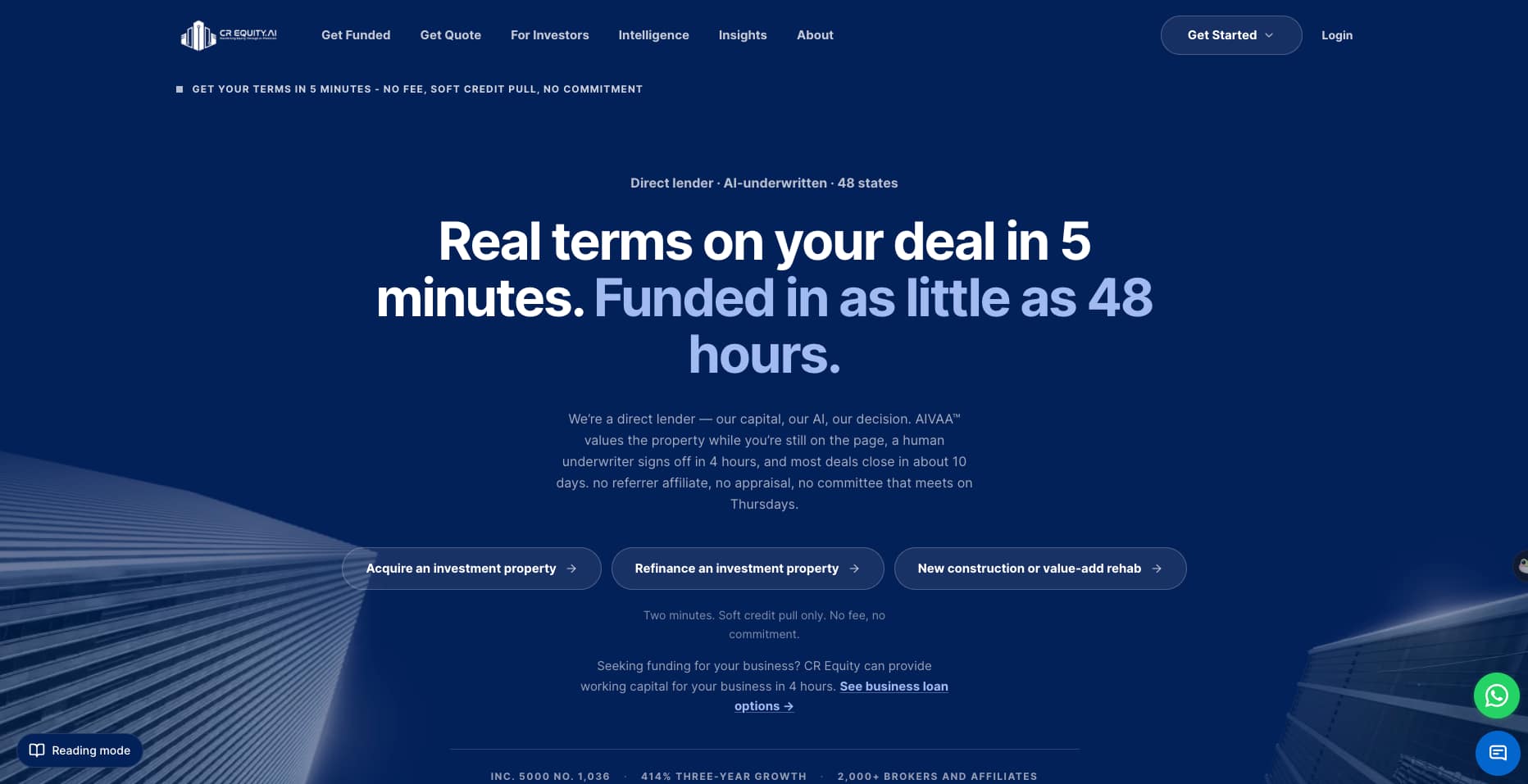
If your deal is a rehab play, review the fix-and-flip loan program, which supports funding up to 100% LTV for qualified sponsors. Need short-term capital to close fast on an acquisition or reposition? The commercial bridge loan program covers that, with origination fees starting near the published rate and terms disclosed before you apply. Ground-up builds run through the construction loan program, funded with milestone draws on CR Equity Ai Inc’s own capital. Sponsors who need cash in 24 to 48 hours should look at F.L.E.X. 50™, and small-balance commercial deals between $100,000 and $100 million fit the small-balance commercial program.
Brokers and sponsors ready to move should submit the deal directly and request the program’s advance-rate grid before spending time on a package that won’t clear underwriting.
Sources
- Are 100% LTV Commercial Real Estate Loans Possible?
- Fix-and-Flip Loan With No Down Payment – The Truth | Axiant
FAQ
Is Zero Down Financing Really Possible for Investors?
What’s achievable is 100% LTC financing on the purchase-plus-rehab budget, provided the total loan still clears the lender’s ARV-based LTV cap.
What’s the Difference Between 100% LTV and 100% LTC?
LTV measures the loan against the property’s appraised value, while LTC measures it against total project cost, meaning purchase price plus rehab or construction.
How Much Cash Do I Still Need at Closing on a Near-Zero Down Deal?
Even on a fully funded LTC structure, closing costs, points, interest reserves, and contingency funds typically require $20,000 to $50,000 on a mid-size fix-and-flip. Whether those items get rolled into the loan or paid in cash depends entirely on the lender’s structure.
Does CR Equity Ai Inc Offer Zero Down or High-LTV Financing?
Current pricing and program terms are listed directly on the CR Equity Ai Inc program pages.
What Documentation Do Lenders Need for a High-Funding Request?
Lenders underwriting a high-LTC deal typically require contractor bids, a detailed rehab or construction scope, conservative ARV support, and a clear exit plan. Packages that stress test the exit against a slower sale or refinance timeline tend to underwrite more smoothly than optimistic pro formas.