

Yes, private lenders that underwrite the asset and the deal can approve and fund certain investor loans in roughly 72 hours when the borrower is lender-ready. We see this at CR Equity AI, where a 19-day DSCR refinance closed on a $925,000 Washington, DC multifamily property shows how far a prepared file can compress a timeline. Not every deal qualifies: appraisal needs, title defects, and unclear exit plans will slow things down. Below is the lender-side timeline and borrower checklist that make 72 hours realistic.
TL;DR:
- Private lenders can close investor loans within 72 hours if the borrower submits a complete package with all required documents upfront.
- Essential preparations include a clear exit plan, entity documents, a preliminary title report, and contractor bids when applicable.
- Speed depends on parallel processing of steps like valuation, underwriting, and document signing, not skipping regulatory or due diligence standards.
- Deals with title issues, environmental concerns, or complex construction risks generally require a longer, more thorough underwriting process.
- When the deal is straightforward, and documentation is fully prepared, market liquidity and operational readiness make rapid closing feasible.
Table of Contents
- What makes a 72-hour private loan close possible
- The lender timeline: from submission to funded wire
- The borrower checklist for a 72-hour close
- Where regulation and risk controls still apply
- When a fast close makes sense, and when it does not
- Getting funded fast with CR Equity AI
- FAQ
- Sources
What makes a 72-hour private loan close possible
Traditional mortgage underwriting reviews the borrower’s income, tax returns, and employment history, a process that can take weeks. Asset-and-deal underwriting looks instead at the property’s value, the deal’s cash flow, and the borrower’s exit plan. That shift removes the slowest parts of consumer underwriting and replaces them with a soft credit pull, a process that checks credit history without the hard inquiry that can delay a file or affect a borrower’s score.
Several operational pieces have to be in place for a lender to move this fast:
- Delegated authority: underwriters who can approve a file without routing it through multiple committees.
- Published advance-rate grids: terms set in advance, so pricing and loan-to-value limits are not negotiated deal by deal.
- Electronic document handling: signed packages that move instantly instead of by mail or fax.
- Title pre-clear: a title company engaged on day one, not after underwriting finishes.
Market liquidity supports this model. Total commercial real estate borrowing and lending increased 40% in 2025, with dedicated mortgage bankers closing $606 billion in CRE loans. That expansion means more investor-driven capital is active in the market, which supports the kind of expedited private lending described here when the underlying deal qualifies.
None of this removes regulatory guardrails. Documentation standards and collateral valuation rules still apply, even on an accelerated timeline.
The lender timeline: from submission to funded wire
A fast-close lender does not work faster by skipping steps. It runs steps in parallel instead of in sequence. A typical 72-hour file moves like this:
- Day 0, submission and initial underwrite: the borrower submits the deal package; the lender runs a soft credit pull and confirms the asset and exit plan fit the program.
- Day 0 to 1, valuation decision: the lender decides whether existing comps, rent rolls, or a broker price opinion are sufficient, or whether a formal appraisal must be ordered. Title work opens the same day.
- Day 1 to 2, final underwriting and conditions: the underwriter clears remaining conditions, insurance binders are confirmed, and the title company reports on liens and ownership.
- Day 2 to 3, documents and funding: closing documents are signed, wiring instructions are verified, and funds are released.
Several triggers reliably break this timeline: a title defect that requires curing, a property that needs a full appraisal rather than desktop valuation, missing insurance coverage, or a contractor who has not confirmed a draw schedule on a construction deal. Escrow and title coordination set up early, with wiring instructions tested before the final day, are what let the last mile move in hours rather than days. Lenders that close fast on investor loans typically parallelize title opening, underwriting, and wire preparation rather than waiting for one to finish before starting the next, a sequencing pattern detailed in our Fast Closing Playbook for Investor Loans.
Pro Tip: Confirm your wiring instructions with your bank and the title company before the day you expect to close, not on the day itself.
The borrower checklist for a 72-hour close
The single biggest variable in a fast close is not the lender. It is whether the borrower’s file is complete before submission. A deal with every document ready on day one moves through underwriting without the back-and-forth that eats days off the timeline.
Have these documents ready before you submit:
- Preliminary title report and a signed purchase contract.
- Entity formation documents (LLC operating agreement, articles of organization) and government-issued ID.
- Insurance binder naming the lender, plus a rent roll or lease agreements for occupied property.
- Contractor bids and a line-item rehab budget for value-add or construction deals.
- Bank statements, when the program requires them, and signed consent for a soft credit pull.
Before submitting, confirm these decisions internally so underwriting does not stall waiting on you:
- Draw schedule: how rehab or construction funds release against completed milestones.
- Exit plan: sale, refinance, or long-term hold, stated clearly and consistently across your documents.
- Target advance rate: what loan-to-value you expect, checked against the published grid for your program.
- Reserve funding: how interest reserves or contingency funds are sourced and documented.
Coordination outside your own paperwork matters just as much. Pick a title company early and open escrow the same day you submit your application. Ask the title company to flag liens or ownership gaps immediately rather than at the end of their review. If a property inspection is required, schedule it in the first 24 hours, not after underwriting asks for it. A practical due-diligence checklist, such as the one published by Trinity Inspections LLC, is a useful reference for sellers and investors who want to catch structural, mechanical, or environmental issues before they surface mid-underwriting.
Pro Tip: Undisclosed liens, missing permits, and pending HOA approvals are the most common reasons a fast-close timeline slips. Ask your title company and your seller about all three before you submit.
For fix-and-flip specific document requirements, our fix and flip loan requirements checklist breaks down the rehab budget and contractor documentation lenders expect.
Where regulation and risk controls still apply
Speed does not suspend the rules that govern how lenders value collateral and document loans. The OCC’s Commercial Real Estate Lending handbook sets expectations for documentation standards, collateral valuation practices, and loan closing controls that apply to CRE loans regardless of how quickly they close.
Appraisal exceptions are narrow, not a shortcut available on demand. The OCC’s guidance on appraisal exceptions states that when a lender does not obtain an appraisal, it must have another supportable basis for the credit decision, such as borrower income or clearly marketable collateral. A rent roll or recent comparable sale may satisfy that standard on a straightforward refinance. A complex construction deal or an unusual property type will likely still require a formal appraisal.
Loan administration controls protect lenders on short-tenor deals too:
- Escrow controls that release funds only against verified title clearance.
- Draw controls tied to completed, inspected construction milestones.
- Takeout or exit verification before funding, confirming the borrower’s stated plan is credible.
When an appraisal is not obtained, the lender must demonstrate a reasonable and supportable basis for the credit decision independent of a property sale or refinance.
Fees and advance rates also shift to reflect speed and risk. A lender compressing a 30-day process into three days is taking on more execution risk, and pricing often reflects that.
When a fast close makes sense, and when it does not
A 72-hour close is the right tool when the acquisition is time-sensitive, the asset is straightforward, the exit plan is clear, and the borrower’s paperwork is genuinely ready on submission day. A DSCR refinance on a stabilized rental property is a good candidate. A construction deal with unresolved permitting is not.
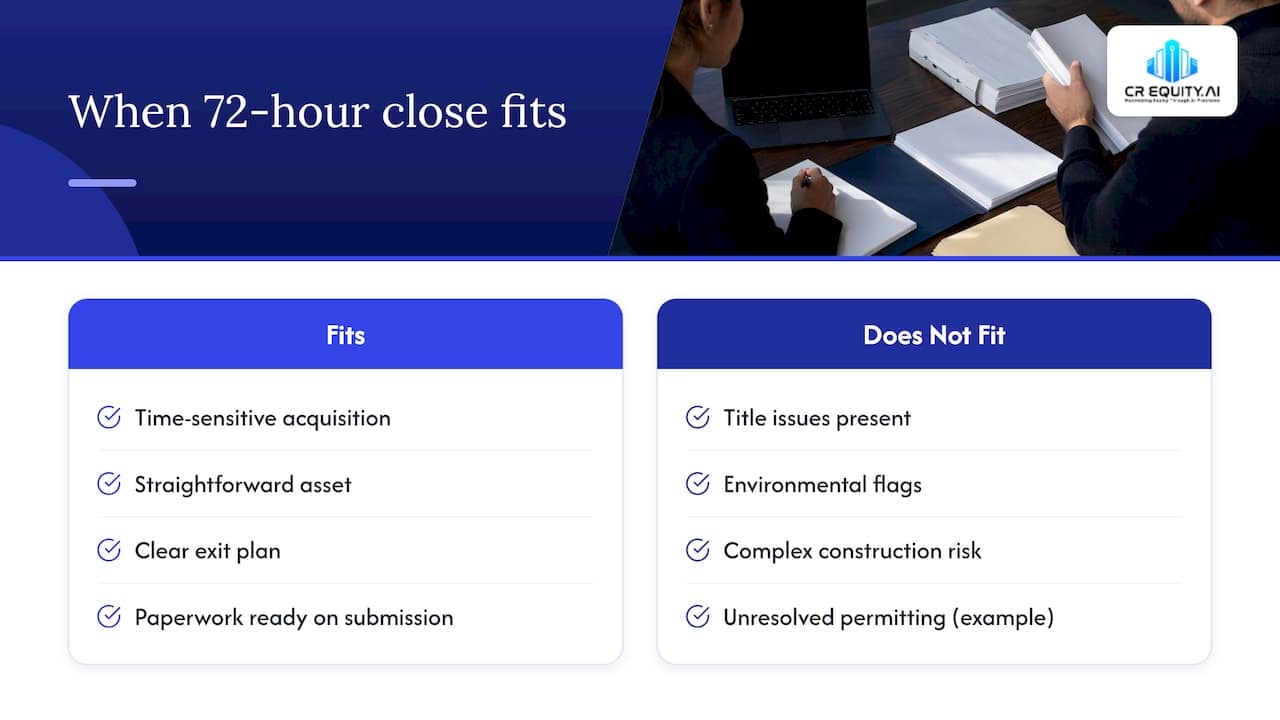
There are documented cases where a 19-day DSCR refinance and a separate multifamily refinance in Washington, DC closed on an accelerated timeline. Both cases shared the same pattern: clean title, a documented rent roll, and a borrower who had every form signed before the lender asked for it.
When title issues, environmental flags, or complex construction risk are present, a slower, more deliberate underwriting path protects both sides better than forcing a deadline that the deal cannot support.
— Robert Stewart Jr
Getting funded fast with CR Equity AI
We underwrite the asset and the deal, not just your paperwork, allowing us to move quickly on investor loans that are genuinely ready to close. We lend our own capital and publish advance-rate grids before you apply, so you know your likely terms before you submit anything.
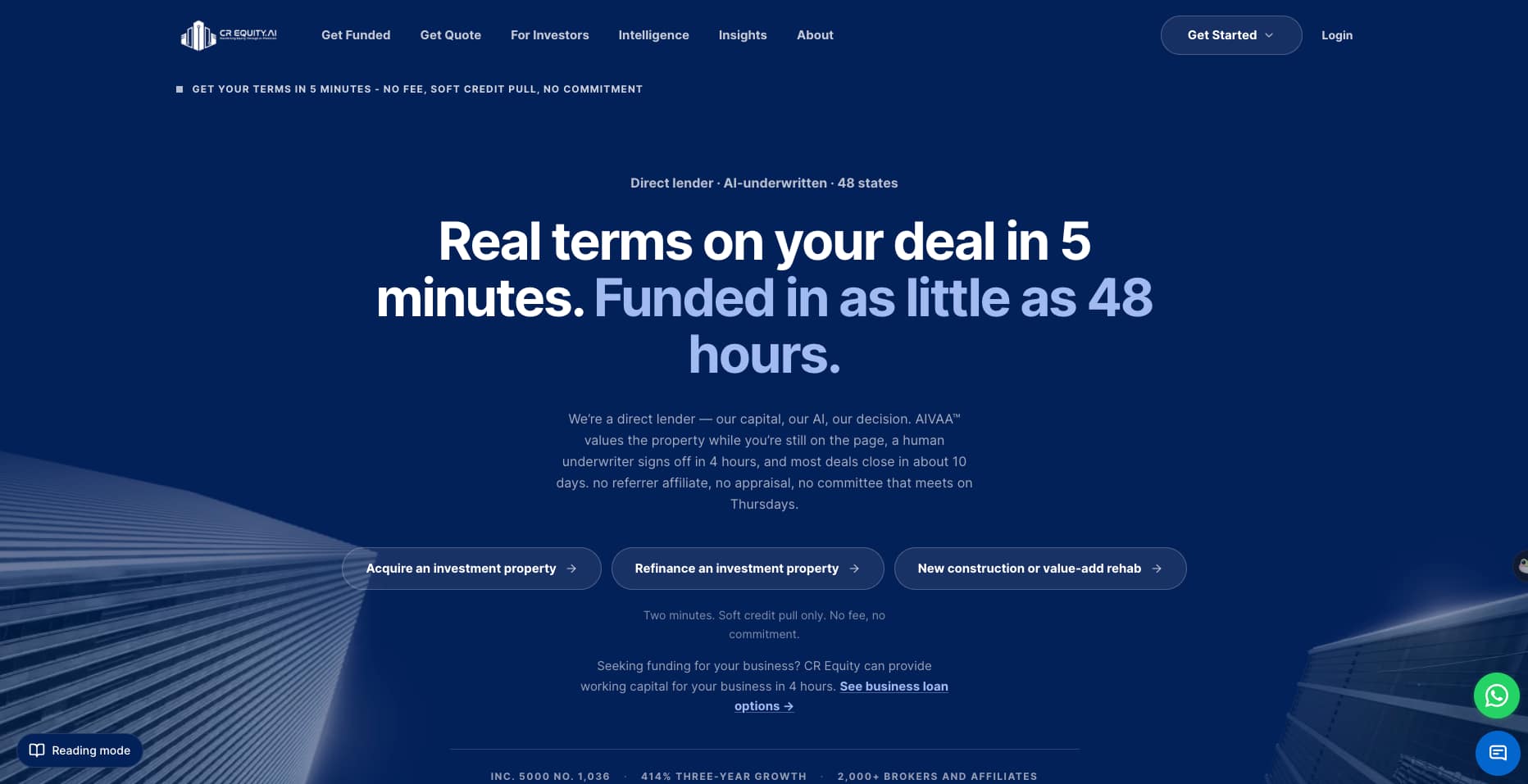
Our programs cover most investor scenarios: F.L.E.X. 50™ for emergency bridge financing funded in 24 to 48 hours, DSCR Cash-Out Refinance qualified on rent rather than tax returns, Fix and Flip Loans, Commercial Bridge Loans, and Ground-Up Construction Loans with milestone draws on our own capital.
Before you submit, have your title report, purchase contract, entity documents, and exit plan ready. If you want the procedural detail first, our Fast Closing Playbook for Investor Loans walks through the same sequencing described above. When your file is ready, submit your deal and our underwriting team takes it from there.
FAQ
What does “clear to close in 72 hours” mean for private lending?
It means the lender has approved the loan and funds are ready to disburse within roughly three days of a complete submission. It applies to asset-and-deal underwriting models, not to the consumer mortgage process, and it depends on the borrower supplying a complete document package upfront.
What documents do I need for fast mortgage approval on an investor loan?
You typically need a preliminary title report, a signed purchase contract, entity formation documents, an insurance binder, and consent for a soft credit pull. Construction and value-add deals also require contractor bids and a line-item rehab budget.
Why do some fast-close loans still require a full appraisal?
Appraisal exceptions are narrow and fact-specific under OCC guidance: a lender must have another supportable basis for the credit decision, such as a rent roll or clearly marketable collateral, to skip a formal appraisal. Complex properties or unclear exit plans generally still need one.
What is the difference between a 72-hour private loan close and a traditional mortgage closing?
A traditional mortgage closing underwrites the borrower’s income and credit history and often takes several weeks. A 72-hour private close underwrites the asset’s value and the deal’s cash flow using a soft credit pull, which removes the slowest steps when the borrower’s file is complete.
Sources
- Commercial real estate lending (Comptroller’s Handbook) — OCC
- MBA annual report: total commercial real estate borrowing and lending increased 40% in 2025