

TL;DR:
- Most waterfall errors stem from mismatched compounding assumptions, misapplied side-letter terms, and spreadsheet control failures. Verifying the correct compounding method, reflecting side-letter terms, and conducting zero-sum reconciliations prevent common mistakes. Embedding rigorous controls and documentation ensures accurate distributions and reduces investor disputes.
Most material waterfall errors trace back to three root causes: mismatched time-value assumptions (compounding frequency vs. IRR hurdle definitions), misapplied LP-specific side-letter terms, and spreadsheet or version-control failures that let stale logic persist through multiple distribution cycles. Catch-up mechanics, double-counted contributions, and reallocation errors round out the list of common waterfall calculation mistakes that fund operators encounter before issuing a distribution notice.
Run these three triage checks before anything else:
- Confirm the LPA hurdle definition and compounding basis. Verify whether the preferred return accrues on a simple, compound-annual, or compound-monthly basis. The LPA clause and the model formula must match exactly.
- Validate which LPs hold side letters. Pull the side-letter registry and confirm that any modified preferred return rates, fee waivers, or priority provisions are reflected in the current model version.
- Run a zero-sum reconciliation. Total distributable proceeds must equal the sum of all LP and GP allocations. Any gap signals double-counting or a reallocation error.
The U.S. private equity market operates at a scale where even a fraction-of-a-percent error in a waterfall model can translate into six- or seven-figure misallocations. The ILPA Capital Call and Distribution Template now requires GPs to provide enough reconstruction detail that institutional LPs can independently verify every distribution tier. Fund operators who cannot supply that detail face LP disputes before the next capital call closes.
Table of Contents
- What are the most common waterfall calculation mistakes?
- How do you prevent waterfall errors before each distribution?
- When does automating waterfall calculations reduce your risk?
- Pre-distribution audit checklist and five test cases
- Key Takeaways
- Why ops teams keep repeating the same waterfall mistakes
- Authoritative references and further reading
- FAQ
What are the most common waterfall calculation mistakes?
The following ten mistakes appear repeatedly across fund accounting teams. Each entry names the error, explains why it persists in real models, and provides a specific corrective action.
1. Mismatched compounding frequency on the preferred return
What it is: The LPA specifies compound-annual accrual, but the model approximates monthly compounding by dividing the annual rate by 12.
Why it happens: Analysts default to simple division because it is faster to build. Over a two- or three-year hold, the difference is small enough to pass a casual review.
The correct conversion: Monthly rate = (1 + annual_rate)^(1/12) − 1. For an 8% annual preferred return, the correct monthly rate is approximately 0.6434%, not 0.6667%. Over a multi-year hold on a multi-million-dollar contribution, the simple approximation overstates accrued preferred return by several thousand dollars per tranche, which compounds further when carry is calculated on the shortfall.
Fix: Replace the division formula with the geometric conversion in every cell that calculates a periodic preferred return accrual. Document the formula in a named input table labeled “Compounding Policy.”
Test to run: Input a $1,000,000 contribution, an 8% annual preferred return, and a 36-month hold. The correct accrued preferred return using geometric monthly compounding is $269,734. If the model returns $270,000 (simple division), the formula is wrong.
Pro Tip: Never hard-code the compounding frequency. Store it as a named, versioned input (e.g., “Compounding_Basis = Monthly_Geometric”) so any future LPA amendment triggers a documented model change, not a silent formula edit.
Incorrect compounding conversions and misreading catch-up language materially change hurdle outcomes; geometric conversion is the only defensible method when the LPA specifies compound accrual.

2. Catch-up mechanics misapplied
What it is: The GP catch-up is calculated as a percentage of the preferred return amount rather than as a percentage of grossed-up total distributions.
Why it happens: The shortcut feels intuitive. If LPs received an 8% preferred return, many analysts apply the catch-up as 20% of that preferred return amount. Most LPAs define the catch-up differently.
Fix: Read the catch-up clause precisely. If the LPA states the GP receives distributions until the GP has received 20% of all distributions made to date (LP preferred return plus GP catch-up combined), the correct calculation grosses up the base. The formula is: GP catch-up = (LP preferred return amount) / (1 − GP carry percentage). For a 20% carry, GP catch-up = LP preferred return / 0.80.
Test to run: With $1,000,000 in LP preferred return and a 20% carry, the GP catch-up should be $250,000, not $200,000. A model returning $200,000 is applying the shortcut.
3. LP-specific side-letter terms not reflected in the model
What it is: One or more LPs hold side letters granting modified preferred return rates, reduced management fees, or priority distribution rights. The waterfall model applies uniform terms to all LPs.
Why it happens: Side letters are negotiated separately from the LPA and often stored in a different system. When the model is built or updated, the ops team references the LPA but not the side-letter registry.
Fix: Maintain a side-letter registry as a versioned input table linked directly to the LP-level allocation rows in the model. Each LP row should reference a “Terms Override” flag that pulls from the registry. Audit the registry against the executed side-letter documents before every distribution cycle.
Test to run: For any LP with a side letter, manually calculate their preferred return using the side-letter rate and compare it to the model output. A mismatch of any amount is a failure.
4. Double-counted contributions and improper contribution timing
What it is: A capital contribution is recorded twice in the contribution ledger, or a contribution is timestamped on the wrong date, causing the preferred return to accrue from an incorrect start date.
Why it happens: Manual entry errors in fund accounting systems, or capital calls funded in tranches where the final tranche date is used for the entire call amount.
Fix: Reconcile the contribution ledger against bank wire confirmations for every capital call. Use the actual settlement date, not the call date, as the accrual start date unless the LPA specifies otherwise. Flag any contribution that appears more than once in the ledger.
Test to run: Sum all LP contributions in the model and compare to the total capital called per the fund’s capital account statements. Any difference greater than rounding tolerance ($1 or less) requires investigation.
5. Reallocation and pro rata errors, including double reallocation
What it is: Distributable proceeds are reallocated among LPs (e.g., after a defaulting LP’s interest is redistributed), and the reallocation is applied twice: once at the LP level and once at the fund level.
Why it happens: Reallocation logic is often added as a patch to an existing model rather than built into the allocation architecture. The patch and the original formula both run.
Fix: Trace every reallocation through the model’s calculation sequence. The total allocated to all LPs after reallocation must equal the total before reallocation. A zero-sum check at each tier catches double reallocation immediately.
6. IRR hurdle vs. preferred return confusion
What it is: The model uses an IRR hurdle (e.g., 8% IRR) but calculates distributions using a preferred return accrual method, or vice versa. These are structurally different mechanisms and produce different outcomes.
Why it happens: Fund documents sometimes use “preferred return” and “hurdle rate” interchangeably, but they are not the same. A preferred return accrues on contributed capital from the date of contribution. An IRR hurdle is satisfied when the LP’s internal rate of return on all cash flows reaches the stated percentage.
Fix: Identify which mechanism the LPA specifies. If IRR-based, use XIRR in Excel or an equivalent time-weighted function applied to the LP’s actual cash flow dates. Never substitute a preferred return accrual for an IRR test without explicit LPA authority.
Test to run: Run XIRR on a sample LP’s cash flows (contributions as negatives, distributions as positives) and confirm the result matches the hurdle threshold before carry is allocated.
7. Multiple-distribution sequencing errors
What it is: When a fund makes multiple partial distributions over its life, each distribution must reduce the outstanding preferred return balance before carry is allocated. Models that recalculate preferred return from scratch at each distribution, rather than rolling forward the accrued balance, overstate the preferred return owed at later distributions.
Why it happens: The model was built for a single-exit scenario and adapted for multiple distributions without restructuring the preferred return rollforward.
Fix: Build a running preferred return ledger that tracks: opening balance, accrual for the period, distributions applied to preferred return, and closing balance. Each distribution cycle starts from the closing balance of the prior cycle.
8. Ownership changes and dilution not reflected in allocation keys
What it is: A post-close capital call, LP transfer, or secondary transaction changes LP ownership percentages, but the model continues to allocate proceeds using the original pro rata percentages.
Why it happens: Ownership tables are updated in the fund’s investor relations system but not synchronized with the waterfall model.
Fix: Store the LP ownership percentage as a versioned, date-stamped input table. The model should reference the ownership percentage as of the distribution date, not the fund’s inception date. Any ownership change triggers a model version update with a documented effective date.
9. GP carry and allocation misapplication
What it is: Carried interest is calculated on gross proceeds rather than net proceeds (after expenses, fees, or reserves), or the carry percentage is applied before the preferred return is fully satisfied.
Fix: Confirm the carry base (gross vs. net) from the LPA. Carry should only be allocated after the LP preferred return and, if applicable, the GP catch-up are fully satisfied in the correct sequence. A sequencing test (described in Section 6) catches this error.
10. Spreadsheet version control and audit trail failures
What it is: Multiple versions of the waterfall model exist with no clear record of which version was used for a given distribution, or formula changes are made without documentation.
Why it happens: Spreadsheet models are copied, renamed, and edited by multiple team members without a formal change-control process.
Fix: Implement a version-naming convention (e.g., “WaterfallModel_FundIII_v2.4_2026-03-15”) and store each distribution’s model version in a locked archive folder. Log every formula change in a change-control tab with the date, editor, and reason for the change.
How do you prevent waterfall errors before each distribution?
Prevention requires embedding controls into the distribution cycle, not reviewing outputs after the fact. The following controls address the root causes identified above.
Core controls to implement
- LPA clause register: Map every waterfall-relevant LPA clause to a specific model input or formula. Store the mapping as a document that updates whenever the LPA is amended. Cross-reference the due diligence checklist against LPA provisions before each distribution cycle.
Pro Tip: Store all model assumptions, including compounding basis, carry percentage, preferred return rate, and LP ownership percentages, as named input tables in a separate tab. Label each table with a version date. When an LPA amendment changes a term, update the input table and create a new model version. This makes the change auditable and prevents silent formula edits.
Reviewer sign-off checklist
Before each distribution notice is issued, the following sign-offs are required:
- Fund accountant: confirms contribution ledger reconciliation and preferred return calculation.
- Fund controller or CFO: confirms model version, compounding policy, and side-letter registry are current.
- Legal counsel (or fund counsel): confirms LPA clause mapping is current and any amendments are reflected.
- Fund administrator (if applicable): confirms distribution amounts match the fund accounting system.
Automation enforces consistent compounding, handles side-letter logic, and prevents many spreadsheet-driven errors when configured correctly — but the controls above remain necessary regardless of whether the model is manual or automated.
When does automating waterfall calculations reduce your risk?
Manual waterfall models become a recurring remediation cost when fund complexity exceeds what a single spreadsheet owner can reliably maintain. The threshold is typically reached when any of the following conditions apply:
- More than 15 LPs, with two or more holding side letters that modify waterfall terms.
- More than two share classes or distribution tiers with different preferred return rates or carry percentages.
- Distributions occurring more than twice per year, each requiring a full preferred return rollforward.
- A lifecycle transition (investment period to harvest period) that changes the applicable waterfall structure.
Pre-distribution audit checklist and five test cases
Pre-distribution audit checklist (copy into your review workbook)
- [ ] LPA clause register reviewed and confirmed current as of distribution date.
- [ ] Side-letter registry reviewed; all LP-level overrides confirmed in model.
- [ ] Compounding policy document version matches model formula.
- [ ] Contribution ledger reconciled to capital account statements; zero variance.
- [ ] Preferred return accrual recalculated from scratch; matches model running balance.
- [ ] Catch-up base confirmed as grossed-up per LPA (not simple percentage of preferred return).
- [ ] LP ownership percentages confirmed as of distribution date; any post-close changes reflected.
- [ ] Zero-sum check passed: total proceeds = sum of all LP + GP allocations.
- [ ] Distribution sequencing confirmed: preferred return fully satisfied before carry allocated.
- [ ] Clawback projection reviewed; no carry cap breach flagged.
- [ ] Model version locked and archived; version ID recorded in distribution packet.
- [ ] All four reviewer sign-offs obtained and documented.
Five test cases with expected results
| Test Case | Inputs | Expected Output | Fail Condition | Remediation |
|---|---|---|---|---|
| Single-exit, single LP | $1M contribution, 8% annual compound preferred return, 36-month hold, 20% carry, 100% catch-up | LP preferred return: $269,734; GP catch-up: —; remaining split — | Model returns $270,000 preferred return (simple division error) | Replace division formula with geometric conversion; rerun |
| Multiple partial distributions | $5M fund, two distributions over the fund life, 8% compound preferred return | Preferred return balance after distribution 1 must roll forward to distribution 2; carry only after preferred return fully satisfied at distribution 2 | Carry allocated at distribution 1 before preferred return satisfied | Rebuild preferred return ledger with opening/closing balance per cycle |
| Post-close capital call + reallocation | New LP contributes —; ownership table updated | New LP’s preferred return accrues from month 6 only; prior LP allocations unaffected | New LP’s preferred return calculated from fund inception | Date-stamp contribution; update ownership table with effective date |
| Catch-up edge case | LP preferred return = $200,000; 20% carry; 100% catch-up to GP | GP catch-up = $250,000 (not $200,000) | Model returns $200,000 (shortcut error) | Apply grossed-up formula: $200,000 / 0.80 = $250,000 total; GP receives — |
| Clawback simulation | GP received — carry over fund life; final return produces LP IRR below hurdle | GP must return carry to restore LP to hurdle; clawback amount calculated per LPA | Model shows no clawback obligation despite LP IRR shortfall | Add clawback projection tab; recalculate carry returned at each exit scenario |
Key Takeaways
Waterfall calculation errors are preventable when fund operators embed controls at the model-design stage rather than reviewing outputs after distribution notices are issued.
| Point | Details |
|---|---|
| Geometric compounding is mandatory | Use (1 + annual_rate)^(1/12) − 1 for monthly accrual; simple division produces a measurable error over multi-year holds. |
| Side-letter registry must link to the model | Every LP-level term override must be stored in a versioned registry and referenced directly by the allocation rows in the model. |
| Catch-up base must be grossed up | GP catch-up = LP preferred return / (1 − carry percentage); applying the carry percentage directly to preferred return alone is incorrect in most LPAs. |
| Zero-sum reconciliation catches most errors | Total distributable proceeds must equal the sum of all LP and GP allocations at every distribution tier; any gap signals a reallocation or double-counting error. |
| Version control is a governance requirement | Every distribution must be processed from a locked, archived model version with a documented change log; no silent formula edits. |
Why ops teams keep repeating the same waterfall mistakes
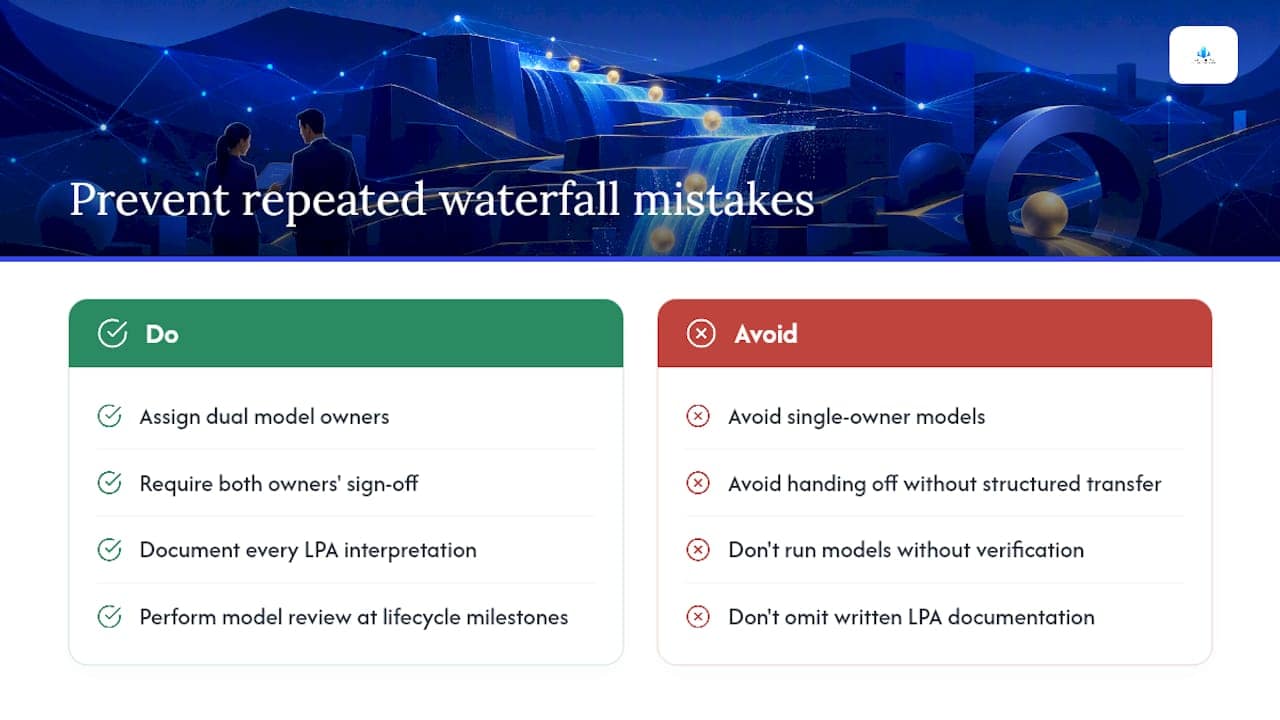
The pattern is consistent across fund sizes and vintages. A single analyst builds the original waterfall model during fund formation, when the LPA is fresh and the logic is straightforward. That analyst becomes the institutional memory for the model. When they leave, or when the fund transitions from the investment period to the harvest period, the model is handed off without a structured knowledge transfer. The new owner inherits formulas they did not write and assumptions they cannot verify.
The pressure to issue distributions on schedule compounds the problem. Distribution notices are often time-sensitive, tied to LP reporting deadlines or asset sale closings. In that environment, the ops team runs the model they have, not the model they should have. A catch-up formula that was “close enough” in year two becomes a material error in year five when cumulative carry is significant.
The organizational fix is dual ownership of the waterfall model: one primary owner who maintains the model and one secondary owner who can independently reconstruct any distribution from the input tables. Both owners must sign off before each distribution. This is not redundancy for its own sake. It is the minimum control structure that prevents single-point-of-failure errors from reaching LPs.
Change control during lifecycle transitions deserves specific attention. When a fund moves from its investment period to its harvest period, the applicable waterfall structure often changes: hybrid rules that applied during the investment period may no longer apply, and the preferred return accrual basis may shift. Failing to update the model for these transitions is a documented cause of long-term distribution shortfalls, because the model continues applying investment-period logic to harvest-period distributions. The fix requires a formal model review at every lifecycle milestone, documented in the fund’s governance records.
One more pattern worth naming: ops teams treat LPA interpretation as a legal question, not a modeling question. When a clause is ambiguous, the team asks legal counsel for an interpretation and then implements it verbally. The interpretation never makes it into the model documentation. Six months later, a different analyst implements the same clause differently, and the fund has two inconsistent distribution histories. Every LPA interpretation that affects a model input must be documented in writing, stored with the model, and reviewed at each distribution cycle.
Authoritative references and further reading
- 8 Common Mistakes We Encounter with Waterfall Calculation Models (Qashqade) — Practitioner list of side-letter omissions, double reallocation, and timing errors with real-model examples.
- Real Estate Distribution Waterfall: 5 Common Mistakes to Avoid (JMCO) — Detailed treatment of compounding frequency errors and geometric conversion formulas.
- How to Avoid Waterfall Calculation Errors with Automation (Agora) — Automation benefits, vendor feature requirements, and error categories that automation prevents.
- Mastering Private Equity Waterfall Calculations (Taru) — Lifecycle transition errors, documentation failures, and version control best practices.
- Why One Miscalculated Waterfall Can Cost You an LP Relationship (GuestCountry/Taru) — LP verification behavior, ILPA template expectations, and reputational risk analysis.
- Waterfalls and GP Catch-Up (EisnerAmper) — Correct catch-up base calculation, grossed-up distribution mechanics, and common shortcut errors.
- Private Equity Market Size Forecast, U.S. (Statista) — Market-scale data supporting the dollar impact of small percentage errors.
- CR Equity Ai Inc — Real Estate Investment Fund Analysis — Fund-level distribution mechanics and model verification practices from CR Equity Ai Inc’s own research.
- CR Equity Ai Inc — Real Estate Compliance and Governance — Operational compliance controls relevant to waterfall governance and audit steps.
- CR Equity Ai Inc — Quick Quote and Loan Calculator — For fund operators who need to model financing terms alongside distribution projections.
This article provides general operational guidance for fund accounting professionals. It does not constitute legal, tax, or investment advice. Confirm all LPA interpretations and distribution calculations with qualified legal counsel and your fund’s auditors.
FAQ
What are the most common problems with waterfall calculations?
The most frequent errors are mismatched compounding frequency (simple division vs. geometric conversion), misapplied LP side-letter terms, incorrect catch-up base calculations, and double-counted contributions. Version control failures allow these errors to persist across multiple distribution cycles.
How do you calculate a waterfall distribution correctly?
A correct waterfall calculation requires four sequential steps: return contributed capital to LPs, accrue and distribute the preferred return using the LPA’s specified compounding method, allocate the GP catch-up using a grossed-up base, and split remaining proceeds at the stated carry percentage. Each step must be fully satisfied before the next begins.
What is an example of a 50/50 catch-up?
In a 50/50 catch-up, after LPs receive their preferred return, subsequent distributions are split 50% to the GP and 50% to LPs until the GP has received a specified percentage of total distributions. This differs from a 100% catch-up, where all post-preferred-return distributions go to the GP until the catch-up target is reached.
What are the biggest risks of using spreadsheets for waterfall models?
Spreadsheet models without version control, documented assumptions, and dual ownership create single-point-of-failure risk. Formula changes made without documentation, multiple model copies in circulation, and no audit trail for prior distributions are the primary failure modes. Automation platforms address these risks by enforcing versioning and logging every calculation run.
How often should waterfall models be reviewed and updated?
Waterfall models should be reviewed before every distribution cycle and formally audited at each fund lifecycle milestone, including the transition from the investment period to the harvest period. Any LPA amendment, LP ownership change, or side-letter modification requires an immediate model update with a documented effective date.