
Deal pipeline automation cuts underwriting cycle time and reduces manual handoffs by automating decision rules, valuation, and document extraction. The main levers are decisioning engines that apply policy consistently, automated valuation models (AVMs) that speed property pricing, document intelligence that reads bank statements and alternative income files, and direct integrations with loan origination systems (LOS) and Fannie Mae’s Desktop Underwriter (DU). The sections below lay out how underwriting teams assemble these pieces, what regulators expect, and how to pilot the approach safely.
TL;DR:
- Preserve the DU casefile ID and Message ID 3087; lenders must replace the soft pull with a three bureau credit report at full application.
- For credit decisions, AVMs require documented random sample testing and nondiscrimination safeguards, while borrowers need a clear reconsideration process before lenders finalize valuations.
- Pilot one loan product or origination channel for 60 to 90 days, and compare automated decisions with manual reviews during the first 30 days.
- Set baseline measures for cycle time, conditional approval, time to fund, and rework; falling cycle time supports higher volume only when staffing stays constant.
Table of Contents
- Benefits and measurable outcomes of automating a lending deal pipeline
- Core components: decision engines, AVMs, document intelligence, and APIs
- Integration checklist: APIs, data contracts, and pipeline design
- Compliance, model risk, and third party controls you must include
- Practical implementation steps and a pilot roadmap for underwriting leaders
- How our platform maps to pipeline automation needs
- Lessons from underwriting automation pilots
- Get started with CR Equity AI
- FAQ
- Sources
Benefits and measurable outcomes of automating a lending deal pipeline
Automating a lending pipeline shortens the time between data pull and underwriting decision, and it does so by removing repetitive manual steps rather than by cutting corners on review. Teams that automate decisioning and document intake typically see fewer manual touchpoints per file, because rules engines apply the same policy every time instead of relying on an underwriter’s individual judgment call.
Consistency is the underrated benefit. A decisioning engine applies identical thresholds to every file, which reduces the variance that creeps in when multiple underwriters interpret guidelines differently.
Underwriting leaders should track a small set of KPIs before declaring a pilot successful:
- Cycle time: elapsed time from application submission to conditional approval.
- Conditional approval rate: share of files that clear automated checks without manual escalation.
- Time-to-fund: total days from application to closed loan.
- Rework rate: percentage of files sent back for correction after an automated step.
Automation drives volume when cycle time drops enough to let the same underwriting staff handle more files; it drives cost savings alone when volume stays flat but headcount per file falls. Distinguishing between the two matters when justifying the investment to a credit committee.
Core components: decision engines, AVMs, document intelligence, and APIs
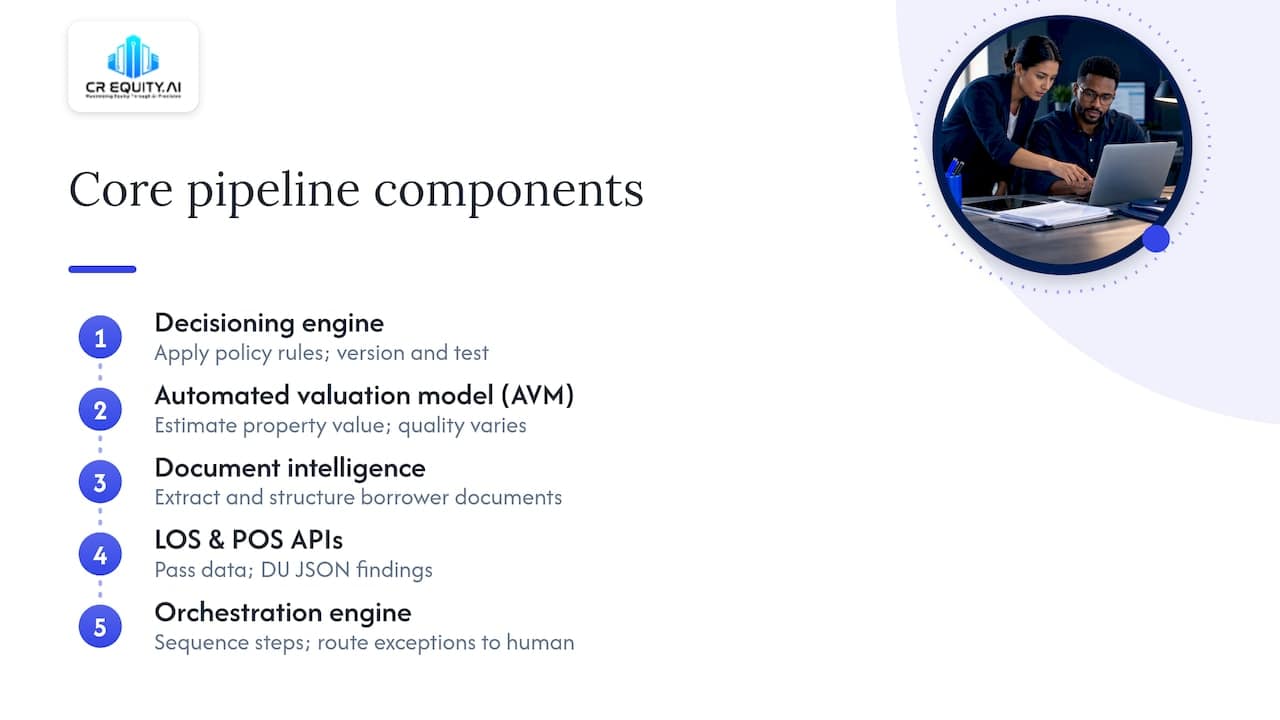
A working pipeline rests on four building blocks, each solving a distinct problem. Decisioning engines apply underwriting policy as structured rules, often through no-code editors that let credit teams adjust thresholds without a developer backlog. The best implementations version every rule change and test it against historical case files before publishing, so a policy tweak never goes live untested.
Automated valuation models (AVMs) estimate property value using statistical models fed by comparable sales and public records. AVMs speed the pipeline, but they carry real limitations in credit decisions: value estimates degrade in markets with thin comparable data, and they require independent quality controls before use in a lending decision, a point regulators have made explicit (see Compliance section below). Our own research into AVM accuracy and confidence bands outlines how model confidence varies by property type and geography.
Document intelligence tools extract data from bank statements, pay stubs, and alternative income documentation, replacing manual data entry with structured fields an underwriter can review in seconds. We have outlined what borrowers typically need to upload for these systems to work correctly.
Integration points tie the pieces together: LOS and point-of-sale (POS) APIs pass data between systems, DU JSON findings deliver underwriting results in a machine-readable format, and credit vendors must be configured for soft-pull early assessment before any hard inquiry occurs.
An orchestration or workflow engine sequences these steps and routes exceptions to a human underwriter rather than letting an edge case fail silently.
Pro Tip: Version every decisioning rule change and keep a rollback path. A single untested rule update can approve files that should have been declined.
Integration checklist: APIs, data contracts, and pipeline design
Technical integration determines whether automation speeds approvals or creates rework. The following sequence reduces the most common integration failures underwriting teams report.
- Preserve the DU casefile ID through the full lifecycle. Fannie Mae’s DU Early Assessment workflow issues a conditional recommendation tied to a specific casefile ID and Message ID 3087; losing that ID between pre-qualification and full application causes delivery errors.
- Configure soft-pull early assessment correctly, then plan the upgrade path. Early Assessment accepts a soft credit pull and a reduced dataset, but lenders must upgrade to a tri-merge credit report at full application to remove conditionality before closing.
- Build event-driven architecture around webhooks and message IDs. Each step in the pipeline, soft pull, valuation, document extraction, should emit a discrete event with a unique identifier, so a failed step can retry without reprocessing the entire file.
- Stage every rule and integration change before production. Run new decisioning logic and new API connections against a staging environment with historical test cases before any live file touches them.
- Maintain version control on decision rules and API contracts. A dated changelog lets compliance and IT trace exactly which rule version processed a given file months later.
Lenders that skip step one most often see Delivery Fatal Edits at the point of sale, a costly failure to catch late in the pipeline.
Compliance, model risk, and third party controls you must include
Automation does not remove regulatory obligations, it concentrates them into fewer, more consequential checkpoints. Three bodies of guidance matter most for a lending pipeline that uses AVMs and automated decisioning.
- AVM quality control standards. The CFPB’s final rule on Automated Valuation Models requires institutions to adopt policies and control systems for AVMs used in credit decisions, including random sample testing, protections against data manipulation, and nondiscrimination checks.
- Reconsideration of value (ROV) processes. Interagency guidance on ROV recommends lenders establish a transparent process, with defined timelines and trained staff, so a borrower can dispute a valuation before the credit decision is finalized rather than after.
- Third party risk management (TPRM). Outsourcing guidance from federal banking regulators calls for board-approved policies, risk-focused due diligence, contract terms that specify performance standards, and ongoing monitoring of any vendor supplying decisioning, valuation, or document extraction technology.
AVM quality control is not optional for credit-decision use: under the final AVM rule, institutions must document random-sample testing and nondiscrimination safeguards, a standard that applies regardless of institution size.
Audit trails matter as much as the controls themselves. Every automated decision needs a record of which rule version, which valuation source, and which document extraction result produced it, so an examiner can reconstruct the file without relying on an underwriter’s memory.
For risk reviews beyond internal capacity, firms such as Geneva Risk Advisory provide independent consulting on vendor due diligence and risk program design, a resource worth considering when building a TPRM framework from scratch.
Practical implementation steps and a pilot roadmap for underwriting leaders
Rolling out pipeline automation across every product at once is the most common way pilots fail. A narrower scope, one loan product or one origination channel, produces a cleaner read on whether the technology works before committing broader budget.
- Choose a single pilot scope and define success metrics (cycle time, rework rate, conditional approval rate) before writing a line of integration code.
- Design the workflow on paper first: which steps are automated, which require human sign-off, and where exceptions route.
- Integrate systems in a staging environment, connecting LOS/POS, credit vendor, AVM, and document intelligence APIs without touching live files.
- Test against historical case files, comparing automated outputs to the actual decisions underwriters made on those same files.
- Run the pilot on new applications for a fixed window, typically 60 to 90 days, with a defined go or no-go review at the end.
- Evaluate against baseline metrics and only then plan phased rollout to additional products or channels.
Staffing a pilot correctly avoids the most common gaps: an underwriting subject-matter expert who owns the rule logic, an operations lead tracking throughput, a compliance reviewer checking every automated decision against regulatory guidance, an IT integration owner managing APIs, and a vendor manager overseeing any third-party tool.
Pro Tip: Run automated and manual underwriting in parallel for the first 30 days of a pilot. Comparing the two outputs on the same files is the fastest way to catch a miscalibrated rule before it reaches production volume.
How our platform maps to pipeline automation needs
We built our underwriting process around the same components this playbook describes, applied to our own direct lending programs. Our advance-rate grids are published before a borrower applies, which gives brokers and investors the inputs a decisioning engine needs without waiting on a manual quote.
- We support soft-pull early assessment so borrowers and brokers get a preliminary read without a hard credit inquiry.
- Our F.L.E.X. 50™ bridge program is funded on a published timeline, reflecting a pipeline designed for speed over discretionary review.
- Our DSCR Cash-Out Refinance program qualifies on rental income rather than tax returns, reducing the document intelligence burden on self-employed borrowers.
- We cover valuation, decision output, and funding execution within the same platform rather than handing a file between separate vendors at each step.
Readers evaluating how instant valuation fits into a faster pipeline can review how our valuation approach works.
Lessons from underwriting automation pilots
Underwriting teams that succeed with automation share a few habits. They start narrow, instrument everything, and treat the first 90 days as a test of the rules rather than a victory lap.
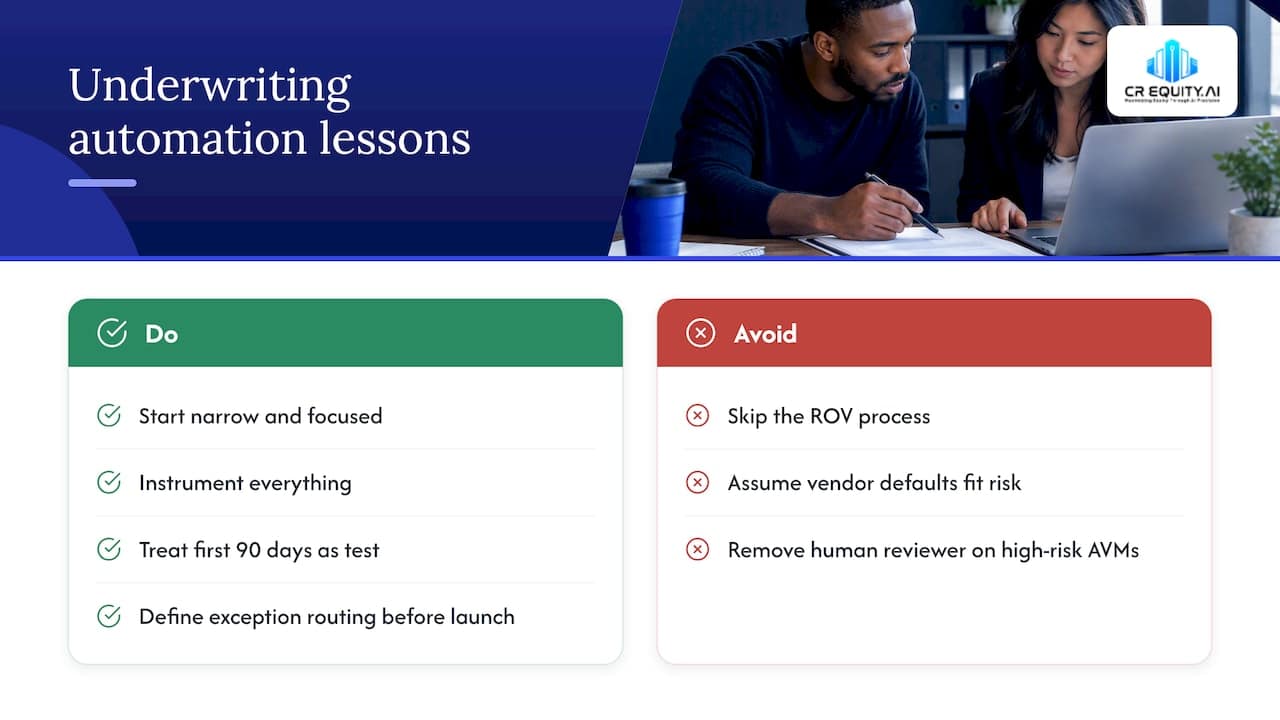
Do this: define exception routing before launch, keep a human reviewer on every AVM-driven valuation above a set risk threshold, and log every rule version. Avoid this: skipping the ROV process to save a day, or assuming a vendor’s default settings match your risk appetite.
Speed and auditability are not competing goals. A pipeline that cannot explain its own decision six months later has not actually reduced risk, it has just moved it downstream.
— Robert Stewart Jr
Get started with CR Equity AI
If you are evaluating a faster path to a funded deal rather than building a pipeline from scratch, we underwrite the asset and the deal, not just a borrower’s paperwork, with a soft credit pull and quick decisions. Our published programs include bridge financing, cash-out refinance, fix-and-flip, ground-up construction, small balance commercial, and investment property acquisition loans.
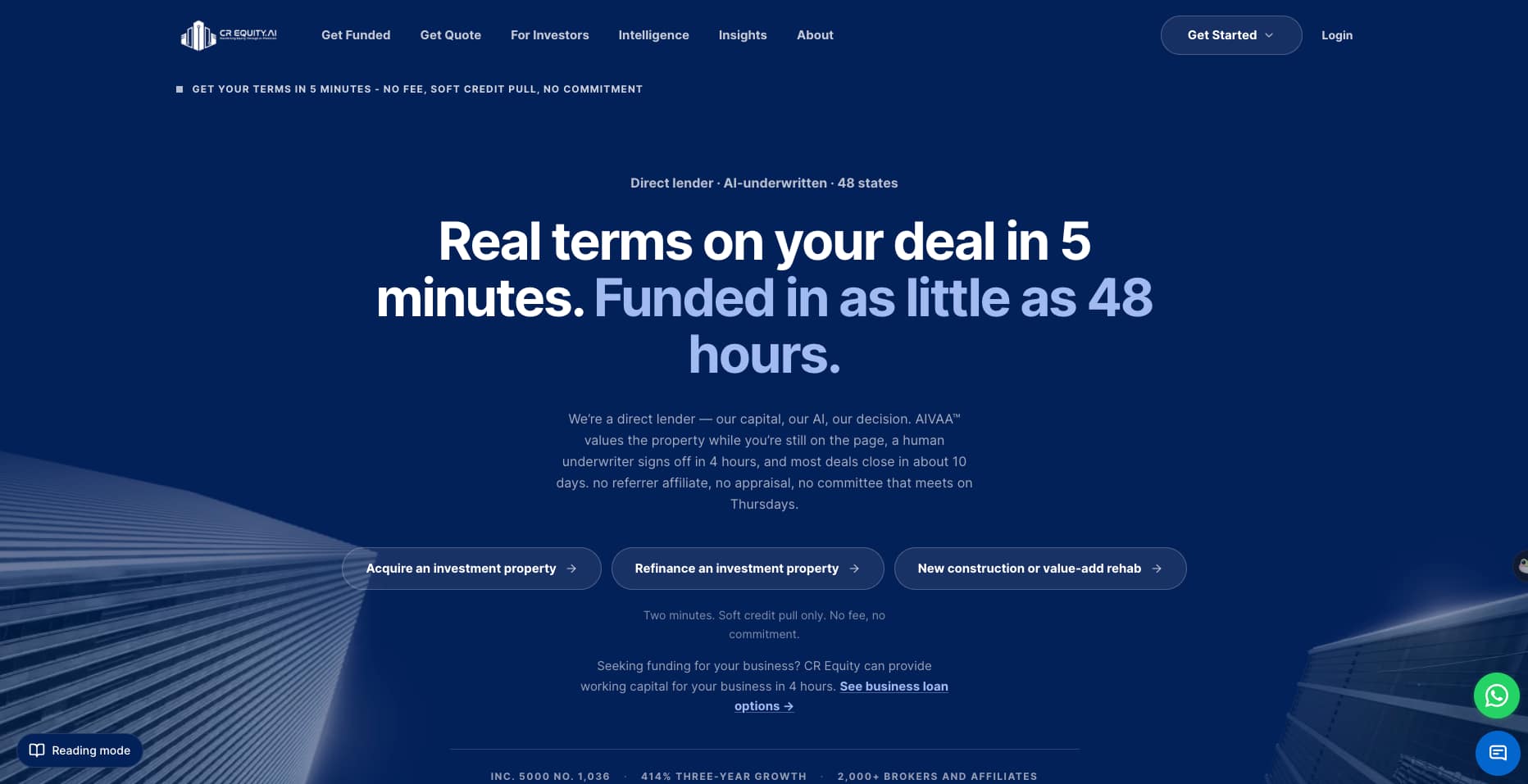
We do not publish rates or guarantees beyond what appears on our own program pages, so review the terms that apply to your deal type before submitting. When you are ready, submit a deal directly and our team will confirm eligibility against the published grid for your program.
FAQ
How much commission do loan officers make on a $500,000 loan?
Loan officer commission structures vary by employer, loan type, and compensation plan, so there is no single published figure that applies across the industry. Commission is typically a percentage of loan amount or origination fee, and the exact rate is set by each lender’s compensation policy rather than a universal standard.
What credit score do you need to get a $30,000 loan?
Minimum credit score requirements depend on the lender, the loan type, and whether the loan is secured or unsecured. Borrowers should check the specific program’s published eligibility criteria rather than assume a single threshold applies across all lenders.
What are the five C’s of lending?
The five C’s of lending are a traditional underwriting framework: character, capacity, capital, collateral, and conditions. Lenders use this framework to evaluate a borrower’s willingness and ability to repay, though automated and asset-based underwriting models may weight these factors differently than a traditional paperwork-first review.
What is Fannie Mae’s automated underwriting system called?
Fannie Mae’s automated underwriting system is called Desktop Underwriter, or DU. DU supports a soft-pull Early Assessment workflow for pre-qualification and issues a conditional recommendation using casefile IDs, including Message ID 3087, that lenders must preserve through the full loan lifecycle.
Sources
- Automated valuation models final rule (CFPB, June 2024)
- Interagency guidance on reconsiderations of value of residential real estate valuations (CFPB interagency, July 2024)
- Desktop Underwriter® (DU®) Early assessment (Fannie Mae)
- DU Early Assessment frequently asked questions (Fannie Mae)