

How machine learning reshapes lending for commercial real estate
Machine learning’s role in lending is straightforward: it automates the extraction, structuring, and analysis of financial data so that credit decisions happen faster, more consistently, and with fewer errors than manual review allows. For commercial real estate investors and business owners, that translates directly into shorter approval timelines, tighter risk pricing, and access to capital at a scale that traditional underwriting workflows cannot match.
The numbers reflect a structural shift already underway. Commercial mortgage originations are projected to increase by 27% in 2026 compared to 2025, reaching $806 billion according to Mortgage Bankers Association figures. This increase is being absorbed largely through AI-assisted underwriting workflows, not proportional headcount growth. Census Bureau research confirms the trend at the bank level, finding that AI use among banks rose from 14% in 2017 to 43% in 2019, with AI-adopting banks extending significantly more credit to distant borrowers while recording lower default rates.
Key functions machine learning performs in lending today:
- Document intelligence: Reads and normalizes rent rolls, T-12 operating statements, appraisals, and leases without manual retyping
- Credit metric computation: Automates DSCR, debt yield, NOI normalization, and occupancy calculations
- Risk flagging: Surfaces environmental, structural, and covenant exceptions consistently across every deal
- Lender matching: Aligns borrower profiles with lender appetite in real time
- Fraud detection: Identifies anomalies in financial submissions before they reach a credit officer
One point worth stating clearly: machine learning enforces credit standards rather than relaxing them. AI platforms surface every flagged risk, every time, producing tighter underwriting scrutiny than a manual review process where fatigue and volume pressure create gaps.
Table of Contents
- 1. How AI extracts and structures financial data for underwriting
- 2. How AI improves risk scoring and deal prioritization
- 3. How AI handles volume without proportional staffing growth
- Why human expertise remains central to AI-driven lending
- Regulatory, compliance, and governance requirements for AI lending
- CR Equity Ai Inc: AI-driven underwriting for CRE and business lending
- Common use cases of machine learning in lending processes
- How machine learning changes credit risk assessment models
- How machine learning integrates with traditional credit scoring systems
- Future trends in machine learning for lending
- Key Takeaways
- Faster capital decisions start with the right platform
1. How AI extracts and structures financial data for underwriting
AI reading and normalizing varied document formats eliminates the manual retyping that historically consumed analyst hours. A system ingesting a rent roll, a trailing 12-month operating statement, and a third-party appraisal can populate an underwriting model within minutes, recomputing NOI, DSCR, and debt yield automatically as inputs change.
- Heterogeneous formats—PDF, Excel, scanned documents—are parsed through natural language processing and optical character recognition
- Extracted figures are cross-referenced against each other to flag inconsistencies before they reach a credit officer
- Lender-specific credit templates and stress-testing parameters are applied automatically, reducing setup time per deal
2. How AI improves risk scoring and deal prioritization
Machine learning models analyze hundreds of variables simultaneously: property characteristics, submarket vacancy trends, sponsor track record, macroeconomic indicators, and comparable loan performance. The output is a risk score that helps lenders prioritize their pipeline and price deals with greater precision than a single analyst reviewing one deal at a time.
- Environmental risk screening uses satellite imagery and historical land use data to flag issues before a Phase I assessment is ordered
- Covenant exception monitoring runs continuously, alerting lenders the moment a borrower falls out of compliance
- Stress testing across rate changes, vacancy spikes, and expense escalation scenarios runs in parallel rather than sequentially
3. How AI handles volume without proportional staffing growth
The 27% increase in 2026 commercial mortgage volume is the clearest evidence that AI has changed the economics of underwriting capacity, as explored in this tendencias préstamos en línea 2026: guía para México. Lenders processing more deals with the same team size are not cutting corners; they are eliminating the data-entry and document-chasing steps that consumed analyst time without adding credit judgment.
Live Oak Bank’s experience in SBA lending illustrates the same dynamic at the small-business level. Using an AI loan origination platform, the bank cut underwriting time roughly in half, targeting a seven-to-ten-day application-to-funding window on loans up to $350,000.
Why human expertise remains central to AI-driven lending
AI rewires underwriting by automating data tasks, but the nuanced assessment of sponsor credibility remains a critical human function. No model currently quantifies whether a borrower’s track record through a prior market cycle reflects genuine operational discipline or favorable timing. That judgment call stays with the credit officer.
The practical division of labor looks like this:
- AI handles: document extraction, metric computation, exception flagging, pipeline prioritization, and compliance monitoring
- Humans handle: sponsor evaluation, complex deal structuring, qualitative narrative interpretation, and final credit approval
- Human-in-the-loop models embed validation checkpoints so AI acceleration does not dilute accountability
AI flags anomalies and summarizes financial data but requires human validation for credit calls. That is not a limitation to be engineered away; it is a deliberate governance design that regulators expect to see documented.
Pro Tip: Borrowers who submit AI-structured deal packages, using the same extraction models lenders rely on, tend to close faster and negotiate tighter loan terms. Pre-structuring your submission before lender intake reduces manual rework on both sides.
Regulatory, compliance, and governance requirements for AI lending
Treating AI as a magic bullet risks regulatory backlash; targeted applications combined with strong governance deliver more defensible and compliant results. The strongest outcomes come from narrow, well-defined use cases: fraud detection, document extraction, and covenant monitoring, each with comprehensive recordkeeping and model validation.
Governance requirements that regulators and institutional lenders expect:
- Model validation: Regular testing to confirm that AI outputs remain accurate as market conditions shift
- Recordkeeping: Audit trails documenting how AI-generated flags influenced credit decisions
- Bias mitigation: Ongoing review to confirm that models do not produce discriminatory lending patterns under the Equal Credit Opportunity Act and Fair Housing Act
- Data privacy: Encrypted data handling, access controls, and compliance with applicable state and federal privacy statutes
- Human accountability: Named credit officers responsible for final decisions, regardless of AI involvement
Institutions embedding AI in workflows experience shorter cycle times and lower rework, but only when governance structures are in place before deployment, not retrofitted afterward. Credit decisioning best practices increasingly require documented model testing as a condition of regulatory approval.
CR Equity Ai Inc: AI-driven underwriting for CRE and business lending
CR Equity Ai Inc applies machine learning across the full credit lifecycle, from application intake through risk scoring, lender matching, and offer optimization. The platform’s document intelligence layer reads and structures financial submissions automatically, computing DSCR, debt yield, and NOI metrics without manual input. Borrowers receive multiple lender offers in minutes rather than days.
The platform’s funding options span commercial real estate bridge loans, construction financing, self-storage acquisition and development, business term loans, working-capital solutions, and asset-based credit lines. That breadth matters for investors managing mixed portfolios who need a single underwriting workflow rather than separate processes for each product type.
On the compliance side, CR Equity Ai Inc integrates automated KYC/AML, digital identity verification, and encrypted data handling within a secure cloud-native infrastructure. These controls satisfy the governance requirements outlined above without adding friction to the borrower experience.
Common use cases of machine learning in lending processes
Machine learning in finance addresses the highest-friction points in the credit workflow. The most widely deployed applications in US commercial and small-business lending include:
- Automated document extraction from operating statements, tax returns, rent rolls, and appraisals
- Real-time lender matching based on dynamic lending appetite rather than static databases
- Fraud detection through anomaly identification in financial submissions
- Portfolio monitoring with early warning signals for occupancy decline, expense escalation, or covenant breach
- Dynamic loan pricing that adjusts based on current market conditions and deal-specific risk factors
- Small-business underwriting using real-time transactional data; Square’s updated ML model now underwrites merchants from their first payment transaction
How machine learning changes credit risk assessment models
Traditional credit scoring relies on linear statistical models that assume borrower risk factors interact in predictable, additive ways. Machine learning identifies nonlinear patterns in data that those models miss. Census Bureau research found that machine learning enables banks to identify creditworthy borrowers that traditional models flag as risky, with AI-adopting banks charging lower interest spreads to distant borrowers because they correctly assessed them as lower risk at origination.

The practical impact on risk scoring in lending is that models now incorporate property-level, market-level, and macroeconomic variables simultaneously, producing scores that reflect actual deal complexity rather than simplified proxies. Lenders gain a more comprehensive view of downside risk; borrowers with strong fundamentals but unconventional profiles gain access to capital they would have been denied under legacy models.
How machine learning integrates with traditional credit scoring systems
Machine learning does not replace FICO scores, debt service coverage ratios, or loan-to-value thresholds. It augments them. The standard integration model layers an ML risk score alongside traditional metrics, giving credit officers a richer picture without discarding the benchmarks that regulators and secondary market buyers expect to see documented.
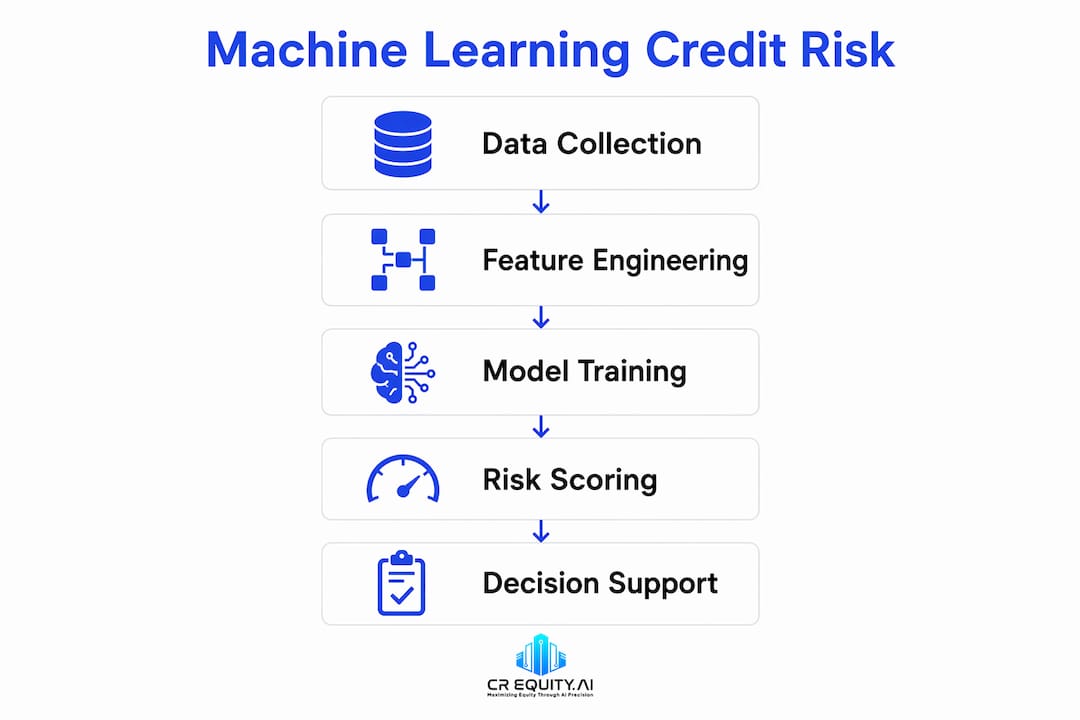
AI underwriting in commercial real estate typically feeds ML-generated outputs into existing credit templates, so the final credit memo reflects both the automated analysis and the traditional covenant tests. This hybrid approach satisfies institutional lender requirements while capturing the accuracy gains that machine learning delivers on complex, data-heavy deals.
Future trends in machine learning for lending
Small business finance is entering a phase where AI integrates with real-time operational data inside borrower systems, shifting credit decisions from periodic snapshots to continuous assessment. For CRE investors, the near-term developments with the most direct impact are:
- Autonomous underwriting agents that orchestrate multi-step workflows, pulling data, running risk models, flagging anomalies, and routing exceptions to humans without manual handoffs
- Predictive deal flow models that identify properties likely to refinance or face distress before they reach the market
- Unified lifecycle platforms integrating sourcing, underwriting, due diligence, closing, and servicing into a single AI-powered environment
- Continuous model refinement with traceability and accountable human oversight embedded at each stage to scale AI use without diluting regulatory compliance
The AI underwriting process is moving from pilot programs to production infrastructure at forward-thinking lenders. Investors and business owners who understand these capabilities now are better positioned to select capital partners and structure submissions that perform well inside AI-driven intake systems.
Key Takeaways
Machine learning in lending accelerates credit decisions, enforces consistent risk standards, and expands capital access, but only delivers defensible outcomes when paired with human oversight and documented governance.
| Point | Details |
|---|---|
| Volume capacity | AI-assisted workflows support a 27% increase in 2026 CRE mortgage volume without proportional staffing growth. |
| Speed advantage | Borrowers submitting AI-structured deal packages close approximately 30% faster and negotiate tighter loan terms, according to recent industry benchmarks. |
| Risk enforcement | AI surfaces every environmental, structural, and covenant exception on every deal, producing stricter scrutiny than manual review. |
| Governance is non-optional | Regulators expect model validation, audit trails, bias monitoring, and named human accountability for every AI-influenced credit decision. |
| CR Equity Ai Inc | The platform applies ML underwriting, automated KYC/AML, and real-time lender matching across CRE and business loan products for faster, compliant approvals. |
Faster capital decisions start with the right platform
Commercial real estate investors and business owners who have read this far understand what separates a well-governed AI lending platform from a marketing claim. CR Equity Ai Inc delivers the full stack: machine-learning document intelligence, automated risk scoring, real-time lender matching, and a secure cloud-native infrastructure with built-in KYC/AML compliance. Where traditional processes take weeks, CR Equity Ai Inc returns multiple lender offers in minutes, across bridge loans, construction financing, business term loans, and working-capital lines.
The platform is built for investors and business owners who need institutional-grade accuracy without the friction of manual underwriting. Whether you are acquiring a self-storage asset, refinancing a mixed-use property, or securing working capital for a growing business, CR Equity Ai Inc structures your deal for the lenders most likely to fund it. View available financing programs or get a loan quote to see current terms for your deal type.