
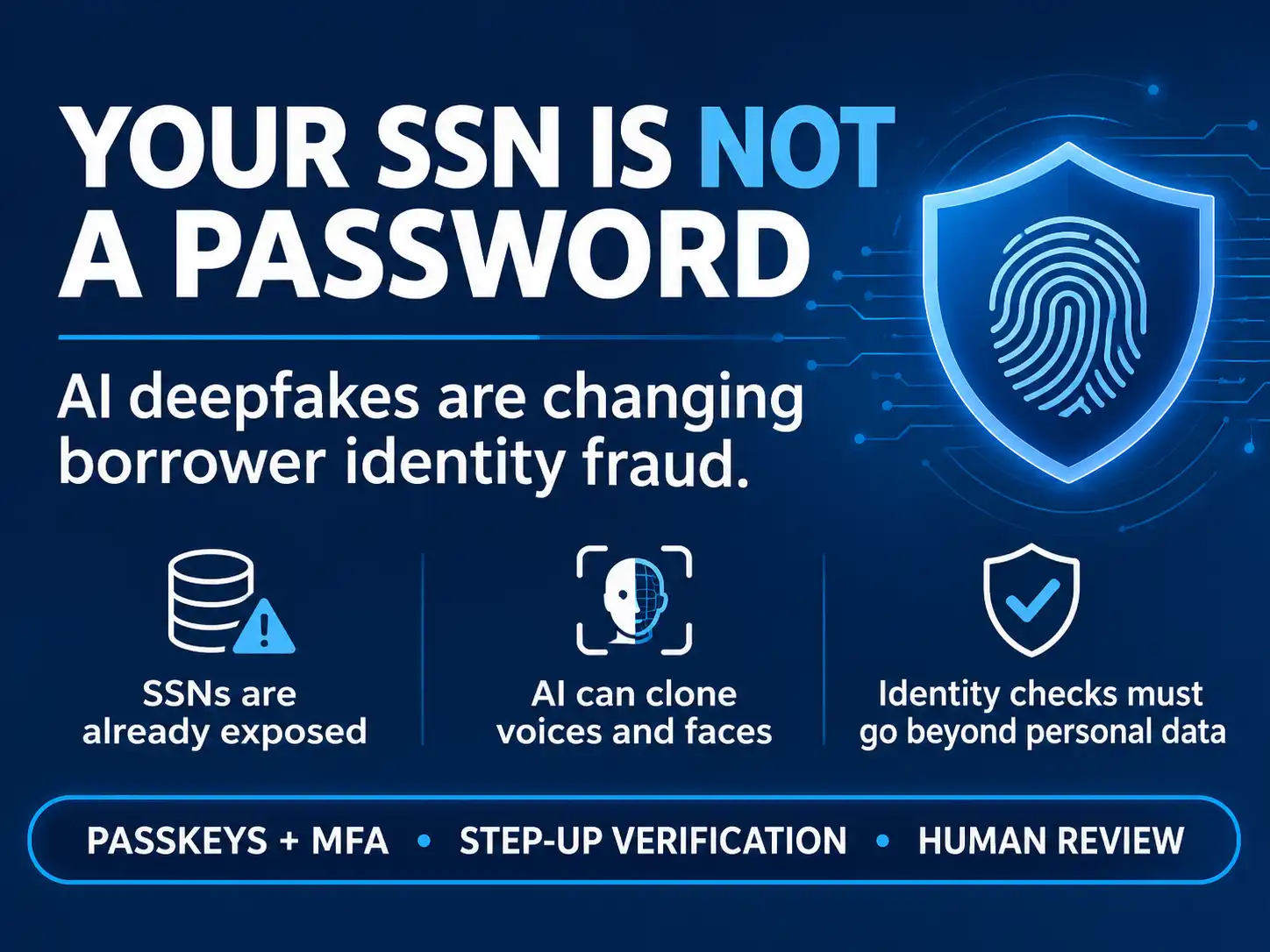
Nearly every major database holding Social Security numbers has been breached. AI can now clone voices and faces. If your AI servicing agent still asks borrowers to “verify your SSN,” you’ve automated the front door and left it unlocked.
Opinion. This article reflects the author’s views and is not legal, compliance or security advice.
Key Takeaways
- Knowledge-based verification is not authentication. SSN, date of birth, address history, mother’s maiden name and loan number are data criminals already have.
- Generative AI makes impersonation cheap. A cloned voice can read a stolen SSN back without hesitating.
- The standards already point the way. NIST SP 800-63-4, the FTC Safeguards Rule, NYDFS Part 500 and FFIEC guidance favor multi-factor, phishing-resistant authentication over “something you know.”
- AI servicing agents must be built to refuse. No step-up authentication means no disclosure of nonpublic personal information (NPI), no payment-instruction changes and no payoff wiring details.
- My proposal: issue every borrower unique cryptographic credentials at closing, bound to passkeys and MFA, with a human-reviewed recovery path.
The conversation that changed my mind
I recently attended a mortgage training conference and learned that one of CR Equity AI’s larger clients is moving its loan servicing to an AI-driven, largely automated platform. I’m a tech geek, so my first reaction was simple: I’m 100% in. Faster answers, 24/7 service, fewer errors and a lower cost per loan are exactly what AI should deliver.
Then I talked with one of the security officers involved in the rollout. I asked a simple question: when a borrower calls or chats with the AI, how do you know it’s really the borrower? The answer was: “We’ll ask them to verify their SSN.”
That answer stopped me cold. The conversation raised several issues, but this article is about one of them: identity verification in an age of deepfakes. If an AI agent will hand payoff figures, escrow details, bank information or loss-mitigation files to anyone who can recite a nine-digit number, we haven’t modernized servicing. We’ve automated the front door and left it unlocked.
Why isn’t the Social Security number a secret anymore?
Over roughly the last decade, nearly every type of organization that holds SSNs and related personal data has been breached. That includes credit bureaus, the federal government, data brokers, carriers, insurers, banks, title companies and mortgage servicers. Many were then sued, fined or put under consent orders. This record is why I say the SSN is not a credential.
Which major breaches exposed SSNs and borrower data?
| Year | Organization | What was exposed | Enforcement / legal outcome |
|---|---|---|---|
| 2015 | Experian (T-Mobile applicant data) | ~15M people; names, addresses, DOB, SSNs, ID numbers | $22M class settlement; 40-state AG settlements in 2022 (combined with T-Mobile, about $16M) [6] |
| 2015 | U.S. Office of Personnel Management | 21.5M background-investigation records incl. SSNs; 5.6M fingerprint records | $63M class settlement with OPM and contractor [2] |
| 2015 | Anthem | 78.8M people; SSNs, DOB and more | $16M HHS OCR settlement; $115M class settlement; $48.2M to state AGs [7] |
| 2017 | Equifax | ~147M people; 145.5M SSNs | At least $575M, up to $700M (FTC, CFPB, 50 states and territories) [1] |
| 2019 | First American Financial | 885M title and closing documents dating to 2003, incl. SSNs and bank and wire records | SEC penalty $487,616 (2021); NYDFS $1M under Part 500 (2023) [8][9] |
| 2019 | Capital One | ~100M U.S. and 6M Canadian individuals | $80M OCC penalty; $190M class settlement [10] |
| 2021 | T-Mobile | ~76.6M people; SSNs, DOB, driver’s licenses | $350M class settlement plus $150M security commitment [11] |
| 2022 | TransUnion South Africa | At least 3M consumers confirmed; ~$15M ransom demanded | TransUnion refused to pay [12] |
| 2023 | Mr. Cooper | 14.7M current and former customers; SSNs, DOB, bank account numbers | Class actions filed [4] |
| 2023 | Fidelity National Financial / LoanCare | ~1.3M consumers; SSNs, loan numbers | $5.9M class settlement, final approval 2025 [13] |
| 2024 | loanDepot | ~16.9M people; SSNs, account numbers | Class settlement; $68.5M incident-related expense in H1 2024 [5] |
| 2024 | National Public Data | ~2.9B records; ~272M unique SSNs | Class actions; company filed for bankruptcy [3] |
| 2024 | AT&T (two incidents) | Data set incl. SSNs released on the dark web; call and text records | $177M combined class settlement [14] |
| 2024 | Change Healthcare | ~192.7M individuals, the largest U.S. healthcare breach | HHS OCR investigation; state AG litigation [15] |
| 2025 | TransUnion (U.S.) | 4.46M people; names, DOB, SSNs via a third-party application | Breach notices filed with state AGs [16] |
The credit bureaus have also faced enforcement that had nothing to do with breaches, including a 2017 CFPB consent order against Experian over how it marketed credit scores. [17]
What this means: if a fraudster has your name, they can probably also buy your SSN, date of birth, address history and phone number. Mortgage-specific breaches (Mr. Cooper, loanDepot, LoanCare, First American) add loan numbers, bank account numbers and closing documents. “Verify the last four of your Social” only checks whether the caller did their homework. It doesn’t check who they are.
Is your servicing platform still trusting the SSN? In 15 minutes I’ll walk through where your borrower authentication is exposed, from IVR and chat to AI voice agents. Book a 15-minute identity-risk review
Deepfakes meet AI servicing: what does the threat look like?
Are deepfakes really being used against financial institutions?
Yes. In November 2024, FinCEN issued Alert FIN-2024-Alert004. It reported a rise, starting in 2023, in suspicious activity reports describing deepfake media used in fraud schemes, including attempts to get around identity verification. The alert lists red flags such as third-party webcam plug-ins during live verification, device or location data that doesn’t match identity documents, and customers who can’t satisfactorily authenticate. It asks institutions to tag related SARs “FIN-2024-DEEPFAKEFRAUD.” [18]
In December 2024, the FBI warned that criminals are using generative AI, including cloned voices, to commit financial fraud. One of its recommendations is to set up a secret word or phrase with family members to confirm identity. [19] That says a lot: even the FBI’s advice depends on a pre-shared secret that only the real person holds.
How much money is at stake?
- Arup, 2024: A finance employee in Arup’s Hong Kong office joined a video call in which the CFO and other colleagues were deepfakes. He made 15 transfers totaling about US$25.6 million. [20]
- Deloitte projection: Deloitte’s Center for Financial Services projects that generative AI could push U.S. fraud losses to $40 billion by 2027, up from $12.3 billion in 2023. That figure is its aggressive scenario, not a measured loss. [21]
- FBI IC3 2024: Reported cybercrime losses hit a record $16.6 billion. Business email compromise, the main vehicle for real estate wire fraud, accounted for $2.77 billion. [22]
Mortgage servicing sits right where these trends meet. A servicer holds what a fraudster wants: payoff amounts, escrow and bank details, borrower contact information and the ability to change where money goes. A payoff-statement request, a new mailing address, a new ACH account or a “please email me my loan file” request are all high-value actions. An overly helpful AI agent can complete each of them in seconds.
The FTC’s Government and Business Impersonation Rule, effective April 2024, lets the FTC go after people who impersonate businesses. [23] But enforcement after the fact does nothing to stop a cloned voice from passing a weak check in real time.
Automating a broken identity check doesn’t modernize it. It speeds up the fraud.
What do the standards actually say?
Does NIST still allow knowledge-based verification?
No. NIST SP 800-63-4, finalized in July 2025, does not accept security questions as an authenticator and bars verifiers from prompting for them. It also clearly brings syncable passkeys into scope. It adds controls against injection attacks and forged media, which includes deepfakes. For facial verification, it calls for presentation attack detection tested under ISO/IEC 30107-3 and for checks on the integrity of the device and camera. [24][25]
What about the FTC, NYDFS, FFIEC, CFPB and Fannie Mae?
- FTC Safeguards Rule (GLBA): Covered non-bank lenders and servicers must require MFA for anyone accessing customer information. Since May 2024, they must also notify the FTC within 30 days of a breach involving unencrypted data of 500 or more consumers. [26]
- NYDFS Part 500: MFA is required for any individual accessing a covered entity’s information systems, with full compliance due November 1, 2025. [27]
- FFIEC (2021): The FFIEC’s authentication guidance points out the weaknesses of single-factor authentication. It also notes that knowledge-based questions alone are not reliable verification. [28]
- CFPB on chatbots (2023): The CFPB warns that poorly deployed chatbots can violate consumer financial law and harm consumers. [29]
- Fannie Mae (2025): Under updated information-security requirements for sellers and servicers, cybersecurity incidents must be reported within 36 hours. [30]
Where do SOC 2, NIST CSF 2.0 and the AI RMF fit?
- SOC 2 (AICPA Trust Services Criteria): A SOC 2 report attests to controls over security, with optional criteria for confidentiality and privacy. Every AI servicing vendor should be able to produce a current SOC 2 Type II report that covers authentication and data-disclosure controls. [31]
- NIST CSF 2.0: Version 2.0 added a “Govern” function. How an AI agent authenticates people is a governance decision, not just an IT setting. [32]
- NIST AI RMF and the Generative AI Profile (AI 600-1): These cover information-security and information-integrity risks in generative AI. An AI agent that can be talked into disclosing NPI is exactly the kind of risk they describe. [33]
My read: regulators and standards bodies already agree. “Something you know” is weak, and MFA with phishing-resistant factors is the baseline. An AI servicing platform that authenticates borrowers with an SSN is behind current guidance.
A better model: borrower-held cryptographic keys issued at closing
This is my proposal. It’s an opinion and an invitation to debate.
At closing, the title or escrow table has already confirmed the borrower’s identity, in person or through remote online notarization. That’s the moment to give the borrower a unique set of cryptographic recovery credentials tied to the loan. Think of a crypto wallet’s recovery phrase or the one-time backup codes Google and Apple issue: high-entropy strings of letters, numbers and special characters, each used once.
Those credentials are then bound to stronger day-to-day factors:
- Primary: a passkey (FIDO2/WebAuthn) on the borrower’s own device. Passkeys are phishing-resistant by design.
- Secondary: a one-time passcode (OTP) from an authenticator app, with SMS only as a last resort.
- Step-up for high-risk actions: a recovery-code challenge and, where appropriate, a liveness-checked biometric with injection-attack detection.
- Out-of-band confirmation: a callback to the phone number recorded at closing before any change to payment instructions.
Is there a precedent?
Yes, and the strongest one is the IRS Identity Protection PIN. It’s a six-digit number known only to the taxpayer and the IRS, reissued every year, and available to anyone who verifies their identity. The IRS created it because SSNs alone could no longer stop tax-refund identity theft. [34] Mortgage servicing has the same problem, with much more money at stake.
What are the hard questions, and how would I answer them?
- Lost codes and recovery: This is the weak point of any key-based system, so recovery has to be harder than everyday login. That means NIST 800-63A-aligned re-proofing (document plus liveness check with injection detection), a cooling-off period, notice to every contact method on file and a human reviewer. Recovery never falls back to “tell us your SSN.”
- Secure delivery at closing: Deliver credentials in person or inside the authenticated eClosing session, never by email. The borrower confirms receipt and enrolls a passkey before leaving the table.
- Storage: Never store codes in plaintext. Keep only salted, slow hashes, the same way passwords are stored, so a database breach doesn’t hand attackers the keys.
- Servicing transfers: Hashed credentials and binding records should travel with the loan under RESPA/Reg X transfer procedures, or the new servicer should run re-enrollment. This needs an industry standard.
- Accessibility and older borrowers: Offer printed code cards, trusted-contact designations, in-branch or notary-assisted recovery, and alternatives to visual biometrics. Security must never block required servicing communications.
- Regulatory fit: Nothing here replaces RESPA/Reg X duties such as answering qualified written requests, resolving errors or meeting loss-mitigation timelines, and authentication must never be used to delay them. The design fits GLBA Safeguards Rule expectations, but servicers should confirm it with counsel before deploying.
What does a layered “human + AI” servicing identity model look like?
| Tier | Example actions | Required authentication | Who decides |
|---|---|---|---|
| 0 · Public | Office hours, general FAQs | None | AI agent |
| 1 · Low-risk | Payment due date, confirmation that a payment posted | Passkey or MFA session | AI agent |
| 2 · NPI disclosure | Payoff statement, escrow detail, loan documents | Passkey + OTP; device and behavior risk checks | AI agent with risk scoring |
| 3 · Money / contact changes | ACH or wire changes, new address or phone, payoff wiring instructions | Recovery code or liveness-checked biometric + out-of-band callback | AI prepares, human approves |
| 4 · Recovery / exceptions | Lost credentials, suspected fraud, third-party authorization | Full re-proofing + human review + cooling-off | Human, with AI support |
The key principle: the AI agent should be designed to refuse. For Tier 2 and above, it should never accept a recited SSN, a familiar voice or a convincing face on video as proof. It should also log every disclosure decision so the process can be audited under SOC 2 and the AI RMF.
Want to pilot borrower credentials at closing? I’m looking for servicers, title and escrow partners, and AI vendors to help build this standard with CR Equity AI. Talk pilot with Rob · Email info@crequity.ai
What should servicers and AI vendors do now?
- Stop using the SSN and knowledge-based questions to authenticate in every channel, including IVR, chat, email and AI voice agents. Keep the SSN as a record-matching field only.
- Deploy passkeys or FIDO2 for borrower portals, and treat SMS OTP as a fallback.
- Define risk tiers and hard-code step-up rules into the AI agent’s policy layer, not just its prompt.
- Add deepfake and injection defenses to every video or selfie flow: ISO/IEC 30107-3-tested presentation attack detection plus virtual-camera and emulator detection.
- Require out-of-band confirmation for every change to payment instructions or contact data. Never let the AI read wiring instructions to an inbound caller.
- Demand evidence from vendors: a current SOC 2 Type II report, a mapping to NIST 800-63-4 assurance levels and an AI RMF risk assessment that covers social engineering and prompt injection.
- Train the people who handle escalations. AI handles the volume; trained people handle exceptions and recovery.
- Pilot borrower credentials at closing with a title or escrow partner, and help write an industry standard for moving them between servicers.
Conclusion: let’s automate the right thing
I’m still a tech geek, and I still believe AI will make loan servicing faster, cheaper and better for borrowers. But the SSN has been breached, sold and resold. Voices and faces can now be cloned. And the standards bodies have already moved past knowledge-based verification.
The industry has a choice. We can bolt AI onto 1990s authentication and wait for the first nine-figure deepfake payoff fraud. Or we can issue borrowers real cryptographic credentials at closing, build AI agents that require step-up authentication, and keep humans in charge of the exceptions. I’m calling on servicers, title and escrow partners, the GSEs and AI vendors to build that standard together.
Do you agree? What would you add or challenge?
I want to hear from security officers, servicers, title professionals, AI builders and borrowers. Push back hard; that’s how this gets better. Send feedback to Rob or book 15 minutes.
Robert Stewart Jr. Founder & CEO, CR Equity AI, Inc. · NMLS ID 2797309
Frequently asked questions
Can a Social Security number verify a borrower’s identity?
Not on its own. Breaches at Equifax, OPM, National Public Data and several mortgage servicers have exposed hundreds of millions of SSNs, and NIST guidance does not accept knowledge-based verification as authentication.
What is a deepfake in mortgage servicing?
AI-generated or altered voice, video, images or documents used to impersonate a borrower or employee, usually to obtain loan information, change payment instructions or redirect a payoff.
What does NIST SP 800-63-4 say about deepfakes?
The final 2025 guidelines add controls against injection attacks and forged media, require presentation attack detection for biometric verification, and recognize syncable passkeys as authenticators.
Is MFA legally required for mortgage servicers?
It depends on the entity. The FTC Safeguards Rule requires MFA for anyone accessing customer information at covered non-bank financial institutions, and NYDFS Part 500 requires MFA for all individuals accessing covered entities’ systems as of November 1, 2025. Confirm your obligations with counsel.
What is the IRS IP PIN and why does it matter here?
It’s a six-digit PIN, reissued each year and known only to the taxpayer and the IRS, created because SSNs alone couldn’t stop identity theft. It’s a working government precedent for giving a person a strong credential of their own.
What happens if a borrower loses their closing credentials?
Under this proposal, recovery uses full identity re-proofing, a cooling-off period, notice to every contact method on file and human review. It never falls back to the SSN.
Should AI chatbots disclose payoff information?
Only after strong step-up authentication. Any change to where money goes should require out-of-band confirmation and a human approver.
About the author: Robert “Rob” Stewart Jr.
Founder & CEO, CR Equity AI, Inc. · NMLS ID 2797309
Rob founded CR Equity AI in 2021. It’s an AI-native specialty real estate private credit and commercial lending platform. He is a U.S. military veteran, a licensed real estate professional in Florida and Virginia, and a self-described tech geek focused on making AI in lending both powerful and trustworthy. Book 15 minutes with Rob
Disclaimer: This opinion article is for informational purposes only. It is not legal, regulatory, compliance or cybersecurity advice. Figures and enforcement outcomes come from public sources as of November 2026; some are projections or still developing (for example, the Deloitte figure is a projection, and the National Public Data total counts records, not people). Consult qualified counsel and security professionals before changing your authentication or servicing practices.
References
- Federal Trade Commission, Equifax data breach settlement. ftc.gov/node/47878
- FedSmith, “OPM data breach and federal employees.” fedsmith.com
- National Public Data breach (2024) summary and litigation. uinat.com; lawsuitwatch.org
- Malwarebytes, “Mr. Cooper leaks personal data of 14 million loan and mortgage customers” (Dec. 2023). malwarebytes.com
- Cybersecurity Dive, loanDepot cyber settlement and costs. cybersecuritydive.com
- SecurityWeek, “US states announce $16M settlement with Experian, T-Mobile over data breaches.” securityweek.com
- HIPAA Journal, Anthem state AG settlement ($48.2M). hipaajournal.com; Saul Ewing, Anthem $16M OCR settlement. saul.com
- First American Financial Corp., Form 8-K (June 2021), SEC settlement. sec.gov
- Cybersecurity Dive, “New York reaches $1M settlement with First American.” cybersecuritydive.com
- Moore & Van Allen, Capital One $190M settlement. mvalaw.com
- Tycko & Zavareei, $350M T-Mobile customer data security litigation settlement. tzlegal.com
- SecurityWeek, “TransUnion confirms data breach at South Africa business.” securityweek.com
- ClassAction.org, $5.9M LoanCare settlement. classaction.org
- AT&T $177M breach settlement summary. shattered.io
- CyberInsider, “Change Healthcare revises breach impact to 192.7 million individuals.” cyberinsider.com
- TransUnion, Form 10-K for fiscal 2025 (SEC). sec.gov
- CFPB, Consent Order, Experian Holdings, Inc. (2017). consumerfinance.gov
- FinCEN Alert FIN-2024-Alert004 on deepfake media fraud (summary). regreport.info
- FBI IC3, PSA I-120324-PSA, “Criminals Use Generative Artificial Intelligence to Facilitate Financial Fraud” (Dec. 3, 2024). ic3.gov
- CNN, “Arup revealed as victim of $25 million deepfake scam involving Hong Kong employee” (May 2024). cnn.com
- Deloitte Center for Financial Services, “Generative AI is expected to magnify the risk of deepfakes and other fraud in banking” (2024). deloitte.com
- FBI Internet Crime Complaint Center, 2024 Internet Crime Report. ic3.gov
- FTC, “FTC Announces Impersonation Rule Goes into Effect Today” (Apr. 2024). ftc.gov
- NIST SP 800-63-4, Digital Identity Guidelines (2025). nist.gov
- NIST SP 800-63B-4, Authentication and Authenticator Management (2025). nist.gov
- FTC, “FTC Safeguards Rule: What Your Business Needs to Know.” ftc.gov
- NYDFS, Second Amendment to 23 NYCRR Part 500 (Nov. 2023). dfs.ny.gov
- FFIEC, “Authentication and Access to Financial Institution Services and Systems” (2021). ffiec.gov
- CFPB, “Chatbots in Consumer Finance” (2023). consumerfinance.gov
- Asurity, “Fannie Mae issues new and updated cybersecurity requirements for sellers and servicers.” asurity.com
- Secure Controls Framework, Trust Services Criteria (SOC 2) guidance. securecontrolsframework.com
- Jones Day, “NIST Extends Its Cybersecurity Framework to Cover Evolving Threats and Governance” (2024). jonesday.com
- NIST AI 600-1, Generative AI Profile, explained. dsalta.com; NIST AI Risk Management Framework. nist.gov
- IRS, “The Identity Protection PIN (IP PIN).” irs.gov